


Abner
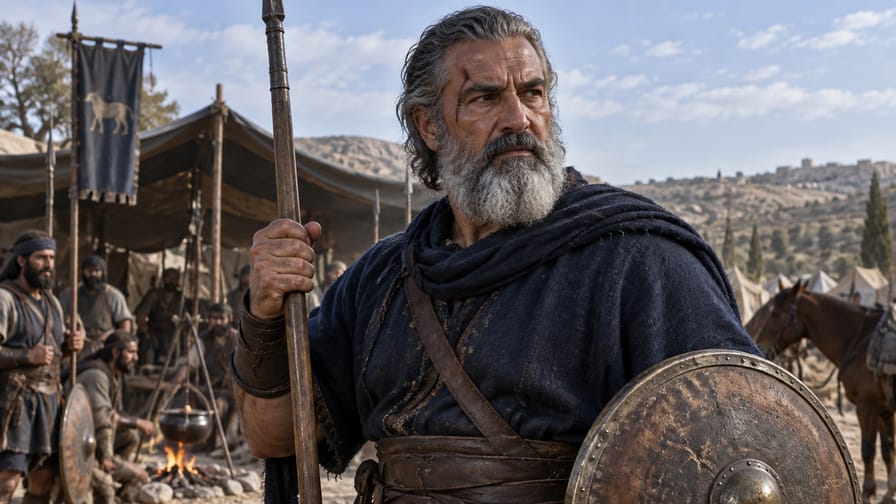
The figure of Abner, son of Ner, cousin and commander of King Saul's army, emerges in the Hebrew Scriptures as a central character in the turbulent period of transition of the monarchy in Israel. His story is intrinsically linked to the decline of Saul's house and the rise of David, the king chosen by God. An analysis of his life offers rich lessons on loyalty, ambition, politics, and divine sovereignty.
This in-depth study will seek to explore the onomastic meaning of Abner, his historical context, the nuances of his character, his crucial role in the biblical narrative, his theological relevance from a Protestant evangelical perspective, and his legacy within the canon. The life of Abner, though marked by complex decisions and a tragic end, serves as a mirror of the tensions and challenges faced by Israel at a decisive moment in its redemptive history.
1. Etymology and meaning of the name
The name Abner, in Hebrew 'Avner (אַבְנֵר), is an abbreviated form of 'Avi-ner (אֲבִינֵר), which means "my father is a lamp" or "father of light." The root 'av (אָב) means "father," and ner (נֵר) means "lamp" or "light." This combination suggests a figure of guidance, illumination, or perhaps someone who reflects paternal glory or wisdom.
The literal meaning of the name Abner, "father of light," can be interpreted in several ways. It may indicate that his father was a prominent figure or a source of wisdom and guidance. In the context of ancient culture, light was often associated with life, truth, prosperity, and the divine presence, as seen in Psalm 119:105, which describes the Word of God as "a lamp for my feet and a light for my path."
Although the name itself is not uncommon in Semitic tradition, Abner is the only prominent biblical character with this name. There are no significant variations of the name in biblical languages that alter its fundamental meaning. The absence of other notable characters with the same name underscores the uniqueness of his position in the narrative of Samuel.
Theologically, the meaning of the name Abner can ironically contrast with some of his actions. While his name suggests "light" or "guide," Abner's trajectory is, at times, marked by decisions that plunge Israel into conflict and political darkness. His ambition and pragmatism, though understandable in a military leader, did not always align with the divine will that favored David, the true "light" and "king after God's own heart" for Israel.
The reference to "lamp" can also evoke the idea of a dynasty. David's "lamp," for example, is promised as a perpetual light for Israel (2 Samuel 21:17 1 Kings 11:36). In Abner's case, his "light" was tied to the house of Saul, a dynasty that God had rejected, making his role an an attempt to maintain a "lamp" that God was extinguishing to light a new one.
Thus, the name Abner, "father of light," can be seen as a reminder of the responsibility of leadership and the importance of discerning the true source of light and direction, which, for Israel, was God Himself and the king He had chosen. The analysis of his life will reveal how he fulfilled, or failed to fulfill, this nominal implication.
2. Historical context and biblical narrative
2.1. Period and political setting
Abner lived during a crucial period in Israel's history, approximately between 1040 and 1000 B.C., spanning the end of the period of the Judges and the beginning of the united monarchy. His life unfolds primarily in the books of 1 and 2 Samuel, witnessing the transition from the charismatic leadership of the judges to royalty, initially under Saul and later under David.
The political context of the time was one of great instability. Israel faced a constant threat from the Philistines, who had subjugated much of the land and posed an existential danger to the Israelite tribes. The demand for a king, as described in 1 Samuel 8, arose as a response to this external pressure and the failure of the prophet Samuel's sons to judge Israel with righteousness.
Saul's ascent as the first king of Israel (1 Samuel 9-10) marked the beginning of a new era, but his disobedience to God (1 Samuel 13 1 Samuel 15) led to his divine rejection and the secret anointing of David (1 Samuel 16:1-13). From that point on, the biblical narrative describes a growing tension between the house of Saul and God's anointed, David, culminating in a civil war after Saul's death.
2.2. Family origin and main events
Abner was the son of Ner, who, in turn, was the brother of Kish, Saul's father (1 Samuel 14:50-51). This made Abner Saul's cousin and, consequently, a prominent member of the tribe of Benjamin. His position as commander of Saul's army was a reflection of his family loyalty and military skills, making him a figure of unquestionable power and influence in Saul's kingdom.
The first significant mention of Abner occurs when he is identified as the commander of Saul's army (1 Samuel 14:50). He is present at crucial moments of Saul's reign, including the battle against the Philistines (1 Samuel 17:55), where he is tasked with bringing David to Saul after the victory over Goliath. Later, he is with Saul when David, for the second time, spares the king's life in the Wilderness of Ziph (1 Samuel 26:5-16), being admonished by David for his failure to protect the anointed king.
After the death of Saul and his sons in the battle on Mount Gilboa (1 Samuel 31), Abner plays a central role in the attempt to preserve Saul's dynasty. He takes one of Saul's sons, Ish-Bosheth (also called Eshbaal in 1 Chronicles 8:33), to Mahanaim, in Transjordan, and proclaims him king over Israel, excluding Judah (2 Samuel 2:8-10). This initiates a period of civil war between the house of Saul and the house of David, which lasted several years (2 Samuel 3:1).
The most notorious confrontation between the two armies occurs at Gibeon, where a challenge between twelve men from each side results in a massacre (2 Samuel 2:12-17). During the subsequent pursuit, Abner kills Asahel, Joab's brother, who was relentlessly pursuing him (2 Samuel 2:18-23). This act seals Abner's fate, for Joab would swear vengeance for his brother's blood.
The civil war continued, but the house of David grew stronger while the house of Saul weakened (2 Samuel 3:1). Eventually, Abner quarreled with Ish-Bosheth over Rizpah, Saul's concubine, whom Abner had taken for himself (2 Samuel 3:7-8). This act, which could be interpreted as a claim to the throne, led Abner to turn to David, promising him the kingdom of Israel (2 Samuel 3:9-12).
Abner then negotiates with the elders of Israel and with David, promising to bring all Israel under David's dominion (2 Samuel 3:17-19). He is well received by David in Hebron. However, upon returning from his mission, Abner is intercepted by Joab, who, motivated by vengeance for Asahel's death and perhaps by jealousy of Abner's influence over David, treacherously murders him (2 Samuel 3:26-27). David deeply laments Abner's death and honors him with a funeral, declaring his innocence in the crime and cursing Joab (2 Samuel 3:31-39).
3. Character and role in the biblical narrative
3.1. Character analysis: Virtues and flaws
Abner's character is complex and multifaceted, revealing notable virtues alongside significant flaws. As a military commander, he demonstrated courage and strategic skill, being the pillar of the house of Saul's resistance after the king's death. His initial loyalty to Saul and, subsequently, to Ish-Bosheth, is evident, fulfilling his duty to protect his cousin's dynasty.
One of his most evident qualities was his military leadership. He managed to mobilize the northern tribes to support Ish-Bosheth and sustain a civil war against David for a considerable time (2 Samuel 3:1). His negotiation skills are also demonstrated in his conversation with the elders of Israel and Benjamin, convincing them to support David (2 Samuel 3:17-19).
However, Abner also exhibited traits of ambition and opportunism. His decision to proclaim Ish-Bosheth king over Israel was not necessarily an act of faith in God's will, but a pragmatic attempt to maintain power and influence for the house of Saul, and by extension, for himself. The taking of Rizpah, Saul's concubine, is an act that demonstrates his audacity and, according to the interpretation of the time, a claim to the throne (2 Samuel 3:7).
His impatience and arrogance are also evident. When Asahel pursues him, Abner warns him not to, but upon being ignored, he kills him with a spear thrust (2 Samuel 2:22-23). Although Asahel's death occurred in combat, the manner in which Abner defends himself and his attitude toward the pursuit reveal a pride that would lead him to a fatal conflict with Joab.
3.2. Vocation, function, and character development
Abner's primary vocation was that of commander of Israel's army under the reign of Saul. His function was strategic and military, responsible for the king's security and the kingdom's defense against external enemies, such as the Philistines. After Saul's death, his role expanded to that of a de facto regent, wielding power behind Ish-Bosheth and attempting to stabilize the kingdom.
The development of Abner's character in the biblical narrative is marked by a significant transformation. Initially, he is the loyal defender of the house of Saul. However, the progressive weakening of Ish-Bosheth's kingdom and his personal disagreement with the king lead him to re-evaluate his loyalties. His decision to ally with David represents a turning point, where he recognizes the inevitability of David's ascent, the Lord's anointed.
This change of loyalty can be seen as an act of political pragmatism, but it may also contain a belated recognition of divine sovereignty over the royal succession. By negotiating the surrender of Israel to David, Abner assumes a crucial intermediary role, facilitating the unification of the kingdom. His actions, though motivated by a mixture of personal and political reasons, were instrumental in the fulfillment of God's plan to establish David as king over all Israel.
The tragedy of Abner lies in his assassination by Joab. Despite his attempt to reconcile with David and his contribution to the unification of Israel, he does not escape the consequences of his past actions, especially the death of Asahel. His untimely death prevents him from witnessing the full glory of David's kingdom, for which he had paved the way.
4. Theological significance and typology
4.1. Role in redemptive history and divine sovereignty
Abner's life, though not directly linked to messianic promises or prophecies, plays a significant role in Israel's redemptive history by facilitating the transition from Saul's kingdom to David. His story vividly illustrates God's sovereignty in orchestrating human events to fulfill His purposes, even through flawed characters and complex political maneuvers.
God had rejected Saul and chosen David as the future king (1 Samuel 15:23, 28 1 Samuel 16:1). Abner's actions, first in trying to uphold the house of Saul and then in turning to David, contributed to the fulfillment of this divine will. His turning to David was the catalyst that finally allowed the unification of the tribes under a single monarch, which was essential for the formation of a strong and stable nation, a precursor to the messianic kingdom.
The narrative of Abner underscores that God's will prevails, regardless of human conspiracies or resistance. The house of Saul, despite Abner's efforts, progressively weakened, while the house of David grew in strength (2 Samuel 3:1). This demonstrates God's faithfulness to His promise and the certainty that His plans cannot be thwarted by human ambitions.
4.2. Theological themes and Christocentric prefiguration
Although Abner is not a direct typological figure of Christ, his story highlights important theological themes. Firstly, the struggle for kingship between Saul and David, and the subsequent civil war, prefigure the spiritual battle between the kingdom of darkness and the Kingdom of God. David, the anointed king, points to Christ, the Messiah King, whose kingdom is eternal and just.
The transition from Saul's kingdom to David, facilitated by Abner's actions, is a reminder of divine election and the rejection of those who oppose God's will. The ascent of David, the shepherd chosen by God, over the house of Saul, which had lost divine favor, is a pattern that repeats in salvation history, culminating in the coming of Christ as the true Shepherd and King.
The death of Abner, a powerful and influential man, at the hands of Joab, can also be seen as a reminder of the corruption and violence inherent in fallen human nature. Even amidst a process of reconciliation and unification, vengeance and ambition persist, illustrating the need for a king who brings true justice and peace, a king who transcends human flaws, namely, Christ.
Abner's story also reinforces the doctrine of human responsibility. His choices, both of loyalty and opportunism, had direct consequences for his life and for the course of Israel's history. He was an agent in God's providence, but his actions were his own, and he was held accountable for them, as seen in David's lament over his death and the condemnation of Joab (2 Samuel 3:31-39).
In sum, the narrative of Abner contributes to the progressive revelation of God's sovereignty in the history of His people, setting the stage for the Davidic dynasty and, ultimately, for the Kingdom of Christ. His life serves as a backdrop for the exaltation of the king chosen by God, and the complexities of his morality point to the need for a perfect Savior.
5. Biblical-theological legacy and canonical references
5.1. Influence on biblical theology and tradition
The figure of Abner, though not mentioned in other canonical books besides 1 and 2 Samuel, exerts significant influence on biblical theology by illustrating the period of transition and the challenges inherent in the formation of the monarchy in Israel. His story is an integral part of the larger narrative that establishes the Davidic dynasty, fundamental to understanding the messianic lineage.
His life demonstrates how God uses imperfect instruments to fulfill His purposes. Abner, with his virtues and flaws, was an unwitting catalyst for the unification of Israel under David, the king after God's own heart. This theme of divine sovereignty operating through human agency is a cornerstone of Reformed and conservative evangelical theology.
In Jewish and Christian interpretive tradition, Abner is often viewed as a tragic figure. Rabbinical and Christian commentators have debated the morality of his actions, especially his attempt to uphold Ish-Bosheth and the death of Asahel. He is perceived as a man of great power and influence, but also as someone whose ambitions and loyalties were in constant conflict with revealed divine will.
Abner's story also serves as a case study on the complexities of leadership and politics. It reveals the tensions between personal loyalty, ambition, and the recognition of divinely established authority. The way David handles Abner's death, publicly lamenting him and condemning Joab, demonstrates David's integrity and wisdom at a moment of great political vulnerability.
5.2. Treatment in evangelical theology and importance for the canon
In Protestant evangelical theology, the narrative of Abner is approached with emphasis on biblical authority and the sovereignty of God. The story is seen as an illustration of divine providence, which guides events toward the establishment of David's kingdom, which is a type of the kingdom of Christ. Abner's rise and fall are interpreted within God's grand plan for salvation.
The exegetical analysis of 2 Samuel 2-3 highlights the nature of the civil war, the motivations of the characters, and, crucially, how God was working behind the scenes to fulfill His promise to David. Abner's death, though tragic, is seen as an event that removes a potential obstacle to the full unification of the kingdom under David, though David had no part in it.
The absence of Abner in other parts of the canon, such as in the prophetic books or the New Testament, does not diminish his importance. His story is essential for understanding the books of Samuel, which are pillars of Old Testament theology concerning the monarchy and the Davidic covenant. Without Abner, the transition from Saul's kingdom to David would be drastically different and less rich in details about the political and human challenges faced by Israel.
In sum, Abner, the "father of light," was a paradoxical figure whose life and death illuminated the path to the consolidation of David's kingdom, the king who would be the ancestor of the Messiah. His story is a testament to the intricate web of divine providence, where human actions, even failures, are used to advance God's redemptive plan, pointing to the coming of a King who would bring true light and peace to the world.