


Abidan
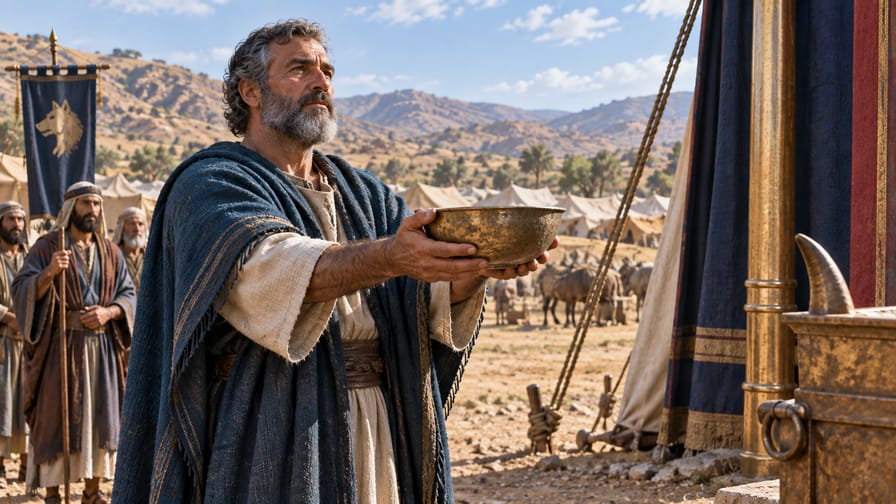
Abidan, son of Gideoni, emerges from the biblical record as a tribal leader during the foundational period of Israel's history. His brief but significant appearances place him firmly within the generation that experienced the Exodus from Egypt and the wilderness wanderings, a pivotal time when the nation of Israel was being shaped by divine law and covenant.
As a representative of the tribe of Benjamin, Abidan played a role in the organization and worship of the nascent Israelite community. His actions, though few, underscore the importance of leadership and tribal identity in the early days of God's chosen people, setting a precedent for communal responsibility and participation in sacred rites.
1. Name and origin
1.1 Etymology and meaning
The name Abidan (אֲבִידָן) is Hebrew, meaning “my father is judge” or “father of judgment.” This etymology suggests a connection to authority, wisdom, or a role in legal or judicial matters, reflecting the patriarchal structure of ancient Israelite society. The name itself might have been aspirational, indicating a family's hope for their son to embody such qualities, or it could have been a recognition of a father's esteemed position.
In a broader sense, the name could also point to God as the ultimate judge, with the individual's father serving as a human reflection of that divine attribute. This understanding aligns with the Israelite worldview where God's sovereignty permeated all aspects of life, including personal names and family lineage.
1.2 Family, era, and geography
Abidan is identified as the son of Gideoni, placing him within the lineage of the tribe of Benjamin. This tribe, descended from Jacob's youngest son, was known for its fierce warriors and later produced figures like King Saul and the apostle Paul. Abidan's era is specifically the time of the Exodus and the wilderness journey, roughly the 15th to 13th centuries BC, a period of immense national formation for Israel.
His geographical context is the wilderness surrounding Mount Sinai and the subsequent journey toward the Promised Land. During this time, the tribes were encamped in specific formations around the Tabernacle, and leaders like Abidan were responsible for their respective tribal contingents, managing their movements and participation in the community's life.
2. Biblical narrative
2.1 Calling and key episodes
Abidan's primary role is that of a tribal leader, specifically a “chief” or “head” of the tribe of Benjamin (Num 1:11). He is first mentioned when Moses and Aaron were commanded by God to take a census of the Israelite men able to go to war. Abidan was among the twelve men, one from each tribe, chosen to assist in this important task (Num 1:1-16).
His most notable appearance is during the dedication of the Tabernacle. Each tribal leader was instructed to bring an offering, and Abidan presented his on the ninth day (Num 7:60-65). His offering, identical to those of the other leaders, included a silver plate weighing 3¼ pounds, a silver sprinkling bowl weighing 1¾ pounds, both filled with fine flour mixed with olive oil for a grain offering, a gold incense dish weighing 4 ounces filled with incense, a young bull, a ram, and a male lamb a year old for a burnt offering, a male goat for a sin offering, and two cattle, five rams, five male goats, and five male lambs a year old for a peace offering. This detailed account highlights the orderliness and communal participation in Israel's worship.
2.2 Relationships and turning points
While the Bible does not explicitly detail Abidan's personal relationships, his position as a tribal chief implies significant interaction with Moses, Aaron, and the other tribal leaders. He was part of a council of twelve men who bore the responsibility of organizing and leading the vast Israelite encampment. This collective leadership was crucial for maintaining order and unity among the diverse tribes.
The dedication of the Tabernacle marked a turning point for the Israelite community, establishing a central place of worship and a structured system for approaching God. Abidan's participation in this event signified his commitment to the newly established covenant and the spiritual life of the nation. His leadership helped to solidify the tribal structure within the larger national identity, ensuring that each family group had representation and a voice.
3. Character and faith
3.1 Virtues and devotion
Though the biblical text offers no direct commentary on Abidan's personal character, his selection as a tribal chief and his participation in sacred duties suggest a man of integrity and faithfulness. In a society where leadership was often tied to spiritual standing, it is reasonable to infer that Abidan possessed qualities of wisdom, discernment, and loyalty to God's commands. His willingness to serve in the census and to present the tribal offering indicates a devotion to the Lord and a commitment to the communal worship life of Israel.
His actions speak to a quiet obedience and a steady hand in leadership, crucial virtues for navigating the challenges of the wilderness. He was a man who understood his place within God's plan for Israel and faithfully carried out his assigned responsibilities.
3.2 Failures and lessons
The Scriptures do not record any specific failures or missteps attributed to Abidan. His portrayal is consistently positive, or at least neutral, focusing on his role as a faithful leader. This absence of negative remarks is not necessarily an indication of perfection but rather a testament to his consistent performance of duties within the divine framework established for Israel.
The lesson from Abidan's life, therefore, is one of steadfastness in service. He reminds us that not all significant contributions are marked by dramatic events or extensive narratives. Sometimes, faithful, consistent leadership in the day-to-day administration and worship of God's people is precisely what is needed, and it is valued in God's eyes.
4. Theological significance and legacy
4.1 Christological foreshadowing or typology
Abidan, as a tribal leader in the wilderness, does not directly offer a strong Christological typology in the way that figures like Moses or David do. However, his role as a representative leader within God's chosen people can be seen as part of the broader Old Testament pattern of human leadership pointing to the ultimate divine leader. Just as Abidan represented his tribe before God, Christ represents all of humanity, and specifically his church, before the Father as our great High Priest and Mediator (Heb 4:14-16).
The meticulous offerings presented by Abidan and the other leaders foreshadow the perfect, once-for-all sacrifice of Christ. Their offerings were temporary and had to be repeated, but Christ's sacrifice on the cross fully atoned for sin, making all other offerings obsolete (Heb 10:1-14). Abidan's participation in the Tabernacle's dedication underscores the need for a consecrated space and a pure offering, both fulfilled definitively in Christ.
4.2 Witness in later Scripture and church memory
Abidan is not mentioned in later biblical texts beyond the books of Numbers. His legacy is primarily contained within these early accounts of Israel's formation. He is not a figure around whom later traditions or theological developments coalesced, nor is he explicitly referenced in the New Testament or by early church fathers.
Nonetheless, his inclusion in the detailed records of Numbers serves as a testament to God's meticulous attention to the organization and worship of his people. Abidan's life, though briefly illuminated, reminds us that every individual, regardless of the length of their biblical entry, plays a part in God's unfolding redemptive history. His story is preserved as a factual record of the faithful leadership that enabled Israel to function as a unified people under God.
5. Conclusion
Abidan's life, though sparsely detailed, provides a glimpse into the foundational period of Israel. As a tribal chief of Benjamin, he faithfully executed his duties, assisting in the census and presenting the required offerings for the Tabernacle's dedication. His story underscores the importance of diligent, unassuming leadership within God's community. While not a figure of dramatic action, Abidan's quiet obedience and participation in the sacred rites of Israel point to the larger truth that God uses ordinary people in positions of responsibility to establish his kingdom, ultimately culminating in the perfect leadership and sacrifice of Jesus Christ, who truly judges and saves his people.