


Ziphion
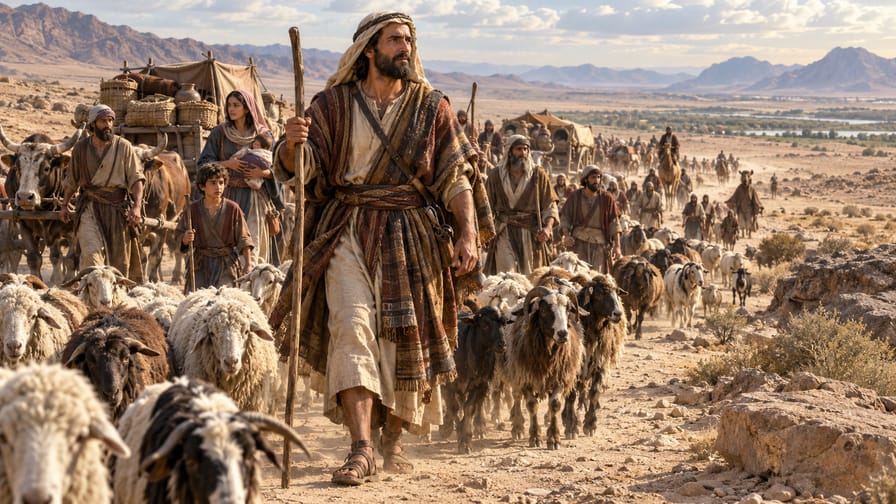
Ziphion was a son of Gad and a grandson of the patriarch Jacob. His name heads the list of Gad's sons among the family members who went down with Jacob to Egypt (Genesis 46:16). In the census taken on the plains of Moab at the end of the wilderness journey, the same man appears as Zephon, the ancestor of the clan of the Zephonites (Numbers 26:15).
That is almost everything the Bible tells us about him. We do not know his age, his character, his wife, the events of his life or the circumstances of his death. It would be wrong to fill that silence with invention. Yet his name is not there by accident: it marks one of the family lines through which God began to fulfill his promise to make Abraham's descendants a great people.
Looking at Ziphion honestly means reading a short entry in a long story, and discovering that even brief names in Scripture serve the larger purpose of God.
1. Etymology and meaning of the name
In Genesis the name is written Ziphion (צִפְיוֹן, Ṣiphyôn), and in Numbers Zephon (צְפוֹן, Ṣephôn). Both forms are clearly the same person, since they stand in the same position in the list of Gad's sons. Variations of this kind are common in biblical genealogies. Some ancient witnesses, such as the Greek Septuagint, use a form close to Zephon in Genesis as well.
The meaning of the name is uncertain. Many scholars connect it with the Hebrew root ṣāpâ, to watch or keep watch, which would give a sense such as watchman or lookout. Others relate Zephon to ṣāpôn, north, or to ṣāpan, to hide or treasure up. None of these explanations can be proven, and the text itself does not comment on the name.
2. Historical context and biblical narrative
2.1 Family origin and genealogy
Ziphion's father, Gad, was the seventh son of Jacob, born to Zilpah, the servant of Leah. When he was born, Leah said that good fortune had come, and she named him Gad (Genesis 30:9-11). Ziphion was therefore a great-grandson of Isaac and a descendant of Abraham, part of the family to whom God had promised land, descendants and blessing (Genesis 12:1-3; 28:13-14).
Genesis lists seven sons of Gad: Ziphion, Haggi, Shuni, Ezbon, Eri, Arodi and Areli (Genesis 46:16). Ziphion is named first. The text does not say explicitly that he was the eldest, although the order of such lists often follows birth order.
2.2 Main events
The only event connected with Ziphion is the migration of Jacob's family to Egypt during the famine. God spoke to Jacob in visions of the night at Beersheba, telling him not to fear going down to Egypt, for there he would make him a great nation, and promising to go down with him and to bring him up again (Genesis 46:2-4). The list that follows names the descendants of Jacob who went with him, among them the sons of Gad, and it concludes that the sons of Zilpah and their descendants numbered sixteen persons (Genesis 46:18). The whole household of Jacob that came into Egypt was seventy persons (Genesis 46:27). The family settled in the land of Goshen (Genesis 47:1-6).
Ziphion himself is not mentioned again in the narrative. His name reappears only generations later, when Moses and Eleazar numbered the new generation of Israel on the plains of Moab. There the tribe of Gad is divided into clans named after Gad's sons, beginning with Zephon, from whom came the clan of the Zephonites. The tribe as a whole numbered 40,500 men (Numbers 26:15-18). This census served as the basis for the distribution of the land (Numbers 26:52-56). The clan that bore Ziphion's name therefore had its place in the inheritance given to Gad east of the Jordan (Numbers 32:33; Joshua 13:24-28).
3. Character and role in the biblical narrative
Scripture says nothing about Ziphion's personality, faith or actions, and it is best not to speculate. His role in the narrative is that of a founder of a family line. He belonged to the generation that crossed from Canaan into Egypt, and through him a clan came into being that survived the years of slavery, the exodus and the wilderness journey. When Israel was finally counted before entering the land, his descendants stood as a recognized family within the tribe of Gad.
That role is modest but real. The book of Numbers does not list the clans merely as a matter of record; the clans were the units through which land was assigned. Ziphion's name thus became attached to a concrete inheritance in the land God had promised.
4. Theological significance
4.1 The promise of a people fulfilled
Ziphion's appearance in two lists, separated by centuries, testifies to the fulfillment of God's word. Jacob went down to Egypt with seventy persons, and God had said he would make him a great nation there (Genesis 46:3). By the time of the census in Numbers, the tribe of Gad alone had more than forty thousand men. The clan of the Zephonites was part of that growth. What God promised to Abraham, that his offspring would be as numerous as the stars (Genesis 15:5), was taking visible shape.
4.2 God knows every name
The genealogies of the Bible show that God's people are not an anonymous mass. Each family was counted and named. This anticipates a truth made clear in the New Testament: the good shepherd calls his own sheep by name (John 10:3). The Bible does not present Ziphion as a type of Christ, and it would be forced to make him one. But the care with which his name is preserved belongs to the same faithfulness that sent the Son to gather a people from every tribe and nation (Revelation 7:9).
5. Legacy and canonical references
Ziphion appears in only two verses of the Bible: as the first of the sons of Gad in the list of Jacob's family that went down to Egypt (Genesis 46:16), and, under the form Zephon, as the ancestor of the clan of the Zephonites in the census on the plains of Moab (Numbers 26:15). He is not named in the genealogy of Gad in 1 Chronicles 5:11-17, which follows other lines of the tribe.
His legacy lies in the clan that carried his name into the land. The tribe of Gad was later known for valiant warriors (1 Chronicles 12:8) and received blessings from both Jacob and Moses (Genesis 49:19; Deuteronomy 33:20-21). Scripture does not say what part the Zephonites played in that history, but they were among those who received their share in God's promise.
6. Application for today
Ziphion reminds us that a life does not need to be famous to have a place in God's story. Most of us will leave no long record behind. What matters is belonging to the people God is gathering and being faithful in the generation in which he has placed us.
His story also encourages patience. Ziphion never saw the promised land. He went down to Egypt and, as far as we know, died there. Only his descendants received their inheritance, centuries later. God's promises often unfold over longer spans than a single life, and faith trusts him even when the fulfillment lies beyond our own days.
Finally, his name invites gratitude. The same God who kept track of a small clan in the tribe of Gad knows each of his children today. In Christ, no believer is lost in the crowd; each one is known, called and given a place among God's people.