


Chelubai
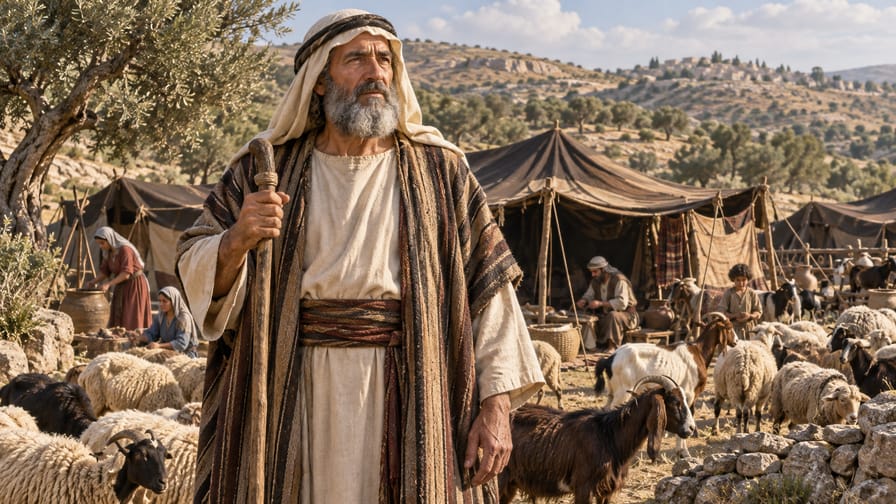
Chelubai was a son of Hezron, grandson of Perez and great-grandson of Judah. He appears by this name only once, in the genealogy of Judah that opens the book of Chronicles: 'The sons of Hezron that were born to him: Jerahmeel, Ram, and Chelubai' (1 Chronicles 2:9). A few verses later the same chapter speaks of 'Caleb the son of Hezron' (1 Chronicles 2:18) and of 'Caleb the brother of Jerahmeel' (1 Chronicles 2:42). Chelubai and this Caleb are the same person, and some translations, such as the NIV and the Luther Bible, simply render the name in verse 9 as 'Caleb'.
It is important to say from the start that he is not Caleb son of Jephunneh, the faithful spy who followed the Lord fully and received Hebron (Numbers 14:24; Joshua 14:6-14). Chelubai lived generations earlier: his great-grandson Bezalel was already a skilled craftsman in the days of Moses.
The Bible records no words or deeds of Chelubai. What we have is a list of wives, sons and descendants. Even so, that list says a great deal about the clans of southern Judah, about the ancestry of Bezalel, and about the faithfulness of God recorded in the genealogies.
1. Etymology and meaning of the name
The Hebrew form Chelubai (כְּלוּבָי, Kelubay) is generally regarded as a variant of Caleb (כָּלֵב, Kalev). The ending -ai is found in other Hebrew names, and some scholars take the form as meaning 'the Calebite' or as a simple alternative spelling. The exact reason for the two forms in the same chapter is not certain.
The name Caleb itself is usually connected with the word kelev, 'dog'. In the ancient Near East that word could express faithfulness or humble service, although it could also be an insult. Popular explanations that read the name as 'whole heart' (kol lev) are attractive but are wordplay rather than etymology. It is best to say that the name is linked with Caleb and that its precise meaning is uncertain.
2. Historical context and biblical narrative
2.1 Family origin and genealogy
Chelubai belonged to the royal tribe of Judah through Perez, the son of Judah and Tamar (Genesis 38:29; 1 Chronicles 2:4-5). His father Hezron is listed among those who went down to Egypt with Jacob (Genesis 46:12). His brothers were Jerahmeel, head of the Jerahmeelite clans (1 Chronicles 2:25-33), and Ram, the ancestor of Amminadab, Nahshon, Boaz, Jesse and David (1 Chronicles 2:10-15; Ruth 4:19-22).
According to 1 Chronicles 2:18-20, Caleb son of Hezron had children by his wife Azubah and by Jerioth (the Hebrew of this verse is difficult, and it is not clear whether Jerioth was a second wife or a daughter); the sons named are Jesher, Shobab and Ardon. When Azubah died, he married Ephrath, who bore him Hur. Hur fathered Uri, and Uri fathered Bezalel. Verses 42 to 50 add further lines through Mesha his firstborn, through his concubines Ephah and Maacah, and through Hur, 'the firstborn of Ephrathah'.
2.2 Main events
Chronicles does not narrate episodes from Chelubai's life. Its information concerns descendants and places. Many of the 'sons' in 1 Chronicles 2:42-55 are called 'father' of towns: Mesha is the father of Ziph, Mareshah the father of Hebron, Shaaph the father of Madmannah, Sheva the father of Machbenah and Gibea. Among the sons of Hur, Shobal is the father of Kiriath-jearim, Salma the father of Bethlehem, and Hareph the father of Beth-gader (1 Chronicles 2:49-51). In this kind of genealogy 'father' often means founder or leader of a settlement, so the list shows the clans descended from Chelubai spread across the hill country of Judah.
The most famous descendant is Bezalel son of Uri, son of Hur, whom God 'called by name' and filled 'with the Spirit of God, with ability and intelligence' to build the tabernacle (Exodus 31:1-5; 35:30-35). Because Hezron went down to Egypt and Bezalel worked in the wilderness, it is reasonable to think that Chelubai lived in Egypt during the years of Israel's stay there, but the Bible does not say so directly.
One detail remains difficult. 1 Chronicles 2:49 says that 'the daughter of Caleb was Achsah', the name of the daughter of Caleb son of Jephunneh (Joshua 15:16-17). Interpreters offer different explanations: some think the Chronicler combined the lists of the whole Calebite clan, into which the later Caleb son of Jephunneh was incorporated; others consider it a separate note. The text does not settle the question, and it is wise to leave it open.
3. Character and role in the biblical narrative
Scripture gives no description of Chelubai's character, faith or actions, and it would be wrong to fill that silence with invention. His role in the biblical narrative is genealogical. He is the head of one of the three great branches of the house of Hezron, alongside Jerahmeel and Ram, and through him the Chronicler traces clans that occupied important towns of Judah, among them Hebron, Ziph, Kiriath-jearim and Bethlehem.
His place in the list also helps readers distinguish two Calebs. Caleb son of Hezron belongs to the patriarchal and Egyptian generations; Caleb son of Jephunneh, called the Kenizzite, belongs to the generation of the exodus and the conquest (Numbers 32:12; Joshua 14:6). Keeping them apart avoids a frequent confusion.
4. Theological significance
4.1 God remembers names
The genealogies of Chronicles were written for the community that returned from exile, to show that they were still the people of the promise. Names like Chelubai, which seem obscure to us, testify that God knows his people individually and keeps his covenant across generations.
4.2 Gifts given for worship
From the house of Chelubai came Bezalel, the first person in Scripture said to be filled with the Spirit of God, and he received that gift to build the place where God would dwell among his people. The line of an almost unknown man thus served the worship of Israel.
4.3 A brother of the royal line
Chelubai was not an ancestor of David or of Jesus; that line passed through his brother Ram (Matthew 1:3-4). Yet the Chronicler associates the name Ephrathah and the founding of Bethlehem with his descendants (1 Chronicles 2:19, 50-51; 4:4). Centuries later Micah announced that from 'Bethlehem Ephrathah' would come the ruler of Israel (Micah 5:2), fulfilled in the birth of Jesus (Matthew 2:5-6). The text does not make Chelubai a type of Christ, but his family history is part of the landscape in which the Messiah was born.
5. Legacy and canonical references
Chelubai's legacy lies in the clans that bore his name, in the towns of Judah associated with them, and above all in Bezalel, whose work on the tabernacle is remembered in Exodus and in 2 Chronicles 1:5.
He is named Chelubai only in 1 Chronicles 2:9. Under the name Caleb son of Hezron he appears in 1 Chronicles 2:18-19, 2:42, 2:46, 2:48-50; 1 Chronicles 2:24 mentions a place called Caleb-ephrathah, whose reading is disputed. His descendant Bezalel is identified as 'son of Uri, son of Hur' in Exodus 31:2; 35:30; 38:22; 1 Chronicles 2:20; and 2 Chronicles 1:5.
Not to be confused with: Caleb son of Jephunneh (Numbers 13:6; 14:6-9, 24; Joshua 14:6-15; 15:13-19); Chelub the brother of Shuhah (1 Chronicles 4:11); and Chelub the father of Ezri, an official of David (1 Chronicles 27:26).
6. Application for today
Chelubai reminds us that a life can matter to God even when little of it is recorded. We know nothing of his words or deeds, yet his name is preserved in Scripture, and from his family came the craftsman who built the tabernacle. Many faithful believers will never be remembered by history, but they are known by God, who 'knows those who are his' (2 Timothy 2:19).
His story also encourages us to think in generations. The gifts given to Bezalel were not Chelubai's, but they came through his house. Parents and grandparents today may never see the full fruit of their faithfulness, but God can use a family line for purposes far beyond what any one generation imagines.
Finally, the genealogy that contains Chelubai leads to Bethlehem and to David, and through David to Jesus Christ. Every obscure name in these lists is part of the history that God was guiding toward the coming of his Son. In Christ, those whose names seem insignificant have their names written in heaven (Luke 10:20).