


Asenath
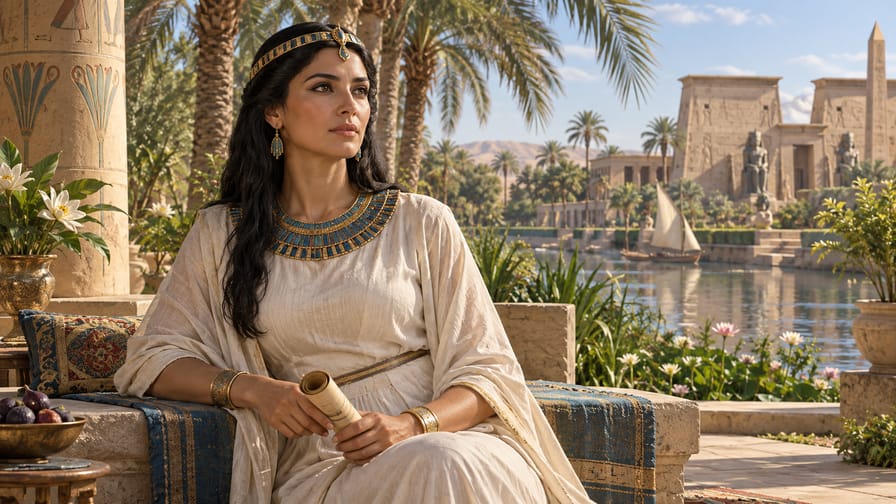
The figure of Asenath, Joseph's wife in Egypt, emerges in the narratives of the book of Genesis as a secondary character, yet of profound theological and historical relevance for understanding the formation of the people of Israel. Although the biblical text provides limited details about her personality or direct actions, her existence and role are crucial for the genealogy and development of God's chosen nation. Her story is intrinsically linked to divine providence in the preservation of the patriarchal lineage and to Joseph's integration into the highest sphere of Egyptian power.
From an evangelical Protestant perspective, the analysis of Asenath transcends mere biography, inviting reflection on God's sovereignty which orchestrates events and relationships to fulfill His purposes. The scarcity of details about her in the biblical canon encourages careful exegesis, focusing on what the Scriptures truly affirm and on the theological implications that can be legitimately drawn from her position in redemptive history. Her life, though briefly narrated, is a testament to God's faithfulness and the comprehensiveness of His plan.
This study seeks to comprehensively explore the figure of Asenath, examining her onomastic meaning, the historical context in which she lived, her role in the biblical narrative, and her theological relevance, including possible typological implications. The analysis will be conducted with academic rigor, grounded in Scripture and Reformed theology, seeking to extract pertinent lessons for faith and understanding God's work in history.
Asenath's presence in the Bible, despite her discretion, underscores the way God uses individuals from different backgrounds and contexts to advance His greater plan. She is a vital link in the chain of events that would lead to the formation of the twelve tribes of Israel, and, consequently, to the messianic lineage. Her story is a reminder that even the most peripheral characters have a significant place in the grand drama of divine redemption.
Throughout this analysis, pertinent biblical references will be highlighted, and, where appropriate, insights from evangelical commentators and theologians who contribute to a richer and deeper understanding of Asenath's importance in the biblical-theological landscape will be mentioned.
1. Etymology and meaning of the name
The name Asenath, in Hebrew Asnat (אָסְנַת), is of Egyptian origin and appears in the Old Testament in Genesis 41:45 and Genesis 46:20. The Greek transliteration in the Septuagint is Aseneth (Ἀσενέθ). The exact etymology is a subject of debate among Egyptologists and Hebraists, but proposals generally point to a connection with the Egyptian goddess Neith.
One of the most widely accepted interpretations for the name Asenath is "belonging to Neith" or "devotee of Neith". Neith was an important goddess in Egyptian mythology, associated with war, hunting, weaving, and wisdom, and was considered the mother of the gods and creator of the universe in some traditions. The element snt in the Egyptian name can mean "sister", leading to "sister of Neith" or "she who belongs to Neith".
Other etymological suggestions include "she who is from her father" or "gift of Neith". Regardless of the exact derivation, the meaning of the name clearly connects her with the Egyptian pantheon and, specifically, with the worship of a pagan deity. This is significant, as she becomes the wife of Joseph, a faithful servant of the God of Israel, and mother of two of the patriarchs of the tribes of Israel.
There are no other biblical characters named Asenath. Her uniqueness in the biblical canon reinforces the specificity of her role in Joseph's narrative. The name, by itself, already points to the cultural and religious contrast that her union with Joseph represents.
The theological significance of the name lies, paradoxically, in its pagan context. The fact that Joseph, the future governor of Egypt and a man who feared Yahweh, married a woman whose name evokes a pagan deity, demonstrates God's sovereignty. He uses and integrates elements of secular and even pagan contexts to fulfill His redemptive purposes, without compromising the faith of His servant.
The union of Joseph and Asenath is an example of how God operates in non-Israelite environments, transforming seemingly adverse circumstances into instruments for the preservation of His covenant. The name Asenath, with its Egyptian connotations, serves as a constant reminder of divine providence amidst a foreign and idolatrous culture, a recurring theme in the history of Israel.
2. Historical context and biblical narrative
Asenath's life is set within the context of Joseph's story, which unfolds during the patriarchal period, approximately between 1800 and 1500 B.C. (approximate dates, varying according to chronologies). This era is characterized by the migrations of the patriarchs Abraham, Isaac, and Jacob, and by the initial formation of the people of Israel. The specific setting for Asenath is ancient Egypt, a powerful and highly developed empire at the time.
2.1 Family origin and genealogy
Asenath is identified in Genesis 41:45 as the daughter of Potiphera, priest of On. On, also known as Heliopolis, was an Egyptian city of great religious and political importance, a center for the worship of the sun god Ra. The title "priest of On" indicated a position of considerable prestige and influence in Egyptian society, suggesting that Asenath came from a family of the empire's religious and social elite.
Her genealogy, though not detailed beyond her father, places her directly in the heart of Egyptian culture. She was not a foreigner from another land, but an Egyptian by birth and upbringing, connected to local traditions and deities. This detail is crucial for understanding the depth of Joseph's integration into Egyptian society and the comprehensiveness of divine providence.
2.2 Main events of her life
The main and only direct mention of Asenath in the canonical biblical narrative occurs in Genesis 41:45, where Pharaoh gives her to Joseph as his wife, after appointing him as his second-in-command: "And Pharaoh called Joseph's name Zaphenath-Paneah and gave him as his wife Asenath, the daughter of Potiphera, priest of On. So Joseph went out over all the land of Egypt."
This marriage was an act by Pharaoh to solidify Joseph's position in the Egyptian court, conferring status and legitimacy upon him. It was a common practice for pharaohs to give wives to their high officials to ensure their loyalty and integration. Through this marriage, Joseph, the Hebrew slave and prisoner, became part of the Egyptian nobility.
The narrative continues by informing that Asenath bore Joseph two sons before the beginning of the famine: Manasseh and Ephraim (Genesis 41:50-52). These two sons would later be adopted by Jacob (Genesis 48:5), becoming heads of two of the twelve tribes of Israel, receiving an inheritance as if they were direct sons of Jacob, alongside Reuben and Simeon.
2.3 Geography and relationships
The geography associated with Asenath is the city of On (Heliopolis), an important religious center in lower Egypt. Her life, therefore, was centered in the heart of Egyptian civilization, in contrast to the semi-nomadic and pastoral origin of Joseph's family. This geographical and cultural distinction highlights the breadth of God's plan.
Her most important relationships are with Joseph, her husband, and their two sons, Manasseh and Ephraim. Through her sons, Asenath becomes an ancestral figure in the lineage of Israel, even though she was Egyptian. She is also connected to Pharaoh, who orchestrated her marriage, and to her father, Potiphera, the priest of On, who represents the Egyptian religious elite. These connections underscore the complex web of relationships God wove to fulfill His promise to Abraham.
3. Character and role in the biblical narrative
The Bible offers very few direct details about Asenath's character. There are no recorded dialogues from her, nor descriptions of her actions or thoughts beyond her marriage and motherhood. This forces us to infer her character and role from the context and the implications of her position in the Genesis narrative. Her discretion in the sacred text, however, does not diminish her importance.
3.1 Analysis of character as revealed in the Scriptures
As the daughter of a priest of On and wife of the second most powerful man in Egypt, it is reasonable to assume that Asenath possessed the qualities expected of a woman of her social standing. She was likely well-educated, possessed decorum, and was accustomed to the responsibilities and etiquette of the Egyptian court. Her acceptance of marriage to Joseph, a foreigner newly elevated to power, suggests a willingness to abide by the social and political arrangements of the time.
Although there is no evidence of her conversion to Joseph's monotheism, the absence of explicit religious or cultural conflicts in her marriage, such as those seen in other biblical narratives (e.g., Ahab and Jezebel), may suggest an attitude of respect or, at minimum, harmonious coexistence. The Bible neither condemns nor praises her, maintaining a factual description of her role.
3.2 Vocation, calling, or specific function
Asenath's primary role in the biblical narrative is threefold: to be Joseph's wife, mother of Manasseh and Ephraim, and, by extension, a link that fully integrates Joseph into Egyptian society. As Joseph's wife, she provided him with a family in Egypt, a home, and a support base in his new and powerful position. This allowed Joseph to feel rooted and fulfill his governmental responsibilities.
Her most significant function lies in motherhood. By giving birth to Manasseh and Ephraim, Asenath became the matriarch of two of the future and prominent tribes of Israel. The names Joseph gave to his sons — Manasseh ("God has made me forget all my hardship and all my father's house") and Ephraim ("God has made me fruitful in the land of my affliction") (Genesis 41:51-52) — reflect Joseph's perspective, but Asenath was the instrument for the fulfillment of these declarations of faith and gratitude.
3.3 Role played and significant actions
Asenath's marriage to Joseph is a significant action orchestrated by Pharaoh, symbolizing Joseph's full acceptance and empowerment in Egypt. This act was not merely a personal event, but a political decision with broad implications for the history of Israel. Without this marriage, Joseph's lineage would have been different, and the narrative of the formation of the tribes of Israel would have taken another course.
Her contribution, therefore, is fundamentally through her relationship with Joseph and her offspring. She is the link that connects Joseph's Hebrew faith with the Egyptian context, and her children represent the continuity of God's promise of fruitfulness and multiplication, even in a foreign land. Her role is passive, but essential for the progression of the divine plan.
In summary, Asenath's character is delineated by her social position and by her obedience to divinely orchestrated arrangements. She is an example of how individuals, even without a prominent active role, can be crucial instruments in God's hand for the fulfillment of His redemptive purposes.
4. Theological significance and typology
The theological significance of Asenath, though not explicit in grand speeches or prophecies, is profound and multifaceted, especially from the evangelical Protestant perspective that values divine sovereignty and Christocentric typology. Her story fits perfectly into the narrative of redemptive history and the progressive revelation of God.
4.1 Role in redemptive history and progressive revelation
Asenath plays a crucial role in the preservation of the covenant lineage. Through her marriage to Joseph, she becomes the mother of Manasseh and Ephraim. These, in turn, are adopted by Jacob and elevated to the status of direct sons, becoming heads of two of the twelve tribes of Israel (Genesis 48:5). This means that an Egyptian woman, with a name of pagan connotation, was the vessel chosen by God to continue the promise of the multiplication of Abraham's offspring and the formation of the tribes that would comprise the nation of Israel.
This event demonstrates God's sovereignty in using means and people that transcend Israel's ethnic and religious boundaries. It shows that God's plan was not limited only to endogamous marriages (within the family or people), but that He could operate through diverse circumstances, including the union of a patriarch with a foreign woman, to fulfill His promises. This is a progressive revelation of the breadth of God's grace.
4.2 Prefiguration or Christocentric typology
Although Asenath is not a direct type of Christ, her role and the context of her marriage can be seen as prefigurations of larger theological themes that culminate in Christ. The union of Joseph, a Hebrew, with Asenath, an Egyptian, can be interpreted as a type of the future inclusion of Gentiles into the people of God. Joseph, who was rejected by his brothers, elevated to a position of power and married to a foreigner, prefigures Christ, who was rejected by Israel, elevated to the right hand of God and whose "bride" is composed of believers from all nations, Jews and Gentiles (Ephesians 2:11-22).
Joseph's "Gentile bride," who gives rise to two of Israel's most important tribes, can be a figure of the Church, composed of believers from diverse origins, who become co-heirs of God's promises through Christ (Galatians 3:28-29). God's providence in bringing Asenath into the covenant lineage, despite her pagan origin, illustrates God's inclusive grace that extends beyond Israel's ethnic boundaries, a central theme in Pauline theology.
4.3 Connection with central theological themes
Asenath's story is intrinsically linked to themes such as **divine providence**, **God's sovereignty**, and **election**. God orchestrated the events of Joseph's life, including his elevation in Egypt and his marriage, to preserve Jacob's family from famine and ensure the continuity of the messianic lineage. The choice of Asenath as the mother of Joseph's children was not accidental, but part of God's sovereign plan.
Her story also touches on the theme of **grace** and **inclusion**. Although there is no explicit mention of her conversion, the fact that her sons were fully integrated and blessed by Jacob, and became tribes of Israel, demonstrates God's ability to transcend cultural and religious barriers to fulfill His purposes. This points to God's grace which, in Christ, abolishes the distinction between Jew and Gentile (Colossians 3:11).
5. Biblical-theological legacy and canonical references
Asenath's legacy in the biblical canon is subtle, yet profoundly significant. She is a character who, though appearing briefly, leaves an indelible mark on the history of Israel and biblical theology. Her importance does not lie in her direct actions, but in her strategic function within God's redemptive plan.
5.1 Mentions of the character in other biblical books
Beyond Genesis 41:45 and Genesis 46:20, where she is named as Joseph's wife and mother of Manasseh and Ephraim, Asenath is not mentioned in other canonical books of the Old or New Testament. Her "presence" in other passages is indirect, through her sons and the tribes descended from them. The prominence of the tribes of Manasseh and Ephraim throughout Israel's history, especially Ephraim as a name that sometimes represents the Northern Kingdom, is the most enduring testimony to her contribution.
5.2 Influence on biblical theology
Asenath's primary influence on biblical theology lies in the demonstration of God's sovereignty over all things, including pagan culture and religion. Her union with Joseph is a clear example of how God works through circumstances seemingly contrary to the purity of Israel's lineage to fulfill His promises. She reinforces the doctrine of divine providence, where God uses the Egyptian empire and an Egyptian woman to bless the covenant family.
For Reformed and evangelical theology, Asenath serves as a reminder of the inclusive character of God's plan. Although salvation came from Israel (John 4:22), biblical history shows a pattern of God reaching out to and using Gentiles, prefiguring the coming of Christ, who would break down the barrier between Jews and Gentiles (Ephesians 2:14). Asenath's inclusion in the patriarchal lineage, even if by marriage, points to this truth.
5.3 Presence in Jewish and Christian interpretive tradition
In Jewish tradition, especially in Midrashic literature, there is an effort to "Judaize" Asenath, transforming her from a pagan Egyptian into a proselyte or even a woman of Israelite origin (Dinah's daughter, for example, or saved from a massacre). A notable example is the apocryphal book Joseph and Asenath, which portrays her as a woman who converted from paganism to Joseph's God, renouncing her idols and embracing monotheistic faith before her marriage. Although these narratives are extra-canonical and should not be treated as Scripture, they reveal the tension and desire to reconcile her pagan origin with her crucial role in Israel's history.
In Christian theology, Asenath is generally seen within the context of God's providence in Joseph's story. Evangelical commentators such as John Calvin, Matthew Henry, and Charles Spurgeon, when addressing Joseph's story, tend to focus on God's faithfulness and the fulfillment of His promises, with Asenath playing a supportive, yet essential, role in this divine drama. Her story is a testimony to the truth that "all things work together for good for those who love God, who are called according to his purpose" (Romans 8:28).
5.4 Importance of the character for understanding the canon
Asenath's importance for understanding the canon lies in her contribution to the genealogy and the formation of the twelve tribes of Israel. Without her, Manasseh and Ephraim would not have been born, and the tribal structure of Israel, as we know it, would be different. She is a vital link connecting the history of Jacob's family with the Egyptian empire, a crucial stage for the initial development of God's people.
Her story illustrates the complexity of God's work, which is not limited to human patterns or expectations. It reminds us that God acts in mysterious and sovereign ways, using improbable people and circumstances to fulfill His eternal plans, culminating in Christ Jesus, the Savior of Jews and Gentiles.