


Матфей
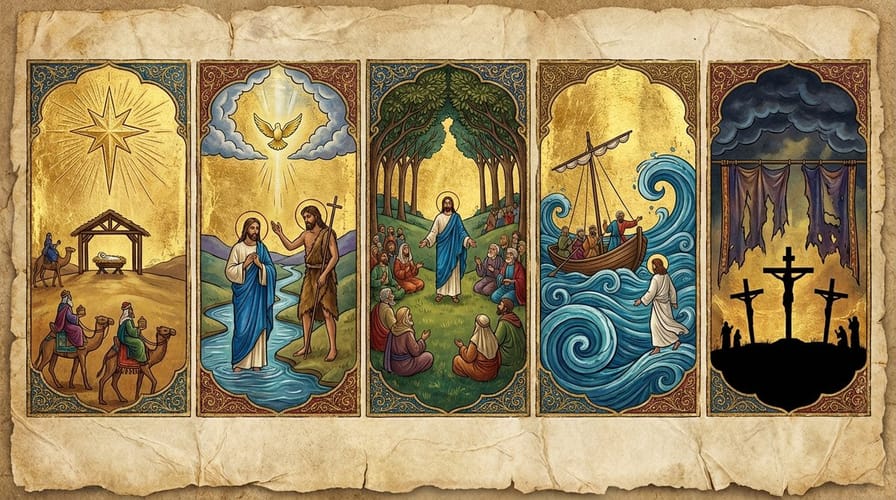
Illustration of the Book of Matthew, one of the 27 books of the New Testament (Nano Banana Pro).
This introduction aims to delve into the Book of Matthew, the first of the canonical gospels, from a conservative evangelical Protestant perspective. This study will not only uncover the intrinsic riches of the Matthean text but will also serve as a structural model for the analysis of any book of the Holy Scriptures.
The approach will be characterized by academic rigor, theological depth, and an unwavering reverence for the inerrancy and verbal inspiration of the Bible. We will seek to balance the scholarship necessary for serious study with pastoral accessibility, so that both the scholar and the common reader may be edified and equipped for a deeper understanding of the Word of God.
Matthew occupies a singular position in the canon, acting as a vital bridge between the Old and New Testaments. He is, par excellence, the gospel that presents Jesus Christ as the Messiah promised to Israel, the Davidic King, and the fulfillment of all Old Testament prophecies.
His meticulous narrative is not merely biographical but profoundly theological, constructed to persuade its readers of Jesus' identity and mission, and to instruct the new covenant community about the nature of the Kingdom of Heaven and the demands of its King. Throughout this introduction, we will defend traditional positions of authorship and dating, responding to modern academic criticisms based on internal and external evidence, and underscoring the christocentric nature of all Scripture.
The proposed analytical model will unfold into five fundamental sections, each exploring a crucial aspect for the comprehensive understanding of a biblical book: its context and authorship, its structure and content, its theological themes and purpose, its canonical relevance, and, finally, the hermeneutical challenges it presents.
This structure aims to provide a robust tool for biblical study, allowing for a systematic and profound analysis that honors the divine authority of Scripture and promotes an informed and mature faith. May the Holy Spirit illuminate our journey through this foundational gospel, revealing the glory of Jesus Christ, the Son of God and Savior of the world.
1. Historical Context, Dating, and Authorship
The understanding of any ancient text is intrinsically linked to its context of production. In the case of the Gospel of Matthew, the question of authorship, dating, and the historical-cultural environment in which it was written are crucial for a faithful interpretation. The conservative evangelical Protestant perspective traditionally defends apostolic authorship and a relatively early dating, positions that seek support in historical and internal evidence from the text itself.
1.1 Apostolic Authorship of Matthew
The earliest and most consistent evidence for the authorship of the Gospel of Matthew points to the apostle Matthew, also known as Levi, the tax collector whom Jesus called to follow Him (Matthew 9:9). The unanimous patristic testimony is a fundamental pillar for this position. The most prominent is Papias of Hierapolis, a second-century bishop, who, according to Eusebius of Caesarea, stated: "Matthew indeed compiled the oracles in the Hebrew language, and each one interpreted them as he was able."
Although the phrase "in the Hebrew language" has generated debate (whether it refers to Aramaic or Hebrew, and whether the original text was a complete gospel or a collection of sayings), the attribution to Matthew is unequivocal and undisputed in the early centuries of the Church. Irenaeus of Lyons, Origen, and Eusebius, among others, echo this tradition, solidifying the belief in Matthean authorship. The universal acceptance of Matthew into the New Testament canon, from its beginnings, also reinforces this attribution, as apostolic authority was an essential criterion for canonicity.
Internally, although the gospel does not explicitly identify itself as "the book of Matthew," there are indications that corroborate apostolic authorship. The familiarity with Jewish details, the Law, and the prophecies of the Old Testament points to a Jewish author. Furthermore, the reference to his own calling (Matthew 9:9) with a touch of humility (he describes himself as "the tax collector," a pejorative term) is consistent with the authorship of one of the twelve apostles, who would have had direct access to the teachings and events of Jesus' life.
1.2 Dating and the Historical-Cultural Context
The dating of the Gospel of Matthew is a subject of debate, but the conservative evangelical position generally favors a date prior to the destruction of the Jerusalem Temple in A.D. 70, preferably between A.D. 50 and 65. This dating is crucial because it implies that the gospel was written in a period when many of the narrated events were still fresh in the memory of eyewitnesses, including Matthew himself.
The absence of any explicit mention of the Temple's destruction as a past event in Matthew 24, where Jesus prophesies its ruin, is a significant argument for a date prior to A.D. 70. If the gospel had been written after, it would be natural for the author to have alluded to the fulfillment of that prophecy. Furthermore, Matthew's strong emphasis on Jewish issues, the Law, and Jesus' relationship with Second Temple Judaism, suggests a period when the debate between Jews and Jewish Christians was still intense and central, before the complete separation of the communities.
The cultural context is that of first-century Judaism, under Roman occupation. Palestine was a cauldron of messianic expectations, political tensions, and religious debates. Matthew writes for a predominantly Jewish-Christian community, confronted with the question of Jesus' identity: Is He the promised Messiah? How do His words and actions relate to the Law of Moses and the prophecies? The Gospel of Matthew answers these questions forcefully, presenting Jesus as the expected King, who fulfills the Law and the Prophets, and who establishes a new Kingdom.
1.3 Response to Modern Academic Criticisms
Modern higher criticism, since the nineteenth century, has raised questions about the traditional authorship of Matthew, mainly through the two-source hypothesis (Marcan priority and a hypothetical Q source). This theory suggests that Matthew and Luke used Mark and a collection of Jesus' sayings (Q) as their main sources, implying that Matthew, the apostle, would not be the direct author or, at least, not the sole source of his own gospel.
The conservative evangelical perspective recognizes the literary complexities among the synoptic gospels but resists the idea that literary dependence nullifies apostolic authorship or inerrancy. It is argued that an apostle like Matthew could have used existing sources, including Mark's gospel (which was an eyewitness account of Peter), or collections of sayings, to compose his own gospel, especially if he was writing in Greek for a broader audience, while Papias referred to an original collection of "oracles" in Hebrew/Aramaic.
Apostolic authorship does not require Matthew to have been the first to write about Jesus, nor that he wrote without reference to other materials. On the contrary, his position as an apostle would give him the authority to compile, interpret, and organize the existing materials, along with his own eyewitness testimony, under the inspiration of the Holy Spirit. The nature of Matthew as a "scribe's gospel" (Matthew 13:52) that brings forth "things new and old" (referring to the Old and New Testaments, or tradition and apostolic testimony) is consistent with the figure of a learned apostle.
In summary, the defense of Matthew's apostolic authorship, its early dating, and the understanding of its Jewish-Christian context provide a solid foundation for interpreting a gospel that, from the beginning, sought to establish Jesus' identity and authority as the Messiah of Israel and the Savior of the world.
2. Structure, Division, and Main Content
The literary structure of the Gospel of Matthew is remarkably organized and reflects a deliberate theological purpose. Unlike a modern linear biography, Matthew employs a careful architecture to present Jesus as the promised Messiah and the master of the new covenant. This organization facilitates the understanding of its central themes and argumentative flow.
2.1 Literary Organization and the Five Major Divisions
One of the most distinctive characteristics of Matthew's structure is the alternation between narrative blocks and long discourses of Jesus. Many scholars identify five major discourse blocks, each concluded by the formula "When Jesus had finished these sayings..." (or variations, such as Matthew 7:28, 11:1, 13:53, 19:1, 26:1).
This structure of five discourses, interspersed with narrative sections, is often compared to the five books of the Pentateuch (Torah), suggesting that Matthew is presenting Jesus as the new Moses, who delivers the new Law for the people of the new covenant. This organization is not merely stylistic but serves a deep theological purpose, demonstrating Jesus' authority as teacher and lawgiver.
The narrative blocks that precede and follow each discourse set the stage, describe Jesus' actions, and provide the context for His teachings. They demonstrate Jesus' authority through His miracles and confrontations, while the discourses reveal the substance of His doctrine and the principles of the Kingdom of Heaven. Together, narrative and discourse form a rich tapestry that delineates Christ's identity and mission.
2.2 The Narrative and Argumentative Flow
The Gospel of Matthew can be broadly divided into three main sections, in addition to an introduction and a conclusion, encompassing the five discourses and the narrative in a cohesive manner:
1. The Presentation of the Messiah (Matthew 1:1-4:16):
- Genealogy and birth of Jesus, establishing His royal and messianic lineage (Matthew 1).
- The visit of the Magi, the flight to Egypt, and the return to Nazareth, fulfilling prophecies and prefiguring His universal reign (Matthew 2).
- John the Baptist and the baptism of Jesus, His anointing and the beginning of His ministry (Matthew 3).
- The temptation in the wilderness, confirming His purity and obedience to the Father, and the beginning of His ministry in Galilee (Matthew 4:1-16).
2. The Ministry of the Messiah in Galilee (Matthew 4:17-18:35):
- First Discourse: The Sermon on the Mount (Matthew 5-7). Jesus as the teacher of the new righteousness, interpreting and fulfilling the Law.
- Narrative of miracles and healings, demonstrating the power of the Kingdom (Matthew 8-9).
- Second Discourse: The Missionary Discourse (Matthew 10). Instructions to the twelve apostles for the proclamation of the Kingdom.
- Narrative of increasing opposition and the identity of John the Baptist (Matthew 11-12).
- Third Discourse: The Parables of the Kingdom (Matthew 13). The nature and growth of the Kingdom of Heaven.
- Narrative of conflict with religious leaders and Peter's confession (Matthew 14-16).
- Fourth Discourse: The Discourse on Church Life (Matthew 18). Instructions on humility, forgiveness, and discipline in the community of believers.
3. The Journey and Ministry of the Messiah in Jerusalem (Matthew 19:1-25:46):
- Fifth Discourse: The Eschatological/Olivet Discourse (Matthew 24-25). Prophecies concerning the destruction of Jerusalem, the coming of the Son of Man, and the end of the age.
- The triumphal entry into Jerusalem, cleansing of the Temple, and confrontations with the authorities (Matthew 21-23).
4. Passion, Death, and Resurrection (Matthew 26:1-28:20):
- The Last Supper, the betrayal by Judas, Jesus' arrest and trials (Matthew 26-27).
- The crucifixion, death, and burial of Jesus, fulfilling the Scriptures.
- The glorious resurrection of Jesus and the Great Commission, concluding the gospel with a call to universal mission (Matthew 28).
2.3 Synthetic Outline of Content
In summary, the Gospel of Matthew can be visualized as a progression that establishes Jesus' identity, demonstrates His authority, reveals the nature of His Kingdom, and culminates with His atoning death and victorious resurrection, sending His disciples to make disciples of all nations. The structure is carefully elaborated to build an irrefutable case for Jesus as the Messiah and Lord.
Each part contributes to the central thesis that Jesus is the fulfillment of Israel's hopes and the universal King. The emphasis on the Law and the prophecies of the Old Testament, along with Jesus' ethical and eschatological teachings, offers a comprehensive plan for life in the Kingdom, both for the individual and for the ecclesial community.
Matthew's narrative is, therefore, a masterpiece of literary and theological composition, designed to instruct, persuade, and transform its readers, inviting them to recognize Jesus as their King and to live under the ethic of His Kingdom.
3. Central Theological Themes and Purpose
The Gospel of Matthew is a theologically rich work, woven with doctrinal threads that reveal the identity and mission of Jesus Christ in a profound and multifaceted way. The conservative evangelical perspective identifies several central themes, all converging on the presentation of Jesus as the promised Messiah and the sovereign King of the Kingdom of Heaven. These themes are not mere abstract concepts, but living truths that ground Christian faith and inform the life of the Church.
3.1 Jesus as the Messiah and King of Israel
This is, without a doubt, the most prominent theme in Matthew. From the initial genealogy (Matthew 1:1), which traces Jesus' lineage to David and Abraham, to His title "King of the Jews" on the cross (Matthew 27:37), Matthew strives to demonstrate that Jesus is the fulfillment of the Old Testament messianic promises. He is the "Son of David," the legitimate heir to the throne of Israel, who will rule with justice and righteousness.
Matthew employs the formula "that what was spoken by the Lord through the prophet might be fulfilled" more than a dozen times, punctuating the narrative with Old Testament citations that reveal how Jesus' life, ministry, death, and resurrection were part of God's sovereign plan. Jesus not only fulfills the Law and the Prophets but also embodies the very presence of God (Immanuel, "God with us," Matthew 1:23), establishing Himself as Lord over all creation and the head of the new covenant.
His authority is demonstrated not only in His teachings (the Sermon on the Mount, Matthew 5-7) but also in His miracles (Matthew 8-9) and in His control over the forces of nature and demons. He is the King who came to reign, although His kingdom is not of this world in a political sense, but spiritual and transformative.
3.2 The Kingdom of Heaven and Its Nature
Matthew is the gospel of the "Kingdom of Heaven" (uses this expression about 32 times, instead of "Kingdom of God," likely out of Jewish reverence for God's name). This Kingdom is the sovereign dominion of God, manifested in the person and work of Jesus Christ. It is not a merely future kingdom, but a present reality that burst into history with Jesus' first coming.
The parables of the Kingdom in Matthew 13 describe its mysterious nature, its gradual growth, and its eventual consummation. The Kingdom is characterized by justice, mercy, and righteousness, and demands a response of faith, repentance, and discipleship. It is not an earthly political utopia, but the rule of God in the hearts of men and in the Church, which will be fully manifested at Christ's second coming.
Entry into the Kingdom requires a "greater righteousness" than that of the Pharisees (Matthew 5:20), a righteousness that comes from inner transformation wrought by the Holy Spirit and radical obedience to Jesus' teachings. The Kingdom of Heaven is, therefore, both a present and future reality, an invitation to submit to Christ's lordship and a promise of future glory.
3.3 The Church and the Kingdom Community
Matthew is the only gospel to explicitly use the word "church" (ekklesia) (Matthew 16:18 and 18:17). This underscores his focus on the community of believers as the people of the Kingdom. The Church is presented as the new covenant community, built upon Peter's confession that Jesus is the Christ, the Son of the living God. It is God's instrument to manifest the Kingdom on earth and to carry out the Great Commission (Matthew 28:18-20) to all nations.
The instructions on discipline and forgiveness in Matthew 18 are fundamental to the life and order of the Church. The Church is called to be a community of disciples, living under Christ's authority, practicing the righteousness of the Kingdom, and witnessing to the world. It is the "salt of the earth" and the "light of the world" (Matthew 5:13-16), entrusted with proclaiming the good news and making disciples.
Reformed theology sees the Church as the body of Christ, a visible and invisible manifestation of the Kingdom of God, called to glorify God and to enjoy Him forever. Matthew offers a foundation for ecclesiology, delineating the mission, structure, and values of the Christian community.
3.4 The New Torah and the Ethic of the Kingdom
Jesus is presented by Matthew as the new Moses, who came not to abolish the Law, but to fulfill it and interpret it in its fullness (Matthew 5:17). The Sermon on the Mount (Matthew 5-7) is Jesus' "New Torah," where he reveals the true intent of God's Law, which goes beyond external conformity to reach the thoughts and motivations of the heart.
The ethic of the Kingdom is radical and demanding, calling disciples to love enemies, to seek justice, to practice mercy, and to live a life of holiness that reflects God's character. This ethic is not a means of salvation, but the evidence and fruit of salvation, demonstrating the transformation wrought by the Holy Spirit. It is an ideal to be aspired to by those who have entered the Kingdom, a standard of life that glorifies God and draws others to His dominion.
3.5 Primary Purpose of the Book
The primary purpose of Matthew is to demonstrate that Jesus is the Messiah promised to Israel, the Davidic King who fulfills the prophecies of the Old Testament. He seeks to persuade His Jewish readers (and, by extension, all readers) of Jesus' messianic identity and the validity of His claim to divine authority. Additionally, Matthew aims to instruct the new covenant community (the Church) about the nature of the Kingdom of Heaven, the demands of discipleship, and the mission to proclaim the gospel to all nations.
Connecting to Reformed systematic theology, Matthew highlights the sovereignty of God in salvation history, the centrality of Christ as mediator of the new covenant, the nature of justification by faith that produces fruits of righteousness, and the role of the Church as an agent of the Kingdom on earth. The Gospel of Matthew is, thus, a powerful declaration of Jesus' divinity and lordship, inviting all to submit to Him as King and Savior.
4. Relevance and Canonical Connections
The Gospel of Matthew is not an isolated island in the biblical canon; on the contrary, it is intrinsically linked to the entire narrative of salvation, from Genesis to Revelation. Its position as the first book of the New Testament is not accidental, serving as an essential bridge between the Old Testament promises and their fulfillment in Jesus Christ. Understanding its canonical connections and its continuing relevance is vital for a robust biblical theology and faithful Christian practice.
4.1 Importance in the Canon and the Bridge Between the Covenants
Matthew is often called "the Old Testament gospel" due to its profuse citation and allusion to the Hebrew Scriptures. It begins with the genealogy that connects Jesus to Abraham and David, immediately establishing His legitimacy as the Messiah of Israel. This approach underscores the continuity of God's redemptive plan, demonstrating that Jesus is not an interruption, but the culmination of Israel's history.
The gospel functions as a theological and narrative transition, explaining how God's promises to Israel are fulfilled in Jesus and, through Him, extended to all nations. It shows that the new covenant in Christ does not annul the old, but perfects and expands it. The inclusion of Matthew at the beginning of the New Testament signals that the history of salvation enters a new phase, but always in continuity with God's faithfulness to His covenant people.
4.2 Typological Connections and the Christocentric Reading
Matthew consistently employs typology to present Jesus Christ as the perfect antitype of Old Testament figures and events. This christocentric reading is fundamental to evangelical theology. Jesus is the new Moses, who ascends a mountain to deliver the "new Torah" (the Sermon on the Mount, Matthew 5-7) and who delivers His people from the bondage of sin. Just as Moses led Israel out of Egypt, Jesus is the way to true freedom.
Jesus is also the new Israel, who undergoes experiences parallel to those of His people: the flight to Egypt (Matthew 2:13-15, echoing Israel's exodus from Egypt), the temptation in the wilderness (Matthew 4:1-11, contrasting with Israel's failure in the wilderness) and perfect obedience. Where Israel failed in its calling, Jesus triumphed, fulfilling in Himself the mission of the people of God.
Furthermore, Jesus is the fulfillment of Daniel's "Son of Man" (Daniel 7:13-14), the divine and royal figure who receives eternal dominion. The typology in Matthew is not merely allegorical, but historical, revealing the unfolding of God's redemptive plan, culminating in the person and work of Jesus. He is the focal point to which all of Old Testament history points.
4.3 New Testament Fulfillments and Citations
Matthew is the gospel that most explicitly declares the fulfillment of Old Testament prophecies. He uses the formula "that it might be fulfilled" more than a dozen times, linking events in Jesus' life to passages such as Isaiah 7:14 (virgin birth, Matthew 1:23), Hosea 11:1 (flight to Egypt, Matthew 2:15), Isaiah 9:1-2 (ministry in Galilee, Matthew 4:15-16), and Zechariah 9:9 (triumphal entry, Matthew 21:5), among many others.
This emphasis on fulfillment not only validates Jesus' messianic identity but also demonstrates God's faithfulness in fulfilling His promises. Old Testament citations in Matthew are often interpreted as having a deeper meaning in Christ than their original context might suggest in isolation, revealing the unified vision of Scripture under divine inspiration.
Matthew himself is cited and alluded to in other New Testament books. The teachings of Jesus in the Sermon on the Mount, for example, profoundly influenced the ethics and theology of the Pauline epistles and James. The Great Commission (Matthew 28:18-20) became the fundamental missionary mandate for the Church, echoing through the Acts of the Apostles and inspiring centuries of evangelization. The vision of Jesus as King and Judge in Matthew 25 finds parallels in Revelation, where Christ is portrayed as the Lamb and the Lion who will reign forever.
4.4 Relevance for the Contemporary Church
The relevance of the Gospel of Matthew for the contemporary Church is immense and multifaceted. It provides a solid foundation for Christology, reaffirming Jesus' divinity, His messiahship, and His sovereign authority. In an age of relativism and syncretism, Matthew calls us back to the centrality of Christ as the only Lord and Savior.
His teachings on the Kingdom of Heaven challenge believers to live a radical ethic of justice, mercy, and holiness, which contrasts with the values of the world. The Sermon on the Mount continues to be the paradigm of Christian discipleship, inviting us to an inner transformation that manifests in love for neighbor, forgiveness, and the pursuit of peace. Matthew reminds us that faith is not merely intellectual, but demands a life of obedience and service.
Furthermore, Matthew's emphasis on the Church as the Kingdom community offers vital principles for ecclesiology and church practice. The instructions on discipline, forgiveness, and leadership (Matthew 18) are guides for the health and purity of the Church. The Great Commission (Matthew 28) is a perennial reminder that the Church's mission is global, calling all believers to actively participate in the proclamation of the gospel and in making disciples of all nations.
In summary, Matthew is a book that confronts us with the majesty of Christ, the depth of His Kingdom, and the breadth of our mission. It challenges us to a living faith, authentic discipleship, and courageous witness in the world.
5. Hermeneutical Challenges and Critical Issues
The interpretation of the Gospel of Matthew, though richly rewarding, is not without its challenges. The theological depth, Jewish-Christian context, and the particularities of its literary genre demand a careful hermeneutical approach. The conservative evangelical perspective seeks to address these difficulties with faithfulness to biblical inerrancy and recognition of the divine authority of Scripture, offering robust answers to the critical questions raised.
5.1 Specific Interpretation Difficulties
1. The Sermon on the Mount (Matthew 5-7): The radical nature of Jesus' demands – such as "love your enemies" (Matthew 5:44), "do not resist the one who is evil" (Matthew 5:39), or the prohibition of divorce (Matthew 5:32) – raises questions about their literal applicability. Some view it as an unattainable ethic intended to lead to repentance, others as an eschatological ideal, and still others as a practical ethic for citizens of the Kingdom.
Evangelical hermeneutics generally understands the Sermon on the Mount as the standard of righteousness for those who have entered the Kingdom of God, an ideal that the Holy Spirit empowers believers to pursue. The "antitheses" ("You have heard that it was said... But I say to you...") do not nullify the Law, but reveal its deeper and spiritual intent, which goes beyond external conformity to the heart and its motivations.
2. The Parables of the Kingdom (Matthew 13): The interpretation of the parables requires discernment to identify the main point of each story, avoiding excessive allegorization. The parables of the weeds and the wheat, the net and the fish, and the leaven, for example, describe the present and future nature of the Kingdom, its inclusion of the righteous and the unrighteous until the final harvest, and its organic and invisible growth.
3. Eschatological Passages (Matthew 24-25): The Olivet Discourse, with its prophecies concerning the destruction of the Temple, the coming of the Son of Man, and the end of the age, presents significant challenges. The question of the "generation" (Matthew 24:34) – whether it refers to Jesus' contemporary generation, a race of people, or a future generation at the time of the end – is central to the interpretation of its chronology.
Evangelical interpretation generally adopts a view that recognizes the "double reference" prophetic, where some prophecies were fulfilled in the fall of Jerusalem in A.D. 70, while others point to Christ's second coming. The complexity of the apocalyptic and prophetic genre demands humility and a commitment to careful study of canonical interconnectedness.
5.2 Literary Genre and Cultural Context
Matthew is a gospel, a unique literary genre that combines elements of ancient biography, history, theology, and ethics. It is not a biography in the modern sense, but a theological presentation of Jesus' life, teachings, death, and resurrection, with the purpose of persuading and instructing. Understanding this is crucial for not imposing anachronistic expectations on the text.
The Jewish cultural context of the first century is vital. Expressions like "Kingdom of Heaven" (instead of "Kingdom of God"), the emphasis on the Law and Jewish customs, and the polemic with the Pharisees and scribes must be read within this context. The text reflects an intra-Jewish debate about who the Messiah is and how the Law should be interpreted, not an indiscriminate attack on the Jewish people as a whole.
5.3 Apparent Ethical or Theological Problems and Accusations of Anti-Judaism
Some passages in Matthew, such as the "woes" to the Pharisees in Matthew 23 or the cursing of the fig tree (Matthew 21:18-22), may seem problematic or harsh. It is important to interpret these passages within their rhetorical and theological context. The "woes" are prophetic condemnations against the hypocrisy and rejection of God by the religious leaders, not a repudiation of the Law or the Jewish people themselves. The cursing of the fig tree is a parable in action, symbolizing God's judgment on the spiritual barrenness of Israel that did not produce fruits of repentance and faith.
The accusation of anti-Judaism in Matthew is a sensitive and important issue. While Matthew is critical of the Jewish religious leaders of his time, he is not inherently anti-Jewish. He is a gospel written by a Jew for a predominantly Jewish-Christian audience, engaged in an internal debate about Jesus' identity as the Messiah. The polemic is directed at those who rejected Jesus and distorted the Law, not against Judaism as a whole. The Great Commission (Matthew 28:18-20) proves the universal character of Matthew's message, which includes Jews and Gentiles in the Kingdom.
5.4 Faithful Evangelical Response to Skeptical Criticisms
The conservative evangelical perspective defends the inerrancy and historicity of Matthew against skeptical criticisms that question its authorship, dating, or the veracity of Jesus' miracles and teachings. The belief in the verbal inspiration of the Scriptures implies that Matthew, like all biblical books, is the Word of God without error in its original manuscripts.
Regarding source criticism (e.g., Marcan priority hypothesis and the Q source), the evangelical response emphasizes that the use of sources does not diminish apostolic authorship or inspiration. Matthew, as an apostle and eyewitness, had the authority to select, organize, and interpret the materials, under the direction of the Holy Spirit, to produce a divinely inspired gospel. Harmonizations among the gospels are not contradictions, but complementary perspectives that enrich our understanding of Jesus' life.
The historicity of miracles and the resurrection is affirmed based on the testimony of the Scriptures and available historical evidence. Evangelical faith recognizes the supernatural as an integral part of God's revelation and His redemptive plan. Matthew's narrative is, therefore, seen as a trustworthy record of Jesus' events and teachings, interpreted theologically.
5.5 Hermeneutical Principles for Correct Interpretation
For a correct interpretation of Matthew, the following hermeneutical principles are essential:
- Grammatical-Historical Principle: To understand the meaning of the text within its original linguistic (Koine Greek), grammatical, historical, and cultural context.
- Canonical Principle: To interpret Matthew in light of the entire biblical canon, recognizing the unity and coherence of Scripture as the Word of God. Old Testament passages are fulfilled in Christ, and Matthew should be read in harmony with the other gospels and the rest of the New Testament.
- Christocentric Principle: To recognize that Jesus Christ is the center of Matthew's revelation and of all Scripture. All narrative and teachings point to Him as the Messiah, the King, and the Savior.
- Theological Principle: To understand the major doctrinal themes (Kingdom of God, salvation, discipleship, etc.) and how they fit into Reformed systematic theology, without imposing systems on the text, but allowing the text to inform the theology.
- Principle of Contextual Application: After understanding the original meaning, to seek the relevance and application of Matthew's teachings for the contemporary Church and individual, always with the awareness that the Holy Spirit illuminates the understanding and application of the Word.
By applying these principles, the scholar and reader of Matthew can navigate the hermeneutical challenges with confidence, extracting the rich truths of this foundational gospel for Christian faith and life.