


Марк
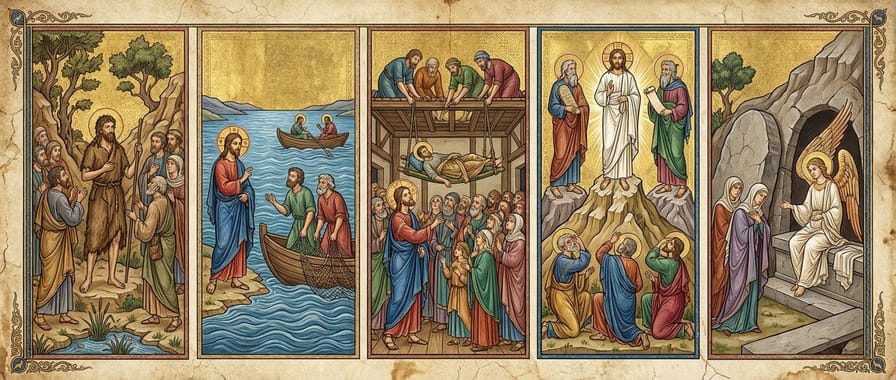
Illustration of the Book of Mark, one of the 27 books of the New Testament (Nano Banana Pro).
This introduction aims to deepen the understanding of the Gospel according to Mark, a text that, despite its conciseness, pulses with the urgency and power of the message of Jesus Christ. As part of a model framework for the analysis of any biblical book, this study proposes to unveil the historical, literary, and theological layers that compose this singular narrative. Adopting a conservative evangelical Protestant perspective, we will defend the inerrancy of the Scriptures and traditional authorship, prioritizing a Christocentric reading that recognizes divine sovereignty in every inspired word.
The book of Mark is not merely a historical record; it is a proclamation of the Son of God, an invitation to radical discipleship, and an exhortation to faith amidst adversity. Its direct language and accelerated pace aim to captivate the reader, compelling them to confront the person and work of Jesus of Nazareth. Throughout this analysis, we will explore the book's original context, its ingenious narrative structure, the theological themes that permeate it, its enduring relevance for the biblical canon and for the church, and the hermeneutical challenges it presents, always with a commitment to a faithful and reverent interpretation of the Word of God.
This Gospel, often considered the earliest and, at times, the most neglected among the Synoptics, offers a privileged window into the identity and mission of Jesus. It confronts us with Christ's authority, the mystery of the Kingdom of God, and the cost of true discipleship. Ultimately, we hope that this introduction will not only inform but also inspire a deeper and more transformative reading of Mark, equipping the reader to apply its eternal truths to contemporary life and faith.
1. Historical Context, Dating, and Authorship
1.1 Traditional Authorship of Mark and Evidence
The authorship of the Gospel that bears his name is traditionally attributed to John Mark, a figure mentioned in several New Testament passages, notably in Acts of the Apostles, Colossians, Philemon, and 2 Timothy. He is identified as a cousin of Barnabas (Colossians 4:10) and a companion of Paul on his first missionary journey (Acts 13:5), although he separated from them in Perga (Acts 13:13), an incident that would later cause a disagreement between Paul and Barnabas (Acts 15:36-40). However, reconciliation is evident, as Paul mentions him favorably in later epistles, asking Timothy to bring him, for "he is useful to me for ministry" (2 Timothy 4:11).
The most crucial evidence for Mark's authorship as the Evangelist comes from Papias of Hierapolis, an early second-century AD bishop, whose writings were preserved by Eusebius of Caesarea. Papias states that "Mark, having become Peter's interpreter, wrote down accurately everything he remembered, though not in order, of what was said or done by the Lord." This statement is fundamental, as it establishes a direct connection between the Gospel and the apostolic preaching of Peter, giving it unquestionable authority and authenticity. Peter, one of Jesus' closest disciples, would have been the primary source of the memories and teachings that Mark diligently recorded.
This tradition is corroborated by other Church Fathers, such as Irenaeus of Lyon, Clement of Alexandria, and Tertullian, who unanimously attribute the Gospel to Mark and his connection with Peter. Irenaeus, for example, states that "after the demise of Peter and Paul in Rome, Mark, the disciple and interpreter of Peter, also handed down to us in writing what Peter had preached." This consistency in patristic testimony, beginning as early as the early second century, provides a solid basis for accepting traditional authorship, challenging modern speculations that seek to detach the Gospel from an eyewitness or his direct interpreter.
1.2 Dating and the Roman Context
The dating of the Gospel of Mark is a topic of academic debate, but the conservative evangelical perspective generally favors an early dating, situated between the mid-50s and the early 60s AD. This temporal window is based on several considerations. Firstly, patristic tradition, again with Irenaeus and Clement of Alexandria, suggests that Mark wrote his Gospel after the deaths of Peter and Paul in Rome, or that he did so while Peter was still alive and preaching in the city. The strongest evidence points to a period when Peter was still active, but with the imminence of his martyrdom, which would motivate the preservation of his preaching.
If Mark was the first of the Synoptic Gospels to be written, as many scholars, including conservatives, argue (the hypothesis of Markan priority), then it must precede Matthew and Luke, who seem to have used Mark as one of their sources. A dating before the destruction of the Jerusalem Temple in 70 AD is widely accepted, even by most critics, due to the absence of any explicit mention of the event, despite Jesus' prophecies concerning its ruin (Mark 13). The absence of references to Nero's persecution of Christians, which began in 64 AD and intensified, also suggests an earlier date, although some argue that the book was written for a community already suffering persecution.
The writing context is widely accepted as Rome, with the primary audience being Gentile Christians, possibly under persecution. There are several internal pieces of evidence that support this view: the explanation of Jewish customs (Mark 7:2-4; 14:12; 15:42), which would be unnecessary for a Jewish audience; the use of transliterated Latin terms (such as centurio in Mark 15:39, quadrans in Mark 12:42, and praetorium in Mark 15:16), which would be more familiar to Roman readers; and the omission of genealogies, which would be of less interest to Gentiles. Furthermore, the emphasis on Jesus' authority and the need for suffering in discipleship would be particularly relevant for a community facing adversity and persecution in the heart of the Roman Empire.
1.3 Response to Criticisms and Reliability
Modern higher criticism, in its methodological skepticism, often challenges the traditional authorship and historicity of the Gospels, including Mark. Critics argue that the Gospel is more a theological construction of the early community than a faithful record of eyewitness testimonies, or that the tradition about Mark and Peter is a later attempt to legitimize the text. The hypothesis of Markan priority, though widely accepted, is sometimes used to suggest that Mark is a "primitive" but not necessarily "accurate" source, subject to theological influences from the community.
However, the evangelical perspective defends the inerrancy and historical reliability of Mark. The defense is based not only on patristic tradition, which is strong and unanimous, but also on the internal coherence of the text and its ability to withstand scrutiny. The idea that Mark was an "interpreter" of Peter suggests that he was not merely a copyist, but someone who translated and organized Peter's preaching for a specific audience, maintaining the substance and truth of the events. The vividness and graphic details of certain passages (such as the description of the Garden of Gethsemane in Mark 14:32-42 or Jesus' emotion in Mark 3:5) are often seen as marks of an eyewitness, transmitted by Peter.
Furthermore, the presence of theological "difficulties" or "embarrassments," such as the apparent incomprehension of the disciples or the "Messianic Secret," paradoxically reinforces the authenticity of the Gospel. If it were a late invention to promote a theological agenda, such elements could have been softened or eliminated. Mark's willingness to present the disciples in such an unflattering light suggests a commitment to the truth, even if it challenges expectations. The sovereignty of God over the inspiration of the Scriptures guarantees that, despite the human process of writing, the final text is divinely authoritative and true.
2. Structure, Division, and Main Content
2.1 The Urgent Narrative and Direct Style
The Gospel of Mark is known for its accelerated pace and direct, almost journalistic, style. The Greek word "εὐθύς" (euthys), frequently translated as "immediately" or "at once," appears about 40 times in the text, imparting a sense of urgency and constant movement. This stylistic characteristic reflects not only Mark's personality but also the haste and intensity of Jesus' mission. The focus is on Jesus' actions, his miracles, and concise teachings, which reveal his divine identity and authority.
Mark omits the narrative of Jesus' birth and begins abruptly with the preparation for ministry, the preaching of John the Baptist, and Jesus' baptism. This direct introduction serves to thrust the reader immediately into the heart of the action. The narrative is vivid, with graphic details that suggest the influence of an eyewitness, such as Peter. The language is simple but powerful, with short, often paratactic sentences (linked by "and"), which contributes to the sense of dynamism. This style is particularly effective for the Roman audience, who valued action and the demonstration of power.
2.2 Main Divisions and Narrative Flow
Mark's structure can be divided into two major geographical and theological sections, centered on Jesus' identity and the meaning of discipleship. The first part (Mark 1:1-8:26) focuses on Jesus' ministry in Galilee, revealing his identity as the Son of God and Messiah through his miracles and teachings. The second part (Mark 8:27-16:8) transitions to Jesus' journey to Jerusalem, emphasizing the way of the cross and the cost of discipleship, culminating in his passion, death, and resurrection.
A crucial turning point occurs in Mark 8:27-30, with Peter's confession at Caesarea Philippi: "You are the Christ." This is the climax of the first part, where Jesus' identity is explicitly recognized, though still poorly understood by the disciples. From there, Jesus begins to predict his passion, death, and resurrection (the "passion predictions": Mark 8:31; 9:31; 10:33-34), shifting the focus from glory and power to suffering and sacrifice. The narrative flow, therefore, is intentional: from the public revelation of Jesus' power to the private revelation of the path of suffering, culminating in the cross as the ultimate point of his mission.
2.3 Synthetic Outline of the Content
A concise outline of the Gospel of Mark can be presented as follows:
- 1. The Prologue and Preparation for Jesus' Ministry (Mark 1:1-13)
- Presentation of Jesus as the Christ, the Son of God.
- The Ministry of John the Baptist and Jesus' Baptism.
- The Temptation of Jesus in the Wilderness.
- 2. Jesus' Ministry in Galilee: Revelation of the Son of God's Power (Mark 1:14-8:26)
- Calling of the First Disciples.
- Teaching with Authority and Exorcisms.
- Healing the Sick and Miracles over Nature.
- Conflicts with Religious Authorities.
- Parables of the Kingdom of God.
- Feeding of the Multitude and Walking on Water.
- Additional Healings and Controversies.
- 3. The Road to Jerusalem: The Cost of Discipleship and the Suffering Servant (Mark 8:27-10:52)
- Peter's Confession at Caesarea Philippi.
- The First Passion Prediction and Teaching on Discipleship (Taking Up the Cross).
- The Transfiguration.
- The Second Passion Prediction and Teaching on Humility.
- The Third Passion Prediction and Teaching on Service.
- The Healing of Blind Bartimaeus.
- 4. Ministry in Jerusalem and the Passion (Mark 11:1-15:47)
- The Triumphal Entry into Jerusalem.
- The Cleansing of the Temple.
- Conflicts with Religious Leaders.
- The Eschatological Discourse (Prophecies about the End Times and the Destruction of the Temple).
- The Anointing at Bethany.
- The Last Supper and the Institution of the Eucharist.
- The Agony in Gethsemane and Jesus' Arrest.
- The Trial Before the Sanhedrin and Pilate.
- The Crucifixion and Death of Jesus.
- The Burial of Jesus.
- 5. The Resurrection (Mark 16:1-8, with notes on 16:9-20)
- The Women at the Empty Tomb.
- The Announcement of the Resurrection.
- The Reaction of Fear and Silence (in the original ending).
3. Central Theological Themes and Purpose
3.1 Christology: Jesus as the Son of God and Suffering Servant
The most prominent and central theological theme in Mark is Christology, the identity of Jesus Christ. From the opening verse, "The beginning of the gospel of Jesus Christ, the Son of God" (Mark 1:1), Mark establishes Jesus' divine nature. This identity is confirmed by the Father's voice at the baptism (Mark 1:11) and the transfiguration (Mark 9:7), by the testimony of demons (Mark 1:24; 3:11; 5:7), and finally, by the confession of the Roman centurion at the cross: "Truly this man was the Son of God!" (Mark 15:39). Jesus demonstrates his divine sonship through his authority over sin (Mark 2:10), over diseases (Mark 1:30-34), over demons (Mark 1:27), and over nature itself (Mark 4:35-41).
However, Mark's Christology is not limited to the demonstration of power. It is equally, if not more, focused on Jesus as the Suffering Servant. This theme is introduced after Peter's confession (Mark 8:29-31) and is reiterated in the three passion predictions. Jesus came not to be served, but to serve and to give his life as a ransom for many (Mark 10:45), a clear allusion to Isaiah 53. The cross is not an accident, but the central purpose of Jesus' coming. The "Messianic Secret," where Jesus forbids people from divulging his identity or his miracles, serves to temper popular expectations of a political Messiah and to reorient the understanding of his mission toward the path of suffering and atonement.
3.2 Discipleship: The Call to Suffering and Service
Intimately linked to the Christology of the Suffering Servant is the theme of discipleship. If Jesus, the Son of God, came to serve and suffer, then his followers are also called to tread the same path. The Gospel of Mark presents Jesus' disciples as flawed figures, who frequently misunderstand their Master's mission, argue about greatness (Mark 9:33-37; 10:35-45), and abandon him in his darkest hour. This realistic representation serves as a mirror for readers, showing that discipleship is not a path of earthly glory, but of self-denial and sacrifice.
Jesus calls his followers to "take up his cross and follow me" (Mark 8:34), a powerful image of self-denial and readiness for suffering and death. True discipleship involves losing one's life for the sake of Christ and the Gospel (Mark 8:35). The emphasis on humility, service to others, and faithfulness amidst persecution is a direct pastoral call to Mark's Roman community, who likely faced the prospect of martyrdom. Reformed theology echoes this call to radical discipleship, emphasizing that saving faith is manifested in obedience and a life of sanctification, even if it entails suffering.
3.3 The Kingdom of God and Jesus' Authority
The Kingdom of God is the central focus of Jesus' preaching in Mark, as in the entire Synoptic tradition. Jesus begins his ministry proclaiming: "The time is fulfilled, and the kingdom of God is at hand; repent and believe in the gospel" (Mark 1:15). The Kingdom is not merely a future concept, but a reality that erupted into history with Jesus' coming. He demonstrates the power of the Kingdom through his healings, exorcisms, and miracles, which are signs of God's victory over evil and sickness.
Jesus' authority is a palpable manifestation of the Kingdom of God. He teaches with an authority that differs from the scribes (Mark 1:22), forgives sins (Mark 2:10), commands demons (Mark 1:27), calms the storm (Mark 4:39), and even raises the dead (Mark 5:41-42). This authority is intrinsic to his identity as the Son of God and is the basis for the proclamation of the Gospel. Mark's purpose, then, is to present Jesus as the sovereign Messiah, whose authority is unquestionable, but whose path to victory passes through the cross. For the persecuted community, this understanding of Jesus' authority, even in his suffering, offered hope and a model of faithfulness.
4. Relevance and Canonical Connections
4.1 Importance in the Canon and Markan Priority
The Gospel of Mark holds fundamental importance within the biblical canon, especially among the Synoptic Gospels. Although traditionally positioned as the second Gospel, most modern scholars, including many evangelicals, adhere to the hypothesis of Markan priority. This theory suggests that Mark was the first of the Synoptic Gospels to be written and served as one of the primary sources for Matthew and Luke. If this hypothesis is correct, Mark is not just a record, but the foundation upon which much of the Gospel narrative was built, making it indispensable for understanding the New Testament testimony about Jesus.
Its conciseness and direct style make it an excellent starting point for anyone wishing to learn about Jesus' life and ministry. It offers a unique and urgent perspective, focusing on Christ's action and power, but also on his path of suffering. As such, it complements the other Gospels, filling out the complete picture of Jesus' person and work. Mark's inclusion in the canon attests to the early church's belief in its divine inspiration and its faithfulness to apostolic testimony, especially that of Peter.
4.2 Typological Connections and a Christocentric Reading
The reading of Mark, like all Scripture, must be intrinsically Christocentric. Although not explicit in Mark with the same frequency as in other books, Jesus' narrative fulfills the expectations and patterns established in the Old Testament. Jesus is presented as the promised Messiah, the Son of God who fulfills the prophecies. His life, ministry, death, and resurrection are the culmination of God's redemptive plan, prefigured in numerous Old Testament typologies.
For example, Jesus as the Suffering Servant is a clear typology from Isaiah 53. His authority over chaos and nature can be seen as a manifestation of divine sovereignty that was revealed in events such as creation and the Exodus deliverance. The Passover, celebrated in the Last Supper, is transfigured by Jesus into a new covenant, where his body and blood become the reality of the redemption prefigured in the Passover lamb. For evangelical theology, every element of Mark's narrative points to Christ as the pinnacle of God's revelation and the only way to salvation. He is the new Adam who obeys where the first failed, and the true Israel who fulfills the covenant.
4.3 Relevance for the Contemporary Church
The Gospel of Mark maintains profound relevance for the contemporary church on several fronts. Firstly, its call to radical discipleship and suffering for Christ is a vital message in a world that often seeks a gospel of prosperity and comfort. Mark reminds Christians that following Jesus involves taking up the cross, denying oneself, and serving others, even if it entails sacrifice. This is a powerful exhortation to faithfulness in contexts of persecution and to integrity in the face of cultural pressures.
Secondly, the emphasis on Jesus' identity as the Son of God and Messiah offers a solid foundation for evangelism and apologetics. Jesus' power over sin, sickness, and demons demonstrates his divine authority and his ability to transform lives. For a church engaged in proclaiming the Gospel, Mark provides a potent and direct narrative of the Savior. Thirdly, the portrayal of the flawed disciples, yet called and used by Jesus, offers hope and encouragement for today's imperfect believers. God's grace operates through imperfect vessels, and growth in discipleship is a continuous process of learning and submission.
Finally, Mark's urgency in proclaiming the Kingdom of God and the imminence of his final coming serves as a reminder to the church of its eschatological mission. The expectation of Christ's return should propel the life and mission of the church, motivating it to live in holiness and to proclaim the Gospel with fervor. The sovereignty of God revealed in Mark assures that the divine plan of redemption will be fulfilled, and the church, as the body of Christ, has a vital role in this eternal design.
5. Hermeneutical Challenges and Critical Issues
5.1 The Problem of Mark's Ending (Mark 16:9-20)
One of the most notable and discussed hermeneutical challenges in the Gospel of Mark is the question of its ending. Most ancient manuscripts end at Mark 16:8, with the women fleeing from the empty tomb, seized with "terror and amazement," and saying nothing to anyone. However, later manuscripts and some translations include the "longer ending" (Mark 16:9-20), which describes appearances of the resurrected Jesus, the Great Commission, and the ascension. The "shorter ending," which is even more concise, also exists in some manuscripts.
The conservative evangelical perspective, while acknowledging the textual evidence suggesting that Mark 16:9-20 probably was not part of Mark's original text, generally maintains that these verses are canonical and divinely inspired. It is argued that, even if they are not from Mark, they may have been added very early in church history to complete the narrative and harmonize it with the other Gospels, and they represent an authentic apostolic tradition. Some commentators suggest that the abrupt ending in Mark 16:8 is intentional, inviting the reader to complete the story with their own faith and proclamation of the resurrection. However, most modern Bibles include footnotes indicating the textual variation, allowing the reader to be aware of the issue without compromising the inerrancy of Scripture as a whole, accepting that the truth of the resurrection is firmly established throughout the canon.
5.2 The Messianic Secret and the Disciples' Misunderstanding
Other interpretive challenges include the phenomenon of the "Messianic Secret" and the persistent misunderstanding of the disciples. The Messianic Secret refers to Jesus' tendency in Mark to silence those who recognize him as Messiah or Son of God (Mark 1:34, 44; 3:12; 8:30), or to order that his miracles not be publicized. Various theories attempt to explain this, ranging from the need to avoid a political uprising against Rome, to Jesus' intention to redefine the concept of Messiah away from popular expectations of a military liberator, focusing on his role as Suffering Servant.
The misunderstanding of the disciples (Mark 4:13; 6:52; 8:17-21; 9:32; 10:32) is another striking feature of Mark. They are portrayed as slow to understand Jesus' parables, unable to grasp the necessity of his suffering, and at times more concerned with their own greatness. For evangelical hermeneutics, these "difficulties" do not diminish the authority of the text, but serve important theological purposes: they highlight the depth and mystery of Jesus' identity, invite the reader to a deeper understanding of discipleship, and underscore God's grace that acts despite human weaknesses. They also authenticate the narrative, showing that the Gospel was not "cleaned up" to present an idealized image of Jesus' first followers.
5.3 Evangelical Response to Skeptical Criticisms and Hermeneutical Principles
The evangelical approach to critical issues and hermeneutical challenges in Mark is guided by a deep trust in the inerrancy and infallibility of the Scriptures. Criticisms that question the historicity of miracles, the veracity of prophecies, or the authenticity of Jesus' words are seen as attempts to undermine the divine authority of the text. The evangelical response affirms that miracles are real events, that Jesus is truly the Son of God, and that the Bible is the inspired Word of God, without error in all that it affirms.
The hermeneutical principles for the correct interpretation of Mark include:
- Literal-Historical-Grammatical Interpretation: Seeks to understand the text in its original meaning, considering the historical context, the literary genre (Gospel as theological biography), and the rules of Greek grammar.
- Christocentric Reading: Recognizes Jesus Christ as the center of God's revelation and interprets each passage in relation to his person and redemptive work.
- Holistic Interpretation or "Scriptura sui ipsius interpres": Allows Scripture to interpret Scripture, seeking clarity in more difficult passages through other clearer passages.
- Recognition of the Sovereignty of God: Understands that God is the ultimate author of Scripture, and that He has faithfully preserved it throughout history, guaranteeing its truthfulness and authority for all generations.
By applying these principles, the contemporary church can approach the complexities of Mark with confidence, extracting its eternal truths and applying them to life and mission. Fidelity to these principles ensures that interpretation does not deviate from the intent of the divine Author, maintaining the integrity of the Gospel message.