


2 Петра
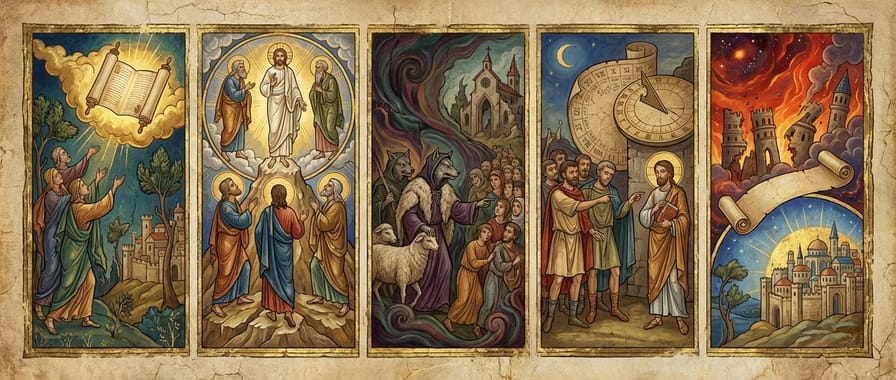
Illustration of the Book of 2 Peter, one of the 27 books of the New Testament (Nano Banana Pro).
The Second Epistle of Peter, often relegated to the background in more superficial biblical studies, emerges, under close and scholarly analysis, as a fundamental pillar of apostolic theology, offering crucial insights for the Christian faith in all ages. Far from being a mere repetition of Pauline themes or a footnote to the New Testament canon, this book presents itself as a prophetic farewell from an experienced apostle, Peter, the fisherman transformed into a shepherd of souls, who, on the verge of his own martyrdom, issues a final and vehement appeal to doctrinal fidelity and practical holiness. His message resonates with an urgency that transcends time, confronting the same threats to truth and conduct that challenge the contemporary church.
This introduction seeks to unfold the layers of meaning and theological depth of 2 Peter from a conservative evangelical Protestant perspective. We will emphasize biblical inerrancy, traditional authorship, and a Christocentric reading, defending the historical positions of the faith against the assaults of modern criticism. More than a simple presentation of the book, this analysis aims to establish a structural model for understanding any book of the Bible, providing a hermeneutical framework that integrates historical context, literary structure, theological themes, canonical connections, and interpretive challenges.
As we delve into 2 Peter, we will be guided by an appreciation of its uniqueness and its indispensable contribution to the fullness of divine revelation. We will see how Peter, with his apostolic authority and his life experience with Christ, weaves a narrative that is simultaneously an exhortation to perseverance in faith, a warning against deception, and a proclamation of the glorious eschatological hope. The epistle, in its conciseness, condenses profound truths about the nature of God, the person of Christ, the authority of the Scriptures, and the destiny of humanity, inviting the reader to an unwavering commitment to revealed truth and a life that reflects the glory of the Lord.
The relevance of 2 Peter for today's believer is undeniable. In a pluralistic and skeptical world, where truth is often relativized and the foundations of faith are constantly questioned, Peter's voice echoes with clarity and authority. He calls us to a deep understanding of the "knowledge" (epignosis) of God and of Jesus Christ, to a sharp discernment to identify and resist "false teachers," and to constant vigilance, motivated by the "expectation" of Christ's second coming. This epistle is not merely a historical document; it is a living and effective word, capable of edifying, correcting, and empowering the church for its mission in the world.
Therefore, this introduction is not merely a gateway to the study of 2 Peter, but a tool for deepening the understanding of the Bible as a whole. Through a systematic and rigorous approach, we will seek to honor the Word of God and equip the reader with the foundations for faithful exegesis and transformative application. May this study lead us to a greater appreciation of the divine wisdom contained in 2 Peter and to a renewed commitment to the truth that liberates and sanctifies.
1. Historical Context, Dating, and Authorship
The Second Epistle of Peter is a document of utmost importance for understanding early Christian faith, particularly concerning its defense against the rise of heresies and the affirmation of eschatological hope. To appreciate it fully, it is imperative to place it in its original context, examining the issues of authorship, dating, and the historical-cultural environment that permeated it. The conservative evangelical perspective firmly upholds traditional Petrine authorship, defending it against the objections of higher criticism.
1.1 The Defense of Peter's Traditional Authorship
The question of the authorship of 2 Peter is one of the most debated in the New Testament, with many modern critics attributing it to a second-century pseudepigraphical writer. However, the traditional evangelical position, which this introduction embraces and defends, is that the epistle was genuinely written by the apostle Simon Peter. The epistle begins with a clear self-identification: "Simon Peter, a servant and apostle of Jesus Christ" (2 Peter 1:1). This is a direct claim of authorship, which, in itself, carries significant weight in the context of ancient literature.
Objections to traditional Petrine authorship often rely on differences in style and vocabulary compared to 1 Peter, as well as on the supposed allusion to already canonized Pauline letters (2 Peter 3:15-16) and a delay in canonical acceptance. However, these objections can be satisfactorily answered. The stylistic variation between 1 Peter and 2 Peter can be explained by various factors, such as the use of a different amanuensis (Silvanus in 1 Peter, perhaps another in 2 Peter), a change in purpose and target audience, or the natural evolution of the writer himself. It is plausible that Peter, an educated man, though not a professional scribe, had access to scribes with different linguistic abilities. Furthermore, the themes and urgency of 2 Peter required a more direct and polemical language than the pastoral and encouraging tone of 1 Peter.
The reference to Paul's epistles does not necessarily imply a fully formed Pauline canon, but rather the recognition that Paul's letters were in circulation and were considered "Scriptures" by Peter, a contemporary. This reflects the apostolic understanding of the divine inspiration of each other's letters. As for canonical acceptance, although some Church Fathers, such as Origen and Eusebius, noted doubts about its authorship, the epistle was eventually accepted by a broad majority and included in the oldest canons, such as the Muratorian Fragment. The early church, despite its caution, recognized the apostolic authority and content of 2 Peter, rejecting the idea of pious pseudonymity, which would be incompatible with the truth and divine inspiration it professes.
1.2 Dating and the Roman-Jewish Context
Assuming Petrine authorship, the most probable dating for 2 Peter is in the latter part of the apostle's life, likely between 64 and 68 A.D., shortly before his martyrdom in Rome. Peter alludes to his imminent death, referring to it as the "laying aside of this tent of mine" (2 Peter 1:14), language that suggests an awareness that his time was running out. This period coincides with the height of Nero's persecution of Christians in Rome, which began after the great fire of 64 A.D. and would culminate in the execution of Peter and Paul.
The historical-cultural context is that of the Roman Empire, where Christianity was spreading but also facing growing external hostility and internal challenges. The epistle is addressed to believers who had already received "a faith of equal standing" (2 Peter 1:1), likely communities scattered throughout Asia Minor, perhaps the same ones to whom 1 Peter was written. The Greco-Roman world was a melting pot of philosophies, religions, and cults, and Christianity stood out for its exclusivity and ethical demands. In this scenario, the early church was under pressure to conform or to defend its identity.
1.3 Response to Criticisms and Evidence for Authorship
Modern criticisms often argue that 2 Peter is anachronistic, addressing problems that would only emerge in a later phase of the church, such as developed Gnosticism or the issue of the delay of the Parousia. However, it is important to note that the seeds of Gnosticism and other Gnostic heresies were already present in first-century Jewish and Hellenistic circles. Peter is not combating fully developed second-century Gnosticism, but rather precursors or proto-Gnostics, or even libertines who denied apostolic authority and lived immorally, distorting grace.
The internal evidence supporting Petrine authorship is robust. Beyond the explicit self-identification, Peter refers to himself as an eyewitness to Christ's "majesty" at the Transfiguration (2 Peter 1:16-18), an event that only an intimate circle of apostles witnessed and that Peter narrates with vivid detail. He also mentions the "first letter" (2 Peter 3:1), establishing a clear connection with 1 Peter. The expectation of his imminent death (2 Peter 1:14) and the reference to Jesus' prophecy about his martyrdom (John 21:18-19) corroborate the apostle's authorship.
External evidence, though initially more complex, eventually solidified the acceptance of 2 Peter. Church Fathers such as Clement of Alexandria and Origen cited the epistle. Although Eusebius classified it as one of the "disputed books," he also noted that it was "acknowledged by most." By the fourth century, the epistle was widely accepted in the West and the East, and its inclusion in the major ancient canons, such as Athanasius' and the Council of Carthage, sealed its status as inspired Scripture. The church's persistence in accepting 2 Peter, despite some initial reservations, demonstrates confidence in its apostolic origin and divinely inspired content, a testimony that conservative evangelical theology finds compelling.
2. Structure, Division, and Main Content
The Second Epistle of Peter, though brief, possesses a logical structure and argumentative flow that reveal its nature as an apostolic "testament" or "farewell discourse." Classified as an epistle, it is distinguished by its strong emphasis on polemics against false teachers and on parenesis (exhortation) to perseverance in faith and eschatological hope. Understanding its literary organization is key to unlocking its central message.
2.1 Literary Organization and Epistolary Genre
2 Peter is a letter, a common literary genre in the New Testament, but with characteristics that make it unique. It is not a letter of introduction or systematic doctrinal teaching, like Romans, but rather an urgent communication from an apostle who senses the end of his life approaching. It is, in many respects, a final spiritual testament, a last farewell, and a solemn warning to the community of faith. The tone is direct, at times severe, and the language is rich in vivid imagery and prophetic references.
The epistolary genre allows Peter to directly address the problems the churches were facing: the internal threat of false teachers and the issue of the delay of the Parousia. Instead of a systematic exposition, Peter offers a series of exhortations, warnings, and reminders, all with the aim of strengthening believers in their faith and preparing them for future challenges. The epistle is characterized by its fluidity, moving between exhortation to piety, denunciation of apostasy, and reaffirmation of eschatological hope.
2.2 Main Divisions and Their Characteristics
The epistle can be divided into three main sections, each with a distinct focus, but interconnected by a common purpose: the defense of truth and the exhortation to holiness.
1. Introduction and Exhortation to Spiritual Growth (1:1-21): This initial section establishes the foundation of the Christian life. It begins with a formal greeting (1:1-2) and immediately moves to the affirmation of divine grace that provides everything for life and godliness (1:3-4). Peter exhorts believers to develop a set of virtues (faith, virtue, knowledge, self-control, perseverance, godliness, brotherly kindness, love - 1:5-7), thereby ensuring a "rich and abundant" entrance into the Kingdom of Christ (1:8-11). He emphasizes the importance of remembering these truths (1:12-15) and grounds the certainty of faith in the authority of apostolic eyewitness testimony (the Transfiguration - 1:16-18) and the prophetic Word (1:19-21), which is sure and divinely inspired. This section serves as a theological and ethical foundation for what is to come.
2. Warning and Denunciation of False Teachers (2:1-22): This is the most polemical section of the epistle, with a notable parallel to the Epistle of Jude. Peter vehemently warns about the "invasion" of "false prophets" and "false teachers" who will introduce "destructive heresies" (2:1). He describes the nature and behavior of these individuals: they deny the Lord who bought them, are driven by greed, exploit believers, despise authorities, and live in depravity (2:2-3, 10-14). Peter illustrates the certainty of divine judgment upon them with historical examples (sinning angels, the flood, Sodom and Gomorrah - 2:4-9), emphasizing that God knows how to "rescue the godly from trials and to hold the unrighteous for punishment on the Day of Judgment" (2:9). The section culminates with a description of the worst condition of these teachers: those who, having escaped the world's corruption, are again entangled and overcome, becoming worse than before (2:15-22).
3. The Certainty of the Second Coming and Exhortation to Holiness (3:1-18): The final section addresses the issue of the delay of the Parousia and its implications. Peter reminds believers of his previous exhortations and of the prophecies of the holy prophets and the command of the Lord and Savior, delivered by the apostles (3:1-2). He then confronts the "scoffers" who mock the promise of Christ's coming, asking where is the "promise of His coming?" (3:3-4). Peter refutes these skeptics by pointing to creation and past judgment (the flood - 3:5-7), reminding them that "with the Lord one day is as a thousand years, and a thousand years as one day" (3:8). The delay is not negligence, but rather divine patience, so that "none should perish, but that all should reach repentance" (3:9). He vividly describes the "Day of the Lord" that will come like a thief, with the destruction of the heavens and earth by fire (3:10-12), and the promise of "new heavens and a new earth, in which righteousness dwells" (3:13). The epistle concludes with a practical exhortation to holiness and vigilance (3:14-17) and an encouragement to grow "in the grace and knowledge of our Lord and Savior Jesus Christ" (3:18).
2.3 Synthetic Outline of Content
A concise outline of 2 Peter can be presented as follows:
Greeting and Foundation of the Christian Life (1:1-11)
Apostolic Greeting (1:1-2)
Divine Provision for Godliness (1:3-4)
The Development of Christian Virtues (1:5-7)
The Certainty of Entrance into the Kingdom (1:8-11)
The Authority of the Prophetic Word and Apostolic Witness (1:12-21)
Peter's Purpose to Remind Believers (1:12-15)
The Authenticity of the Apostolic Message (1:16-18)
The Inerrancy of the Prophetic Word (1:19-21)
The Threat and Judgment of False Teachers (2:1-22)
The Warning Against False Teachers (2:1-3a)
Historical Examples of Divine Judgment (2:3b-10a)
The Description and Condemnation of False Teachers (2:10b-19)
Apostasy and Its Destiny (2:20-22)
The Certainty of the Parousia and Exhortation to Holiness (3:1-18)
The Letter's Purpose: Remembrance (3:1-2)
The Refutation of the Scoffers of the Parousia (3:3-7)
God's Patience and the Certainty of the Day of the Lord (3:8-10)
The Hope of the New Heavens and New Earth (3:11-13)
Final Exhortations to Holiness and Growth (3:14-18)
This outline demonstrates Peter's argumentative flow, which moves from the affirmation of fundamental truths of faith to the denunciation of dangers threatening it, culminating in the reaffirmation of eschatological hope as the primary motivator for a life of godliness. The epistle is, therefore, a masterpiece of practical theology and pastoral polemics.
3. Central Theological Themes and Purpose
The Second Epistle of Peter is a treasure trove of theological teachings, condensing into its few pages essential doctrines that form the backbone of the Christian faith. Its theological depth, combined with an urgent practical application, reveals the apostle's primary purpose for his original audience and, by extension, for the church of all generations. The conservative evangelical Protestant perspective highlights the sovereignty of God, the authority of the Scriptures, and the centrality of Christ in these themes.
3.1 The Knowledge (epignosis) of God and of Christ
One of the most prominent themes in 2 Peter is the "knowledge" (in Greek, epignosis) of God and of Jesus Christ. Peter begins the epistle with "May grace and peace be multiplied to you in the full knowledge [epignosis] of God and of Jesus our Lord" (2 Peter 1:2). He reiterates the importance of this knowledge throughout the letter, exhorting believers to grow "in the grace and knowledge of our Lord and Savior Jesus Christ" (2 Peter 3:18).
This epignosis is not merely an intellectual or cognitive knowledge, but an experiential, profound, and transformative knowledge. It is an intimate and personal relationship with God and with Christ, which results in life change and the production of Christian virtues. Peter argues that Christ's "divine power" "has granted to us all things that pertain to life and godliness, through the knowledge [epignosis] of him who called us by his own glory and virtue" (2 Peter 1:3). Without this true knowledge, individuals are spiritually blind and ineffective (2 Peter 1:9). False teachers, in contrast, are characterized by a superficial or distorted "knowledge," which leads them to perdition (2 Peter 2:20-22).
From the perspective of Reformed systematic theology, epignosis is intrinsically linked to regeneration and progressive sanctification. It is through the Holy Spirit that this knowledge is communicated and deepened, leading the believer to participate in the "divine nature" (2 Peter 1:4). Peter's emphasis on the need to "add" virtues to faith (2 Peter 1:5-7) highlights human responsibility in the process of sanctification, which is nonetheless empowered by God's sovereign grace. It is a knowledge that not only informs the mind but transforms the heart and conduct.
3.2 The Authenticity and Authority of the Prophetic Word
Another central theme is the vehement defense of the authenticity and authority of the prophetic Word, that is, the Scriptures. In an era when truth was attacked by mockers and false teachers, Peter reaffirms the divine origin of revelation. He bases his apostolic authority not on "cleverly devised myths," but on his eyewitness testimony to Christ's majesty at the Transfiguration (2 Peter 1:16-18). However, he elevates the written Word to an even higher plane:
"And we have the prophetic word more fully confirmed, to which you will do well to pay attention as to a lamp shining in a dark place, until the day dawns and the morning star rises in your hearts, knowing this first of all, that no prophecy of Scripture comes from someone's own interpretation; for no prophecy was ever produced by the will of man, but men spoke from God as they were carried along by the Holy Spirit" (2 Peter 1:19-21).
This is one of the most important texts in the Bible on the verbal and plenary inspiration of the Scriptures. Peter affirms that the Bible is not the product of human intellect, but rather the Word of God, breathed out by the Holy Spirit through human instruments. This establishes the inerrancy and infallibility of the Scriptures as the unshakable foundation for Christian faith and life. The prophetic Word is the "lamp" that guides believers in darkness, and its authority is superior even to the most sublime personal experiences, such as the Transfiguration. This doctrine is a pillar of Reformed theology, which upholds Sola Scriptura as the sole infallible rule of faith and practice.
3.3 The Reality and Judgment of False Teachers
The denunciation and condemnation of false teachers constitute the most extensive and intense part of 2 Peter (chapter 2). Peter does not hesitate to expose the perverse nature and inevitable destiny of those who distort the truth and seduce believers. He describes them with strong terms: "false prophets," "false teachers," "destructive heresies," "greed," "deceptive words," "despise authority," "bold," "arrogant," "blasphemers" (2 Peter 2:1-12). Their teachings are "cleverly devised myths" (2 Peter 1:16), and their lives are characterized by immorality and the pursuit of personal gain (2 Peter 2:3, 13-14).
Peter's purpose in detailing the nature of these teachers is twofold: first, to warn the church of the imminent danger, and second, to assure believers that God's judgment on them is certain and inevitable. He uses Old Testament examples – the angels who sinned, the flood, Sodom and Gomorrah (2 Peter 2:4-9) – to demonstrate the consistency of the divine character in punishing ungodliness. The message is clear: God is just and will not tolerate sin and heresy. This theme connects with the doctrine of the holiness of God and divine justice, which demand retribution for sin. Reformed theology, with its emphasis on man's total depravity and God's sovereignty over judgment, finds strong validation in 2 Peter.
3.4 The Certainty of Christ's Second Coming and the New Heaven and New Earth
The eschatology of 2 Peter is a theme of profound importance, especially because the epistle directly addresses the issue of the delay of the Parousia (the second coming of Christ). Peter confronts the "scoffers" who mock the promise of Christ's coming, saying: "Where is the promise of his coming? For ever since the fathers fell asleep, all things are continuing as they were from the beginning of creation" (2 Peter 3:3-4). Peter's response is multifaceted and theologically rich.
First, he reminds them that God's apparent delay is not slackness, but rather patience, giving time for more people to come to repentance (2 Peter 3:9). This is a powerful affirmation of God's mercy and His desire for salvation. Second, he reaffirms the certainty of the "Day of the Lord," which will come "like a thief," a catastrophic event that will involve the destruction of the heavens and earth by fire (2 Peter 3:10-12). This apocalyptic description is not to incite fear, but to motivate a life of holiness and godliness.
Third, Peter points to the glorious hope of "new heavens and a new earth, in which righteousness dwells" (2 Peter 3:13). This is the consummation of the history of redemption, the complete restoration of creation, and the establishment of God's eternal kingdom. This eschatological vision is a powerful motivator for the Christian life, impelling believers to live "holy and godly" lives, awaiting and hastening the coming of the Day of God (2 Peter 3:11-12). Reformed theology values eschatological hope as a vital element of faith, which shapes the ethics and mission of the church, always with eyes fixed on the glory of Christ and the consummation of His Kingdom.
3.5 Primary Purpose of the Book
In summary, the primary purpose of 2 Peter is threefold: 1) To exhort believers to grow in faith and in the knowledge of Christ, developing virtues that ensure their entrance into the eternal Kingdom. 2) To warn and protect the church against false teachers and their destructive heresies, exposing their nature, their doctrines, and their inevitable judgment. 3) To reaffirm the certainty of Christ's second coming and the hope of the new heavens and new earth, encouraging perseverance in holiness and vigilance while awaiting the consummation of all things. Peter, acting as a faithful shepherd, seeks to solidify the faith of his readers, equipping them with the truth to discern error and with the hope to persevere to the end.
4. Relevance and Canonical Connections
The Second Epistle of Peter, despite its brevity, occupies an irreplaceable place in the biblical canon, offering unique and essential perspectives for understanding the Christian faith. Its relevance transcends the original circumstances of its writing, echoing with power and depth for the contemporary church. The canonical connections it establishes reinforce its authority and its interconnectedness with the rest of divine revelation, particularly through a Christocentric reading.
4.1 Importance of the Book within the Complete Canon
2 Peter serves as a crucial link in the chain of apostolic revelation. As one of the last New Testament writings, likely from a first-generation apostle, it offers a bridge between the founding of the church and the challenges that would arise in subsequent generations. Its inclusion in the canon is a testament to divine wisdom, which foresaw the need for an apostolic voice to combat internal heresies and strengthen faith amidst the waiting for the Parousia.
The book reinforces the unity of the biblical message by echoing themes of judgment and redemption present since the Old Testament. It validates the authority of other Scriptures, notably Paul's epistles, and serves as a manual for the defense of the faith (apologetics) against attacks on truth and morality. In a canon that spans from creation to consummation, 2 Peter firmly positions itself in eschatology, pointing to the glorious future and motivating holiness in the present.
4.2 Typological Connections and the Christocentric Reading
Although 2 Peter is not an Old Testament book with direct typologies in the prophetic sense, its theology is profoundly Christocentric. The figure of Jesus Christ is central to Peter's message, being "our Lord and Savior" (2 Peter 1:1, 11; 2:20; 3:18). The "knowledge" Peter so strongly exhorts to seek is the knowledge of Christ (2 Peter 1:2, 3, 8; 3:18), and it is through His "divine power and glory" that believers receive everything for life and godliness (2 Peter 1:3).
The Transfiguration, which Peter witnessed and vividly describes (2 Peter 1:16-18), is an event that prefigures Christ's future glory at His second coming, connecting Christ's present majesty with His eschatological manifestation. The "prophetic word" itself (2 Peter 1:19), which Peter exalts, finds its fulfillment and climax in Christ. The "new heavens and new earth" (2 Peter 3:13) are the setting of Christ's Kingdom, where righteousness dwells. Thus, the entire epistle, whether in the exhortation to spiritual growth, the denunciation of false teachers, or the proclamation of future hope, revolves around the person and work of Jesus Christ, the promised Messiah and the coming Lord.
4.3 Quotations, Allusions, and Parallels in Other Biblical Books
The connections of 2 Peter with other biblical books are notable and multifaceted:
With 1 Peter: The epistle makes an explicit reference to the "first letter" (2 Peter 3:1), confirming the continuity of authorship and message. Both letters address themes of suffering, hope, holiness, and the importance of the Word of God.
With Jude: Chapter 2 of 2 Peter has striking parallels with the Epistle of Jude, to the point of suggesting a literary relationship. The descriptions of false teachers, their vices, and divine judgment are almost identical. The question of which book influenced the other, or if both drew upon a common source, is an academic debate. However, the fact that two independent apostolic epistles address the same problems with the same urgency reinforces the seriousness of the heretical threat in the early church and the unity of apostolic witness.
With the Pauline Epistles: Peter's reference to Paul's letters (2 Peter 3:15-16) is of paramount canonical importance. He not only recognizes the authority of Paul's letters, calling them "Scriptures" (the same term used for the Old Testament), but also warns against their distortion. This demonstrates the apostles' awareness of the divine inspiration of each other's writings and the beginning of the formation of the New Testament canon. It confirms the theological harmony between Peter and Paul, despite their ministerial differences.
With the Synoptic Gospels: Peter's description of the Transfiguration (2 Peter 1:16-18) is a direct apostolic witness to the events narrated in Matthew 17:1-8, Mark 9:2-8, and Luke 9:28-36, lending authenticity and authority to his message.
With the Old Testament: Peter makes allusions and quotations from the Old Testament, such as the examples of divine judgment (fallen angels, the flood, Sodom and Gomorrah) and Isaiah's prophecy about the new heavens and new earth (Isaiah 65:17; 66:22). This demonstrates the continuity of divine revelation and the Old Testament basis for Christian eschatological hope.
4.4 Relevance for the Contemporary Church
The message of 2 Peter is surprisingly relevant for the church in the 21st century. In a postmodern world, where truth is often seen as relative and morality is subjective, Peter's emphasis on the objective truth of God's Word and the need for a genuine "knowledge" of Christ is vital. Today's church faces challenges similar to those of Peter's time:
Threats of false teachings: Proliferation of heresies, religious syncretism, theologies that distort grace, promote antinomianism, or deny biblical authority. 2 Peter offers a model for discerning and combating these errors.
Moral relativism: Contemporary culture challenges Christian ethical norms. Peter's exhortation to holiness and purity of life, in contrast to the depravity of false teachers, is a call to ethical fidelity.
Skepticism regarding the second coming: Many within and outside the church question the reality or imminence of Christ's return. Peter's response to the "scoffers" reaffirms the certainty of the Parousia and God's patience, motivating the church to live in vigilance and hope.
Need for spiritual growth: The exhortation to "grow in grace and in the knowledge" of Christ is a constant reminder of the importance of progressive sanctification and the development of Christian virtues. In an era of nominal Christianity, Peter calls for genuine and transformative discipleship.
2 Peter, therefore, is not merely a historical document, but a prophetic word for the church today, equipping it to navigate spiritual and cultural challenges, standing firm in the truth of the Gospel and living in holy expectation of the Lord's return.
5. Hermeneutical Challenges and Critical Issues
The Second Epistle of Peter, like any biblical text, presents hermeneutical challenges and has been the subject of various critical issues throughout the history of the church and academia. A faithful evangelical approach does not shy away from these difficulties but confronts them with intellectual rigor and commitment to the inerrancy and authority of Scripture, seeking answers that honor divine revelation.
5.1 Specific Interpretive Difficulties of the Book
Some passages and concepts in 2 Peter require careful interpretation:
The "participation in the divine nature" (2 Peter 1:4): This phrase has been misinterpreted in contexts that suggest a deification of the believer, a concept foreign to Reformed theology. The correct interpretation understands that, through union with Christ and the power of the Holy Spirit, believers are transformed into the image of God, reflecting His moral and ethical attributes, without, however, becoming deities. It is a participation in God's holiness and righteousness, not in His ontological essence.
The relationship with the Epistle of Jude: The remarkable similarity between 2 Peter chapter 2 and Jude is a significant exegetical challenge. Which came first? Did one quote the other, or did both rely on a common source, perhaps an oral tradition or a written document about false teachers? While most modern scholars suggest that 2 Peter used Jude, the evangelical position does not require one to have preceded the other. It is equally plausible that both apostles were aware of the same problems and used similar language and examples, or that Peter, as an apostle, had the prerogative to adapt or quote existing material for his own purpose. The important thing is that both books are inspired by God and carry apostolic authority.
The reference to Paul's letters as "Scriptures" (2 Peter 3:15-16): This passage is crucial for bibliology, as it indicates that, already in Peter's time, Paul's letters were recognized as divinely inspired and placed on the same level as the Old Testament Scriptures. The difficulty lies in understanding what Peter meant by "all his letters" – whether he referred to an already complete corpus or only to the letters that were in circulation. In any case, Peter's affirmation validates the apostolic authority and inspiration of the Pauline epistles.
The nature of the "new heavens and new earth" (2 Peter 3:13): There is an eschatological debate about whether the new creation will be a radical renovation of the existing creation (continuity) or a completely new creation (discontinuity). Peter's language about the dissolution of the heavens and earth by fire suggests a profound transformation, but Reformed theology generally sees a renewal and purification of the existing creation, not its total annihilation, in line with other biblical passages (Romans 8:19-23; Revelation 21:1).
5.2 Issues of Literary Genre and Cultural Context
The genre of 2 Peter is epistolary, but with a strong tone of testament or farewell discourse, common in Greco-Roman and Jewish literature. This means that Peter is conveying his final instructions and warnings, with the authority of someone who is about to depart. The cultural context was a Hellenized world, where religious syncretism and incipient Gnostic philosophies were common. Peter's language, at times, reflects this reality, using terms that would resonate with his audience, while at the same time confronting them with the truth of the Gospel.
The epistle also has a strong polemical character, which explains Peter's blunt language against false teachers. He is not seeking an ecumenical dialogue, but rather the protection of the truth and purity of the church. The context of imminent persecution (Nero) also adds a layer of urgency to his exhortation to perseverance and holiness.
5.3 Apparent Ethical or Theological Problems
The main ethical issue that may arise from reading 2 Peter is Peter's use of apparently "harsh" or "intolerant" language regarding false teachers. Describing them as "waterless springs and mists driven by a storm, for whom the gloom of utter darkness has been reserved" (2 Peter 2:17) may seem devoid of "Christian love" to some. However, from an evangelical perspective, the defense of truth and the protection of Christ's flock against ravenous wolves are acts of love and pastoral responsibility. Tolerance of heresy is not a virtue, but negligence. Peter, as an apostle, had the responsibility to guard the deposit of faith and to warn believers against those who sought to lead them astray to perdition. God's wrath against sin and ungodliness is a fundamental biblical doctrine, and Peter expounds it with clarity.
5.4 Faithful Evangelical Response to Skeptical Criticisms
The most persistent and significant criticism against 2 Peter is the issue of pseudonymity. Many modern scholars argue that the book was written by an author different from Peter, using his name to confer authority on the message. The bases for this criticism include:
Stylistic and vocabulary differences: Supposed distinctions between 1 Peter and 2 Peter.
Allusion to Paul as "Scripture": It is argued that this would be anachronistic for Peter's time.
Delay in canonical acceptance: Some initial doubts on the part of certain Church Fathers.
"Later" themes: Addressing issues such as the delay of the Parousia and proto-Gnosticism that, according to some, only developed after Peter's death.
The conservative evangelical response to these criticisms is robust:
Style and vocabulary: Differences can be explained by the use of a different amanuensis (which was common at the time), by a change in purpose or audience, or by the natural evolution of the author's writing. Peter was an educated man, and his ability to use different styles and vocabularies should not be underestimated.
Allusion to Paul: As contemporaries, Peter was aware of Paul's letters. The recognition of his letters as "Scripture" does not require a complete canon to have been formed, but rather that these letters were already considered inspired and authoritative by other apostles and churches. This is a testimony to immediate inspiration and mutual apostolic recognition.
Canonical acceptance: The initial doubts reflect the early church's caution in accepting new writings, which is a sign of its rigorous approach to the canon. However, the eventual and widespread acceptance of 2 Peter demonstrates that the church, after careful examination, recognized its authenticity and apostolic authority. The idea of "pious pseudonymity" is ethically incompatible with the nature of inspired and inerrant Scripture, as it would imply that God used a deception to reveal the truth.
"Later" themes: The seeds of heresies (proto-Gnosticism, antinomianism, eschatological skepticism) were already present in the apostolic era. Peter, with his prophetic and apostolic insight, was addressing emerging problems that would, in fact, intensify later. This does not make the book anachronistic, but rather prophetic and preventative.
The evangelical position affirms the integrity and authenticity of 2 Peter as a genuinely apostolic, divinely inspired, and inerrant document.
5.5 Hermeneutical Principles for Correct Interpretation
For a correct interpretation of 2 Peter, the following hermeneutical principles are essential:
Grammatical-Historical Interpretation: Understanding the meaning of the text in its linguistic (Koine Greek), historical, cultural, and literary context. This involves researching the meaning of words, sentence structure, and the original author's purpose for their original audience.
Canonical Context: Interpreting 2 Peter in light of the entire biblical canon, recognizing its theological coherence and unity. This includes its connections with 1 Peter, Jude, the Pauline writings, and the Old Testament.
Christocentric Reading: Recognizing that all Scripture points to Jesus Christ. Although 2 Peter is an epistle, its themes of knowledge, salvation, holiness, judgment, and eschatological hope are intrinsically linked to the person and work of Christ.
Recognition of Literary Genre: Understanding that, as an epistle with testamentary and polemical tones, it should be read with the awareness that Peter is exhorting, warning, and teaching with apostolic authority.
Theological and Practical Application: After careful exegesis, apply the truths of 2 Peter to the life of the contemporary church and believer, seeking transformation and faithfulness to the Gospel. The warnings against false teachers and the exhortation to holiness are always relevant.
By applying these principles, the church can extract the theological richness and practical relevance of 2 Peter, remaining firm in the truth and growing in the grace and knowledge of our Lord and Savior Jesus Christ.