


Песнь Песней
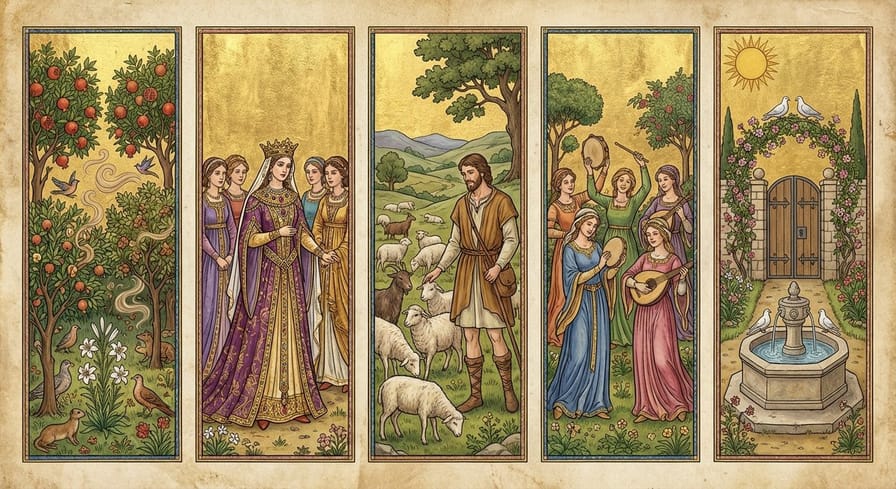
Illustration of the Book of Song of Solomon, one of the 39 books of the Old Testament (Nano Banana Pro).
The book of Canticles, often designated as Song of Songs or Song of Solomon, represents one of the most singular and, at times, challenging jewels of the Old Testament canon. Its inclusion in Holy Scripture has provoked centuries of debate and contemplation, from Jewish rabbis to the church fathers and Reformed theologians. Far from being an anomaly or a piece of secular literature mistakenly inserted, Canticles is, from a conservative evangelical Protestant perspective, a divinely inspired revelation that offers profound truths about human and divine love.
This poetic volume, rich in vivid imagery, sensual metaphors, and passionate dialogues, celebrates the beauty and purity of romantic and sexual love within the bounds of marriage. However, its message transcends the mere exaltation of human affection; it points to higher spiritual realities, serving as a type of the intimate and unbreakable relationship between Christ and His Church. This introduction aims to unveil the layers of this enigmatic book, establishing a framework of analysis that can be applied to any biblical book, while defending its inerrancy, traditional authorship, and its Christocentric relevance for contemporary faith and practice.
We will approach Canticles with reverence and academic rigor, guided by the conviction that "All Scripture is God-breathed and is useful for teaching, rebuking, correcting and training in righteousness" (2 Timothy 3:16). Our analysis will seek to balance theological erudition with pastoral accessibility, recognizing that the Word of God is both an object of intellectual study and a source of spiritual nourishment for the soul. Ultimately, we hope that the reader will understand not only the complexity and beauty of Canticles, but also its profound contribution to biblical theology and the Christian life.
1. Historical Context, Dating, and Authorship
The question of the authorship, dating, and historical context of Canticles is fundamental for a solid hermeneutical understanding. Jewish and Christian tradition, for millennia, has attributed the authorship of the book to Solomon, son of David and king of Israel. This position is robustly supported by internal evidence and by consistency with the monarch's wisdom and literary style.
The book's title, Song of Songs 1:1, explicitly declares: "The Song of Songs, which is Solomon's." The Hebrew preposition "לְ" (le) can mean "of," "to," "about," or "belonging to." While not an unequivocal declaration of authorship in the modern sense, tradition has consistently interpreted it as an indication that Solomon was the author. This attribution is reinforced by other references to Solomon within the text (e.g., Song of Songs 3:7, 9, 11; 8:11-12), suggesting that he is both the subject and the possible author.
1.1 Solomonic Authorship and Internal Evidence
The internal evidence favoring Solomonic authorship is substantial. First, the text demonstrates an encyclopedic knowledge of the flora and fauna of the region of Israel and the Near East, something that aligns with Solomon's reputation as a man of vast wisdom and naturalistic knowledge (1 Kings 4:33). Approximately 21 types of plants and 15 types of animals are mentioned, many of which are specific to the geographical region of ancient Palestine.
Second, geographical references span various localities, from Lebanon to En-Gedi and Tirzah, indicating extensive knowledge of the territory that was part of Solomon's unified kingdom. Third, the luxury and wealth described in the book (e.g., chariots, gold, ivory, cedars of Lebanon) are consistent with the opulence of Solomon's reign, a period of great prosperity in Israel.
Fourth, the literary style and poetic wisdom reflect Solomon's literary capacity, to whom 3,000 proverbs and 1,005 songs are attributed (1 Kings 4:32). Song of Songs, as "the song of songs" (a Hebrew superlative meaning "the most excellent of songs"), fits perfectly the profile of an author with such prolificacy and poetic mastery.
1.2 Period of Writing and Ancient Near Eastern Context
Assuming Solomonic authorship, the dating of the book would be the 10th century B.C., during the zenith of the United Kingdom of Israel (c. 970-931 B.C.). This was a period of unprecedented peace and prosperity, which would provide an appropriate backdrop for the celebration of love and life, free from the concerns of war or oppression that would characterize later eras.
The cultural context of the Ancient Near East is crucial for understanding Song of Songs. Love poetry and nuptial songs were common in civilizations such as Egypt and Mesopotamia. Although there are thematic and stylistic parallels, Song of Songs distinguishes itself by its monotheistic morality and by the celebration of conjugal love within a divinely ordained structure, in contrast to the polygamous and, at times, promiscuous love literature of other cultures.
Israelite society of the time, although it allowed polygamy in actual practice, idealized monogamous marriage and sexual purity (e.g., Genesis 2:24). Song of Songs, therefore, can be seen as a reaffirmation of this divine ideal amidst a culture that often deviated from it.
1.3 Response to Modern Academic Criticisms
Modern higher criticism has largely challenged Solomonic authorship and early dating. Some scholars suggest that Song of Songs is a collection of popular love songs, from different authors and periods, compiled much later, perhaps during the post-exilic or Hellenistic period. Arguments for this include supposed inconsistencies in the plot, the presence of Aramaicisms (though few and debatable), and the absence of explicit references to the Law or to God, which is unusual for a biblical book.
However, the conservative evangelical perspective defends Solomonic authorship against these criticisms. The "inconsistencies" can be explained by the poetic and non-linear nature of the literary genre, or by the dramatic interpretation of the book. The Aramaicisms can be understood as part of the royal dialect or as a natural development of the Hebrew language, even in the Solomonic period, given the vast international influence of the kingdom.
The absence of God's name is notable, but not unprecedented (see the book of Esther). It may be a deliberate choice to focus on the beauty of human love as a reflection of creation, without diminishing the sacredness of the text. Furthermore, Jewish tradition, which was extremely careful with the inclusion of texts in the canon, accepted Song of Songs as canonical, attributing it to Solomon, which lends significant weight to the traditional position.
The defense of Solomonic authorship and 10th-century B.C. dating is not merely a matter of tradition, but of a coherent interpretation of internal and external evidence, which respects the integrity of Scripture and its historical transmission. This allows us to understand Song of Songs as an integral part of Solomonic wisdom, offering a divinely inspired perspective on love and marriage from the earliest days of the Israelite monarchy.
2. Structure, Division, and Main Content
The structure of Song of Songs is one of the most debated aspects of the book, with various organizational proposals. Some see it as a drama with a linear plot, others as an anthology of independent love poems, and still others as a unified lyrical poem without a strict narrative. The conservative evangelical perspective tends to favor an interpretation that recognizes a thematic unity and a progression in the relationship of the lovers, even if it is not a drama in the modern Western sense.
The main literary genre of Song of Songs is lyrical poetry. It is a collection of love songs, dialogues, monologues, and poetic descriptions. The absence of an explicit narrator or clear scene markers contributes to the difficulty in delineating a rigid structure. However, it is possible to identify a flow of emotional and relational development between the two main characters: the King (Solomon) and the Shulammite (the bride/wife), with the participation of a chorus (the "daughters of Jerusalem").
2.1 Literary Organization: Lyrical Poetry and Drama
Although not a drama in the conventional theatrical sense, Song of Songs possesses dramatic elements, including distinct characters, dialogues, and a progression of events that mirror the phases of love: courtship, marriage, and married life. The language is rich in sensory imagery, nature metaphors, and vivid comparisons, characteristic of Hebrew poetry.
The repetition of refrains (e.g., "Do not arouse or awaken love until it so desires," Song of Songs 2:7; 3:5; 8:4) and the structure of "descriptions" or wasfs (poems that describe the physical beauty of the beloved) are striking stylistic elements. The alternation between the voices of the Beloved (the king), the Bride (the Shulammite), and the chorus (the daughters of Jerusalem) creates an engaging dynamic that invites the reader to participate in the experience of love.
2.2 Main Divisions and Narrative Flow
Despite the poetic fluidity, many scholars propose a division that reflects the development of the relationship. A common structure, though not universally accepted, can be seen as follows:
- I. The Courtship and Mutual Longing (Song of Songs 1:2-3:5): This section expresses the ardent desire of the lovers for each other before marriage. The Shulammite longs for her beloved, and he praises her. There is a sense of seeking and discovery, with the beloved expressing her love and purity, and the beloved responding with admiration and promises. The famous verse "I am my beloved's, and my beloved is mine" (Song of Songs 2:16) encapsulates the exclusivity of this period.
- II. The Wedding and Celebration of Union (Song of Songs 3:6-5:1): This is the climax of the relationship, with the majestic arrival of the king and the consummation of the marriage. The descriptions are of great beauty and celebration. The beloved invites his beloved to the pleasures of matrimony, and she responds with surrender. The divine blessing upon the union is implicitly declared in the invitation to "eat, O friends, and drink; yes, drink abundantly, O beloved ones" (Song of Songs 5:1), an endorsement of the joy of union.
- III. Challenges and the Deepening of Love (Song of Songs 5:2-6:3): This section portrays a more mature phase of marriage, with a brief period of separation and seeking that tests the lovers' commitment. The beloved seeks her beloved in the night, facing difficulties, but her love and loyalty remain firm. This demonstrates that true love is not exempt from trials, but is strengthened through them. The mutual description of each other's beauty deepens, revealing a more profound intimacy.
- IV. The Enduring Beauty and Security of Love (Song of Songs 6:4-8:14): The final phase of the book reaffirms the security and intensity of the spouses' love. The king praises the unparalleled beauty of the Shulammite, and she reaffirms her exclusivity and possession. The section culminates with a reflection on the invincible strength of love, which is "strong as death" (Song of Songs 8:6), and the importance of purity and faithfulness. The book ends with the bride expressing her desire for the continued presence of her beloved.
2.3 Synthetic Outline of Content
In summary, Song of Songs narrates the journey of romantic love from initial desire and courtship, through the celebration of marriage, to the maturation and deepening of conjugal intimacy. It presents a model of relationship characterized by:
- Mutual and Exclusive Desire: Both lovers express a deep and exclusive longing for each other.
- Praise and Affirmation: They constantly praise each other, affirming each other's beauty and value.
- Purity and Prudence: Love is cultivated with purity and is repeatedly exhorted not to be awakened prematurely.
- Physical and Emotional Intimacy: The book does not shy away from the physical dimension of love, celebrating it within the context of commitment.
- Fidelity and Security: Despite minor challenges, love proves resilient and secure, culminating in the declaration of its unshakable strength.
This thematic progression offers a complete panorama of conjugal love, from its conception to its fullness, making Song of Songs a rich source of wisdom for life as a couple, always from the perspective that God is the author and giver of this love.
3. Central Theological Themes and Purpose
Song of Songs, though distinct in its genre and focus, is deeply rooted in biblical theology and serves a specific divine purpose. For the conservative evangelical perspective, its themes are not merely secular, but are expressions of God's goodness and His designs for humanity. We will identify and elaborate on the central theological themes, connecting them to Reformed systematic theology.
3.1 The Sanctity and Beauty of Conjugal Love
The most evident theme of Song of Songs is the celebration of romantic and sexual love within marriage. The book presents physical and emotional intimacy between husband and wife as something beautiful, pure, good, and divinely sanctioned. In a culture that often sexualizes and distorts love, Song of Songs offers a redemptive view of human sexuality as a gift from God.
The passion expressed in the book is not sinful, but a manifestation of God's glory in creation. This reflects the theology of creation, where God declared that the union between man and woman to be "one flesh" was "very good" (Genesis 1:31; 2:24). The book legitimizes and dignifies sexual desire, showing that it is not only for procreation, but also for mutual pleasure and the deep union of spouses. Reformed theology, with its appreciation for the ordinances of creation and the goodness of material creation, embraces this perspective.
3.2 Human Love as a Reflection of Divine Love
Although Song of Songs does not explicitly mention God, Jewish and Christian tradition has viewed the human love described therein as a type or metaphor of God's love for His people and, subsequently, of Christ's love for the Church. This typological reading does not negate the literal meaning of the text, but elevates it to a deeper spiritual dimension.
The intensity, exclusivity, and faithfulness of the love between the king and the Shulammite serve as a mirror of God's covenant with Israel and, more fully, of Christ's love for His bride, the Church. The mutual desire and passionate seeking can be interpreted as the soul's longing for God and God's longing for His children. This connection is vital for Reformed theology, which sees all Scripture pointing to Christ and His redemptive work.
3.3 Commitment, Exclusivity, and Fidelity in Marriage
Song of Songs emphasizes the exclusive and committed nature of conjugal love. The Shulammite declares: "I am my beloved's, and my beloved is mine" (Song of Songs 2:16), and later, "I am my beloved's, and his desire is for me" (Song of Songs 7:10). This mutual and exclusive possession is the basis for conjugal fidelity. Love is portrayed as something to be guarded and not awakened before the proper time, suggesting the importance of sexual purity and patience.
The unwavering strength of love, compared to death and to waters that cannot quench it (Song of Songs 8:6-7), underscores the resilience and permanence of the marital commitment. This theme resonates strongly with the Reformed view of marriage as a sacred covenant, a lifelong pact instituted by God, which reflects God's covenant faithfulness to His people.
3.4 The Primary Purpose of the Book
The primary purpose of Song of Songs for the original audience, and for us today, is threefold:
- To affirm the goodness of creation: It celebrates the beauty and sanctity of romantic and sexual love in marriage as a gift from God, counteracting any asceticism or dualism that denigrates the body or sexuality.
- To instruct on the nature of true love: It teaches about the passion, purity, exclusivity, faithfulness, and resilience necessary for a flourishing conjugal relationship. It is a school of love for engaged and married couples.
- To point to a greater reality: Through the type, it prepares us to understand the depth and passion of God's love for us in Christ, and the type of relationship He desires to have with His Church.
Song of Songs, therefore, is not merely a love poem, but a piece of divinely inspired wisdom that invites us to contemplate the beauty of love in all its dimensions, from the human to the divine. It is an exhortation to holiness and joy in marriage, and an invitation to worship the God who is the very source of love.
4. Relevance and Canonical Connections
The inclusion of Song of Songs in the biblical canon itself attests to its importance. As one of the five Megilloth (scrolls) read at Jewish festivals (specifically at Passover, celebrating God's deliverance and love for Israel), its relevance is undeniable. For evangelical Protestant theology, its importance lies in its unique contribution to understanding love, marriage, and above all, the relationship between Christ and the Church.
4.1 Importance of the Book within the Complete Canon
Song of Songs plays a crucial role in the canon by providing a balanced perspective on sexuality and love. In contrast to books dealing with the Law, prophecy, or history, Song of Songs delves into the most intimate human experience. It serves as an antidote against distorted views of sexuality, whether the libertinism that vulgarizes it or the asceticism that denies it. It affirms that sexuality, within marriage, is a sacred and beautiful part of God's creation.
Its position among the Wisdom books (Proverbs and Ecclesiastes) is significant. While Proverbs offers practical wisdom for life and Ecclesiastes ponders the meaning of life under the sun, Song of Songs celebrates the joy of life and love. Together, they form a body of literature that addresses the totality of human experience from a divine perspective.
4.2 Typological Connections with Christ: A Christocentric Reading
The Christocentric reading of Song of Songs is fundamental to the evangelical perspective. Although the book literally deals with human love, it functions as a type of the covenantal relationship between Christ and His Church. The Old Testament often uses the metaphor of marriage to describe God's relationship with Israel (e.g., Isaiah 54:5-8; Jeremiah 3:1-14; Ezekiel 16; Hosea 2:19-20). Song of Songs intensifies this metaphor.
The passionate, exclusive, and unwavering love between the King and the Shulammite prefigures Christ's love for His Church. He is the Bridegroom who loves His bride "just as Christ loved the church and gave himself up for her" (Ephesians 5:25). The Church, in turn, is the Bride who longs for Her Beloved, seeks Him, and delights in His presence. The beauty of the Shulammite, praised by the king, can be seen as the beauty of the Church, which Christ is sanctifying and purifying to present to Himself "without stain or wrinkle or any other blemish, but holy and blameless" (Ephesians 5:27).
This typological interpretation is key to understanding the theological depth of Song of Songs for Christians. It invites us to see human love as an imperfect, yet divinely ordained, reflection of God's perfect and redemptive love for us in Jesus Christ. The Shulammite's desire for her beloved echoes the believer's desire for Christ, and the satisfaction she finds in him is a foretaste of the full joy we have in our union with the Messiah.
4.3 New Testament Fulfillments and Allusions
Although Song of Songs is not directly quoted in the New Testament, its themes and the typology of conjugal love find their fulfillment and expansion in the Pauline epistles and the book of Revelation. The most prominent passage is Ephesians 5:22-33, where Paul uses the analogy of marriage to illustrate the relationship between Christ and the Church. He instructs husbands to love their wives "just as Christ loved the church," and wives to submit to their husbands "as the Church submits to Christ." Paul concludes that this "mystery is profound, and I am saying that it refers to Christ and the Church" (Ephesians 5:32), suggesting that human marriage is a profound symbol of a greater spiritual reality.
Likewise, the book of Revelation portrays the consummation of salvation history as the "marriage supper of the Lamb" (Revelation 19:7-9; 21:2, 9), where Christ, the Lamb, marries His bride, the Church. The images of celebration, beauty, and eternal union in Revelation resonate with the joy and passion expressed in Song of Songs, elevating human love to an eschatological and eternal dimension.
Exhortations to sexual purity and marital fidelity in the New Testament (e.g., Hebrews 13:4; 1 Corinthians 7) also find echo in the principles of Song of Songs, which values exclusive and guarded love.
4.4 Relevance for the Contemporary Church
For the contemporary church, Song of Songs is of immense relevance. In an era of confusion and distortion of sexuality, Song of Songs offers a robust biblical theology of romantic and sexual love within the bounds of marriage. It reminds us that conjugal intimacy is a sacred gift from God, to be celebrated with joy and purity, and not with shame or exploitation.
Pastorally, Song of Songs can be used for pre-marital and marital counseling, teaching about the importance of mutual desire, communication, affirmation, exclusivity, and resilience in love. It also challenges believers to seek a deeper intimacy with Christ, the Beloved of our souls. The passion expressed in the book serves as a model for spiritual fervor and longing for God. It invites us to love God with our whole being, just as the lovers in Song of Songs love each other. It is a reminder that love is the essence of faith and Christian life.
5. Hermeneutical Challenges and Critical Issues
Song of Songs is, without a doubt, one of the most challenging books of the Bible to interpret. Its poetic nature, explicit language, and absence of direct theological references present difficulties that demand careful and faithful hermeneutics. The conservative evangelical perspective seeks to address these challenges with rigor, defending the inerrancy of Scripture and its authority, while dealing with the complexities of the text.
5.1 Specific Interpretive Difficulties of the Book
One of the main difficulties is determining the exact literary genre. As mentioned, the question of whether it is a drama, a collection of poems, or a unified lyrical poem directly affects the interpretation of the characters and the "plot." The lack of stage directions or clear identification of who is speaking at certain times makes assigning speeches an interpretive exercise. Most conservative commentators, however, can identify the main voices of the Beloved, the Bride, and the Daughters of Jerusalem.
Another question is the identity of the characters. Although tradition identifies the Beloved as Solomon and the Bride as the Shulammite, some interpretive models propose a "three-character drama," where the Shulammite is a peasant woman in love with a shepherd, and Solomon is the seductive king. This view, while popular in certain circles, lacks explicit textual support and tends to undermine the unity and traditional authorship of the book. The two-character view, where Solomon is the Beloved and the Shulammite is the Bride, is more consistent with Solomonic authorship and the message of pure and exclusive love.
5.2 Issues of Literary Genre and Cultural Context
The erotic language of Song of Songs is another point of difficulty. The explicit descriptions of physical beauty and sexual desire can be embarrassing for some modern readers, especially in religious contexts. However, it is crucial to understand that the Bible, in its inerrancy, does not shy away from addressing the totality of human experience, including sexuality. The cultural context of the Ancient Near East viewed love poetry as a legitimate form of expression, and Song of Songs elevates it to the level of divine revelation.
The key is to interpret this language within the biblical context of marriage, where sexual intimacy is a sacred gift and an expression of the covenant. The book is not pornography, but a celebration of the beauty and purity of conjugal love. The metaphorical and poetic language should be appreciated for its ability to communicate passion and desire without being vulgar.
5.3 Apparent Ethical or Theological Problems
An apparent "problem" is the absence of God's name and explicit references to the Law or religious themes. For some, this raises doubts about the canonicity of the book. However, as mentioned earlier, the book of Esther also does not mention God directly, but His providence is evident. The absence of direct references to God in Song of Songs may be a deliberate choice to focus on the goodness of creation and human love as a reflection of divine realities, without overly spiritualizing every detail of the narrative.
Another apparent problem is the allegorical versus literal interpretation. Jewish tradition (e.g., Akiva) and much of the early church (e.g., Origen) interpreted Song of Songs strictly as an allegory of God's love for Israel or of Christ for the Church, disregarding or minimizing the literal meaning of human love. This approach, though well-intentioned, can lead to arbitrary interpretations and a devaluing of the goodness of human love and sexuality.
5.4 Faithful Evangelical Response to Skeptical Criticisms
The conservative evangelical response to these criticisms is multifaceted. First, we reaffirm the inerrancy and full authority of Scripture. If Song of Songs is in the canon, it is because God inspired it and has a message for us.
Second, we advocate for a hermeneutic that prioritizes historical-grammatical interpretation, that is, seeking the literal meaning of the text within its historical and literary context. This means that Song of Songs is, primarily, a poem of human love celebrating marriage.
Third, we embrace typological interpretation, where the literal meaning of human love serves as a type or illustration of a greater spiritual reality: Christ's love for the Church. This approach avoids the dangers of arbitrary allegorization, as the literal meaning is maintained, but elevated to a deeper and Christocentric theological dimension.
Fourth, we recognize that the absence of explicit references to God does not mean the absence of God. The beauty of love and creation in Song of Songs points to the Creator. It is a testimony to God's common grace and the goodness of His designs for human life.
5.5 Hermeneutical Principles for Correct Interpretation
To interpret Song of Songs correctly, the following hermeneutical principles are essential:
- Canonical Context: Interpret Song of Songs in light of all Scripture, recognizing its position in Wisdom literature and its resonance with themes of creation, covenant, and eschatology.
- Literary Genre: Understand that it is lyrical poetry and not a theological treatise or a book of laws. The language is figurative, metaphorical, and expressive.
- Primary Literal Meaning: Prioritize the literal meaning of the celebration of conjugal love, recognizing that God created and blessed sexuality within marriage.
- Secondary Typological Application: See how human love in Song of Songs prefigures and points to the covenantal and redemptive love of Christ for the Church, as revealed in the New Testament.
- Theological Purpose: Recognize that the book serves to glorify God by celebrating the goodness of His creation and by giving us glimpses of His own love.
By applying these principles, Song of Songs reveals itself not as a problematic text, but as a masterpiece of divine revelation, offering a unique and invaluable perspective on human and divine love, which nourishes the soul and edifies the Church.
In conclusion, the Song of Songs of Solomon is a sublime and complex book that challenges and enchants the reader. Far from being a marginal text, it is central to the biblical understanding of love, marriage, and the nature of God's relationship with His people. Through a faithful hermeneutic, anchored in the inerrancy of Scripture and its Christocentric perspective, Song of Songs emerges as a prophetic and pastoral voice, celebrating the glory of love that is "strong as death" (Song of Songs 8:6), and that points to the even stronger and eternal love of Jesus Christ for His Church.