


Ездра
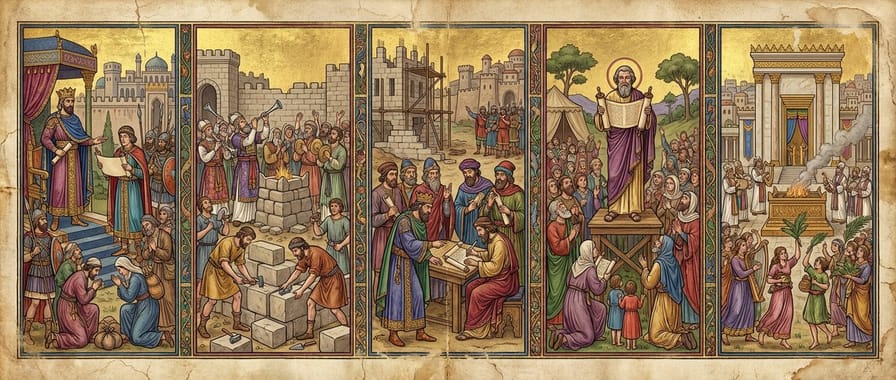
Illustration of the Book of Ezra, one of the 39 books of the Old Testament (Nano Banana Pro).
The introduction to any book of Holy Scripture is an endeavor of profound theological and hermeneutical responsibility. It serves as a portal, inviting the reader to enter the textual and spiritual universe of an inspired and inerrant portion of the Word of God. In a postmodern world, where the authority and truthfulness of ancient texts are often questioned, a robust and biblically grounded introduction is not merely useful, but essential. For the evangelical Protestant reader, the approach must be characterized by unwavering reverence for divine inspiration, for biblical inerrancy and the infallibility of the Scriptures, recognizing them as the revealed, living, and effective Word of God (Hebrews 4:12).
This introduction model aims to establish a comprehensive framework for the analysis of any biblical book, anchored in conservative and Reformed theological principles. The intention is not only to contextualize the work in question but also to demonstrate its perennial relevance for the faith and practice of the contemporary church, always with a Christ-centered lens. By applying this model to the book of Ezra, we will unveil the layers of its historical and theological narrative, reaffirming its vital position in the canon and its transformative message for the people of God of all ages. Ezra, a frequently underestimated book, is a poignant testimony to divine faithfulness, the need for covenantal purity, and the restoring power of the Word of God, elements that resonate deeply with evangelical theology.
The scholarship employed here seeks to engage with serious academic research, while simultaneously reiterating and defending the traditional positions of the Reformed faith. We will address the criticisms of higher criticism with a balanced perspective, yet firmly rooted in God's sovereignty over His revelation. The language will be academic, but the heart pastoral, aiming to equip both the scholar and the devotional reader with tools for a deeper and more fruitful understanding of Scripture. May this journey through the introduction to Ezra be a model for the appreciation of every book of the Bible, revealing the glory of God in every inspired page.
The book of Ezra, together with Nehemiah, and often considered a continuation of the books of Chronicles, narrates a crucial period in the history of Israel after the Babylonian exile. It documents the return of a portion of the Jewish people to Jerusalem and Judah, the rebuilding of the Temple, and the efforts to restore the religious and social life of the community according to the Law of Moses. Ezra's narrative is a powerful illustration of divine providence, human obedience, and the challenges inherent in the spiritual and physical restoration of a people who had experienced God's judgment. The evangelical Protestant perspective emphasizes that, even amidst the ruins of past disobedience, God is faithful to fulfill His promises of restoration and to use godly individuals as instruments of His will.
Throughout this introduction, we will explore the historical and literary complexities of Ezra, highlighting its central theological themes, its canonical relevance, and the interpretive challenges it presents. Each section will be carefully constructed to provide a detailed analysis, defending the traditional authorship and historical integrity of the text against skeptical objections, and underscoring Ezra's eternal message to the church. The centrality of the Word of God, the importance of worship, and the purity of the covenant community are lessons that Ezra offers with particular force, echoing fundamental principles of the evangelical faith. This study of Ezra is not merely an academic exercise, but an invitation to reflect on God's faithfulness and the responsibility of His people in all generations.
The following structure is designed to be an exhaustive guide, allowing the reader to understand the book of Ezra in its fullness, from its historical roots to its contemporary theological implications. Adherence to this structure not only ensures a complete analysis but also reinforces the interconnectedness of each element of biblical study, demonstrating how context, structure, themes, and challenges combine to form a cohesive and enriching understanding of Scripture. May the reading of Ezra, through this lens, inspire a renewed passion for the Word of God and for His redemptive work in history.
1. Historical Context, Dating, and Authorship
The book of Ezra emerges from one of the most transformative periods in the history of Israel: the post-Babylonian exile. After seventy years of captivity, a divine judgment imposed for their persistent idolatry and covenantal disobedience, God, in His sovereignty and faithfulness to His promises, orchestrated the return of His people to the land of Judah. This event was not a historical accident, but the direct fulfillment of the prophecies of Jeremiah (Jeremiah 25:11-12; Jeremiah 29:10) and Isaiah (Isaiah 44:28; Isaiah 45:1). The dominant political scenario was the vast Persian Empire, which had subjugated Babylon in 539 BC under the command of Cyrus the Great.
Cyrus's decree, recorded in Ezra 1:1-4 and also corroborated by extrabiblical evidence such as the Cyrus Cylinder, allowed the Jews to return to Jerusalem and rebuild the Temple. This decree is a remarkable testimony to divine providence, using a pagan monarch to fulfill His redemptive purposes. Ezra's narrative covers approximately a century, from the first return in 538 BC (under Zerubbabel and Jeshua) until Ezra's reforms in 458 BC and 444 BC, with a significant gap between chapters 6 and 7, spanning about 58 years, during which the Temple was completed, but the community still struggled with the observance of the Law.
1.1 Traditional Authorship and Evidence
The traditional authorship of the book of Ezra, along with Nehemiah and the books of Chronicles, is attributed to Ezra, the priest and scribe. This view is widely accepted by conservative commentators and evangelical theologians. Ezra is described in Ezra 7:6 as "a scribe skilled in the Law of Moses, which the LORD, the God of Israel, had given." His background and position uniquely qualified him to compile, edit, and write the history of the return and restoration. The connection between Ezra-Nehemiah and Chronicles is reinforced by linguistic, stylistic, and theological similarities, suggesting common authorship or, at minimum, a "Chronicler's" school of thought.
Internal evidence supporting Ezra's authorship includes the first-person sections (e.g., Ezra 7:27-28; Ezra 8:1-36; Ezra 9:1-15), where Ezra narrates events from his own perspective. Although the book incorporates official documents (royal decrees, letters) and lists, the structure and selection of the material reflect a cohesive theological mind. The emphasis on the Law of Moses, the Temple, and the purity of worship—themes dear to a priest and scribe like Ezra—permeates the entire narrative. Jewish tradition (Babylonian Talmud, Baba Bathra 15a) also attributes Ezra-Nehemiah to Ezra, reinforcing traditional authorship.
1.2 Response to Criticisms of Higher Criticism
Higher criticism, since the nineteenth century, has raised questions about the authorship, dating, and historicity of Ezra. Some scholars propose that Ezra-Nehemiah is a late pseudepigraphical work, or a compilation of various sources without a central authorial figure, or even that Ezra never existed as a historical figure. Common arguments include alleged chronological inconsistencies, stylistic differences between sections, and the claim that Cyrus's decree is a later Jewish invention.
However, the evangelical perspective defends traditional authorship and historicity. The alleged chronological inconsistencies can be explained by the nature of ancient historical narrative, which does not always follow a strict chronology, or by the time gap between chapters 6 and 7. Stylistic differences are expected in a book that incorporates royal decrees, lists, and first-person narratives. Archaeology has corroborated the existence of Cyrus and the Persian policy of allowing the return of exiled peoples and the rebuilding of their temples, as evidenced by the Cyrus Cylinder, undermining the criticism that the decree would be an invention.
The criticism that questions Ezra's existence is often based on arguments from silence or on an epistemological distrust of religious texts. However, the wealth of biographical details and the theological coherence of the book, along with Jewish tradition, provide a solid basis for affirming Ezra's existence and authorship. The evangelical view, founded on biblical inerrancy, maintains that the book of Ezra is a historically reliable and divinely inspired record of post-exilic events, written or compiled by Ezra, the scribe, under the direction of the Holy Spirit.
The dating of the book, therefore, falls within the period of Ezra's life, likely between 450 and 400 BC, after the events narrated in Nehemiah and after the completion of most of the post-exilic prophetic books (Haggai, Zechariah, Malachi). This period is crucial for understanding the formation of post-exilic Jewish identity, the emphasis on the Law and the Temple, and the messianic expectation that would develop in the following centuries. Ezra is not only a historian but a theologian who interprets the events of his time through the lens of God's covenant with Israel.
2. Structure, Division, and Main Content
The book of Ezra presents a well-defined narrative structure, divided into two main parts, separated by a significant temporal hiatus, but united by a theological thread: the restoration of God's people under divine sovereignty. Ezra's literary organization is predominantly historical, with the inclusion of official Persian documents, genealogical lists, and first-person narratives, which lend the text remarkable documentary richness and authenticity. The narrative flows chronologically within each section, although the transition between the two main parts represents a leap of almost six decades.
The first part of Ezra (chapters 1-6) focuses on the first return of the exiles under the leadership of Zerubbabel, a descendant of David, and the high priest Jeshua. The main objective of this group was the rebuilding of the Temple in Jerusalem. The second part (chapters 7-10) describes the return of Ezra, the priest and scribe, and his efforts to restore the purity of the covenant community through the revitalization of the Law of Moses. Both parts highlight divine intervention and human response, whether in obedience or failure, before the revealed will of God.
2.1 The Rebuilding of the Temple (Ezra 1-6)
This section begins with the impressive decree of Cyrus (Ezra 1:1-4), which not only allowed the return of the Jews but also ordered the rebuilding of the Temple and the return of the sacred utensils taken by Nebuchadnezzar. Chapter 2 lists those who returned with Zerubbabel, emphasizing genealogical continuity and the identity of the people of God. The foundation of the Temple is laid with great celebration (Ezra 3:8-13), but also with weeping by the elders who remembered the glory of the first Temple.
The following chapters narrate the opposition from the Samaritans and other peoples of the land, who tried to hinder the work (Ezra 4:1-24). This opposition led to a long period of cessation in the Temple's construction, which lasted until the second year of the reign of Darius I (about 16 years). Divine intervention manifests through the prophets Haggai and Zechariah (Ezra 5:1-2), who exhorted the people to resume the work. The rebuilding is finally completed, and the Temple is dedicated with great joy (Ezra 6:15-18), culminating in the celebration of the Passover. This section is a testimony to God's faithfulness in fulfilling His promises of restoration and His people's perseverance amidst adversity.
2.2 The Reform of the Covenant Community (Ezra 7-10)
After a hiatus of approximately 58 years, the narrative resumes with Ezra's arrival in Jerusalem in the seventh year of King Artaxerxes (458 BC). Chapter 7 presents Ezra as a priest and scribe, "dedicated to studying the Law of the LORD, practicing it, and teaching its decrees and precepts in Israel" (Ezra 7:10). He came with royal authorization to implement God's Law and restore religious and civil order. Chapter 8 lists the heads of families who returned with Ezra, highlighting the importance of leadership and organization for the restoration.
The final part of the book (chapters 9-10) describes Ezra's main reform: the issue of mixed marriages. Upon arriving in Jerusalem, Ezra is horrified to discover that the people, including priests and Levites, had married foreign women, violating God's Law and compromising the purity of the covenant community (Ezra 9:1-2). Ezra's response is dramatic: he tears his garments, pulls out his hair and beard, and offers a powerful prayer of confession and repentance on behalf of the people (Ezra 9:5-15). This prayer is a model of corporate repentance and recognition of divine justice.
The community responds with repentance and a commitment to separate from their foreign wives and children (Ezra 10:1-5). Ezra organizes a process of investigation and implementation of this difficult measure, which aimed to preserve the identity and theological purity of the people of Israel as the LORD's holy nation. The controversy surrounding this action will be addressed in the hermeneutical challenges section, but it is crucial to understand that, in the post-exilic context, the identity and survival of God's people depended on strict observance of the covenant, which included the prohibition of marriages with pagan peoples.
In summary, the structure of Ezra is a testimony to God's restorative work on two fronts: the physical restoration of the Temple as a center of worship, and the spiritual and covenantal restoration of the community through the Law. The interconnection of these two parts, mediated by God's faithfulness and the leadership of men like Zerubbabel and Ezra, demonstrates the divine plan for a redeemed people dedicated to Him.
3. Central Theological Themes and Purpose
The book of Ezra, though narrative in form, is deeply theological in its content and purpose. It is not merely a historical record of the post-exilic return, but a theological interpretation of those events, revealing God's hand in every step of His people's journey of restoration. For the evangelical Protestant reader, Ezra offers a rich tapestry of doctrines that resonate with Reformed systematic theology, highlighting the sovereignty of God, covenant faithfulness, the importance of the Law, and the need for holiness in the covenant community. We will identify and elaborate on three to five central themes.
3.1 God's Sovereignty in History
One of the most prominent themes in Ezra is the unquestionable sovereignty of God over historical events and over the hearts of pagan kings. The book opens with the declaration that "the LORD stirred up the spirit of Cyrus, king of Persia" (Ezra 1:1) to issue the decree that allowed the return of the Jews and the rebuilding of the Temple. This same phrase is repeated in relation to Darius and Artaxerxes, who also supported the work. God is not merely a passive observer, but the Architect and Director of history, using worldly empires to fulfill His redemptive purposes for Israel. This doctrine of divine providence is a pillar of Reformed theology, which affirms that God governs all things, great and small, for His glory and for the good of His people (Romans 8:28).
God's intervention through the prophets Haggai and Zechariah to reanimate the people and leaders in the rebuilding of the Temple (Ezra 5:1-2) is another example of His active sovereignty. Even in the face of opposition and apathy, God's will prevails. This theological perspective comforts the believer, reminding them that, regardless of political or social circumstances, God is in control and His Word will be fulfilled.
3.2 The Fulfillment of Prophecy and Covenant Faithfulness
The return from exile is presented as the direct fulfillment of Jeremiah's prophecies concerning the seventy years of captivity (Jeremiah 25:11-12; Jeremiah 29:10). Ezra underscores that God is a promise-keeper, and His faithfulness to His covenant with Israel is unwavering, even when Israel fails in its part. The restoration is not a sign that Israel deserved God's grace, but a testimony to God's covenantal grace. This theme resonates with the Reformed doctrine of God's covenant faithfulness, which is unconditional in its foundation and gracious in its application.
The return to the promised land, the rebuilding of the Temple, and the restoration of worship are all essential steps in God's plan to maintain the messianic lineage and prepare the way for the coming of Christ. Ezra shows that God had not abandoned His people but was actively engaging them in a new chapter of their salvation history, a chapter that pointed to an even greater and more complete restoration in the future.
3.3 The Centrality of the Law and the Temple for the Covenant Community
The book of Ezra demonstrates a profound reverence for the Law of Moses and for the Temple as the center of Israel's worship and community life. Ezra is described as a scribe "skilled in the Law of Moses" (Ezra 7:6), and his purpose in returning to Jerusalem was "to study the Law of the LORD, to practice it, and to teach its decrees and precepts in Israel" (Ezra 7:10). The Law was not seen as a legalistic burden, but as the revelation of God's will, essential for the identity and holiness of the covenant people. The emphasis on the Law reflects the Reformed view of Scripture as the sole infallible rule of faith and practice.
The rebuilding of the Temple was not merely an architectural undertaking, but a theological act of reaffirming God's presence among His people and the importance of sacrifice and worship. The Temple was the place where propitiation for sins was made and where communion with God was restored. The dedication of the Temple and the celebration of the Passover (Ezra 6:16-22) mark the renewal of religious life. The purity of the covenant community, as required by the Law and symbolized by the Temple, is a crucial theme, leading Ezra to deal severely with the issue of mixed marriages.
3.4 The Need for Holiness and the Purity of the Community
The theme of holiness and the purity of the covenant community is central to the second part of Ezra. The discovery of mixed marriages (Ezra 9:1-2), which compromised Israel's identity and holiness, provokes a dramatic reaction from Ezra and a profound confession of sin from the people. The Law prohibited such marriages to prevent apostasy and idolatry (Deuteronomy 7:3-4). Ezra understood that the purity of the lineage and separation from pagan customs were vital for the spiritual survival of Israel as God's people. The measure to separate from foreign wives, though painful, was seen as an act of radical obedience to preserve the integrity of the covenant.
For evangelical theology, this episode underscores the importance of holiness and separation from the world for God's people. The church, as the new covenant community, is called to be holy and blameless (Ephesians 5:27), remaining distinct from the sinful patterns of the surrounding culture. Although the literal application of mixed marriages is contextual, the underlying principle of spiritual purity and faithfulness to God remains universally relevant. Ezra's primary purpose, then, is to demonstrate God's faithfulness in restoring His people and the imperative need for this restored people to live in obedience and holiness, according to God's Law, to maintain their identity and their relationship with Him.
4. Relevance and Canonical Connections
The book of Ezra occupies a strategic position in the Old Testament canon, serving as a vital bridge between the pre-exilic and intertestamental periods. Its narrative not only concludes the history of Israel begun in Chronicles (and in some canonical arrangements, serves as its continuation) but also sets the stage for the emergence of Second Temple Judaism, preparing the way for the messianic era. The importance of Ezra transcends its historical value, offering rich typological connections with Christ and perennial lessons for the contemporary church, which resonate with evangelical Protestant theology.
4.1 Importance in the Canon and Connections with Other Books
Ezra is inseparable from Nehemiah, being frequently considered a single work in some Jewish and academic traditions, known as Ezra-Nehemiah. Together, they provide the most detailed record of the return from exile and the rebuilding of Jerusalem, both of the Temple and the walls. Ezra also connects intrinsically with the books of Chronicles, which end with Cyrus's decree, exactly where Ezra begins (2 Chronicles 36:22-23; Ezra 1:1-4). This link reinforces the continuity of Israel's salvation history and God's faithfulness in fulfilling His promises.
Furthermore, Ezra provides the historical context for the post-exilic prophets Haggai, Zechariah, and Malachi. Haggai and Zechariah prophesied during the period of the Temple's rebuilding, exhorting the people to resume the work (Ezra 5:1-2). Malachi, in turn, addresses issues of priestly purity and covenantal faithfulness that Ezra and Nehemiah had tried to reform, showing that the struggle for holiness continued. Thus, Ezra is not an isolated book, but a fundamental piece in the canonical panorama, essential for understanding the development of Israel's theology and community.
4.2 Typological Connections and the Christ-Centered Reading
A Christ-centered reading of Ezra reveals several typological connections that point to Christ and His redemptive work. The return from exile and the restoration of Jerusalem and the Temple are types or foreshadowings of the greater liberation and restoration that would come through Jesus Christ. Just as God liberated Israel from Babylonian captivity, He liberates His people from the captivity of sin and death through Christ (John 8:36).
The Temple rebuilt in Ezra, though a physical place of worship, points to Christ as the definitive Temple, where God dwells in fullness and through whom we have access to the Father (John 2:19-21; Ephesians 2:19-22). The covenant community restored in Ezra, called to holiness and purity, typifies the Church as the body of Christ, a holy, redeemed community indwelt by the Holy Spirit (1 Peter 2:9-10).
Ezra, as a priest and scribe dedicated to the Law of God, can be seen as a type of Christ in His ministry of teaching and purification. Ezra taught the Law, called the people to repentance, and sought the sanctification of the community. Jesus, the high priest and the incarnate Word Himself, came to fulfill the Law, teach the truth, and purify His people by His blood (Matthew 5:17; Hebrews 7:26-28). Ezra's prayer of confession (Ezra 9) is an echo of Christ's intercession for His people, though Ezra interceded for himself and the people, while Christ intercedes as the spotless Lamb. The restoration of worship and the Law in Ezra prefigures the new covenant in Christ, where the Law is written on our hearts and true worship is in spirit and in truth (Jeremiah 31:33; John 4:23-24).
4.3 Relevance for the Contemporary Church
Ezra's message resonates powerfully for the contemporary church. First, it reminds us of God's unwavering faithfulness. Even when His people fail and suffer the consequences of sin, God is faithful to fulfill His promises of restoration. This is a message of hope for the church facing challenges, persecutions, or periods of spiritual decline. God never abandons His covenant.
Second, Ezra emphasizes the centrality of the Word of God. Ezra's reform was driven by the study, practice, and teaching of the Law. For the church today, Scripture must be the supreme authority for faith and life, shaping worship, doctrine, and ethics. Expository preaching, diligent biblical study, and obedience to the Word of God are crucial for the church's spiritual vitality.
Third, the book highlights the importance of the purity of the church as a covenant community. The issue of mixed marriages in Ezra, though specific to the Old Testament context, underscores the principle of separation from the world and holiness. The church is called to be distinct, not to conform to the sinful patterns of culture, but to live in a way that reflects God's holiness (Romans 12:2; 1 Peter 1:15-16). This implies vigilance against doctrinal, ethical, and moral compromises that can dilute Christian identity and the church's mission.
Finally, Ezra is a call to repentance and renewal. Ezra's prayer of confession and the people's response serve as a model for corporate and individual repentance. When the church acknowledges its sins and turns to God in contrition, He is faithful to forgive and restore. Ezra, therefore, is not just a history of the past, but a mirror for the present church, inviting it to a renewed faithfulness to the Word of God, to holiness, and to hope in God's sovereign work of restoration.
5. Hermeneutical Challenges and Critical Issues
The interpretation of the book of Ezra, like that of any ancient text, is not without its challenges. In addition to the issues of authorship and dating already addressed, difficulties arise concerning chronology, literary genre, and notably, ethical and theological questions, especially regarding the treatment of mixed marriages. A faithful evangelical hermeneutic must approach these questions with intellectual honesty, academic rigor, and submission to the inerrant authority of the Scriptures, defending biblical truth against skeptical criticisms.
5.1 Chronological and Literary Difficulties
One of the main chronological difficulties in Ezra is the 58-year gap between chapters 6 and 7. Chapter 6 ends with the dedication of the Temple in 516 BC (year 6 of Darius), and chapter 7 begins with Ezra's arrival in Jerusalem in the 7th year of Artaxerxes (458 BC). During this long period, the book is silent about events in Jerusalem. Critics suggest that this gap indicates a fragmentation of the text or historical inaccuracy. However, an evangelical perspective understands that the author (Ezra) focused on the events he considered most theologically significant: the rebuilding of the Temple and the reform of the community through the Law. The absence of details about this period does not invalidate its historicity but reflects the author's narrative priorities.
Another literary challenge is the inclusion of official Persian documents (decrees, letters) and lists. While these elements lend historical authenticity, some critics question their veracity or whether they were edited by the author. The evangelical response, based on the plenary inspiration of the Scriptures, is that these documents were faithfully preserved and incorporated by Ezra, serving as external evidence for the biblical narrative. The alternation between the third and first person, and the use of Aramaic in some sections (Ezra 4:8-6:18; Ezra 7:12-26), are also characteristics that some consider problematic, but which can be explained by the compiling nature of Ezra's work and the inclusion of primary sources.
5.2 The Ethical Issue of Mixed Marriages (Ezra 9-10)
Perhaps the most challenging issue in Ezra, from an ethical standpoint, is the command for Jewish men to divorce their foreign wives and separate from their children (Ezra 10:1-17). To modern sensibilities, this seems a harsh, xenophobic measure contrary to the principles of love and grace. Critics argue that Ezra imposed an arbitrary and cruel law, which caused unjust suffering to women and children.
The evangelical response to this issue requires a careful understanding of the theological and historical context. In first place, the prohibition of mixed marriages was not a matter of racial or ethnic prejudice, but of covenantal purity and religious identity. The nations in question (Canaanites, Hittites, Perizzites, Jebusites, Ammonites, Moabites, Egyptians, and Amorites) were peoples who practiced idolatry and immorality, and the Law of Moses prohibited marriages with them to prevent Israel from being led astray from the worship of the one true God (Deuteronomy 7:1-6). The history of Israel had already demonstrated the disastrous consequences of such marriages (e.g., Solomon in 1 Kings 11:1-8).
Second, the post-exilic community was at a critical point in its existence. After the exile, Israel's identity as God's people was at risk. Intermarriage with pagan peoples threatened the very survival of their monotheistic faith and the messianic lineage. Ezra's drastic measure, therefore, was an act of preserving the covenant and the identity of the chosen people, essential for the continuity of God's redemptive plan. It was not a policy of cultural genocide, but spiritual surgery to save the life of the nation.
Third, the Bible presents divorce as undesirable but permitted in certain circumstances as a concession to the hardness of the human heart (Matthew 19:8). In Ezra's case, the divorce from these unlawful unions was a measure of obedience to God's Law and repentance for corporate sin. It is important to note that the initiative to separate from foreign wives came from the people themselves, led by Shecaniah (Ezra 10:2-3), in response to Ezra's preaching and prayer, indicating a collective recognition of the seriousness of the sin.
5.3 Hermeneutical Principles for Correct Interpretation
To interpret Ezra correctly, especially the challenging passages, evangelical hermeneutical principles must be applied consistently:
- Historical and Cultural Context: Understand the book within its post-exilic environment, covenant theology, and the threats to Israel's identity.
- Canonical Unity and Coherence: Interpret Ezra in light of all Scripture, recognizing its connection to the Mosaic Law and its function in God's redemptive plan.
- Christ-Centered Reading: Seek out the foreshadowings of Christ and His work, understanding that the Old Testament points to the New.
- Authority of Scripture: Affirm the inerrancy and infallibility of the text, even when its actions seem difficult to modern sensibilities, trusting in God's wisdom and justice.
- Distinction between Universal Principles and Contextual Applications: Discern timeless theological principles (e.g., holiness, faithfulness to the Word of God) from specific applications that were contextual to Ezra's time (e.g., the specificity of mixed marriages and the measures taken).
In conclusion, the book of Ezra, with its hermeneutical challenges and critical issues, remains a vital and inspired portion of the Word of God. Its message about divine sovereignty, covenant faithfulness, the centrality of the Law, and the need for holiness is a powerful testimony for all generations. The evangelical Protestant perspective, when approaching Ezra, seeks to honor the integrity of the text, defend its historicity, and extract its eternal truths, always pointing to the culmination of salvation history in Jesus Christ.