


Hannah
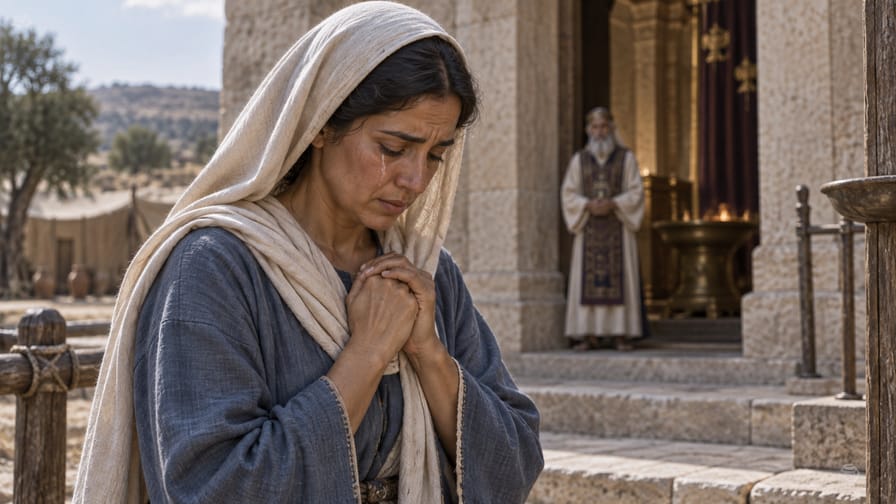
The figure of Hannah, whose story is narrated in the first chapters of the book of 1 Samuel, is one of the most inspiring and theologically rich in the Old Testament. She is best known as the mother of the prophet Samuel, one of Israel's most important judges and the one responsible for anointing the first kings of the chosen people. Her life, marked by barrenness and fervent prayer, serves as a powerful testimony to God's sovereignty and His faithfulness in answering those who seek Him with sincerity.
Hannah's story transcends mere personal biography, inserting itself deeply into the history of redemption. Her experience of pain, faith, and gratitude prefigures central themes of biblical theology, such as divine grace, the exaltation of the humble, and the coming of the Messiah. An analysis of her life, character, and legacy offers valuable lessons on God's providence and the importance of individual piety in the divine plan.
1. Etymology and meaning of the name
The name Hannah, in Hebrew, is Ḥannah (חַנָּה). This name is derived from the Hebrew verbal root ḥnn (חָנָן), which means "to be gracious," "to show favor," "to have mercy," or "to plead for favor." Consequently, the literal meaning of the name Hannah is "grace" or "favor."
The theological significance of the name Hannah is profound and intrinsically linked to her own story. Her life is a vivid testimony to God's "grace" and "favor." Although barren, a condition often seen as a sign of divine disfavor in ancient culture, God extended His grace to her, granting her a son after her persistent plea.
This name is not exclusive in the Bible, but the Hannah of 1 Samuel is the most prominent figure with this name. There is another Hannah mentioned in the New Testament, the prophetess who recognized Jesus as the Messiah in the temple (Luke 2:36). The coincidence of names for pious and prophetic women reinforces the meaning of "grace" in their lives and ministries.
The name Ḥannah resonates with the idea that God's goodness does not depend on human merit but on His free and sovereign initiative. Hannah's story is a practical demonstration of the meaning of her name, for it was by divine grace that she was visited and her affliction was transformed into joy and testimony.
The etymology of the name, therefore, is not just a linguistic detail, but a theological summary of divine intervention in her life. God's "grace" is the driving force of the narrative, transforming the sorrow of barrenness into a prophetic song of praise, as we will see in her prayer of thanksgiving.
2. Historical context and biblical narrative
2.1 Period and socio-religious context
Hannah's story unfolds in a crucial period of Israel's history, the transition between the era of the Judges and the establishment of the monarchy. This period, approximately in the 11th century BC, was characterized by great political, social, and, above all, spiritual instability. The book of Judges concludes with the somber phrase: "In those days there was no king in Israel everyone did what was right in his own eyes" (Judges 21:25).
The religious context was one of decadence. The priesthood in Shiloh, where the tabernacle and the ark of the covenant were located, was corrupted by Eli's sons, Hophni and Phinehas, who "did not know the Lord" and disrespected the sacrifices (1 Samuel 2:12-17). The annual pilgrimage to Shiloh, though still practiced, took place in an environment of compromised morality and failed spiritual leadership.
Society was patriarchal, and fertility was highly valued, especially the ability to bear male children, who would perpetuate the family name and inherit property. Barrenness was a great affliction, often interpreted as a sign of divine disapproval, and could lead to profound emotional and social suffering, as evidenced in Hannah's life.
2.2 Family origin and main events
Hannah was one of Elkanah's two wives, a Levite (according to some rabbinic traditions, though 1 Samuel 1:1 identifies him as an Ephraimite, which may indicate his residence, not his tribe of birth) from Ramah, in the hill country of Ephraim (1 Samuel 1:1). His other wife was Peninnah, who had children, while Hannah had none (1 Samuel 1:2). Polygamy, though not the divine ideal, was practiced at the time and often generated family tensions and rivalries.
The biblical narrative describes Elkanah as a God-fearing man, who annually went up to Shiloh to worship and offer sacrifices to the Lord of Hosts (1 Samuel 1:3). During these pilgrimages, he showed love and consideration for Hannah, giving her a double portion of the sacrificed meat, perhaps to compensate for her affliction or to show his special affection for her (1 Samuel 1:4-5).
However, Hannah's barrenness was a source of constant pain and humiliation, exacerbated by Peninnah's provocation. Peninnah severely distressed and provoked her because of her condition, making Hannah's life very difficult (1 Samuel 1:6-7). This rivalry and Hannah's suffering are portrayed with great sensitivity, highlighting the depth of her anguish.
On one of these trips to Shiloh, Hannah, in deep bitterness of soul, poured out her heart before the Lord in prayer. Her prayer was so intense and silent that Eli, the high priest, mistook her for a drunken woman (1 Samuel 1:9-14). When corrected, Hannah explained her affliction, and Eli blessed her, saying: "Go in peace, and may the God of Israel grant you what you have asked" (1 Samuel 1:17).
After the prayer and Eli's blessing, Hannah returned home with an attitude of hope and was no longer sad (1 Samuel 1:18). In due time, the Lord remembered her, and she conceived and gave birth to a son, whom she named Samuel, which means "heard by God" or "name of God", explaining: "Because I asked him of the Lord" (1 Samuel 1:20).
Faithful to her vow, as soon as Samuel was weaned, Hannah took him to Shiloh and dedicated him to the Lord for the rest of his life, entrusting him to the care of the priest Eli (1 Samuel 1:24-28). This act of surrender is a powerful testament to her faith and integrity. In return, the Lord blessed Hannah with three more sons and two daughters (1 Samuel 2:21), demonstrating His generosity and faithfulness.
3. Character and role in the biblical narrative
3.1 Virtues and spiritual qualities
Hannah's character is one of the most beautiful and edifying presented in the Scriptures, revealing a woman of profound piety, unwavering faith, and remarkable integrity. Her story is not just about overcoming barrenness, but about the transformation of an afflicted soul into an instrument of praise and prophecy.
One of Hannah's most prominent virtues is her perseverance in prayer. Even in the face of the pain of barrenness and Peninnah's provocation, she did not give up seeking God. Her prayer in Shiloh (1 Samuel 1:10-16) is a model of sincere and humble intercession, where she pours out her soul before the Lord, without reservation.
Her faith is equally remarkable. Despite the long wait and the apparent divine silence, Hannah trusts that God is capable of doing the impossible. Her attitude after Eli's blessing, when her sadness disappears even before the conception of her son (1 Samuel 1:18), demonstrates a genuine faith in God's promise and the authority of His servant.
Hannah's integrity is evidenced in the fulfillment of her vow. By promising to dedicate her son to the Lord, she does not hesitate to do so, even if it meant giving up her only son for ministry in the temple (1 Samuel 1:24-28). This is an act of profound self-denial and faithfulness, which distinguishes her as an example of commitment to God.
Furthermore, Hannah demonstrates keen spiritual sensitivity. Her song of praise (1 Samuel 2:1-10) is not just an expression of personal gratitude, but a profound theological declaration about God's sovereignty, His justice, and His redemptive plan. She anticipates truths that will be fully manifested in the history of Israel and, ultimately, in Christ.
3.2 Role in the narrative and character development
Hannah's role in the biblical narrative is multifaceted. Firstly, she is the mother of the prophet Samuel, who would become a central figure in Israel's transition from the theocracy of the judges to the monarchy. Samuel's dedication to God from childhood, under Hannah's influence, was fundamental to his future prophetic and priestly ministry.
Secondly, Hannah serves as an example of individual piety in a time of great apostasy in Israel. While the priesthood was corrupted, Hannah's faith shone brightly, demonstrating that God still worked through faithful individuals, even amidst institutional spiritual decay.
Her song is a prophetic act that goes beyond her own personal experience. It proclaims divine principles that govern history, such as the exaltation of the humble and the humbling of the proud, and points to the coming of an anointed king. This song establishes a theological link with the Magnificat of Mary (Luke 1:46-55), which echoes Hannah's themes, showing a continuity of divine revelation.
The development of Hannah's character is marked by the transition from pain and barrenness to joy and spiritual fertility. Her journey of suffering leads her to a deeper relationship with God, culminating in a powerful testimony that impacts not only her family but the entire nation of Israel, through her son Samuel. Her story is a microcosm of God's work in bringing life from death and hope from despair.
4. Theological significance and typology
Hannah's story is rich in theological significance and contains important typological elements that point to God's redemptive work, culminating in Christ. Her narrative is not merely a biographical account, but a fundamental piece in the progressive revelation of the divine plan.
4.1 Role in redemptive history and theological themes
Hannah's life illustrates the sovereignty of God over life and death, fertility and barrenness. The text explicitly states that "the Lord had closed her womb" (1 Samuel 1:5), and that "the Lord remembered her" (1 Samuel 1:19). This demonstrates that God is in control of all circumstances, and that He uses even affliction for His greater purposes, preparing the way for the manifestation of His grace and power.
Hannah's story is a testimony to the power of prayer and God's faithfulness in answering the supplications of His children. Her fervent prayer (1 Samuel 1:10-16) and the subsequent conception of Samuel show that God hears and answers those who seek Him with a sincere heart. This theme resonates throughout Scripture, encouraging dependence on God in all circumstances.
Furthermore, Hannah's dedication of Samuel to the service of the Lord (1 Samuel 1:27-28) is a powerful example of faithfulness and consecration. She fulfilled her vow with integrity, demonstrating that true faith is manifested in sacrificial obedience. This act of surrender foreshadows the dedication of lives to God's service throughout salvation history.
Hannah's song (1 Samuel 2:1-10) is a profound theological exposition that reveals the nature of God. It exalts the justice of God ("For the Lord is a God of knowledge, and by him actions are weighed" - 1 Samuel 2:3), His holiness ("There is none holy like the Lord" - 1 Samuel 2:2), and His ability to reverse situations ("He raises the poor from the dust and lifts the needy from the ash heap" - 1 Samuel 2:8). This song establishes a theological framework for understanding divine providence in history.
4.2 Prefiguration and Christocentric typology
The Christocentric typology in Hannah's story is notable, especially through her song. Although she lived centuries before Christ, her words contain clear proto-Messianism. In verse 10 of 1 Samuel 2, she prophetically declares: "The adversaries of the Lord shall be broken to pieces against them he will thunder in heaven. The Lord will judge the ends of the earth he will give strength to his king and exalt the horn of his anointed." The Hebrew word for "anointed" is mashiaḥ (מָשִׁיחַ), from which "Messiah" is derived.
This is one of the first explicit references to a "king" and the "Messiah" in the Bible, even before Israel had a king. Hannah, through divine inspiration, prophesies the coming of a king anointed by God who would bring justice and salvation. This prefiguration finds its final fulfillment in Jesus Christ, the true King and Messiah, who rules with power and justice.
The theme of the reversal of fortunes (the humble are exalted, the strong are weakened) present in Hannah's song is a recurring theme in Scripture and finds its climax in Christ. Jesus, who humbled himself even to death on a cross, was highly exalted (Philippians 2:6-11). Christ's resurrection is the greatest demonstration of God's ability to bring life from death and exaltation from humiliation.
Furthermore, Hannah's experience of barrenness and miraculous birth echoes other biblical narratives (Sarah, Rebekah, Rachel, Elizabeth) that prepare the ground for divine intervention in salvation history. These stories culminate in the virgin birth of Jesus, where divine intervention is even more extraordinary, emphasizing that salvation is entirely God's work, not dependent on human capacity.
In summary, Hannah's story is not just a beautiful narrative of faith and prayer, but a window into understanding God's redemptive plan, which unfolds progressively, pointing to the coming of the Messiah and the establishment of His eternal kingdom.
5. Biblical-theological legacy and canonical references
Hannah's legacy in biblical theology is profound and enduring, extending far beyond the first chapters of 1 Samuel. Although she is not directly mentioned in many other biblical books, her story and, especially, her song of praise, establish a theological and prophetic precedent that resonates throughout the canon.
5.1 Influence on biblical theology and the New Testament
Hannah's most notable influence on biblical theology is the clear connection between her song (1 Samuel 2:1-10) and the Magnificat of Mary (Luke 1:46-55). The thematic and structural similarities are so striking that it is widely accepted that Mary, inspired by the Holy Spirit, echoed Hannah's words. Both songs celebrate God's sovereignty, His justice, His ability to reverse the fortunes of the humble and the powerful, and His faithfulness to His promises.
This connection is not merely literary it is theological. It demonstrates the unity of God's redemptive plan through the covenants. The Messianic hope expressed by Hannah in the Old Testament finds its fulfillment in Jesus Christ, the son of Mary, in the New Testament. Hannah's song, therefore, serves as a prophetic bridge between the expectations of the Old Testament and the reality of Christ's incarnation.
The figure of Hannah contributes to the understanding of the theme of divine grace and God's sovereign intervention in history. Her story reinforces the doctrine that God chooses the weak and despised of the world to confound the strong (1 Corinthians 1:27-28). Hannah's barrenness, like that of Sarah and Rebekah, highlights that the birth of a leader or savior is not the result of human capacity, but of a supernatural act of God, preparing the ground for the virgin birth of Jesus.
Hannah's dedication of Samuel to the Lord also establishes a model of consecration and service that is fundamental in evangelical theology. The idea that children are a gift from God to be dedicated to His service is a principle that permeates Christian life, emphasizing stewardship and total surrender to God.
5.2 Treatment in tradition and evangelical theology
In Jewish and Christian interpretive tradition, Hannah is revered as a model of faith, prayer, and pious motherhood. Jewish commentators often highlight her prayer as an example of sincere and moving tefillah (prayer).
In Reformed and evangelical theology, Hannah is frequently studied for various reasons. Her song is seen as a clear Messianic prophecy and a key text for understanding the nature of God's kingdom and divine justice. Theologians such as John Calvin and Matthew Henry, in their commentaries, emphasize God's sovereignty in Hannah's life and the divine providence behind Samuel's birth.
Hannah's life is used to illustrate the effectiveness of persistent prayer and the importance of fulfilling vows made to God. She is a testament that God does not despise a contrite and broken heart (Psalm 51:17). Her story encourages believers to trust God even in the most difficult circumstances, knowing that He has a purpose for every trial.
Hannah's importance for understanding the canon lies in her role as a vital link in salvation history. She not only gave birth to Samuel, the last judge and first prophet of the monarchical era, but also prophetically articulated the coming of the Messiah and the principles of God's kingdom, demonstrating the continuity and consistency of the divine plan from the Old Testament to the fullness revealed in Jesus Christ.