


Ben-Hadad
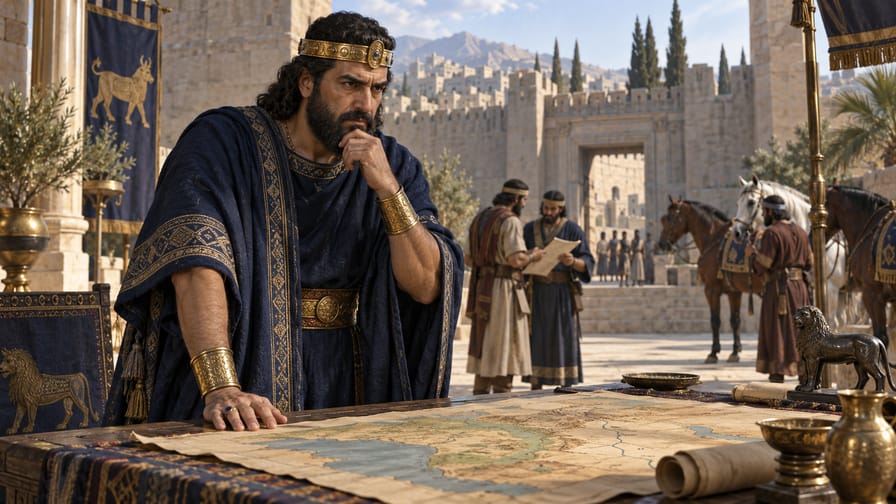
The figure of Ben-Hadade, a prominent name in the ancient history of the Middle East, emerges in the Hebrew Scriptures as a king of Aram (Syria), whose reign extended through critical periods in the history of the kingdoms of Israel and Judah. The biblical narratives primarily portray him as a formidable adversary of God's people, an instrument, at times, of divine discipline, and a demonstration of Yahweh's sovereignty over pagan nations.
The analysis of his life and reign offers valuable insights into the geopolitics of the region during the divided monarchy, the nature of God's covenant with Israel, and the infallibility of the prophetic word. His history is complex, involving multiple individuals with the same name, highlighting the need for careful exegesis to discern the events and their theological significance.
This study will delve deeper into the etymology of the name, the historical context of his reign, the analysis of his character and role, his theological significance from an evangelical Protestant perspective, and the legacy his figure left for understanding the biblical canon.
1. Etymology and Meaning of the Name
The name Ben-Hadade (Hebrew: בֶּן-הֲדָד, Ben-Hadad) is of Aramean origin and literally means "son of Hadad". Hadad (also known as Adad) was a prominent deity in the Syro-Aramean pantheon, a god of storm and fertility, revered as the "king of the gods" and the "lord of heaven and earth" in various inscriptions from Syria and Mesopotamia.
The etymological root indicates a filiation, be it literal (the king was the son of a worshiper or priest of Hadad) or symbolic (the king considered himself a protégé or representative of the god Hadad). The name, therefore, not only identified the individual but also affirmed his connection and loyalty to one of his people's main deities, conferring upon him religious and political legitimacy in the eyes of his subjects.
There are no significant variations of the name in biblical languages, being consistently transliterated as Ben-Hadad. It is crucial to note that the Scriptures mention at least three kings of Aram-Damascus with this name, which requires attention to the context for correct identification.
The first Ben-Hadade (I) is mentioned in 1 Kings 15:18-20 the second (II) is the most prominent, appearing extensively in 1 Kings 20 and 2 Kings 6-8 and the third (III) is alluded to in 2 Kings 13:3, 24-25. The theological significance of the name lies in the irony of a king who proclaims himself "son of Hadad" being repeatedly subjugated and, ultimately, used by Yahweh, the God of Israel, demonstrating the Lord's supremacy over all pagan deities and their supposed offspring.
2. Historical Context and Biblical Narrative
2.1. The First Ben-Hadade (I)
The first Ben-Hadade, son of Tabrimmon and grandson of Hezion, reigned over Aram-Damascus around 885-860 BC. His reign coincided with the initial period of the divided monarchy in Israel and Judah. He is introduced in the biblical narrative in 1 Kings 15:18-20, when King Asa of Judah, instead of fully trusting in the Lord, sought an alliance with him against King Baasha of Israel.
Asa sent treasures from the temple and the palace to Ben-Hadade, asking him to break his covenant with Baasha. Ben-Hadade heeded the request, attacking Israelite cities such as Ijon, Dan, Abel-Beth-Maachah, and all the region of Kinnereth, besides Naphtali (1 Kings 15:20). This event demonstrates Asa's spiritual weakness and Aram's growing influence in regional politics.
Asa's alliance with Ben-Hadade, although seemingly successful from a military standpoint, was rebuked by the prophet Hanani, who warned Asa that, for not trusting in the Lord, he would face continuous wars (2 Chronicles 16:7-9). This episode establishes Aram's pattern as a troublesome neighbor and a tool of judgment or testing for Israel and Judah.
2.2. The Second Ben-Hadade (II)
The best known and most widely documented is the second Ben-Hadade, probably the son or successor of the first, who reigned around 860-842 BC. He is a contemporary of Kings Ahab, Ahaziah, and Jehoram of Israel, and of Jehoshaphat of Judah. His story is primarily told in 1 Kings 20 and 2 Kings 6-8, where he is portrayed as a persistent enemy of Israel.
In 1 Kings 20, Ben-Hadade besieged Samaria and demanded a humiliating surrender from Ahab, requesting all his possessions and even his wives and children. After a consultation with the elders, Ahab refused the more extreme demands. Through an anonymous prophet, the Lord promised Ahab victory over the Arameans, which materialized in two successive battles (1 Kings 20:13-34).
In the first battle, the Israelites, led by Ahab, defeated the Arameans in Samaria (1 Kings 20:20). In the second, at Aphek, Ben-Hadade was again defeated and went into hiding. Ahab, instead of executing the Aramean king according to God's will, made a covenant with him, an act that cost him a strong prophetic rebuke (1 Kings 20:31-43).
Later, the narrative in 2 Kings 6-7 describes another siege of Samaria by Ben-Hadade, resulting in a severe famine in the city. During this siege, the prophet Elisha prophesied deliverance and an abundance of food the next day, which was miraculously fulfilled when the Arameans fled in panic, abandoning their supplies (2 Kings 7:1-16). Divine intervention demonstrates Ben-Hadade's powerlessness before the might of Yahweh.
Finally, 2 Kings 8:7-15 recounts Ben-Hadade's illness in Damascus. He sent Hazael, one of his officials, to consult the prophet Elisha about his recovery. Elisha prophesied that Ben-Hadade would die and that Hazael would be the next king of Aram, bringing great harm to Israel. Hazael, returning to Damascus, suffocated Ben-Hadade with a blanket and usurped the throne, fulfilling Elisha's prophecy.
2.3. The Third Ben-Hadade (III)
The third Ben-Hadade, son of Hazael, is mentioned in 2 Kings 13:3, 24-25. He continued the oppression of Israel, especially during the reigns of Jehoahaz and Joash. However, the Lord had mercy on Israel and, through King Joash, allowed Israel to defeat Ben-Hadade III three times, recovering the cities his father Hazael had taken (2 Kings 13:25). This marks the decline of Aramean power in relation to Israel.
The geography associated with Ben-Hadade includes Damascus (his capital), Samaria (Israel's capital, often besieged), Aphek (battle site), and Ramoth-Gilead (disputed city). His relations with other biblical characters are extensive, including Asa, Baasha, Ahab, Jehoshaphat, Jehoram, Ahaziah, Jehoahaz, Joash, and the prophets Elijah and Elisha, who played crucial roles in his story.
3. Character and Role in the Biblical Narrative
The character of Ben-Hadade, particularly the second, is multifaceted, revealing a combination of arrogance, aggression, cunning, and, at certain moments, a glimpse of fear or vulnerability. He is primarily portrayed as an ambitious military and political leader, determined to expand Aram's dominion and subjugate Israel.
His arrogance is evident in his extreme demands to Ahab during the siege of Samaria (1 Kings 20:5-6) and in his reliance on his armies and chariots, despising the God of Israel (1 Kings 20:23). He underestimated Yahweh's power, attributing Israel's victories to local geography ("god of the mountains", 1 Kings 20:23), a common flaw among pagan kings.
Among his weaknesses and moral failures are idolatry (worshiping Hadad), unjustified military aggression against Israel, the breaking of covenants, and, in the case of Ben-Hadade II, the attempt to deceive the prophet Elisha (2 Kings 8:10). His leadership, though militarily competent in some respects, was marked by a profound lack of spiritual discernment.
Ben-Hadade's role in the biblical narrative is that of an external antagonist, a pagan king who serves as a constant challenge to Israel. He is an agent of divine providence, used by God to discipline Israel for its apostasy and disobedience (2 Kings 13:3). Nevertheless, he is also an enemy whom God repeatedly defeats to demonstrate His sovereignty and protect His people, even when they are unfaithful.
His significant actions include the sieges of Samaria, the battles against Ahab, and the interaction with Elisha. Ben-Hadade's key decisions, such as his alliance with Asa (1 Kings 15:19) and his military campaigns against Israel, shaped the political landscape of the time. His death at the hands of Hazael (2 Kings 8:15) is a culmination point that fulfills Elisha's prophecy, demonstrating the infallibility of God's word, even over pagan kings.
There is no positive development of Ben-Hadade's character in a spiritual sense. He remains a pagan king, focused on his own interests and the expansion of his kingdom. His story serves more as a backdrop for the revelation of God's faithfulness to Israel and the power of His prophets than as an arc of personal redemption.
4. Theological Significance and Typology
The figure of Ben-Hadade is theologically relevant, not for his virtues or faith, but for his role in Israel's redemptive history and the progressive revelation of divine sovereignty. He exemplifies how God uses pagan nations and kings as instruments of His purposes, whether for judgment or for the preservation of His people, regardless of their own intention.
A central theme is divine sovereignty. Despite Ben-Hadade being a powerful Aramean king, he is repeatedly subjugated by the hand of Yahweh. Israel's victories over him, especially those prophesied by Elisha (1 Kings 20:28 2 Kings 7:1 2 Kings 13:17-19), demonstrate that the God of Israel is not merely a "god of the mountains," but the Lord of all the earth and of all battles.
The story of Ben-Hadade also illustrates the consequences of Israel's apostasy. Aramean aggressions are often presented as divine judgment upon Israel's idolatry and disobedience. For example, in 2 Kings 13:3, it is stated that "the anger of the Lord was kindled against Israel, and he delivered them into the hand of Hazael king of Syria and into the hand of Ben-Hadade the son of Hazael continually." This highlights the doctrine of the conditional covenant and the blessings/curses of Deuteronomy.
The figure of Ben-Hadade is a case study of prophetic authority. The word of the prophets Elijah and Elisha not only foretells events related to him (such as Israel's victory in 1 Kings 20, the deliverance of Samaria in 2 Kings 7, and Ben-Hadade's death in 2 Kings 8), but also shapes his destiny. Prophetic intervention is a manifestation of God's voice amidst political and military upheaval.
While Ben-Hadade is not a Christocentric figure in a direct typological sense, his story points to eternal truths about Christ. God's control over pagan kings and the eventual victory of His people over their enemies prefigure Christ's ultimate victory over every principality and power (Colossians 2:15). The miraculous deliverance of Samaria from Ben-Hadade's siege in 2 Kings 7 can be seen as a type of the divine provision and deliverance that Christ definitively offers.
The doctrine of sovereign grace also manifests itself, for even when Israel was in its worst phase of apostasy, God, at times, intervened to save it from total annihilation, as demonstrated in the victories against Ben-Hadade (1 Kings 20) and in the compassion shown to Jehoahaz (2 Kings 13:23). This reveals God's faithfulness to His covenant, despite the unfaithfulness of His people.
Elisha's prophecy to Hazael about Ben-Hadade's death and Hazael's ascent to the throne (2 Kings 8:12-13) is a clear example of prophetic fulfillment. It shows that God's plan unfolds independently of human machinations, and that He uses even the wickedness of men like Hazael for His own purposes, though without endorsing such wickedness.
5. Biblical-Theological Legacy and Canonical References
Mentions of Ben-Hadade are primarily found in the books of 1 and 2 Kings and 2 Chronicles, which narrate the history of the kingdoms of Israel and Judah. He is also briefly referred to in the book of the prophet Amos (1:4), where the Lord promises to send fire upon the house of Hazael, which will consume the palaces of Ben-Hadade, referring to his successors or his royal lineage. This mention in Amos underscores the continuous rivalry between Aram and Israel and the certainty of divine judgment upon the oppressors.
Ben-Hadade made no direct literary contributions to the biblical canon, but his story is intrinsic to understanding Old Testament biblical theology. His figure helps illustrate the nature of the divided monarchy in Israel, the constant external threat that God's people faced, and the way the Lord operated through prophets to guide and correct His people.
Ben-Hadade's influence on biblical theology resides primarily in his function as a "rod" in God's hands (cf. Isaiah 10:5 for Assyria). He demonstrates that God is the Lord of history, controlling the destinies of all nations, not just Israel. The conflicts with Ben-Hadade serve to highlight Israel's need to trust in Yahweh and not in political alliances with pagan nations, a recurring theme in prophetic theology.
In Jewish and Christian interpretive tradition, Ben-Hadade is seen as an example of the arrogance and hostility of God's enemies. His defeat and death, especially the prophecies that preceded them, reinforce the belief in God's sovereignty and omniscience. Commentators such as Keil & Delitzsch emphasize the historical accuracy and divine intervention in the events surrounding him.
In Reformed and evangelical theology, the narrative of Ben-Hadade is often used to illustrate the doctrine of divine providence, where God ordains and executes all His purposes, even through evil agents who act freely. John Gill, in his commentary, highlights how God uses Israel's enemies to chastise them, but also how He limits them and, in due time, destroys them.
The story of Ben-Hadade is crucial for understanding the canon, for it fills a significant period of Israel's history and demonstrates the consistency of God's character in His interactions with His people and the surrounding nations. It underscores the truth that "the Lord reigns let the peoples tremble" (Psalm 99:1), and that no earthly power can thwart divine plans.
In summary, Ben-Hadade, though an adversary, is an indispensable character for understanding the complex tapestry of biblical history, the dynamics of the covenant, and God's unshakeable sovereignty over human history.