


Abia
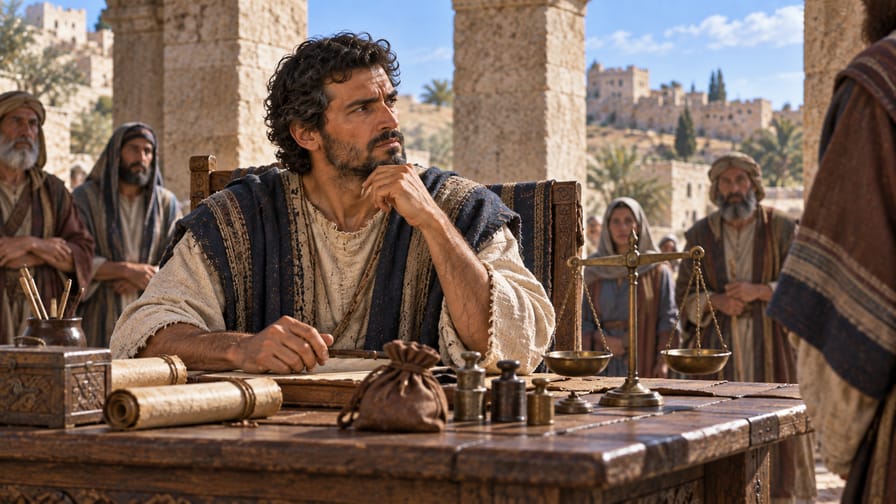
Abia is primarily known in the Old Testament as one of the two sons of the prophet Samuel, appointed by their father to serve as judges in Israel. His story, though brief, is pivotal in the narrative of Israel’s transition from a tribal confederacy led by judges to a monarchy. His unrighteous conduct, along with that of his brother Joel, became a catalyst for the people’s demand for a king, setting the stage for the anointing of Saul.
His life serves as a cautionary tale, highlighting the dangers of inherited position without personal integrity and the profound impact of leadership on a nation’s spiritual and political trajectory. Abia’s actions underscore the recurring biblical theme that privilege does not guarantee piety.
1. Name and origin
1.1 Etymology and meaning
The name Abia (אֲבִיָּה, ’Aviyah) is a common Hebrew name meaning “my father is Yahweh” or “Yahweh is my father.” This name, rich with theological significance, reflects a covenantal relationship with God. It was borne by several individuals in the Old Testament, including a king of Judah, a priest, and one of Samuel’s sons. The irony of Abia’s name is stark, as his actions often contradicted the very meaning of “Yahweh is my father,” suggesting a disconnect between his nominal identity and his actual conduct.
The name itself points to a heritage of faith, given that his father was Samuel, one of Israel’s most righteous judges and prophets. However, the narrative demonstrates that a godly lineage does not automatically confer godliness upon the descendants.
1.2 Family, era, and geography
Abia was the younger son of Samuel, born in Ramah, a central location in the tribal territory of Benjamin. His older brother was Joel. Their father, Samuel, was a towering figure in Israelite history, serving as the last judge, a revered prophet, and the one who anointed both Saul and David as kings. Samuel’s own life was marked by deep devotion and integrity, having been dedicated to God from birth (1 Sam 1:28).
Abia lived during a transitional period in Israel, roughly the late 11th to early 10th century BC. This was a time when the loose confederation of tribes under judges was proving insufficient to address internal strife and external threats, particularly from the Philistines. The judges, including Samuel, operated from various locations, and Abia, along with Joel, was appointed to serve as a judge in Beersheba, a significant city in the southern part of Judah (1 Sam 8:2).
2. Biblical narrative
2.1 Calling and key episodes
The primary biblical account of Abia is found in 1 Samuel 8. As Samuel grew old, he appointed his two sons, Joel and Abia, as judges over Israel. This appointment was likely intended to ensure continuity of leadership and justice within the nation, following the pattern of judges that had governed Israel for centuries. However, their tenure was short-lived and disastrous.
The key episode detailing Abia’s conduct is concise but impactful: “But his sons did not follow his example. They were interested only in making money, so they accepted bribes and perverted justice” (1 Sam 8:3). This indictment reveals a profound moral failure. Their corruption became a major grievance for the elders of Israel, who then approached Samuel with a demand that would forever alter Israel’s political landscape.
2.2 Relationships and turning points
Abia’s most significant relationship was with his father, Samuel, a man of unparalleled integrity and devotion. Despite having such a righteous father, Abia failed to emulate his example. This stark contrast highlights a crucial biblical truth: faith and character are not inherited but must be personally cultivated. The relationship between father and son here is tragic, as Samuel’s legacy of faithful leadership was marred by the unfaithfulness of his immediate successors.
The turning point in Abia’s narrative, and indeed for Israel, came when the elders confronted Samuel. Their complaint about Joel and Abia’s corruption was the direct impetus for their demand: “Give us a king to judge us like all the other nations” (1 Sam 8:5). This moment marked the end of the era of judges and the beginning of the monarchy, a profound shift in Israelite governance that had far-reaching consequences for their national and spiritual identity. Abia’s failure, therefore, inadvertently served God’s larger purpose in establishing the Davidic line.
3. Character and faith
3.1 Virtues and devotion
The biblical text offers no positive virtues for Abia. His character is painted in entirely negative terms, specifically regarding his conduct as a judge. Unlike his father Samuel, who “walked before the Lord” with integrity, Abia’s devotion was evidently to personal gain rather than to justice or God’s law. The narrative presents him as a cautionary figure, a stark contrast to the faithful leaders who preceded him.
His appointment to a position of spiritual and judicial authority, despite his lack of personal godliness, underscores the danger of relying on lineage or position alone. True devotion requires a heart committed to God’s ways, which Abia clearly lacked.
3.2 Failures and lessons
Abia’s primary failure was his corruption in judgment. He “accepted bribes and perverted justice” (1 Sam 8:3). This was a direct violation of God’s law, which strictly forbade judges from accepting bribes (Exod 23:8; Deut 16:19). His actions were not merely personal failings but had profound societal and spiritual implications, undermining the very foundation of justice in Israel.
The lesson from Abia’s life is multifaceted. It teaches that even those raised in godly homes and given positions of authority can stray from righteousness. It also demonstrates the corrosive effect of greed and the perversion of justice, which can lead to widespread discontent and a desire for radical change. For leaders, it serves as a powerful warning against using one’s position for personal enrichment rather than for the good of the people and the glory of God. His story reminds us that God holds leaders to a high standard, and their failures can have national consequences.
4. Theological significance and legacy
4.1 Christological foreshadowing or typology
Abia’s story, as a figure of failed leadership, stands in stark contrast to the perfect and righteous kingship of Jesus Christ. While Abia perverted justice for personal gain, Christ is the ultimate righteous judge, whose reign is characterized by perfect justice and unwavering integrity (Isa 9:7; John 5:30). Abia’s corruption highlighted the desperate need for a truly just ruler, a need that is fully met in Christ, the King who rules with righteousness and equity.
His failure also underscores the human inability to provide perfect leadership, pointing to the divine solution found in Christ. The demand for a king in Israel, prompted by Abia’s unrighteousness, ultimately paved the way for the Davidic covenant and the promise of a Messiah who would establish an everlasting kingdom of justice and peace.
4.2 Witness in later Scripture and church memory
Abia’s legacy is primarily remembered as a negative example, a catalyst for Israel’s demand for a king. His name is not mentioned in later Scripture as a figure of faith or virtue, but rather as part of the historical context that led to the establishment of the monarchy. The narrative in 1 Samuel 8 serves as a foundational text for understanding the theological implications of human leadership and the divine response to human sin and desire.
In church memory, Abia’s story reinforces the importance of personal holiness and integrity for those in positions of spiritual authority. It stands as a perpetual reminder that God’s people require leaders who genuinely reflect His character, rather than those who exploit their position for selfish gain. His life continues to be a sober lesson on the consequences of unrighteous leadership.
5. Conclusion
Abia’s life, though brief and marked by failure, played a crucial role in Israel’s history. His corruption as a judge highlighted the inherent flaws of human leadership and ultimately prompted the people’s demand for a king. This demand, while initially viewed with divine displeasure, ultimately set the stage for the establishment of the Davidic monarchy, from which the Messiah, Jesus Christ, would eventually come. Abia’s story thus serves as a powerful reminder that even human failings can be woven into God’s sovereign plan, ultimately pointing to the perfect and righteous King who alone can deliver true justice and salvation.