


Zuriel
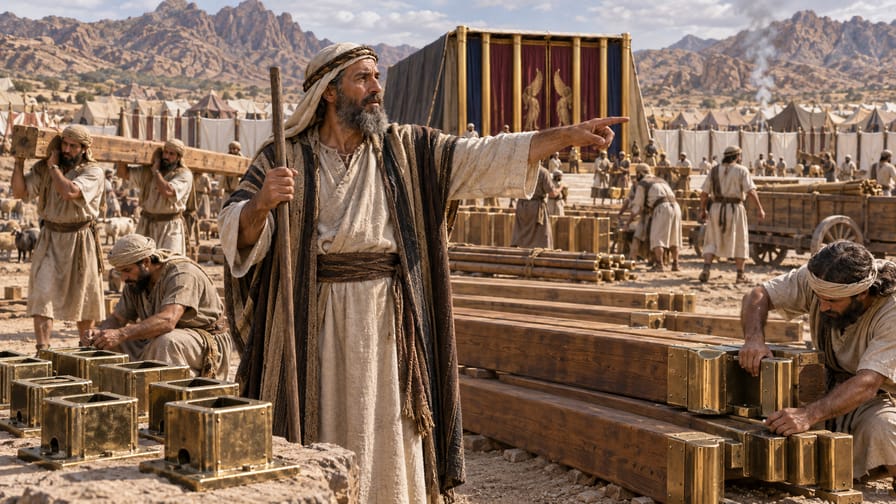
Zuriel is a figure briefly mentioned in the Book of Numbers, identified as a leader within the Merarite clan of the Levites. His primary significance stems from his specific role in the organization and transportation of the Tabernacle during Israel's wilderness journey. While his personal story remains largely untold, his position highlights the meticulous divine order established for the worship and movement of God's presence among His people.
Living during the foundational period of Israel's nationhood, Zuriel's service was integral to maintaining the sanctity and mobility of the Tabernacle. His leadership within the Merarites underscores the importance of every assigned task in the grand tapestry of Israelite worship, even those that might seem less prominent than the priestly duties of Aaron and his sons.
1. Name and origin
1.1 Etymology and meaning
The name Zuriel (צוריאל) is of Hebrew origin and carries a significant meaning: “my rock is God” or “God is my rock.” This name reflects a profound theological statement, common in ancient Israelite nomenclature, where personal names often expressed faith, a declaration about God's character, or a prayer. For Zuriel, his name would have served as a constant reminder of God's steadfastness and strength, a fitting attribute for one entrusted with the weighty responsibilities of the Tabernacle.
The emphasis on God as a “rock” frequently appears in Scripture, symbolizing reliability, protection, and an unshakeable foundation (e.g., Deut 32:4; Psa 18:2). While we have no direct insight into Zuriel’s personal faith, his name suggests a heritage or a parental hope rooted in this understanding of God's nature. It subtly points to the divine strength necessary for the monumental tasks assigned to the Levites.
1.2 Family, era, and geography
Zuriel is identified in Numbers 3:35 as the head of the ancestral house of the families of Merari. He was the son of Abihail. The Merarites were one of the three main divisions of the Levites, descended from Merari, one of Levi’s sons. The other two divisions were the Gershonites and the Kohathites. This lineage placed Zuriel within the tribe of Levi, which was set apart for service to the Tabernacle.
His era is precisely during the wilderness wanderings of Israel, following their exodus from Egypt and preceding their entry into the Promised Land. This period, roughly spanning the 15th to 13th centuries BC, was a time of intense divine revelation, covenant-making, and the establishment of Israel's religious and social structures. Geographically, Zuriel's activities would have taken place across the Sinai Peninsula, as the Israelites journeyed from Mount Sinai toward Canaan.
2. Biblical narrative
2.1 Calling and key episodes
Zuriel's primary appearance and role are detailed in Numbers 3, where Moses is commanded by God to number the Levites and assign them specific duties related to the Tabernacle. The Merarites, under Zuriel’s leadership, were given the responsibility for the heaviest and most substantial components of the Tabernacle. This included the frames of the Tabernacle, its crossbars, posts, bases, and all its equipment, as well as the posts of the surrounding courtyard with their bases, tent pegs, and ropes (Num 3:36-37).
This was a physically demanding and crucial task. The Tabernacle was not a light structure; its components were large and unwieldy. The Merarites were therefore allocated four wagons and eight oxen for transportation, two wagons and four oxen specifically for Zuriel’s division (Num 7:8). This provision highlights the practical challenges of their sacred duty and God's meticulous planning for every aspect of His people's worship and movement.
2.2 Relationships and turning points
While the Bible does not record any personal relationships or dramatic turning points in Zuriel’s life, his position as a clan leader implies significant interaction with Moses and Aaron, as well as with the other Levite leaders, Gershon and Kohath. The organization of the Levites was hierarchical, with Moses and Aaron at the top, overseeing the entire system. Zuriel would have reported directly to Ithamar, Aaron’s son, who was responsible for supervising the Merarites and Gershonites (Num 4:28, 33).
The turning point for Zuriel and his clan was the divine assignment of their specific duties, which transformed them from ordinary tribal members into consecrated servants of God. This calling defined their identity and purpose during the wilderness journey. Their faithful execution of these duties ensured the proper assembly and disassembly of the Tabernacle, allowing God's presence to move with His people.
3. Character and faith
3.1 Virtues and devotion
Although the biblical text provides no direct commentary on Zuriel's character, his leadership role within the Merarite clan suggests certain virtues. He would have needed to possess strong organizational skills, a sense of responsibility, and the ability to manage a large group of men engaged in strenuous labor. His position as a “head” (Num 3:35) implies a degree of respect and authority among his kinsmen.
Devotion, though not explicitly stated, would have been inherent in his service. The tasks assigned to the Merarites were sacred, directly related to the dwelling place of God. Carrying the heavy components of the Tabernacle was not merely a logistical exercise; it was an act of worship, requiring careful adherence to divine instructions. This commitment to duty, even in its physical demands, reflects a form of practical devotion to God and His commands.
3.2 Failures and lessons
The Bible records no specific failures attributed to Zuriel or his direct leadership. This silence can be interpreted in a few ways: either he performed his duties faithfully without notable incident, or his role was not central enough for his personal shortcomings to be recorded in the broader narrative of Israel's history. Unlike some other biblical figures whose struggles are highlighted for instructional purposes, Zuriel remains a figure of quiet, diligent service.
The lesson from Zuriel’s life, even in its brevity, is the importance of faithful service in assigned roles, no matter how seemingly mundane or physically demanding. Every part of God's work is essential, and those who carry out the less glamorous but necessary tasks are just as vital as those in more prominent positions. His example underscores that obedience and reliability are profound expressions of faith.
4. Theological significance and legacy
4.1 Christological foreshadowing or typology
While Zuriel himself does not directly foreshadow Christ in a typological sense, his role within the Levitical system points to broader themes that find their ultimate fulfillment in Jesus. The entire Tabernacle system, with its meticulous instructions for construction, care, and movement, served as a shadow of greater spiritual realities (Heb 8:5; 10:1). The Merarites’ task of carrying the physical structure of God's dwelling place can be seen as a precursor to Christ, who is the true dwelling place of God among humanity—Emmanuel, “God with us” (Matt 1:23).
Jesus, as the ultimate Temple (John 2:19-21), embodies the presence of God in a way no physical structure ever could. Furthermore, Christ bears the weight of humanity's sin and the burden of God's righteous judgment, a far greater load than any physical Tabernacle component. In His life, death, and resurrection, He establishes a new and living way for God's presence to dwell not in a tent, but in the hearts of believers through the Holy Spirit (1 Cor 6:19).
4.2 Witness in later Scripture and church memory
Zuriel is not mentioned in later Scripture beyond the Book of Numbers, nor does he feature prominently in church memory or tradition. His legacy is embedded within the larger narrative of the Levitical service and the detailed organization of the Tabernacle worship. His name, along with those of other Levite leaders, stands as a testament to the divine order and the communal effort required to maintain Israel's relationship with God.
The meticulous records of the Levites' duties, including those of Zuriel and the Merarites, serve as a witness to God's attention to detail and His desire for holy worship. For the church today, this account reinforces the principle that all service within God's kingdom, whether visible or behind the scenes, is valuable and contributes to the overall mission of glorifying God and making His presence known.
5. Conclusion
Zuriel, whose name means “God is my rock,” stands as a quiet testament to faithful service within God's intricate plan for His people. As a leader of the Merarite Levites, he was entrusted with the physically demanding yet sacred duty of transporting the Tabernacle's heavy components. His life, though briefly recorded, reminds us that every role in God's kingdom, no matter how seemingly small or laborious, is essential and contributes to the greater purpose of making God's presence known. In a world that often values prominence, Zuriel's story subtly points us to Christ, who bore the ultimate weight of our redemption, demonstrating that true strength and service are found in faithfully carrying out God's will.