


Sennacherib
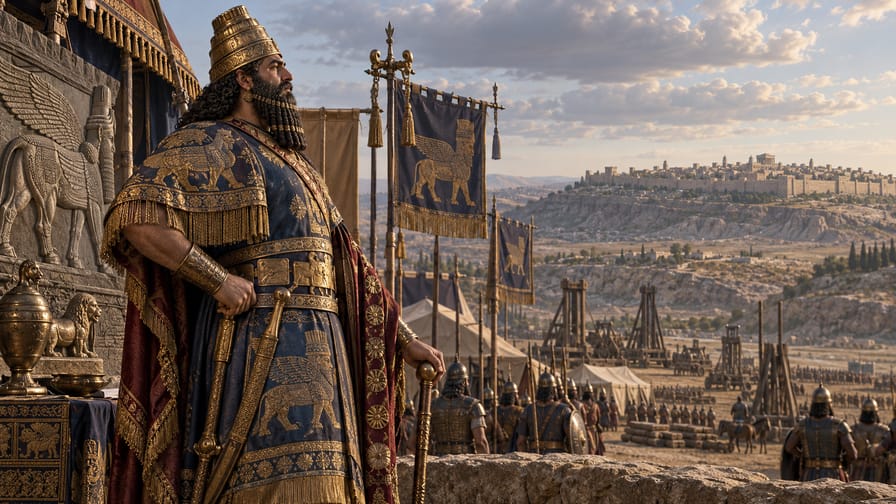
1. Etymology and meaning of the name
The name Sennacherib (Hebrew: סַנְחֵרִיב, Sanḥeriv) designates one of the most prominent kings of the Assyrian Empire, whose figure is central in biblical narratives. Although it appears in the Old Testament in its Hebrew form, the name's origin is Akkadian, the official language of Assyria.
The original Akkadian name is Sîn-ahhē-erība, which can be translated as "Sîn (the moon god) replaced the brothers." This etymology suggests a possible family or dynastic history, where the lunar deity Sîn might have "compensated" for the loss of brothers, perhaps through death or disgrace, by the birth or ascent of Sennacherib himself.
The etymological root reflects the deep Assyrian polytheistic religiosity, where personal names frequently invoked deities. In the case of Sennacherib, the mention of Sîn, one of the main gods of the Mesopotamian pantheon, reveals the cosmovision of his time and culture.
There are no other biblical characters with the name Sennacherib, making him unique and distinctly associated with the Assyrian king. The name's singularity reinforces his unmistakable identity in the Scriptures and in the history of the Ancient Near East.
From a theological point of view, the meaning of Sennacherib's name, which invokes a pagan deity, contrasts sharply with the God of Israel, YHWH. This opposition is a recurring theme in the biblical narrative, where the power and authority of YHWH are demonstrated as superior to any foreign gods.
The very history of Sennacherib in the Bible serves to illustrate the sovereignty of God over pagan gods and kings, ironically transforming a name that glorified Sîn into a testimony of the glory of YHWH.
2. Historical context and biblical narrative
2.1 Period and political context
Sennacherib reigned as king of Assyria from 705 to 681 BC, succeeding his father, Sargon II. This period marked the zenith of the Assyrian Empire, characterized by its military brutality, relentless territorial expansion, and a policy of terror and deportation to maintain control over conquered peoples.
The kingdom of Judah, under the rule of King Hezekiah, was a small vassal nation, constantly threatened by Assyrian hegemony. Judah's foreign policy was a delicate balance between forced loyalty to Assyria and the temptation to seek alliances with Egypt or other regional powers, a practice frequently condemned by the prophets of Israel.
The religious context of the time was one of syncretism and apostasy in many parts of Judah, despite Hezekiah's reforms. The Assyrian threat was seen as a divine judgment upon the people's infidelity, as prophesied by Isaiah and other prophets.
2.2 Main events and biblical passages
The biblical narrative focuses primarily on Sennacherib's campaign against Judah in 701 BC, detailed in 2 Kings 18:13-19:37, Isaiah 36:1-37:38, and 2 Chronicles 32:1-23. These passages offer a parallel and complementary record of the events.
After the death of Sargon II, several vassal nations, including Judah, rebelled against Assyria. Sennacherib undertook a massive campaign to restore control, recording his deeds in his annals, such as the Sennacherib's Cylinder, which largely corroborates the biblical narrative.
The Assyrian campaign devastated the fortified cities of Judah. The Bible reports that Sennacherib took "all the fortified cities of Judah" (2 Kings 18:13), an assertion confirmed by Assyrian records that mention the capture of 46 fortified cities.
Lachish (Lachish) was a crucial strategic point, whose fall is vividly described in Assyrian reliefs and mentioned in the Bible (2 Kings 18:14). After the fall of Lachish, Sennacherib sent his envoys, including the Rabshakeh (chief commander), to demand the surrender of Jerusalem.
The Rabshakeh delivered an arrogant and blasphemous speech in Hebrew, mocking Hezekiah's trust in YHWH and comparing God to the defeated gods of other nations (2 Kings 18:19-35). He challenged YHWH's ability to deliver Jerusalem, arguing that no god had been able to resist Assyrian power.
In the midst of despair, Hezekiah sought the counsel of the prophet Isaiah and prayed fervently to God (2 Kings 19:1-19). Isaiah, in the name of YHWH, assured that Jerusalem would be spared and that Sennacherib would be forced to return to his land (2 Kings 19:20-34).
The divine intervention occurred spectacularly: "That night the angel of the Lord went out and put to death a hundred and eighty-five thousand in the Assyrian camp" (2 Kings 19:35). This miraculous event led to Sennacherib's immediate withdrawal.
The end of Sennacherib is also recorded in the Bible: "While he was worshiping in the temple of Nisroch his god, his sons Adrammelech and Sharezer killed him with the sword" (2 Kings 19:37). He was assassinated by his own sons in Nineveh, his capital, fulfilling Isaiah's prophecy (2 Kings 19:7).
2.3 Geography and relations
The passages about Sennacherib geographically involve Assyria, with its capital Nineveh, and the kingdom of Judah, with its key cities Jerusalem and Lachish. The Assyrian campaign extended throughout the Levant region, affecting various peoples and cities.
Sennacherib's relations with other biblical characters are predominantly antagonistic, highlighting his interaction with King Hezekiah of Judah and the prophet Isaiah. He is the main adversary in the narrative that exalts faith and dependence on God.
3. Character and role in the biblical narrative
3.1 Character analysis
Sennacherib's character, as revealed in the Scriptures, is marked by an overwhelming arrogance and boundless pride. He saw himself as invincible, a conqueror whose military successes were attributed solely to his own strength and the superiority of his gods, or to the lack of power of enemy gods.
His cruelty is evident in Assyrian records and implicit in the devastation of Judah, which made him an instrument of judgment for God. He showed neither compassion nor mercy, seeking to annihilate those who opposed his empire.
Blasphemy is a central trait of his character in the biblical narrative. Through his Rabshakeh, Sennacherib openly challenged the sovereignty of YHWH, comparing Him to powerless idols and mocking Hezekiah's faith. This direct affront to God sealed his destiny.
No positive virtues or spiritual qualities are attributed to Sennacherib in the Scriptures. He is portrayed as an enemy of God and His people, an example of the futility of human power when confronted with divine omnipotence.
3.2 Role in the biblical narrative
Sennacherib's role in the biblical narrative is multifaceted, serving as an instrument of divine providence and a catalyst for the revelation of God's power. Firstly, he is the "rod of YHWH's anger" (Isaiah 10:5), used to judge the nations, including Judah, for their disobedience.
Despite his intention being merely imperialistic conquest, Sennacherib unwittingly executed God's purposes. Isaiah prophesied that, although Assyria would be used to punish Israel, it would itself be judged for its arrogance (Isaiah 10:12).
His campaign against Jerusalem serves to test the faith of Hezekiah and Judah. The desperate situation leads the king to a deep dependence on God and to prayer, demonstrating the power of faith and intercession in the midst of adversity (2 Kings 19:15-19).
The miraculous defeat of Sennacherib before Jerusalem is an unquestionable demonstration of YHWH's sovereignty over human empires and pagan gods. God protected His city and His people, fulfilling His covenant promises, despite Judah's failures.
Sennacherib's actions, therefore, are not just historical events but vehicles for biblical theology. He is a character who, by his own impiety, serves to glorify the name of God and reinforce the prophetic message about divine judgment and salvation.
4. Theological significance and typology
4.1 Role in redemptive history and progressive revelation
The figure of Sennacherib is crucial for understanding redemptive history by demonstrating God's sovereignty over all nations and kings, even the most powerful and wicked. He is a vivid example of how YHWH uses even the enemies of His people to fulfill His purposes and reveal His glory.
His story illustrates the progressive revelation of God as the one true sovereign, contrasting with the impotence of idols and the arrogance of human rulers. Sennacherib's defeat in Jerusalem is a testimony to God's faithfulness to His covenant and to His city.
The narrative serves to reaffirm the authority of the prophetic word, especially that of Isaiah, who foresaw both the use of Assyria as an instrument of judgment and its eventual downfall due to its own insolence (Isaiah 10:5-19).
4.2 Typology and theological themes
Although Sennacherib is not a positive type foreshadowing Christ, he serves as an "anti-type" or a contrasting type. He represents the arrogant and blasphemous enemy of God and His people, whose ultimate destiny is defeat and judgment.
In this sense, Sennacherib can be seen as a foreshadowing of God's eschatological enemies, whose attempts to annihilate the people of God will ultimately be frustrated by divine intervention. His fall points to Christ's final victory over all forces of evil.
The story of Sennacherib and Hezekiah highlights several central theological themes:
- Sovereignty of God: God controls world events and uses pagan nations for His purposes (Isaiah 14:24-27).
- Power of Prayer: Hezekiah's prayer is an example of faith that moves the hand of God (2 Kings 19:15-19).
- Covenant Faithfulness: God fulfills His promises to protect Jerusalem and the Davidic lineage (2 Samuel 7:16).
- Divine Judgment: Sennacherib's arrogance and blasphemy are severely punished by God.
- Protection of the Remnant: God ensures the preservation of a faithful remnant, even in the midst of destruction.
There are no direct citations of Sennacherib in the New Testament. However, the theological principles of divine judgment on human arrogance and God's sovereignty over worldly powers are widely present, resonating with the message of Christ and the apostles.
The doctrine associated with Sennacherib is, therefore, that of divine providence and the absolute authority of YHWH. The narrative serves as a fundamental teaching about the futility of trusting in human strength and the necessity of relying exclusively on God.
5. Biblical-theological legacy and canonical references
5.1 Canonical mentions and influence on biblical theology
The mentions of Sennacherib in the biblical canon are concentrated in the historical and prophetic books of the Old Testament: 2 Kings 18-19, Isaiah 36-37, and 2 Chronicles 32. The repetition of the story in three different books underscores its theological and historical importance for the editors of the canon.
The story of Sennacherib and his defeat in Jerusalem is fundamental to biblical theology for several reasons. It authenticates the message of the prophets, especially Isaiah, demonstrating the accuracy of his predictions about Assyria's fate and Jerusalem's salvation.
This narrative reinforces the doctrine of inerrancy and authority of the Scriptures, as the biblical details align remarkably with extrabiblical records, such as the Assyrian annals, while offering a unique theological perspective on the events.
The story of Sennacherib contributes significantly to understanding the nature of God as the Lord of history, who intervenes directly in human affairs to protect His people and fulfill His redemptive purposes.
5.2 Presence in interpretive tradition and evangelical theology
In the Jewish interpretive tradition, the story of Sennacherib is a hymn to the divine protection of Jerusalem and a testimony to Israel's resilience. It is a narrative that inspires confidence in God's intervention in moments of extreme crisis.
In Christian theology, and particularly in the evangelical Protestant perspective, the story of Sennacherib is frequently used to illustrate the absolute sovereignty of God. Commentators like John Oswalt, in his work on Isaiah, highlight how God uses pagan nations for His purposes and judges them for their arrogance.
The story is a powerful reminder that, no matter how powerful an enemy appears, the Lord of Hosts is supreme. It encourages faith and prayer, showing that dependence on God is the only true security in the face of worldly threats.
Reformed theology, with its emphasis on providence and the sovereignty of God, finds an exemplary case in the narrative of Sennacherib. The miraculous defeat of the Assyrian army is seen as a clear demonstration that God acts throughout history for the glory of His name and the salvation of His people.
Sennacherib's importance for understanding the canon lies in his function as a catalyst for the revelation of God's faithfulness to the covenant, the veracity of prophecy, and the power of prayer. His story is a pillar for the doctrine of divine providence and God's protection over His church, whether ancient Israel or the church of Christ.