


Selah
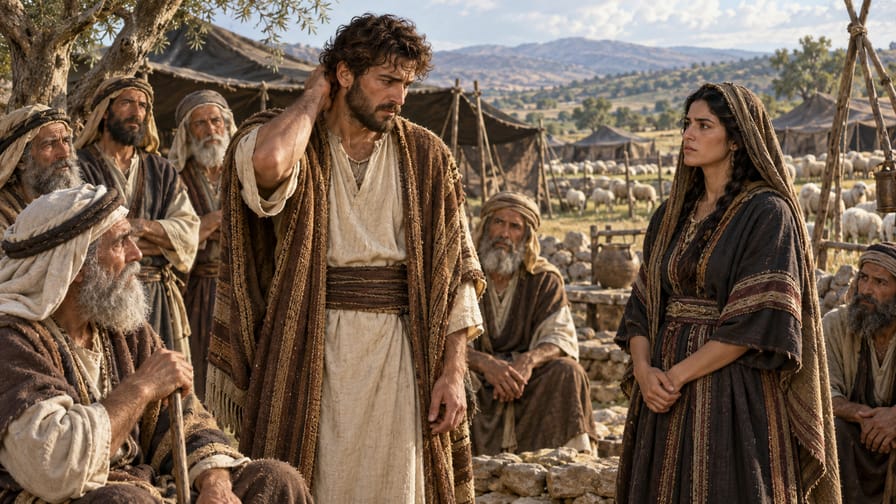
The figure of Shelah (in Hebrew, שֵׁלָה, Shēlāh) emerges in the pages of the Old Testament as a discreet, yet crucial, character within the complex tapestry of patriarchal history. Although he has no recorded actions or words, his existence and the context of his birth and marriage promise are fundamental to the narrative of Genesis 38.
His story is part of the family drama of Judah, one of Jacob's sons, and serves as a silent, yet significant, link in the preservation of the messianic lineage. From an evangelical Protestant perspective, the analysis of Shelah reveals not only genealogical details but also profound theological lessons about the sovereignty of God, divine faithfulness amidst human failure, and the intricate providence that paves the way for redemption.
This study seeks to comprehensively explore the figure of Shelah, addressing his etymology, historical context, role in the biblical narrative, theological significance, and legacy. The intention is to provide a scholarly and theologically precise analysis, suitable for a biblical-theological dictionary, highlighting his relevance for understanding redemptive history.
1. Etymology and Meaning of the Name
The name Shelah, transliterated from Hebrew as Shēlāh (שֵׁלָה), is of Semitic origin, and its etymology is the subject of some discussion among scholars. The most commonly accepted root for the name is שָׁאַל (sha'al), which means "to ask," "to demand," or "to request."
From this root, the name Shelah could be interpreted as "request" or "requested." This interpretation suggests that the name may have reflected the circumstances or desires of his parents at the time of his birth. However, the Bible does not offer an explicit explanation for the meaning of the name in relation to the event of his birth, as it does with some other biblical characters.
Other less common etymological suggestions include derivations connecting the name to concepts such as "javelin" or "weapon," or even to "peace" or "tranquility." However, the connection to the root sha'al is the most widely accepted in academic and theological circles, due to its recurrence and linguistic consistency in biblical Hebrew.
In some Bible versions and transliterations, the name may appear as "Shelah," maintaining the same phonetic and etymological essence. It is important to note that, although the name Shelah has a potential meaning, the biblical narrative does not explore it for direct symbolic purposes in relation to the character's own nature or destiny.
There are no other prominent characters in the Bible with the exact same name as Shelah, son of Judah, which makes him unique in his identification within the Scriptures. The distinction is crucial, as the name "Selah" (סֶלָה, selah) is also a liturgical term found in the Psalms, with a completely different meaning ("pause," "to lift up"), and does not refer to a person.
The theological significance of Shelah's name, therefore, does not lie in an intrinsic prophecy within its literal meaning, but rather in its insertion into the context of salvation history. He is a link in the genealogy, and his existence, even if passive, is vital for the unfolding of the divine plan, as will be explored in the following sections.
The presence of Shelah in Judah's genealogical record is, in itself, a testament to divine providence that preserves the lineage, even amidst human complexities and failures. His name, "requested," can thus be seen as an echo of God's "requests" and longings for a righteous lineage that would culminate in the Messiah.
2. Historical Context and Biblical Narrative
2.1 Family Origin and Genealogy
Shelah is introduced in the book of Genesis, specifically in chapter 38, which interposes itself in the narrative of Joseph's life. This chapter is crucial for understanding the history of Judah and the development of his lineage. Shelah is Judah's third son, born of his Canaanite wife, Bath-shua, daughter of Shuah (Shu'a), according to Genesis 38:2, 5.
His older brothers were Er and Onan. The biblical narrative details that Er was Judah's firstborn, but he was wicked in the sight of the Lord and died without leaving offspring (Genesis 38:7). Onan, the second son, was then instructed to fulfill the law of levirate marriage, taking Tamar, Er's widow, to raise up offspring for his brother.
However, Onan also refused to fully fulfill his obligation, spilling his semen on the ground so as not to give offspring to his brother. For this attitude, he was also wicked in the sight of the Lord and died (Genesis 38:9-10). This series of tragic events left Judah with only one remaining son, Shelah.
The genealogy of Shelah is reaffirmed in other passages of the Old Testament, consolidating his position in the tribe of Judah. He is mentioned in Genesis 46:12, in the list of those who went down to Egypt with Jacob, and in Numbers 26:20, in the census of the tribes, where he is identified as the progenitor of the Shelanites (Shelanites).
Furthermore, 1 Chronicles 2:3 and 1 Chronicles 4:21 also record Shelah as a son of Judah, highlighting the continuity of his descendants and the importance of his lineage for the history of Israel. These references demonstrate that, although his personal narrative is brief, his genealogical identity is firmly established in the Scriptures.
2.2 Main Events and Geography
The historical period in which Shelah lived is that of the patriarchal era, approximately between the 18th and 17th centuries BC, before Jacob and his family's complete descent into Egypt. The political and social context was one of nomadic or semi-nomadic clans and families, interacting with local Canaanite populations.
The main narrative involving Shelah unfolds in Genesis 38. After the death of his brothers, Judah, fearing that Shelah might also die if he married Tamar, his daughter-in-law, instructed her to return to her father's house and wait until Shelah grew up (Genesis 38:11). This promise, however, was not fulfilled by Judah.
The geography associated with this part of the story includes locations such as Adullam, where Judah settled and met Shelah's mother, and Chezib, where Shelah was born (Genesis 38:1, 5). These locations place the narrative in the region of Judea, indicating the patriarchs' interaction with the Canaanite cities and peoples.
Shelah's relationships with other biblical characters are primarily with his immediate family: his father Judah, his mother Bath-shua, his brothers Er and Onan, and Tamar, who was his sister-in-law and whom he was supposed to marry. Judah's decision to withhold Shelah from Tamar is the central point that triggers the subsequent events of chapter 38, leading to the complex interaction between Judah and Tamar.
Although Shelah is a passive character in the narrative, his existence and the unfulfilled promise of his marriage to Tamar are the pivot of the plot. Judah's failure to give Shelah to Tamar not only demonstrates the ambiguous morality of the time but also sets the stage for divine intervention that would ensure the continuity of Judah's messianic lineage through Perez and Zerah.
3. Character and Role in the Biblical Narrative
3.1 Analysis of Character and Function
The analysis of Shelah's character is peculiar, as the Scriptures do not record any action, speech, or decision attributed directly to him. He is, in essence, a silent and passive character in the biblical narrative, functioning more as a catalyst for the actions of others than as an active agent in his own story.
We cannot discern virtues or spiritual qualities in Shelah from the text, nor sins, weaknesses, or moral failings. His youth at the time of the events of Genesis 38 implies that he was a child or adolescent, still under the guardianship and decisions of his father Judah.
His primary role, therefore, is to be the object of the levirate marriage promise made by Judah to Tamar. Judah promised: "Remain a widow in your father's house until my son Shelah grows up" (Genesis 38:11). Judah's failure to fulfill this promise is the driving force of the plot of Genesis 38.
The specific vocation or function of Shelah, besides being Judah's son, is not detailed. He is not presented as a prophet, priest, king, or any other leadership role. His importance lies purely in his genealogical position and the impact his existence had on the decisions of his father and Tamar.
The significant actions and key decisions in the narrative of Genesis 38 are made by Judah and Tamar, not by Shelah. He is the son Judah feared losing, and because of whom Judah withholds Tamar, failing in his obligation. This failure of Judah is what leads Tamar to conceive by Judah through a stratagem, giving birth to Perez and Zerah.
There is no character development for Shelah throughout the narrative, as he remains a static figure. His relevance is not in his personal evolution, but in how his presence (or the absence of his action) shapes the destiny of others and, by extension, Judah's messianic lineage. The story of Shelah is, in fact, the story of Judah's failure and Tamar's determination.
Shelah's passivity, paradoxically, makes him a central figure for understanding divine providence that operates through human imperfections. He is a reminder that God can use even the inaction of an individual and the failures of others to fulfill His redemptive purposes.
4. Theological Significance and Typology
4.1 Role in Redemptive History and Divine Providence
Although Shelah is a passive character, his figure is intrinsically linked to the redemptive history of Israel and the progressive revelation of God's plan. The narrative of Genesis 38, in which Shelah is a pivot, highlights God's sovereignty in preserving the messianic lineage, even in the face of moral failure and human disobedience.
Divine providence is notably evident. Judah's failure to fulfill the law of levirate marriage, by withholding Shelah from Tamar, is circumvented by God through Tamar's shrewdness. She conceives by Judah, not by Shelah, and thus Perez and Zerah are born. It is through Perez that the lineage of Judah leading to David and, ultimately, to Christ, is established (Matthew 1:3).
Therefore, Shelah is not a direct Christocentric prefiguration or typology in the sense that his actions or character point to Christ. Instead, his story serves as a crucial backdrop to illustrate God's work amidst human imperfection. Judah's omission regarding Shelah is the catalyst that, paradoxically, ensures the continuity of the promised lineage through unexpected means.
The narrative of Shelah and Tamar is a powerful testimony to God's faithfulness to His covenants, especially the Abrahamic Covenant, which promised that through Abraham's offspring would come blessing for all nations (Genesis 12:3). The promise of a royal and messianic lineage from Judah is kept, not by human merit, but by God's sovereign grace.
The story of Shelah also connects to central theological themes such as faith, obedience, and grace. The disobedience of Judah and Onan (and the passivity of Shelah) contrasts with Tamar's determination to ensure the continuation of the lineage, demonstrating that God can use improbable instruments to fulfill His purposes, sometimes even through morally ambiguous actions.
4.2 Connection to the New Testament and Doctrine
It is fundamental to clarify Shelah's connection to the New Testament. Unlike his half-brothers Perez and Zerah, who are explicitly mentioned in the genealogies of Jesus (Matthew 1:3), Shelah, son of Judah, is not directly named in the messianic lineages of the New Testament. The genealogies of Matthew and Luke trace Judah's descent through Perez, not through Shelah.
Confusion may arise from the fact that Luke 3:35 mentions a "Shelah, son of Arphaxad," but this is a much earlier character in biblical history, one of the post-diluvian patriarchs, and not Shelah, son of Judah. Therefore, the Shelah of Genesis 38 is not a direct ancestor of Jesus Christ in the genealogical line recorded in the New Testament.
However, Shelah's theological relevance for evangelical doctrine lies in demonstrating the sovereignty of God over human history and the perseverance of the covenant. The story of Judah, Tamar, and Shelah illustrates God's ability to operate His redemptive plans even when human agents fail in their responsibilities.
The doctrine of the grace of God is also prominent. It is not the righteousness of the ancestors that guarantees the coming of the Messiah, but God's grace and faithfulness. The story of Shelah, set in the context of Judah's failure, highlights that God is not limited by human imperfection but can transform adverse circumstances into instruments for His glory and the fulfillment of His promises.
The analysis of Shelah reinforces the evangelical Protestant belief in biblical authority and the integrity of the canon, which does not hesitate to record the failures and moral complexities of the patriarchs. These narratives, including that of Shelah, serve to reveal fallen human nature and the desperate need for a Savior, who would come from the lineage that God sovereignly preserved.
5. Biblical-Theological Legacy and Canonical References
5.1 Mentions and Influence in Biblical Theology
The figure of Shelah is mentioned in various canonical passages of the Old Testament, in addition to Genesis 38, the central chapter of his narrative. He appears in genealogical lists that attest to the continuity of the families and tribes of Israel. In Genesis 46:12, he is listed among the sons of Judah who went down to Egypt with Jacob.
In the book of Numbers, during the census conducted by Moses, Shelah is identified as the progenitor of a specific clan within the tribe of Judah: "The sons of Judah, according to their families, were: of Shelah, the family of the Shelanites..." (Numbers 26:20). This demonstrates his importance as an ancestor and founder of one of the subdivisions of the tribe of Judah.
The books of Chronicles also refer to Shelah in their detailed genealogies. In 1 Chronicles 2:3, he is again listed as one of Judah's sons. Later, in 1 Chronicles 4:21-23, the "sons of Shelah, son of Judah" are mentioned, showing the continuity of his descendants and their activities as weavers, indicating a specific profession for some of his descendants.
Shelah is not known for direct literary contributions, as there are no books, Psalms, or epistles attributed to him. His influence on biblical theology lies in how his story, and that of his family, illustrates fundamental principles of the Judeo-Christian faith. He is a testament to the intricate way in which God orchestrates human history to fulfill His plans.
The presence of Shelah in Jewish and Christian interpretive tradition is generally contextualized within the narrative of Judah and Tamar. He is seen as the son whom Judah should have given to Tamar, and his retention led to the events that resulted in the birth of Perez, the true ancestor of the Davidic and messianic lineage.
5.2 Treatment in Reformed and Evangelical Theology
In Reformed and evangelical theology, the story of Shelah and Genesis chapter 38 are often used to underscore the doctrine of the sovereignty of God. Commentators like John Calvin and Matthew Henry, while not focusing extensively on Shelah individually, analyze the context to highlight how God, in His providence, overcomes human failures to accomplish His purposes.
The narrative of Shelah serves as a vivid example of the grace of God in action. Even in an environment of questionable morality and broken promises (on Judah's part), God ensures that the lineage from which the Savior would come is not interrupted. This demonstrates that election and redemption do not depend on human perfection, but on divine faithfulness.
The story of Shelah, although not directly typological of Christ, is fundamental to Christocentric typology in an indirect way. It illustrates the principle that salvation comes through unexpected means and often through a "remnant" or a line preserved by divine intervention. Judah's failure to give Shelah to Tamar is the "mistake" that God uses to lead to the "correction" of the messianic lineage through Perez.
Shelah's importance for understanding the canon lies in his contribution to the completeness of Judah's story. Genesis chapter 38, with the inclusion of Shelah, is not a diversion from the main narrative of Joseph, but a vital section that establishes Judah's lineage, justifying why the messianic promise would come through this tribe, despite its initial failures.
Thus, Shelah, the passive son and object of an unfulfilled promise, remains a biblical-theological reminder of God's marvelous work, who weaves His redemptive will through the complexities and imperfections of human history, ensuring the coming of the Messiah in His appointed time and manner.