


Barzilai
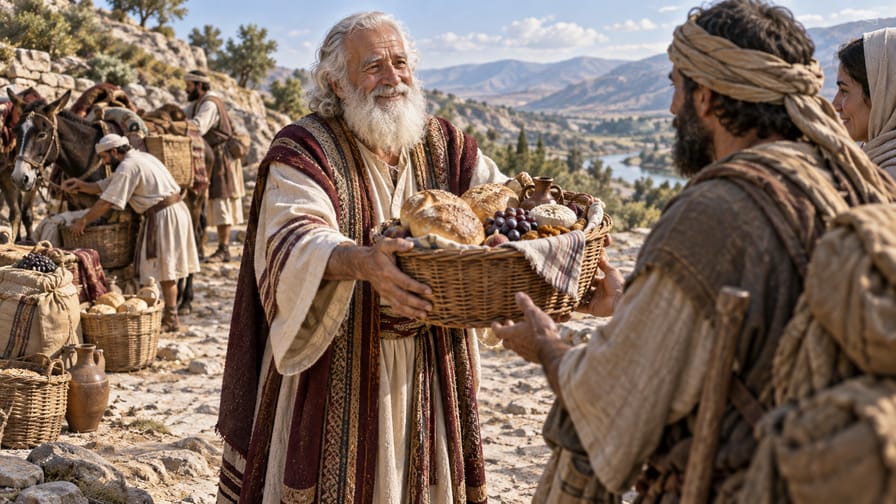
The figure of Barzilai, a man from Gilead, emerges in the Scriptures during one of the most turbulent periods in King David's life: Absalom's rebellion. Although his appearance is brief, his character, his actions, and the legacy he left for his family and for the history of Israel are profoundly instructive and full of theological significance.
His story is a testament to unwavering loyalty, sacrificial generosity, and practical wisdom, serving as a model of faithful service to God's anointed king, even in times of great adversity. An analysis of his life offers rich lessons on divine providence, the nature of true devotion, and the importance of discernment in the Christian life, viewed through an evangelical Protestant lens.
1. Etymology and meaning of the name
The name Barzilai (in Hebrew: בַּרְזִלַּי, Barzillay) is of Semitic origin and has a quite evocative meaning, which largely reflects the character of the individual who bore it. The etymological root of the name derives from the Hebrew word barzel (בַּרְזֶל), meaning "iron."
Thus, the name Barzilai can be transliterated as "man of iron," "ironworker," "made of iron," or "sturdy as iron." This literal meaning points to qualities such as strength, solidity, resilience, and unbreakability, characteristics that are prominently manifested in the biblical narrative associated with him.
There are no significant variations of the name Barzilai in biblical languages, and it is consistently represented in its original Hebrew form. Interestingly, there are no other prominent biblical characters with the same name, which makes his identification unique and his legacy distinctive.
The theological significance of the name lies in its correspondence with the man's character. In a period of crisis and instability for David's kingdom, Barzilai demonstrated a firmness and loyalty that were, indeed, "like iron." He remained unwavering in his support for God's anointed king, contrasting with the fragility and inconstancy of many others.
The name, therefore, is not merely a label, but a prophetic or retrospective description of his essence, highlighting his strength of character and his integrity. For the evangelical reader, the name Barzilai serves as a reminder of the importance of robust faith and unwavering loyalty to God and His purposes, even in the face of adversity.
2. Historical context and biblical narrative
The figure of Barzilai emerges in the biblical narrative during one of the darkest and most challenging periods of David's reign, approximately between 1000 and 970 BC. The context is Absalom's rebellion, David's son, who had usurped the throne and forced the king to flee Jerusalem (2 Samuel 15:13-14).
This was a time of great political and social instability in Israel, with the nation divided and David himself in a position of extreme vulnerability. The chaos resulting from Absalom's insurrection generated distrust and uncertainty, leading many to abandon David in his time of need.
2.1 Family origin and genealogy
Barzilai is identified as a man from Rogelim, a locality in Gilead, a region east of the Jordan River, known for its fertility and for being a refuge in times of conflict (2 Samuel 17:27). He is described as a very wealthy and influential man (2 Samuel 19:32), which gave him the capacity to provide substantial help.
Although his detailed genealogy is not provided in the Scriptures, the mention of his son, Chimham (Kimham), who later associated with David, indicates that Barzilai was the patriarch of a prominent and established family in the region of Gilead (2 Samuel 19:37-40).
2.2 Key events in his life
Barzilai's main appearance in the biblical narrative occurs in 2 Samuel 17:27-29, when David and his followers, fleeing Absalom, arrived at Mahanaim in Gilead. At this moment of extreme need, Barzilai, along with Shobi son of Nahash from Rabbah, and Machir son of Ammiel from Lo-Debar, demonstrated extraordinary loyalty and generosity.
They brought abundant provisions for David and his army: beds, basins, earthenware vessels, wheat, barley, flour, roasted grain, beans, lentils, honey, curds, sheep, and cheese from their herd. This help was crucial, as the Bible states that "the people were hungry, weary, and thirsty in the wilderness" (2 Samuel 17:29).
After Absalom's defeat and David's restoration to the throne, the king, upon his return to Jerusalem, invited Barzilai to accompany him and live at court, promising him sustenance and honor (2 Samuel 19:31-33). This invitation was an acknowledgment of David's debt of gratitude to the man from Gilead.
However, Barzilai, with his wisdom and discernment, declined the king's offer. He pleaded his advanced age (eighty years) and his desire to die in his own city, near his parents' tomb. Instead, he asked that his son, Chimham, go with David and receive the royal blessings and favor (2 Samuel 19:34-37).
This act of humility and detachment is a high point in Barzilai's narrative. David accepted the request, blessed Barzilai, and took Chimham with him. Later, in his final instructions to Solomon, David commanded that the sons of Barzilai should receive kindness and provision from the royal court, as a reminder of their father's loyalty (1 Kings 2:7).
Subsequently, Barzilai's name appears in Ezra 2:61 and Nehemiah 7:63, where a family of priests could not prove their lineage, because one of their ancestors had married a daughter of Barzilai the Gileadite and adopted her name. This shows the prominence of the name and the importance of priestly lineage in the post-exilic period.
3. Character and role in the biblical narrative
Barzilai's character is portrayed in the Scriptures with great admiration, revealing various virtues that make him a remarkable example of faith and service. His figure stands out as a model of loyalty and generosity in a moment of profound national crisis.
One of Barzilai's most evident qualities is his unwavering loyalty to King David, the Lord's anointed. While many turned against David or hesitated in their support during Absalom's rebellion, Barzilai demonstrated unquestionable faithfulness, providing vital aid to the king and his followers (2 Samuel 17:27-29).
His generosity is another striking trait. Being a wealthy man, he did not hesitate to use his resources to supply the needs of David and his army, who were hungry and exhausted. This act of munificence was not just a donation, but an investment in the kingdom of God and in His earthly representative, David.
Barzilai's wisdom is evident in his refusal to go to Jerusalem with David (2 Samuel 19:34-37). He recognized his limitations due to advanced age and the impossibility of fully enjoying life at court. This decision reveals humility, self-knowledge, and discernment about what truly mattered to him in his final years.
He did not seek personal glory or material benefits for himself, but rather secured a future for his son, Chimham, demonstrating an altruistic spirit and concern for his family's well-being. This underscores his maturity and detachment from worldly honors, preferring the peace and comfort of his homeland.
There are no records of sins, weaknesses, or moral failures documented for Barzilai in the biblical narrative. On the contrary, his conduct is consistently presented in a positive light, as a man of integrity and one who feared God.
His role in the narrative is that of a provider and a pillar of support for King David. He was not a prophet, priest, or chief warrior, but a community leader who used his influence and wealth to sustain the kingdom in its moment of greatest fragility. His calling was that of a faithful benefactor, a "man of iron" who did not bend under pressure.
Barzilai's significant actions — the provision of supplies and the refusal of royal honor in favor of his son — are key decisions that shape his biblical image. They illustrate the importance of practical loyalty and discernment in managing the gifts and time that God bestows.
The development of Barzilai's character is consistent he appears already as a mature and established man, and his actions confirm a character already formed by solid principles. His story is an example of how individuals, even in secondary roles, can have a profound and lasting impact on salvation history, through their faithfulness and service to God and His servants.
4. Theological significance and typology
The figure of Barzilai, though not central to salvation history, offers rich theological meanings and practical lessons for evangelical faith. His life fits into the progressive revelation of God, demonstrating how divine providence operates through faithful individuals in times of crisis.
He exemplifies the truth that God uses ordinary people, with their resources and social position, to fulfill His purposes and sustain His anointed ones. Barzilai's generosity towards David reflects God's faithfulness in providing for His servants, even in the most adverse circumstances (Philippians 4:19).
In terms of Christocentric typology, Barzilai is not a direct prefiguration of Christ, as he does not bear messianic or redemptive attributes. However, his actions and character can be seen as a type of service and loyalty that points to the principles of the Kingdom of God and the expected conduct of Christ's followers.
His unwavering loyalty to David, the anointed king, can be interpreted as a model of loyalty to authority constituted by God, and, ultimately, to the sovereignty of Christ as King of kings (Revelation 19:16). Barzilai's provision for David in his hour of need can be seen as a metaphor for the church that serves and sustains the body of Christ on earth.
Barzilai's refusal to accept the honors and luxury of David's court in Jerusalem, preferring to die in his own land, carries profound theological significance. This can be interpreted as an example of detachment from earthly possessions and honors in favor of a more eternal perspective or satisfaction in a spiritual "home" (Matthew 6:19-21).
He valued the rest and peace of his own home and family above the ostentation of the royal court, which resonates with the biblical teaching to seek first the Kingdom of God and His righteousness (Matthew 6:33). His wisdom in recognizing his physical and spiritual limitations for life at court is a model of discernment regarding each one's place and time of service in the body of Christ (Romans 12:3-8).
Barzilai's connection with central theological themes is evident. His story illustrates the importance of faith manifested in works of love and service (James 2:17). His obedience and loyalty to David, even when the latter was fleeing, demonstrate the seriousness of the commandment to honor authorities (Romanos 13:1-7).
David's gratitude and his instruction to Solomon to show kindness to the sons of Barzilai (1 Kings 2:7) reveal the doctrine of divine reward for those who serve faithfully. Although Barzilai did not seek an earthly reward, God, through David, ensured that his lineage would be blessed, echoing the promise that "whoever gives one of these little ones a cup of cold water... will certainly not lose his reward" (Matthew 10:42).
In summary, Barzilai is an example of selfless service, loyalty, and practical wisdom. His life teaches us about God's providence, the importance of Christian generosity, and the discernment needed to live a life that pleases the Lord, seeking not the honors of this world, but the well-being of the Kingdom and the glory of God.
5. Biblical-theological legacy and canonical references
Barzilai's legacy is notable not only for his actions during Absalom's rebellion but also for the way he is remembered and referenced in other parts of the biblical canon. His story serves as an enduring testimony of loyalty and generosity, influencing biblical theology in various ways.
The most prominent mentions of Barzilai occur in 2 Samuel 17 and 19, and in 1 Kings 2. In 2 Samuel 17:27-29, he is the crucial provider for David. In 2 Samuel 19:31-39, he is the wise elder who refuses royal honor in favor of his son. In 1 Kings 2:7, David, on his deathbed, instructs Solomon to extend kindness to Barzilai's sons, ensuring the continuity of royal favor to his family.
This instruction from David to Solomon is particularly significant. It is not merely an act of personal gratitude, but a declaration that loyalty and service to God's anointed king should be rewarded and remembered through the generations. This underscores the importance of faithfulness in the covenant and God's providence that honors those who serve Him, even indirectly, through His leaders.
Besides these passages, Barzilai's name resurfaces in Ezra 2:61 and Nehemiah 7:63. In these texts, a family of priests, who had returned from the Babylonian exile, is mentioned as "the sons of Barzilai (who had married one of the daughters of Barzilai the Gileadite and was called by their name)."
This reference does not refer directly to the original Barzilai, but to a family that adopted his name through marriage. The problem here is that, by adopting the name of a layperson, they lost the ability to prove their priestly lineage. This highlights the importance of genealogical purity for the Levitical priesthood and, by extension, the need for discernment and faithfulness to God's ordinances, even in times of difficulty.
In Jewish and Christian interpretive tradition, Barzilai is often cited as an archetype of loyalty, generosity, and wisdom. Evangelical commentators like John Gill and Matthew Henry highlight his humility and detachment from worldly honors as exemplary virtues. He is seen as someone who understood the transience of life and the priorities of the kingdom.
In Reformed and evangelical theology, Barzilai's story is used to illustrate principles such as divine providence, the reward for faithfulness, and the importance of selfless service. He is an example of how God's grace is manifested through human generosity and how loyalty to the "anointed one" (whether a king, a spiritual leader, or Christ Himself) is valued in the divine plan.
Barzilai's refusal to go to Jerusalem is also seen as an act of wisdom and discernment, teaching that not all opportunities, even those offered by godly leaders, are for everyone. There is a time and a place for everyone in God's service, and wisdom lies in recognizing one's own limitations and what God calls us to do in each phase of life (Ecclesiastes 3:1).
Barzilai's importance for understanding the canon lies in his practical demonstration of Kingdom values. He reminds us that faithfulness to God and His servants is a path to blessing, and that true wisdom often involves humility and detachment from earthly glories in favor of a legacy of faithful service and an eternal perspective.