


Arphaxad
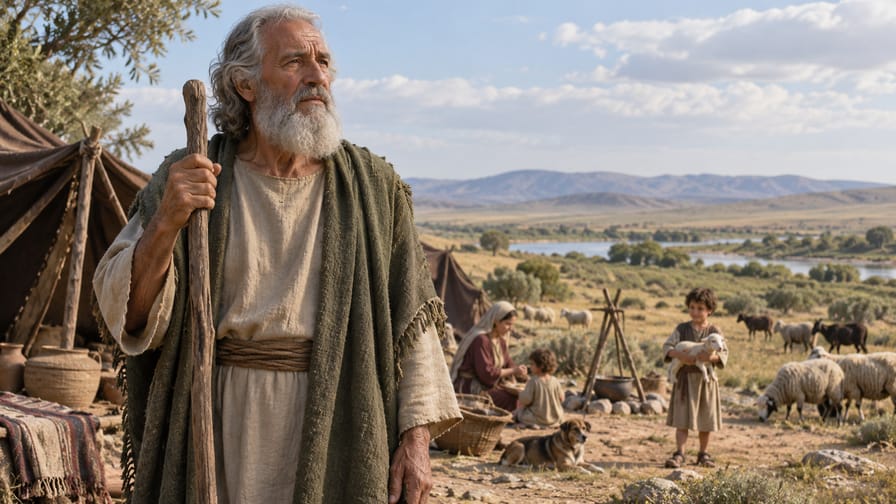
1. Etymology and Meaning of the Name
The name Arphaxad (in Hebrew: אַרְפַּכְשַׁד, Arpakhshad) is one of the most enigmatic and debated names in the post-diluvian genealogies of the Old Testament. He appears as the son of Shem and father of Salah in biblical narratives, marking a crucial link in the messianic lineage that would culminate in Abraham and, finally, in Jesus Christ. The complexity of its etymology reflects the antiquity and possible geographical origin of the character.
The etymological root of Arpakhshad is not entirely clear to scholars. Various theories have been proposed, many of them linking the name to geographical regions or descriptive meanings. One interpretation suggests a connection with the land of the Chaldeans, "fortress of the Chaldeans" or "region of the Chaldeans," deriving from a possible Akkadian or Aramaic term.
Another etymological hypothesis attempts to derive the name from Hebrew or Semitic roots that could mean "healer" or "restorer," although this is less consensual. The ambiguity in the etymology underscores the archaic nature and the difficulty in deciphering names from such remote periods. Nevertheless, the mere presence of such a name in a genealogy is a testament to its historicity and relevance to the biblical writers.
Despite the etymological uncertainties, the name Arphaxad carries a symbolic meaning implicit in its position in redemption history. He represents the continuity of the divine promise, the preservation of the chosen lineage through Shem after the Flood. Even if the literal meaning of the name is obscure, its theological significance lies in its genealogical function.
There are no other prominent biblical characters with the same name, which makes him unique in Scripture. His uniqueness highlights the importance of his position as an irreplaceable link in the genealogical chain leading to the Redeemer. The mention of Arphaxad in Genesis 10:22, 11:10-13, 1 Chronicles 1:17-24, and Luke 3:36 consistently establishes his identity throughout the canon.
From a theological standpoint, the very obscurity of the literal meaning of the name Arphaxad can serve to highlight God's sovereignty. It is not the meaning of the name itself that is crucial, but the person who holds it and his function in the divine plan. God chooses and uses individuals, regardless of whether their names carry explicit prophetic meanings.
2. Historical Context and Biblical Narrative
2.1 Family Origin and Post-Diluvian Period
Arphaxad emerges in the biblical narrative during the post-diluvian period, a crucial era for the reconfiguration of humanity and the establishment of nations. He is the third son of Shem, one of Noah's three sons who survived the Flood, as recorded in Genesis 10:22. This position places him directly in the Semitic lineage, which is of primordial importance to salvation history.
The Bible informs us that Arphaxad was born two years after the Flood, when Shem was one hundred years old (Genesis 11:10). This temporal precision is notable and underscores the meticulous biblical chronology, which aims to trace human descent from creation. The historical period can be approximated to the beginning of the second millennium B.C., depending on the biblical chronology adopted (Ussher or others).
The political, social, and religious context of Arphaxad's time was one of reconstruction and repopulation. After the Flood, humanity was in its initial stage of rediversification and the establishment of new communities. Nations were beginning to form, and the dispersion of languages at Babel was still on the horizon (Genesis 11:1-9), although Arphaxad lived before or during this event, depending on the exact calculation of the generations.
2.2 Key Events and Biblical Passages
The biblical narrative about Arphaxad is concise and focused on his genealogical function. Key passages are found in Genesis 10:22, where he is listed as the son of Shem Genesis 11:10-13, which details his age when he begot his son Salah and his longevity 1 Chronicles 1:17-24, which reiterates his position in the genealogy of Israel and Luke 3:36, which includes him in the genealogy of Jesus Christ.
According to Genesis 11:12-13, Arphaxad lived 35 years and begot Salah. After the birth of Salah, he lived another 403 years and had other sons and daughters, totaling 438 years of life. This longevity, although less than that of his pre-diluvian ancestors and his father Shem, is still significant and reflects the gradual decrease in human life expectancy after the Flood.
There are no accounts of specific actions, journeys, or detailed interactions of Arphaxad with other characters outside of the genealogical context. His existence is documented primarily by his fatherhood and his position in the line of descent. This lack of personal narrative does not diminish his importance but directs it toward his structural function in redemption history.
The geography related to Arphaxad is, by inference, the region where the descendants of Shem initially settled after the Flood. The mention of "Chaldeans" in some interpretations of his name suggests a connection to Mesopotamia, perhaps the region later known as Abraham's homeland, Ur of the Chaldeans (Genesis 11:28). This geographical connection, though speculative, reinforces the idea that the chosen lineage was rooted in one of the first great post-diluvian civilizations.
3. Character and Role in the Biblical Narrative
The Bible offers no details about Arphaxad's personal character, nor about his virtues or flaws. Unlike figures such as Abraham, Moses, or David, there are no narratives describing his actions, decisions, or interactions that could reveal personality traits. His figure is presented in a purely genealogical manner, serving as a vital link in the chain of redemptive history.
Arphaxad's primary role in the biblical narrative is that of a progenitor. His importance lies not in what he did, but in what he is: a direct ancestor of Abraham and, consequently, of Jesus Christ. Scripture highlights his fatherhood of Salah in Genesis 11:12, an act that, though common, is theologically laden with meaning for the continuity of the divine promise.
His existence and procreation represent God's faithfulness in preserving the chosen lineage, the "seed of the woman" promised in Genesis 3:15. Even without explicit narratives of his faith or obedience, his inclusion in Jesus' genealogy in Luke 3:36 implies that he, as part of that lineage, was under divine providence and contributed to the plan of salvation.
In a broader sense, the lack of details about Arphaxad's character can be instructive. It reminds us that God's sovereignty operates through ordinary people, many of whom are not heroic or prominent figures in human history. His contribution to the divine plan was simply to exist, marry, and have children, thus fulfilling God's mandate to "be fruitful and multiply" (Genesis 9:1).
Evangelical theologians like John Walton emphasize that biblical genealogies are not mere genealogical records, but theological documents that highlight God's faithfulness and the progression of His covenant. The presence of Arphaxad in these lists is a testament to God's sovereign hand guiding history toward the fulfillment of His purposes.
While we cannot attribute specific virtues or flaws to him based on Scripture, his position in the lineage allows us to infer that he was a man who lived in a time of hope and expectation, aware of his Semitic heritage and God's promise. His long life, according to Genesis 11:13, allowed him to witness several generations and the expansion of humanity.
4. Theological Significance and Typology
The theological significance of Arphaxad is immense, although his figure is devoid of narrative action. He is an irreplaceable link in redemption history, serving as a crucial genealogical bridge between Shem and Abraham. His presence in Scripture is a demonstration of God's meticulous faithfulness in preserving the chosen lineage through which the Messiah would come.
The inclusion of Arphaxad in the genealogies of Genesis 11 and 1 Chronicles 1 is not accidental it serves a fundamental theological purpose: to establish the authenticity and continuity of the messianic lineage. He is one of the post-diluvian patriarchs who ensure that the promise of the "seed of the woman" (Genesis 3:15) is transmitted from generation to generation until its fulfillment in Christ.
While Arphaxad is not a direct type of Christ in the prophetic or ritual sense, his existence prefigures God's faithfulness in upholding His covenant. The preservation of the lineage through him is a manifestation of divine sovereignty, which operates through circumstances and individuals to accomplish His redemptive plan. He is part of the "preparation" for the coming of Christ.
There are no direct quotes of Arphaxad in the New Testament, except for his inclusion in the genealogy of Jesus in Luke 3:36. This reference is, however, of utmost theological importance. It validates the historicity of Arphaxad and confirms his position as an ancestor of Jesus, demonstrating the continuity of the divine plan from the dawn of humanity to the advent of the Savior.
Arphaxad's life, though not detailed, connects with central theological themes such as God's sovereignty, covenant faithfulness, and divine election. His existence is proof that God, in His grace, chooses and preserves a people through whom His promises will be fulfilled, even in a fallen and dispersed world after the Flood.
The Reformed theologian John Calvin, in his commentaries on Genesis, emphasizes the importance of genealogies for demonstrating God's providence in the formation of the Church and in the preparation for Christ. Arphaxad, in this sense, is a silent testimony to God's continuous work in history. The line of Shem, through Arphaxad, is the line of blessing and salvation.
Ultimately, Arphaxad's role in salvation history is that of a vessel, an essential link in the chain connecting the original promise of a Redeemer to its final realization. He is not the focus of the promise, but the guarantee of its transmission, demonstrating God's unwavering faithfulness in fulfilling His designs through generations.
5. Biblical-Theological Legacy and Canonical References
The biblical-theological legacy of Arphaxad, though discreet in terms of narrative, is profoundly significant for understanding salvation history and biblical theology. His main contribution lies in his mention in three canonical books: Genesis, 1 Chronicles, and Luke, solidifying his position as a historically and theologically relevant figure.
In Genesis 10:22 and 11:10-13, Arphaxad is presented as the son of Shem and father of Salah, establishing the continuity of the lineage that would lead to Abraham. This is the first and most detailed reference, providing information about his age when begetting Salah and his longevity. This precision underscores the seriousness with which biblical authors treated the history of humanity.
The genealogy in 1 Chronicles 1:17-24 reiterates Arphaxad's position, confirming his importance to the people of Israel by tracing their origins. The genealogies in Chronicles had a vital purpose for Israel's national and religious identity, connecting them directly to the patriarchs and, by extension, to the divine promises made to them.
The most theologically charged reference in the canon is found in Luke 3:36, where Arphaxad is listed as an ancestor of Jesus Christ. His inclusion in one of the Messiah's genealogies in the New Testament is the ultimate validation of his relevance. It connects Jesus directly to the lineage of Shem, Noah, and Adam, emphasizing His humanity and His position as the fulfillment of the ancestral promise.
In Reformed and evangelical theology, the figure of Arphaxad is seen as a testament to God's sovereignty and faithfulness in His election. He is a link in the chain of divine grace, through whom the promise of redemption was carefully preserved. Commentators like Matthew Henry emphasize that God's providence extends to every individual in the line of Christ, even those with little to no personal narrative.
The presence of Arphaxad in Jewish and Christian interpretative tradition reinforces the idea of a linear history of redemption, guided by God's hand. His life, though without dramatic events, ensures the integrity of the messianic lineage, showing that God does not abandon His purposes. He is a reminder that each generation has a role to play in the divine plan.
Arphaxad's importance for understanding the canon lies in his contribution to the cohesion of the biblical narrative, linking the post-diluvian period to the patriarchal era. He demonstrates God's meticulous providence in preparing the way for the coming of Christ, confirming that salvation history is a continuous and divinely orchestrated narrative, from creation to consummation.