


Abimelech
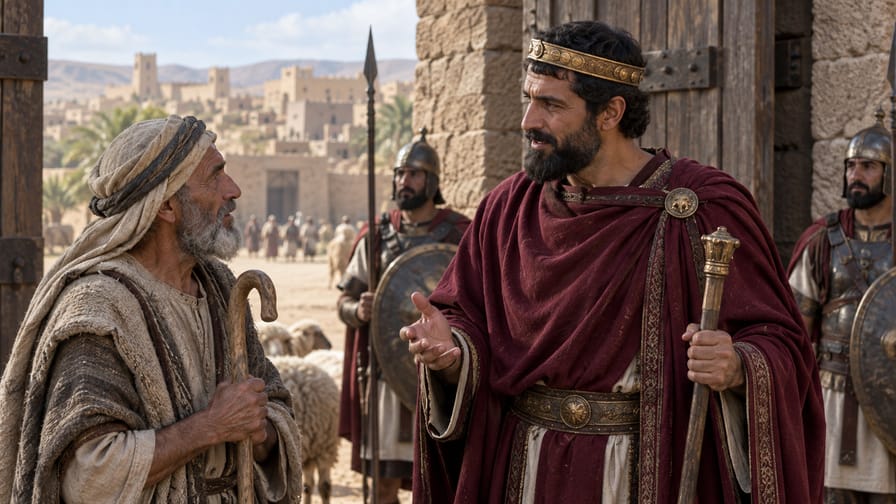
The biblical figure of Abimelech (in Hebrew, *ʾĂḇîmeleḵ*, אֲבִימֶלֶךְ) does not refer to a single individual, but to several prominent characters in the Old Testament, the most notable being the Philistine king of Gerar and the son of Gideon. The name, possibly a dynastic title in some cases, carries substantial theological and historical significance, revealing aspects of divine sovereignty, human justice, and the complexities of leadership. This analysis will address the most significant instances of the name, focusing on their stories, characters, and theological relevance from a conservative evangelical Protestant perspective.
1. Etymology and meaning of the name
The name Abimelech derives from the Hebrew *ʾĂḇîmeleḵ* (אֲבִימֶלֶךְ), a composition of two words: *ʾāḇ* (אָב), which means "father," and *meleḵ* (מֶלֶךְ), which means "king." The combination results in "my father is king," "father of the king," or, more commonly interpreted as a title, "royal father" or "king-father."
This compound name suggests a deep connection to royalty. In the context of the Philistine kings of Gerar, it is probable that Abimelech was a dynastic title, similar to "Pharaoh" for Egyptian kings or "Caesar" for Roman emperors, indicating a succession of rulers who bore the same name or designation. This explains why the same name appears in Genesis with Abraham and, later, with Isaac (Genesis 20:2 Genesis 26:1).
For Abimelech, son of Gideon, the name is clearly a personal name. Its choice may have been aspirational, reflecting Gideon's desire not to be king (Judges 8:23), but perhaps an expectation from his mother or the son himself for a position of power, which aligns with his subsequent attempt to usurp the throne in Shechem. The theological significance of the name lies in its intrinsic relationship with authority and government, whether legitimate or illegitimate, divinely instituted or humanly ambitious.
In addition to the kings of Gerar and the son of Gideon, there is a third mention of an Abimelech in the superscription of Psalm 34, where it reads that David "feigned madness before Abimelech, who drove him away, and he departed." However, the historical account in 1 Samuel 21:10-15 identifies the king of Gath with whom David interacted as Achish. Many scholars suggest that Abimelech was a royal title for the Philistine kings, and Achish was the personal name of the king at that time, reinforcing the idea that the name was often a royal designation.
2. Historical context and biblical narrative
2.1 Abimelech, king of Gerar
The first significant Abimelech appears in the book of Genesis, interacting with the patriarchs Abraham and Isaac. His story is set in the patriarchal period, approximately between 2000 and 1800 B.C., an era characterized by migrations of semi-nomadic peoples, the emergence of city-states in the Levant, and an incipient social and political organization.
This Abimelech was the king of Gerar, a Philistine city located in the Negev region, south of the land of Canaan. The biblical narrative presents him in two distinct episodes. The first occurs in Genesis 20, when Abraham, fearing for his life, presents his wife Sarai (Sarah) as his sister. Abimelech takes her for himself, but God intervenes in a dream, warning the king about the impending sin and the sanctity of Abraham and Sarah's union (Genesis 20:3-7).
God reveals to Abimelech that he acted with integrity of heart, but that the woman was married. The king, in response to the divine warning, returns Sarah to Abraham, along with gifts and permission to dwell in his land. This event culminates in a covenant between Abimelech and Abraham in Beersheba (Genesis 21:22-34).
Years later, another Abimelech (likely a successor, maintaining the dynastic title) interacts with Isaac, son of Abraham, in Genesis 26. Isaac, also out of fear, repeats his father's deception, presenting Rebekah as his sister. Abimelech discovers the truth by observing Isaac caressing Rebekah (Genesis 26:8) and rebukes Isaac, issuing a decree to protect the couple. Later, he and his officials visit Isaac in Beersheba to make a covenant, recognizing that the Lord was with Isaac (Genesis 26:26-31).
2.2 Abimelech, son of Gideon
The second Abimelech of great relevance is the son of Gideon, whose story is told in Judges 9. This period of the Judges (approximately 1200-1050 B.C.) was a time of great turbulence in Israel, marked by the absence of a central king, religious apostasy, and cycles of oppression and liberation. After the death of Gideon, who refused kingship for Israel (Judges 8:23), his son Abimelech, born of a Shechemite concubine, emerged as an ambitious and violent figure.
The narrative of Judges 9 describes how Abimelech conspired with his maternal relatives in Shechem, convincing them to support him as king instead of Gideon's seventy legitimate sons. He massacred seventy of his brothers in Ophrah, sparing only Jotham, the youngest son, who managed to escape (Judges 9:5).
After the massacre, the citizens of Shechem and Beth-Millo crowned him king. Jotham, from a rock, uttered a parable and a prophetic curse against Abimelech and the Shechemites (Judges 9:7-21). The parable of the trees seeking a king foretells the mutual destruction between Abimelech and Shechem. His tyranny lasted three years, culminating in a revolt in Shechem, which Abimelech brutally suppressed, destroying the city and sowing it with salt (Judges 9:45).
The story of Abimelech ends tragically in Thebez, where he was mortally wounded by a millstone thrown by a woman from the top of a tower (Judges 9:53). To avoid the dishonor of dying by a woman's hand, he ordered his armor-bearer to kill him with a sword (Judges 9:54). His death is presented as the fulfillment of Jotham's curse and an example of divine justice.
2.3 Abimelech, king of Gath (Achish)
The mention in Psalm 34:1, which attributes the psalm to David "when he feigned madness before Abimelech, who drove him away," refers to the episode narrated in 1 Samuel 21:10-15. In this account, the king of Gath is named Achish. As mentioned, the identification of Abimelech as a generic title for Philistine kings resolves the apparent discrepancy. David, fleeing from Saul, sought refuge among the Philistines, and to avoid being captured or killed, he feigned madness, managing to escape from Achish's court.
3. Character and role in the biblical narrative
3.1 Abimelech, king of Gerar
The Abimelech of Gerar is portrayed in a remarkably positive light for a pagan king. He demonstrates a sense of justice, moral integrity, and, crucially, fear of God, especially after divine intervention. When God warns him in a dream, he responds with humility and obedience, seeking to rectify the situation and avoid sin (Genesis 20:4-7). His readiness to make covenants with Abraham and Isaac, recognizing God's blessing upon them, reflects wisdom and pragmatism uncommon for the time (Genesis 21:22 Genesis 26:28).
His role in the narrative is multifaceted. He serves as a moral contrast to the patriarchs, who, despite being God's chosen ones, demonstrate character flaws (fear, deception). The relative righteousness of Abimelech highlights God's sovereign grace in protecting His people, even when they fail. He is also an instrument of divine providence, as God uses him to protect Sarah and Rebekah, ensuring the continuation of the messianic lineage.
3.2 Abimelech, son of Gideon
The character of Gideon's son is diametrically opposite. He is a figure of inordinate ambition, cruelty, and tyranny. His rise to power is marked by fratricide and deception (Judges 9:5-6). He shows no fear of God, but seeks power through selfish and violent means. His leadership is oppressive, culminating in the destruction of Shechem, the city that had supported him (Judges 9:45).
His role is that of an anti-hero, a negative example of the consequences of the absence of theocratic leadership in Israel and the pursuit of human power. He embodies Jotham's curse and divine retribution. His story is a warning about the corruption of the human heart and the dangers of anarchy and autocracy. He is a vivid reminder of the need for a just and divinely chosen king for Israel.
3.3 Abimelech/Achish of Gath
The character of Achish (or Abimelech) in 1 Samuel 21 is less developed. He appears as a ruler who recognizes the potential danger of David, but who can be deceived by David's cunning. His decision to expel David, though based on the perception of madness, unintentionally serves God's purposes, protecting David and allowing him to continue his journey of preparation for kingship.
4. Theological significance and typology
4.1 Abimelech of Gerar in theology
The Abimelech of Gerar is theologically significant for several reasons. Firstly, he illustrates the sovereignty and providence of God, who protects His covenants and promises, even in the face of His servants' failures. God intervenes directly to prevent Abimelech's sin and, consequently, to preserve the purity of the patriarchal lineage (Genesis 20:6).
Secondly, the story of Abimelech demonstrates God's "common grace," extended to all human beings, regardless of their covenant affiliation. Abimelech, a pagan, possesses a sense of morality and justice, and God communicates with him in a dream, revealing the moral law inscribed on the human heart (Romans 2:14-15). His integrity is praised by God, which contrasts with the duplicity of Abraham and Isaac.
Although not a direct typological figure of Christ, Abimelech, in his relative righteousness and recognition of divine blessing upon Abraham, can be seen as a precursor to Gentiles who would recognize the God of Israel and His people. He represents an external witness to God's work, a theme that would unfold in the inclusion of the Gentiles in the redemptive plan.
4.2 Abimelech, son of Gideon, in theology
Abimelech, son of Gideon, serves as a powerful antitype, an example of what a leader should not be. His story is a somber commentary on the rejection of theocracy and the pursuit of corrupt human government. Gideon had refused kingship, stating: "The Lord shall rule over you" (Judges 8:23). Nevertheless, his son Abimelech imposed himself as king, resulting in chaos and bloodshed.
He is a vivid illustration of the curse of sin and God's retributive justice. Jotham's parable (Judges 9:7-15) is a prophecy literally fulfilled in the destruction of Abimelech and Shechem, demonstrating that "the wages of sin is death" (Romans 6:23) and that "God is not mocked" (Galatians 6:7). His humiliating death at the hands of a woman highlights divine sovereignty over the most powerful and the irony of his end.
The figure of Abimelech, the tyrant, indirectly points to the need for a just and perfect king, who would only be found in Jesus Christ. He is the contrast to the Messiah, who rules with love, justice, and sacrifice, rather than ambition and violence. The narrative of Abimelech underscores the importance of leadership according to God's standards and the tragic consequence of ignoring them.
4.3 Abimelech/Achish of Gath in theology
David's interaction with Achish/Abimelech in Gath (1 Samuel 21:10-15) is theologically relevant for demonstrating God's providence in protecting His anointed one. David, the future king of Israel, finds himself in a desperate situation, but God delivers him through his own cunning and the Philistine king's permission. Psalm 34, associated with this event, celebrates God's faithfulness in delivering the righteous from their afflictions (Psalm 34:4-6).
This episode reinforces the theme of trust in God amidst adversity and the idea that God uses unexpected means and even the actions of enemies to fulfill His purposes. It is a testimony to God's sovereignty over all nations and kings, including pagans, to protect His redemptive plan centered on David and, ultimately, on Christ.
5. Biblical-theological legacy and canonical references
The various figures of Abimelech leave a multifaceted legacy in biblical and Reformed theology. The Abimelech of Gerar is fundamental to understanding patriarchal history, highlighting God's faithfulness to His promises and His ability to use even pagans for His purposes. He is often cited in discussions on common grace and natural law, important themes in Reformed theology. Commentators such as John Calvin and Matthew Henry emphasize divine providence and the moral integrity of the Philistine king as a testimony to God's work outside the formal covenant.
Abimelech, son of Gideon, is a central figure in the book of Judges, serving as a dramatic culmination of the apostasy and disorder of the period. His story is a case study on the corruption of human power and divine justice. Jotham's parable (Judges 9:7-15) is one of the most literary and prophetic passages in the Old Testament, offering an incisive critique of godless monarchy. He is often used in sermons and studies on leadership and the consequences of rebellion against divine sovereignty, pointing to the need for the true King, Jesus Christ.
The mention of Abimelech in the superscription of Psalm 34 connects David's experience with divine providence and trust in God in times of danger. This psalm, with its message of deliverance and refuge in God, is a vital part of the poetic and wisdom canon, reinforcing the believer's dependence on God. The identification of Abimelech as a generic title also contributes to the understanding of Philistine royal terminology in biblical exegesis.
In summary, the characters named Abimelech, though distinct, contribute to the tapestry of biblical revelation, illustrating God's sovereignty over kings and nations, the protection of His people, the consequences of sin and human ambition, and the need for a just and divinely anointed king. They provide valuable lessons on the nature of God, the human condition, and the history of redemption, as interpreted by evangelical Protestant theology.