


Zimri
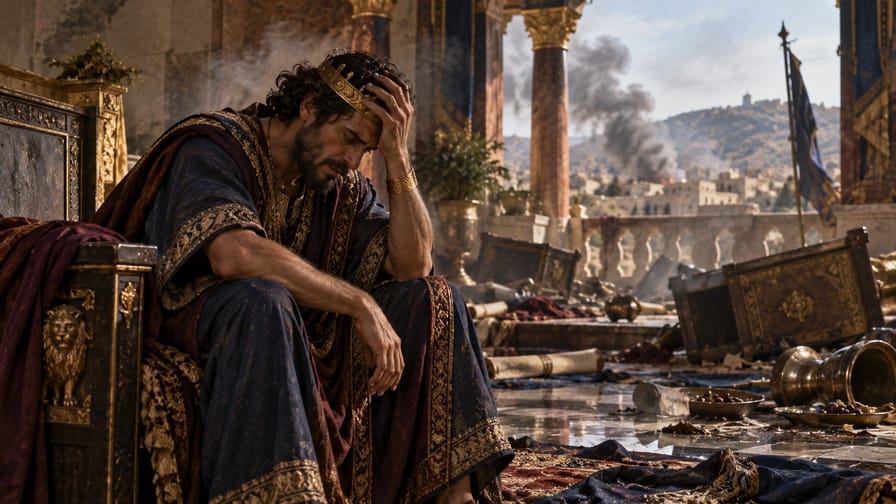
The figure of Zimri, though of brief appearance in the Hebrew Scriptures, offers a concise and potent case study on the nature of power, usurpation, and the consequences of disobedience to God in the context of the divided kingdom of Israel. His story, primarily recorded in 1 Kings 16, is a vivid example of the political instability and moral corruption that plagued the Northern Kingdom, Israel, after the division of the united monarchy.
The analysis of Zimri from a conservative evangelical Protestant perspective emphasizes the sovereignty of God over human kingdoms, the inevitability of divine judgment upon sin, and the importance of covenant faithfulness. His meteoric rise and fall serve as a perennial warning about the futility of seeking power through violence and unfaithfulness, and the swiftness with which God's justice can be executed, even amidst apparent human anarchy.
This entry will detail the etymology of his name, the historical context of his brief reign, the characteristics of his character, the theological significance of his narrative, and the legacy he left in the Scriptures, underlining the biblical authority and doctrinal relevance of his story for the evangelical Christian faith.
1. Etymology and meaning of the name
The name Zimri (Hebrew: זִמְרִי, Zimrī) is of Hebrew origin and appears in several instances in the Scriptures, although the most prominent is the king of Israel. The etymological root of Zimrī is associated with the verb זָמַר (zāmar), which can mean "to sing" or "to play an instrument".
However, another possible derivation is from a root meaning "my protection" or "my shadow," although this is less consensual among linguists. The most common and accepted interpretation relates Zimri to the idea of music or singing.
It is ironic that a name potentially associated with joy or artistic expression was borne by a man whose life and reign were marked by violence, intrigue, and a tragic end. This dissonance between the name and the character's destiny can serve as an implicit comment on divine irony or human fallibility in living up to a named meaning.
Besides the king of Israel, there are other biblical characters with the same name, though with distinct meanings and contexts. A Zimri is mentioned as a son of Zerah, from the tribe of Judah, in 1 Chronicles 2:6, and another as a son of Salu, leader of a paternal house of the Simeonites, in Numbers 25:14, notorious for his involvement in the apostasy of Peor.
Although these other Zimris do not share the same royal prominence, the presence of the name in different biblical contexts demonstrates its common existence in Hebrew culture. For King Zimri of Israel, the literal meaning of the name does not seem to have a direct theological or symbolic significance that aligns with his character or actions.
Instead, the strength of its meaning lies in the narrative itself, which reveals the consequences of sin and unfaithfulness, regardless of any positive connotation his name might suggest. His story is a reminder that an individual's character is defined by their choices and not by the etymology of their name.
2. Historical context and biblical narrative
Zimri's story unfolds in the turbulent period of the Northern Kingdom of Israel, approximately in the 9th century BC, after the division of the united kingdom under Rehoboam. This was a time of great political instability, characterized by coups d'état, assassinations of monarchs, and a rapid succession of dynasties, many of them short-lived.
The religious context was equally chaotic. Since the founding of the Northern Kingdom by Jeroboam I, the worship of Yahweh had been corrupted by the introduction of golden calves in Bethel and Dan (1 Kings 12:28-30), as well as by the growing influence of pagan cults. This widespread apostasy was at the root of much political and social instability, for unfaithfulness to the covenant with God brought with it divine judgment.
2.1 The rise of Zimri
Zimri was commander of half the chariots of King Elah, son of Baasha, who had usurped the throne from Nadab, son of Jeroboam I (1 Kings 15:27-28). Baasha's dynasty, which reigned for 24 years, was marked by the continuation of Jeroboam's idolatry, provoking God's wrath and the prophecy of Jehu, son of Hanani, that his house would be exterminated (1 Kings 16:1-4).
Elah, Baasha's son, reigned for only two years. The Bible portrays him as a weak and negligent king. It is during one of his moments of drunkenness in Tirzah, the kingdom's capital, in the house of Arza, the palace steward, that Zimri executes his coup plot (1 Kings 16:9).
The biblical narrative is direct and concise: Zimri conspired against Elah and assassinated him while the king was drunk. This act of regicide was not an isolated event but part of a recurrent pattern of violence and usurpation that characterized the history of the kings of Israel, the Northern Kingdom.
2.2 The seven-day reign and the fall
After Elah's assassination, Zimri ascended to the throne of Israel. His first action as king was to eliminate all of Baasha's house, fulfilling Jehu's prophecy (1 Kings 16:11-12). He left no man of Baasha alive, neither relatives nor friends, in a brutal purge to consolidate his power. This act, though cruel, was seen as a fulfillment of the word of the Lord against Baasha's house for his sins and for having made Israel sin (1 Kings 16:12-13).
However, Zimri's reign was the shortest in Israel's history, lasting only seven days. News of his usurpation and Elah's assassination quickly reached Israel's army, which was encamped at Gibbethon, a Philistine city. The army, led by Omri, the army commander, reacted immediately (1 Kings 16:15-16).
The soldiers proclaimed Omri king over Israel, and he and the entire army marched from Gibbethon to besiege Tirzah, the capital where Zimri was. The city was quickly taken. Seeing that the city was about to fall and that there was no hope of escape or maintaining the throne, Zimri sought a dramatic and ignominious end (1 Kings 16:17-18).
He entered the fortress of the king's house and set fire to the palace over himself, dying in the flames. His death by suicide amidst the collapse of his ephemeral reign is a testament to the hopelessness and condemnation that surrounded his actions. Geography is crucial here: Tirzah, once a city of beauty, became the stage of his downfall.
Zimri's narrative is a microcosm of the political instability of the Northern Kingdom and the constant threat of divine judgment upon kings who strayed from God's law. His story is intrinsically linked to that of Elah, Baasha, Jeroboam and, subsequently, Omri, forming a chain of violence and usurpation that demonstrates the absence of godly and stable leadership in Israel.
3. Character and role in the biblical narrative
Zimri's character is revealed concisely but impactfully through his actions in 1 Kings 16. He emerges as a figure of inordinate ambition, ruthless cruelty, and lack of political wisdom. The Bible records no virtues or positive qualities associated with him, presenting him as a negative example of leadership.
Zimri's first striking characteristic is his betrayal. As commander of half the chariots, he held a position of trust under King Elah. His conspiracy and the assassination of the king while he was drunk (1 Kings 16:9) reveal a profound lack of loyalty and cynical opportunism. This betrayal is a grave sin against established authority, even if that authority was flawed.
Secondly, his cruelty is evident in the complete purge of Baasha's house. Upon taking the throne, Zimri exterminated all of Baasha's relatives and friends, leaving no man alive (1 Kings 16:11). This brutal act of extermination aimed to eliminate any potential threat to his reign and consolidate his power through terror. Such violence is condemned in the Scriptures, even when it fulfills a divine prophecy, for the means employed are sinful.
Lack of strategic vision and impulsiveness are also traits of his character. His coup successfully overthrew Elah, but Zimri failed to foresee the reaction of the army and its commander, Omri. He could not secure the support of the military forces, which led to his swift downfall. His inability to consolidate power and ensure the loyalty of the troops demonstrates a fundamental incompetence for royal leadership.
Zimri's despair, culminating in his suicide by fire in the palace fortress (1 Kings 16:18), illustrates the futility of his efforts and the ultimate consequence of his sinful ambition. His death is an act of desperation and cowardice, avoiding capture and possible public execution, but not divine condemnation.
Zimri's role in the biblical narrative is, therefore, that of a usurper and regicide who serves as a link in the chain of impiety and instability of the Northern Kingdom. His story is a partial fulfillment of Jehu's prophecy against the house of Baasha, but also a testament to his own godlessness. Verse 1 Kings 16:19 states that he died "because of the sins he committed, doing what was evil in the eyes of the Lord, walking in the way of Jeroboam, and in his sin that he committed, making Israel sin."
This verse is crucial for understanding his theological role: he not only committed personal sins of violence and usurpation but also continued Jeroboam's pattern of idolatry, which had corrupted Israel. Thus, Zimri is presented as an example of a leader who not only failed morally but also spiritually, perpetuating the apostasy that would lead to the eventual destruction of the Northern Kingdom.
4. Theological significance and typology
The brief, yet intense, narrative of Zimri is rich in theological significance from an evangelical Protestant perspective, serving primarily as an antithesis of a godly leader and as a clear example of divine judgment. He offers no positive Christocentric typology on the contrary, his story is an anti-type, illustrating what Christ is not and the dangers of godless leadership.
Firstly, Zimri's story highlights the sovereignty of God over human history and over rulers, even the most wicked. Although Zimri acted out of ambition and cruelty, his actions resulted in the fulfillment of the Lord's word uttered by Jehu against the house of Baasha (1 Kings 16:7, 12). This demonstrates that God can use even the sinful acts of men to execute His purposes and judgments, without, however, endorsing or absolving the individual's sin.
Secondly, the narrative is a powerful testimony to divine judgment upon sin, especially idolatry and violence. Zimri's death by suicide, only seven days after his ascension, is a swift and visible manifestation of God's retribution. 1 Kings 16:19 explicitly states that he died "because of the sins he committed, doing what was evil in the eyes of the Lord, walking in the way of Jeroboam, and in his sin that he committed, making Israel sin."
This verse directly connects Zimri's sins (usurpation, murder, cruelty) to his adherence to Jeroboam's pattern of idolatry (the golden calves), which was the root of the Northern Kingdom's apostasy. His punishment serves as a reminder that God does not tolerate unfaithfulness to the covenant, not even in its leaders.
The political instability and violent succession of kings in Israel, exemplified by Zimri, are direct consequences of the rejection of God's law and the worship of idols. The lack of a stable dynasty, like the one promised to David in Judah (2 Samuel 7:12-16), is a sign of the covenant curse for disobedience (Deuteronomy 28:15ff).
Zimri's story, therefore, emphasizes the doctrine of God's holiness and His intolerance of sin. It reinforces the truth that disobedience brings severe consequences and that no one, not even a king, is above divine law. For Reformed theology, this resonates with the doctrine of God's retributive justice and humanity's inability to escape His scrutiny.
There is no direct Christocentric typology in Zimri. He does not prefigure Christ, nor does he point to Him in a positive way. On the contrary, his story serves as a radical contrast to the righteous, eternal, and peaceful reign of Jesus Christ. While Zimri ascended to the throne through murder and violence, Christ, the true King, came in humility, offering Himself as a sacrifice for humanity's redemption (Philippians 2:6-8).
Zimri's reign lasted only seven days, ending in despair and self-destruction, while Christ's kingdom is eternal and unshakable (Luke 1:33 Hebrews 1:8). The figure of Zimri is, thus, a somber reminder of human depravity and the need for a Redeemer, whose government is based on justice and love, and not on tyranny and violence.
5. Biblical-theological legacy and canonical references
Zimri's legacy in biblical theology is primarily that of a negative example, a solemn warning about the consequences of sin and inordinate ambition. His mention is brief, confined almost exclusively to 1 Kings 16:9-20, but his story is a crucial link in the narrative of the moral and political decadence of the Northern Kingdom of Israel.
Although Zimri did not contribute literary or prophetic works, his story is frequently referenced in theological contexts to illustrate the swiftness of divine judgment and the instability of kingdoms built on injustice. He is a character who punctuates the incessant series of coups and counter-coups that afflicted Israel, serving as a temporal marker for the transition of power.
The most notable mention of Zimri outside of his immediate context occurs in 2 Kings 9:31, where Queen Jezebel, confronting Jehu, who had just assassinated King Jehoram, rhetorically and accusingly asks: "Is it well with Zimri, who murdered his master?" This reference shows that, even generations later, Zimri's name was synonymous with betrayal, regicide, and an ignominious end. Jezebel uses Zimri's name to suggest that Jehu, by killing Jehoram, would follow the same fate as a usurper who had a brief and tragic reign.
In the Jewish and Christian interpretive tradition, Zimri is consistently seen as a type of wicked leader, whose power is ephemeral and whose downfall is a testament to God's justice. He is not remembered for his achievements, but for his catastrophic failure. Evangelical and Reformed theologians frequently cite his story to emphasize God's sovereignty over history and divine retribution upon those who reject His ways.
Zimri's story underscores the importance of covenant faithfulness. His sins, and the sins of the kings who preceded and followed him, are presented as the fundamental cause of the instability and eventual destruction of the Northern Kingdom. His narrative contributes to the understanding of the biblical canon by illustrating the consequences of large-scale disobedience and the manifestation of divine judgment in Israel's history.
In sum, Zimri, the seven-day king, remains a minor figure in terms of duration, but significant in terms of theological impact. He is a powerful reminder that human power is transient, that injustice does not prevail, and that God's sovereignty manifests even in the most chaotic of human events. His story, though brief, is an echo of the prophetic voice that the way of the wicked will perish (Psalm 1:6) and that the fear of the Lord is the beginning of wisdom (Proverbs 9:10).
His life and death are a microcosm of the tragedy that befell the Northern Kingdom, a kingdom that consistently turned away from God, culminating in its destruction and exile. Thus, Zimri's narrative continues to be an instructive tool for biblical theology, reinforcing the seriousness of sin and the certainty of divine judgment.