


Jared
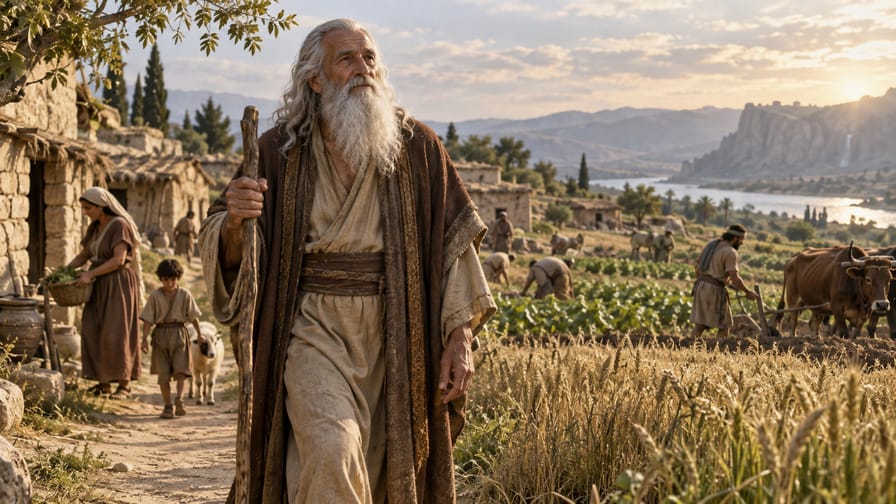
The figure of Jared, though briefly mentioned in the Scriptures, plays a crucial role in the antediluvian genealogy, serving as a vital link in the lineage leading to the Messiah. His existence, recorded in the book of Genesis, offers insights into the history of humanity before the Flood, the long lives of the patriarchs, and the persistence of the divine promise amidst a world in moral decline.
From an evangelical Protestant perspective, the analysis of Jared transcends mere genealogical listing, revealing aspects of God's faithfulness, the reality of sin, and the hope of redemption. This in-depth study will seek to unravel the onomastic meaning, historical context, role in the biblical narrative, and theological relevance of Jared, as revealed by the Holy Scriptures.
1. Etymology and meaning of the name
The name Jared, in Hebrew, is Yered (יֶרֶד), derived from the verbal root yarad (יָרַד), which means "to descend," "to go down," or "to fall." This root is frequently used in the Bible to describe movements of descent, whether physically (like descending a mountain) or metaphorically (like descending to the grave or descending in status).
The most common transliteration into Portuguese is Jarede, but other variations can be found in different translations. The literal meaning of "descent" or "he who descends" is particularly intriguing and laden with symbolism, especially considering the context of his life and the era in which he lived, shortly before the universal Flood.
There are no other prominent biblical characters with the exact same name as Jared. The uniqueness of the name and its etymological meaning invite reflection on the conditions of the antediluvian world and the direction of humanity in that era. The "descent" can allude both to the moral decay of humanity and to the descent of the "daughters of men" by the "sons of God" (Genesis 6:1-4).
Some commentators suggest that the name Jared may have been prophetic or descriptive of the time in which he lived. The moral and spiritual "descent" or "fall" of humanity was accelerating, culminating in the widespread corruption that led to the judgment of the Flood (Genesis 6:5-7). Thus, Jared's name may serve as a somber echo of the human condition of his era.
Another theological interpretation of the name "descent" could be more subtle. It might refer to the descent of God's grace upon the godly lineage of Seth, or even to the "descent" of divine revelation itself, which manifested to the patriarchs. However, the predominant view associates the name with the degeneration of humanity before the impending judgment.
The theological significance of the name Jared, therefore, is not limited to mere personal identification. It fits into the broader panorama of redemption history, where the meaning of a name often reflects divine purpose or the circumstances of the individual or their era. In Jared, we see a possible premonition of the decline that was to come.
2. Historical context and biblical narrative
Jared is a figure from the antediluvian period, as recorded in the genealogy of Genesis 5. He represents the sixth generation from Adam, through the lineage of Seth (Genesis 5:1-20). This genealogy is crucial for biblical theology, as it establishes the continuity of humanity after the Fall and, more importantly, the preservation of the messianic lineage.
The period in which Jared lived is characterized by long life expectancies, with the patriarchs often living for many centuries. He was born when his father Mahalalel was 65 years old (Genesis 5:15) and lived 962 years, making him the second longest-lived patriarch recorded in the Bible, surpassed only by Methuselah (Genesis 5:27).
The key biblical passages where Jared is mentioned are Genesis 5:15-20, 1 Chronicles 1:2, and Luke 3:37. Genesis 5 details his genealogy, his birth, the birth of his son Enoch, and his death. 1 Chronicles 1:2 lists him as part of the genealogy from Adam, and Luke 3:37 includes him in the genealogy of Jesus Christ through Mary, validating his historicity and redemptive importance.
The political, social, and religious context of Jared's time is sparsely detailed, but we infer from Genesis 6 that it was an era of increasing iniquity. The human population was multiplying, and the wickedness of man on the earth was great, and every imagination of the thoughts of his heart was only evil continually (Genesis 6:1-5).
Jared's genealogy is presented as part of the toldot (generations) of Adam, a literary pattern that structures Genesis and emphasizes the history of humanity. He is the son of Mahalalel and the father of Enoch (Genesis 5:15-18). His son Enoch is particularly notable for having "walked with God" and having been translated without experiencing death (Genesis 5:24).
Jared's relationship with Enoch is that of father and son, and this is the only specific personal relationship mentioned. Jared's life is a link between Mahalalel, who lived in Adam's time, and Enoch, who prophesied about the coming judgment (Jude 1:14-15). Jared's longevity allowed him to witness a large part of humanity's degeneration.
There are no specific geographical mentions associated with Jared, beyond the general context of antediluvian humanity, which is presumed to have spread from the region of Eden. The names in Seth's genealogy represent the line of faith, distinguishing itself from the line of Cain, which was characterized by technological innovation and violence (Genesis 4:17-24).
2.1 Family origin and genealogy
Jared's family origin is clearly established in Genesis 5:15-18. He is the son of Mahalalel, who in turn was a direct descendant of Seth, the third son of Adam and Eve, born after the death of Abel (Genesis 4:25-26). This lineage is of utmost importance, for it is from it that the messianic promise will be preserved.
The genealogy of Genesis 5 is known as the "line of Seth," which is contrasted with the "line of Cain" in Genesis 4. While the line of Cain is characterized by cultural advancements and, unfortunately, by violence and polygamy, the line of Seth is the lineage of hope, from which the promised Redeemer would come (Genesis 3:15).
Jared is the father of Enoch, a singular figure in biblical history who "walked with God" and did not see death, being translated by God Himself (Genesis 5:24 Hebrews 11:5). This family connection highlights Jared's importance as the father of one of the most enigmatic and pious characters in the Old Testament.
Jared's inclusion in the genealogy of Jesus in Luke 3:37 solidifies his position as an indispensable historical and theological link. He is not just a name on a list, but an ancestor of Christ, part of God's plan to bring salvation to humanity through a specific and divinely ordained lineage.
3. Character and role in the biblical narrative
The Bible provides very limited information about Jared's personal character. Unlike figures such as Abraham or David, there are no narratives describing his actions, decisions, or conversations. His life is summarized by his parentage, fatherhood, and the duration of his existence before his death, a common pattern for the antediluvian patriarchs in Genesis 5.
Nevertheless, his inclusion in Seth's messianic lineage, which is distinct from Cain's lineage, suggests an implicit righteousness. The line of Seth is often interpreted as the "seed of the woman" promised in Genesis 3:15, the lineage through which faith in God was maintained and transmitted in an increasingly corrupt world. Therefore, Jared is presumed to have been a man who maintained faith in God, like his ancestors and his son Enoch.
There is no record of documented sins, weaknesses, or moral failures for Jared in the Scriptures. The absence of such details, although not absolute proof of impeccability, is consistent with how the patriarchs of Seth's lineage are presented in Genesis 5: as vital links in the genealogical chain of promise, whose primary "action" is procreation and the transmission of life.
His primary role in the biblical narrative is that of a genealogical link. He is the father of Enoch, who, in turn, is the father of Methuselah, who is Noah's grandfather (Genesis 5:18-29). This function is essential for the progression of redemptive history, ensuring that the lineage chosen by God to bring the Savior remains intact.
Jared's calling, like that of other antediluvian patriarchs, was primarily to perpetuate humanity and, more specifically, the lineage of Seth, which was the bearer of the divine promise. In a time of great longevity, each patriarch was a guardian of history and the oral tradition of God's revelation, transmitting it from generation to generation.
Jared's most significant "action," as recorded, is having fathered Enoch at 162 years of age (Genesis 5:18). This event is the focal point of his existence in the biblical narrative, as it establishes the connection with one of the most notable figures of the Old Testament. Jared's longevity also means that he lived for a substantial period of human history before the Flood, witnessing the growth of the population and increasing iniquity.
Jared's character development is not explored in the biblical narrative. He serves more as a structural pillar in the genealogy than as a character with a narrative arc. However, his mere existence and longevity reinforce God's faithfulness in preserving His promised lineage, even in a world that was increasingly drifting away from Him.
4. Theological significance and typology
The theological significance of Jared primarily lies in his role as an unbreakable link in redemptive history. He is part of Seth's genealogy (Genesis 5), the lineage chosen by God to preserve the "seed of the woman" (Genesis 3:15) who would one day crush the serpent's head. His inclusion in the genealogy of Jesus Christ in Luke 3:37 confirms his soteriological relevance.
Jared's life, like that of other antediluvian patriarchs, serves as a testament to God's patience. Their long lives allowed for the transmission of divine truth for many generations and offered ample opportunity for repentance in an era of increasing depravity (Genesis 6:3). Longevity, in this context, can be seen as an extension of divine grace before judgment.
Although there is no explicit Christocentric typology directly associated with Jared, his existence in the messianic lineage implicitly connects him to Christ. He is one of the many ancestors who paved the way for the incarnation. The "descent" implied in his name can, in an inverse sense, prefigure Christ's "descent" from heaven to earth (Philippians 2:6-8), in a redemptive humility that contrasts with the fall of humanity.
The absence of detailed narratives about Jared emphasizes God's sovereignty in choosing and preserving His lineage. It is not Jared's prominence or great works that make him important, but rather the fact that God used him as an instrument in His greater plan. This resonates with the doctrine of grace, where God chooses and empowers, regardless of human merits.
Jared's connection with Enoch, his son, is theologically significant. Enoch, who "walked with God" and was translated, is a type of the raptured Church and an example of faith and piety in an ungodly world (Hebrews 11:5). Jared's existence as Enoch's father highlights the importance of the godly lineage and the transmission of faith through generations.
The long lives of the patriarchs, including Jared, can also be interpreted as a reflection of the fullness of life in Eden, before the Fall. The decrease in longevity after the Flood symbolizes the progressive degradation of creation and the intensification of the effects of sin, although God's grace continues to operate. Jared's life, therefore, is linked to themes of creation, fall, and redemption.
Jared's inclusion in the New Testament (Luke 3:37) is a confirmation of the historicity of the Genesis genealogies and the reliability of the Scriptures. For evangelical theology, this reinforces biblical authority and the belief in the verbal and plenary inspiration of the Word of God. Every name in Christ's genealogy is a testament to God's faithfulness in fulfilling His promises.
In sum, Jared, though a secondary character, is fundamental to understanding the history of redemption. He is a link in the chain of promise, a testament to God's patience, and an ancestor of Christ, whose life points to divine sovereignty in preserving a godly lineage amidst human decay, culminating in the coming of the Messiah.
5. Biblical-theological legacy and canonical references
Jared's legacy, though not marked by great deeds or extensive narratives, is of profound biblical-theological importance. His main contribution is that of being an unbroken link in the genealogy that connects Adam to Noah, and subsequently, to Jesus Christ. He is mentioned in Genesis 5:15-20, 1 Chronicles 1:2, and Luke 3:37.
The mentions in 1 Chronicles and Luke are particularly significant. 1 Chronicles 1:2, by listing the generations from Adam, validates Jared's historicity and his importance for the continuity of the history of the people of Israel. Luke 3:37, in the genealogy of Jesus, reiterates his position as a direct ancestor of the Savior, establishing the connection between primeval humanity and the divine incarnation.
There are no literary contributions attributed to Jared he is not the author of any book, psalm, or epistle. His relevance does not lie in his authorship, but in his existence and passive role in divine providence. He is a testament to how God works through ordinary individuals to fulfill His extraordinary purposes.
Jared's influence on biblical theology primarily resides in his role in the theology of covenant and redemption. He is part of the lineage of the covenant of grace, which God established with Adam and Eve (Genesis 3:15) and which was preserved through Seth. His life represents the continuity of faith amidst the progressive apostasy that led to the Flood.
In Jewish interpretive tradition, the antediluvian patriarchs are seen as figures of great longevity and wisdom, who transmitted the knowledge of God and the history of creation. Although Jared is not a primary focus, he is recognized as part of this chain of transmission of tradition and faith.
In Reformed and evangelical theology, Jared is frequently studied in the context of systematic biblical theology, specifically when addressing the doctrine of Christ's genealogy and the history of redemption. His inclusion in Seth's lineage is seen as evidence of God's faithfulness in preserving the "holy seed" (Isaiah 6:13) through which salvation would come.
The treatment of Jared in these traditions emphasizes God's sovereignty in choosing and preserving His lineage, the importance of generational transmission of faith, and the historicity of the Genesis accounts. He is a reminder that every individual, even the seemingly "minor" ones in the biblical narrative, has a place in God's great plan.
Although Jared is not prominently mentioned in intertestamental literature, apocryphal and pseudepigraphal books, such as the Book of Enoch, expand upon the antediluvian period and the interactions between humanity and celestial beings. In these texts, Jared's name may appear in contexts that seek to further detail the genealogy and events of that era, but these sources are not considered canonical or normative for evangelical faith.
Jared's importance for understanding the biblical canon lies in his function as a bridge. He connects the initial generations of humanity with the era immediately preceding the Flood, establishing the genealogical basis for the history of Noah and, by extension, for all subsequent history of Israel and the Church. His life, though concisely reported, is a testament to God's faithfulness throughout the ages.