


Jael
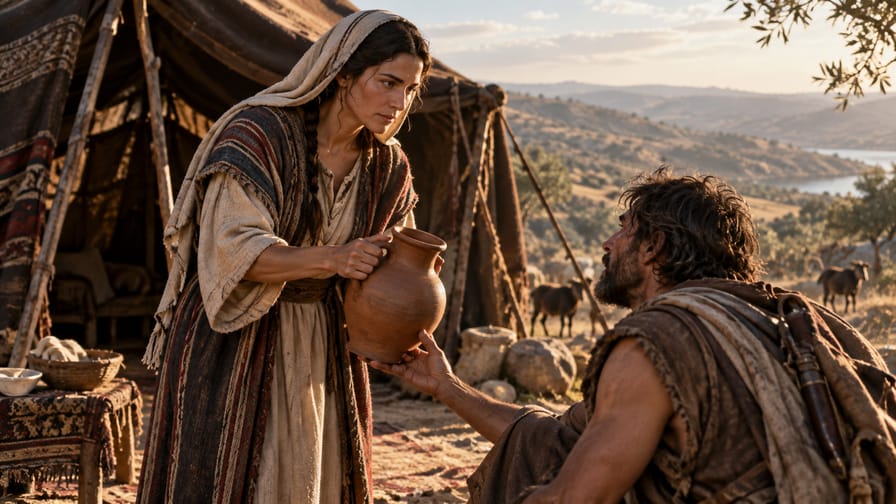
The figure of Jael emerges on the pages of the book of Judges as an unexpected, yet powerful, instrument of divine providence in the liberation of Israel. Her story, though concise, is rich in theological and exegetical implications, challenging superficial interpretations and inviting deep analysis. Within the evangelical Protestant perspective, Jael is seen as a heroine of faith, whose decisive act demonstrates God's sovereignty and His ability to use the least likely to fulfill His redemptive and judgmental purposes.
This study will examine the life and legacy of Jael, focusing on her onomastic significance, the historical context of her actions, the nuances of her character, the theological relevance of her actions, and their lasting impact on the biblical narrative. The analysis will seek to contextualize her story within the broad tapestry of redemptive history, as revealed in the Scriptures, highlighting biblical authority and exegetical precision.
1. Etymology and meaning of the name
The name Jael, in Hebrew Yael (יָעֵל), is a term that possesses a notable literal and symbolic meaning. The etymological root of the word is directly linked to the common name for a wild animal: the mountain goat or ibex. This animal is known for its agility, strength, and ability to inhabit rocky and elevated terrains, a characteristic that may reflect unexpected qualities of the biblical character.
The most common transliteration from Hebrew to Portuguese is Jael, although other forms such as Ya'el may be found in academic contexts. The meaning of "mountain goat" or "ibex" for Yael (יָעֵל) is consistently accepted by lexicographers and scholars of the Hebrew language, such as Koehler-Baumgartner (HALOT) and BDB (Brown-Driver-Briggs), who confirm the derivation from the common noun.
In the biblical context, the name Jael is unique there are no other characters with the same name in the Hebrew or Greek Scriptures, which gives the figure in the book of Judges even greater singularity. This onomastic exclusivity suggests that Jael's narrative is unique in its purpose and impact, not to be confused with other stories or lineages.
The theological significance of the name, though not explicitly detailed in Scripture, can be inferred from the character of the animal it represents. The mountain goat is a robust and determined animal, capable of overcoming obstacles in hostile environments. These qualities of tenacity and resilience can be seen as a foreshadowing of the bold and decisive actions that Jael would undertake against Israel's enemy, Sisera, in a time of great oppression.
The strength and agility of the ibex, which may seem contrasting with the traditional image of a tent-dwelling woman, underscore the divine irony of using "the weak things of the world to shame the strong" (1 Corinthians 1:27). Thus, the name Jael is not merely an identification, but a possible prefiguration of the unexpected and powerful nature of her intervention in the history of Israel.
2. Historical context and biblical narrative
Jael's story unfolds in one of the most tumultuous periods of Israel's history, the Era of the Judges, approximately between the 12th and 11th centuries BCE. This period, as described in the book of Judges, was marked by a cycle of apostasy, oppression by neighboring nations, cries to God, and deliverance through charismatic leaders, the "judges."
The political and social context was one of great instability. Israel was under the oppression of Jabin, king of Hazor, whose army commander, Sisera, possessed nine hundred iron chariots, an overwhelming military force for the time (Judges 4:3). The nation suffered severely under this dominion for twenty years, which led the people to cry out to the Lord.
Jael's genealogy and family origin are crucial for understanding her position. She was the wife of Heber, the Kenite (Judges 4:17). The Kenites were a nomadic clan, descendants of Hobab (also known as Jethro or Reuel), Moses' father-in-law (Judges 4:11 Exodus 18:1). They maintained peaceful relations with Israel, though they were a distinct people, and often lived on their borders or within their territory, maintaining diplomatic neutrality with other nations, including the Canaanites.
The main narrative involving Jael is found in Judges 4:17-22 and is poetically celebrated in the Song of Deborah in Judges 5:24-27. After Israel's miraculous victory over Sisera's army at the Kishon Brook, orchestrated by Deborah and Barak, Sisera flees on foot. He seeks refuge in the tent of Jael, wife of Heber, the Kenite, for there was peace between Jabin and the house of Heber (Judges 4:17).
Jael, with cunning and apparent hospitality, invites Sisera into her tent, offers him milk (instead of water, to induce deeper sleep) and covers him with a blanket. As Sisera falls into a deep, exhausted sleep, Jael takes a tent peg and a hammer, and with a decisive and brutal action, pierces Sisera's temple, killing him. When Barak arrives in search of Sisera, Jael leads him to the tent and shows him the dead enemy, confirming Deborah's prophecy that the Lord would deliver Sisera into the hands of a woman (Judges 4:9, 21-22).
The geography related to Jael and Heber is the plain of Zaanaim, near Kedesh, in the region of Naphtali (Judges 4:11). This strategic location, near the battlefield, allowed Sisera to seek refuge there and for Jael to play her crucial role. Her relations with Deborah and Barak are of prophetic fulfillment, as Jael becomes the instrument by which Deborah's prophecy is realized, bringing final deliverance and peace to Israel for forty years (Judges 5:31).
3. Character and role in the biblical narrative
Jael's character is complex and multifaceted, revealed primarily through her decisive action against Sisera. Scripture presents her as a woman of extraordinary courage and remarkable cunning, capable of acting with determination at a critical moment in Israel's history. Her actions challenge the social and gender expectations of the time, making her a singular figure.
One of the main spiritual qualities evidenced in Jael is faith, albeit implicit. Although she was not an Israelite by birth, her action is interpreted in the Song of Deborah as an act of loyalty to the God of Israel and a service to His cause. She is declared "Most blessed among women" (Judges 5:24), a blessing that echoes that of Mary, mother of Jesus (Luke 1:42), suggesting divine favor upon her action.
Her decision to kill Sisera involved an act of deception and violence, which raises ethical questions for the modern reader. However, within the context of Old Testament holy war and Canaanite oppression, Jael's action was seen as a righteous act of divinely approved deliverance. Her shrewdness in offering false hospitality and her discernment in seizing the opportunity demonstrate remarkable practical intelligence.
Jael did not have a formal prophetic, priestly, or royal calling, but she played a crucial role as an instrument of divine providence. Her role was to execute God's judgment upon the enemy of Israel and to fulfill Deborah's prophetic word. She was not a trained warrior, but her familiarity with the tools of nomadic life (the tent peg and the hammer) made her the perfect agent for the task.
Jael's significant actions include inviting Sisera into her tent, offering milk to induce sleep, and finally, executing divine judgment. Each of these decisions was fundamental to the outcome of the narrative. Her courage in confronting the powerful enemy commander, even when he was defenseless, demonstrates an unwavering determination to serve God's greater purpose.
There is no character "development" in the sense of a journey across multiple narratives, as Jael appears only in this episode. However, her single appearance is impactful and establishes her as a symbol of divinely directed courage and cunning. She personifies the idea that God can use anyone, from any background, to accomplish His plans, regardless of their social position or gender, especially in a context of war and judgment.
4. Theological significance and typology
Jael's theological significance is profound and multifaceted, fitting into the redemptive history of Israel and the progressive revelation of God. Her action is not merely an isolated event, but a link in the chain of divine acts that demonstrate God's sovereignty over history and His commitment to His covenant people. She serves as a powerful reminder that God often uses the improbable to accomplish His grand purposes.
Jael's story illustrates God's faithfulness to His covenant with Israel, even when the people fail in their obedience. Amidst apostasy and oppression, God raises up deliverers and, in this case, uses a Kenite woman to execute His judgment. This highlights the theme of God's sovereign grace, which does not depend on human strength or merit, but on His own will and power (Romans 9:16).
Although Jael is not a direct prefiguration or a typological figure of Christ in the classical sense of pointing to His person or salvific work, her action can be seen as a type of divine judgment and victory over the enemy. Sisera's "crushed head" at Jael's hands evokes the messianic promise of Genesis 3:15, where the seed of the woman would crush the serpent's head. This connection, though indirect, resonates with Christ's final victory over Satan, sin, and death.
Jael's act is a vivid example of how God uses "the weak things of the world to shame the strong, and the things which are despised, and the things which are not, to bring to nothing the things that are" (1 Corinthians 1:27-28). This is a central theological connection, as it points to the way God operates through humble instruments to manifest His glory, a principle that finds its apex in the incarnation and crucifixion of Jesus Christ, the Messiah.
Her story also connects with central theological themes such as divine providence, God's justice, and faith. Providence is evident in the way Sisera is directed to Jael's tent, a place of apparent security that becomes his downfall. God's justice is manifest in the judgment upon Sisera, an oppressor of God's people. Jael's faith, though not explicitly stated, is inferred by the divine approval expressed in the Song of Deborah, placing her among the blessed women.
The absence of direct mentions of Jael in the New Testament does not diminish her significance. Her story reinforces eternal principles about the nature of God and His interaction with humanity. She serves as a reminder of God's power to use improbable individuals in times of crisis, and how obedience and courage, even in violent acts of holy war, can be praised when aligned with divine purposes of judgment and deliverance.
5. Biblical-theological legacy and canonical references
Jael's legacy in biblical theology is significant, although her mention is limited primarily to the book of Judges. She is a powerful example of how the sovereignty of God is manifested through human agents, often unexpected, to fulfill His purposes. Her story is a testimony to God's ability to subvert expectations and use what is apparently weak to defeat the strong.
The canonical references to Jael are restricted to Judges 4 and Judges 5. In Judges 4, the prose narrative describes the events leading to her action and the action itself. In Judges 5, the Song of Deborah and Barak elevates Jael to a heroic status, celebrating her action with great praise: "Most blessed among women is Jael, most blessed among tent-dwelling women" (Judges 5:24).
Her influence on biblical theology lies in her practical demonstration of divine providence. Jael's story highlights that God is not limited by social conventions, gender, or ethnicity to accomplish His will. She is a reminder that faithfulness to God can manifest in surprising ways, even by those who are not formally part of the covenant people, but who align with divine purposes.
In Jewish and Christian interpretive tradition, Jael has been viewed in various ways. In many Jewish traditions, she is celebrated as a heroine who helped save Israel. In Christian tradition, her act is often contextualized within the ethics of Old Testament holy war, being valued for her faith and courage, but also recognized for its violent and deceptive nature, which differs from New Testament ethics.
Reformed and conservative evangelical theology tends to interpret Jael's act as divinely sanctioned, an instrument of God's judgment against the oppressor of His people. Commentators such as John Gill and Matthew Henry, in their expositions on Judges, emphasize that Jael was moved by a divine impulse, and that her cunning and violence, though shocking by modern standards, were justified by the context of holy war and the subsequent divine blessing.
Jael's importance for understanding the canon lies in her contribution to the narrative of the book of Judges, which illustrates the cycle of sin, oppression, and deliverance. She is a vivid example of the principle that God chooses what is despised and weak to confound the strong, a theme that runs throughout Scripture until the coming of Christ. Her story, therefore, is not merely an ancient tale, but a vital piece in the revelation of God's character and His methods in salvation history.