


Boaz
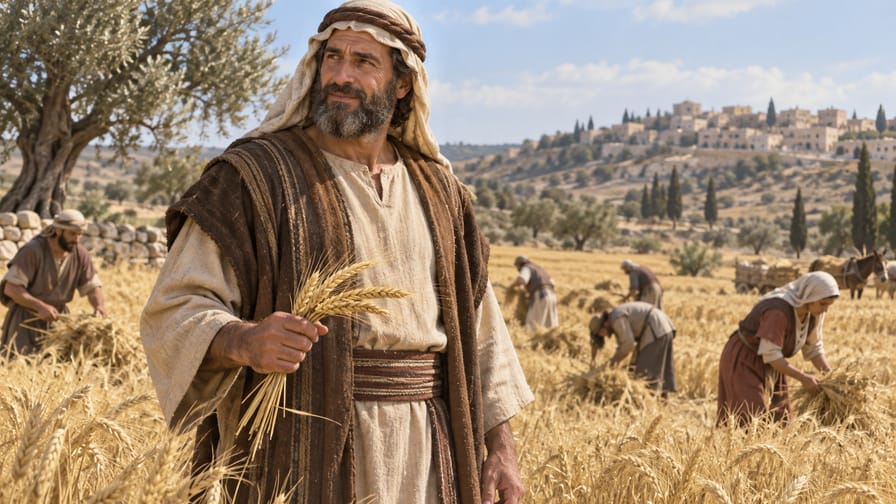
The figure of Boaz emerges in the Old Testament as a pillar of integrity, faith, and divine providence, playing a crucial role in the messianic lineage. His story, narrated in the Book of Ruth, is a testament to God's sovereignty and how He operates through righteous individuals to fulfill His redemptive purposes. From an evangelical Protestant perspective, Boaz is more than a historical character he is an example of righteousness and a type of Christ, the supreme Redeemer.
This in-depth study will explore the etymology and meaning of his name, the historical context and biblical narrative in which he is situated, the analysis of his character and role, his theological and typological significance, and his biblical-theological legacy. The relevance of Boaz transcends his era, offering perennial lessons on grace, redemption, and God's faithfulness to His people and His promises, culminating in the coming of Jesus Christ.
1. Etymology and meaning of the name
The name Boaz, in Hebrew בֹּעַז (Bo'az), is of great significance and points to characteristics intrinsic to the biblical character and his role in the history of redemption. The common transliteration reflects the pronunciation of the original Hebrew, found in Ruth 2:1 and other Old Testament passages.
The etymological root of the name בֹּעַז is often associated with the expression "in him is strength" or "in strength." Although the verb אָעַז (a'az), "to be strong," is hypothetical or rare, the connection to the idea of strength is widely accepted. Many scholars derive the name from the combination of the preposition בְּ (be, "in") and the noun עֹז ('oz, "strength," "power"), resulting in "in strength" or "with strength."
The literal meaning "in strength" or "in him is strength" is profoundly symbolic for the character of Boaz. He demonstrates strength not only physical, but also moral and spiritual, by acting with integrity, generosity, and wisdom. His strength is manifested in his ability to sustain, protect, and redeem, essential qualities for his role in the narrative of Ruth.
There are no significant variations of the name Boaz in biblical languages, as it is a specific proper name. However, the mention of "Boaz" as the name of one of the columns of Solomon's Temple (1 Kings 7:21 2 Chronicles 3:17) adds a layer of meaning. The column Boaz (on the left, or north) and Jachin (on the right, or south) represented the strength and establishment of the Temple and, by extension, God's presence among His people.
The theological significance of the name in the biblical context is multifaceted. The idea of "strength" in Boaz prefigures the strength of the Messiah, who would come from his lineage. He is the strong man who restores hope and security. The connection with the Temple column suggests that, just as the Temple was the dwelling place of God and a symbol of His strength and stability, Boaz becomes a human pillar in the history of salvation, sustaining the lineage from which King David and, ultimately, Christ Himself would come.
Thus, the name Boaz is not merely a designation, but an implicit prophecy of his character and function. He is the "man of strength" whom God uses to preserve His covenant and advance His redemptive plan, providing a vital link in the genealogical chain that would culminate in the Savior of the world.
2. Historical context and biblical narrative
The story of Boaz unfolds during the period of the Judges, an era of great turbulence and anarchy in Israel, as described in the book of Judges. Although the book of Ruth does not provide an exact date, the narrative begins with a famine "in the days when the judges ruled" (Ruth 1:1), placing it approximately between the 12th and 11th centuries BC. This was a time marked by apostasy, idolatry, and the maxim that "everyone did what was right in his own eyes" (Judges 21:25).
The political context was fragmented, with tribes operating autonomously and frequently involved in internal and external conflicts. Socially, the people of Israel lived in an agrarian society, where the laws of land tenure, redemption, and levirate marriage were crucial for maintaining family structure and property. Religiously, although there was a general decline, the book of Ruth highlights pockets of faith and obedience to God's Law, especially in Bethlehem of Judah.
The genealogy of Boaz is of paramount importance for understanding his role. He was the son of Salmon and Rahab (Matthew 1:5), although Jewish tradition and some Christian commentators identify Rahab as the prostitute of Jericho (Joshua 2:1-21). This connection, if true, highlights the early inclusion of Gentiles in the messianic lineage. Boaz belonged to the tribe of Judah, the tribe from which King David and, later, the Messiah would come (Genesis 49:10).
The main events of Boaz's life are narrated in detail in the book of Ruth. The story begins with the arrival of Naomi and Ruth, a Moabitess, in Bethlehem after the death of their husbands and sons in Moab (Ruth 1:19-22). Ruth, to support herself and Naomi, goes to glean in the fields. It is in Boaz's fields that she finds her provision (Ruth 2:3-7).
Boaz notices her, asks about her, and, upon learning of her faithfulness to Naomi, extends generosity and protection to her (Ruth 2:8-16). He shows himself to be a God-fearing man and one who keeps the Law. Later, following Naomi's counsel, Ruth presents herself to Boaz at the threshing floor, asking him to exercise the right of a kinsman-redeemer (go'el) and take her as his wife (Ruth 3:9).
Boaz, aware that there was a closer relative with the right of redemption, proceeds with integrity and wisdom. He summons the elders of the city to the gate and, before them, presents the situation to the closer relative. When this relative refuses the right of redemption because he does not want to harm his own inheritance, Boaz assumes the role of redeemer, buying Elimelech's property and taking Ruth as his wife (Ruth 4:1-10).
This blessed union results in the birth of Obed, father of Jesse and grandfather of King David (Ruth 4:13-17). The key biblical passages describing Boaz are, therefore, Ruth 2:1-4:22, and the genealogies of Jesus in Matthew 1:5 and Luke 3:32. The geography related to the character is predominantly Bethlehem of Judah, with its surrounding fields, where God's providence is manifested.
His relationships with other biblical characters are central: with Naomi, he demonstrated compassion and familial responsibility with Ruth, he exhibited generosity, honor, and redemptive love and, through his son Obed, he connected directly with the lineage of David and, by extension, with the Messiah, Jesus Christ.
3. Character and role in the biblical narrative
The character of Boaz is portrayed in the Scriptures in an exemplary manner, highlighting him as a model of virtue and integrity. He is presented as a "man of great wealth" (Ruth 2:1), but his wealth did not corrupt him rather, it served as a means to express his piety and generosity. His first appearance in the text already reveals his devotion, as he greeted his reapers with the blessing "The Lord be with you!" (Ruth 2:4).
Among the virtues and spiritual qualities of Boaz, piety, generosity, righteousness, wisdom, and compassion stand out. His generosity is evidenced by allowing Ruth to glean in his fields and, even more, by instructing his servants to purposefully leave grain for her (Ruth 2:15-16). He not only fulfilled the Mosaic Law of provision for the poor (Leviticus 19:9-10) but exceeded it in grace.
Boaz's righteousness is evident in his diligence in following the legal procedures for the redemption of the property and for taking Ruth as his wife (Ruth 4:1-12). He did not take advantage of Ruth's vulnerability but acted with complete transparency and honor before the elders of the city, ensuring that everything was done according to the law and public testimony.
His wisdom is seen in his patience and discernment. He did not act impulsively when Ruth presented herself to him at the threshing floor, but pondered the situation, recognizing the presence of a closer relative. He demonstrated a profound understanding of the Law and culture, as well as the importance of preserving the reputation of all involved (Ruth 3:11-14).
Boaz's compassion for Ruth and Naomi is a central theme. He recognized Ruth's virtue and her sacrifice for Naomi, blessing her so that she might receive full reward from the Lord (Ruth 2:12). He became a protector for Ruth, ensuring her safety and dignity in his fields (Ruth 2:8-9). There are no documented sins, weaknesses, or moral failures for Boaz in the narrative, making him one of the few biblical characters presented in an almost impeccable way.
Boaz's vocation was that of a rich landowner and a man of influence in Bethlehem. His specific role in the narrative is that of a go'el, the redeemer or kinsman-redeemer. This function, rooted in the Law of Moses, was crucial for maintaining family integrity and property in Israel. The go'el had the responsibility to redeem land that had been sold (Leviticus 25:25), free an enslaved relative (Leviticus 25:48), and, in cases of death without an heir, marry the widow to raise offspring for the deceased (levirate marriage, Deuteronomy 25:5-10).
Boaz fulfilled this function in an exemplary manner, not only redeeming Elimelech's property but also marrying Ruth to perpetuate the name of his deceased relative's family. His significant actions and key decisions, such as his initial generosity, his acceptance of Ruth's request, and his legal handling of the redemption process, demonstrate his commitment to justice, law, and divine providence. The development of Boaz's character in the narrative is the progression of a righteous and wealthy man to the fulfillment of his divinely ordained role as a vital link in the lineage of the Messiah.
4. Theological significance and typology
The theological significance of Boaz is profound and multifaceted, especially from the evangelical Protestant perspective, which often sees him as a typological figure of Jesus Christ. His role in redemptive history is undeniable, as he is a crucial link in the genealogy connecting Abraham to David and, ultimately, to Jesus Christ (Matthew 1:5 Luke 3:32). The story of Boaz and Ruth is a testament to God's faithfulness in preserving the messianic lineage, even in times of apostasy and through seemingly improbable circumstances.
The Christocentric prefiguration or typology of Boaz is one of the richest aspects of his theological analysis. He serves as a type of the supreme Redeemer, Jesus Christ, in several dimensions:
- Boaz is a kinsman-redeemer (go'el): He had the right and ability to redeem Ruth and her family's property. Christ, our go'el, became our kinsman by incarnating, assuming human nature so that He might redeem us (Hebrews 2:14-17).
- Boaz was able to redeem: His name means "in him is strength," and his wealth and position gave him the ability to act. Christ possesses all strength and authority to redeem humanity from sin and death (Isaiah 63:1 Colossians 1:13-14).
- Boaz was willing to redeem: He was not compelled but voluntarily took on the responsibility. Jesus Christ, out of love, voluntarily gave Himself as a sacrifice for the redemption of sinners (John 10:18 Philippians 2:8).
- Boaz paid the price of redemption: He bought the property and took Ruth as his wife. Christ paid the ultimate price for our redemption through His blood shed on the cross (1 Peter 1:18-19 Mark 10:45).
- Boaz brought rest and security to Ruth: By marrying her, he took her out of insecurity and poverty. Christ offers eternal rest and security to all who come to Him by faith (Matthew 11:28-30).
- Boaz, a Jew, took a Gentile (Ruth) as his wife: This act prefigures the inclusion of Gentiles into the family of God through Christ, who broke down the barrier between Jews and Gentiles, forming one body, the Church (Ephesians 2:11-22).
Boaz's connection with divine covenants and promises is evident. His union with Ruth and the birth of Obed are a fulfillment of the promise made to Abraham that his descendants would be numerous and bless all nations (Genesis 12:3). More specifically, he is instrumental in preserving the lineage of Judah, from which the Messiah would come, as prophesied by Jacob (Genesis 49:10). The New Testament explicitly recognizes this connection by including Boaz in the genealogies of Jesus (Matthew 1:5 Luke 3:32).
Central theological themes such as God's providence, redemptive grace, faith, obedience, and inclusion are manifest in the story of Boaz. Divine providence is seen in how God orchestrates encounters and events, leading Ruth to Boaz's fields (Ruth 2:3). Grace is demonstrated in Boaz's generosity toward Ruth, a foreigner without rights. Ruth's faith in seeking refuge under the wings of the Lord (Ruth 2:12) is rewarded through Boaz's kindness.
In summary, the figure of Boaz is a testament to God's faithfulness in fulfilling His promises and in using righteous individuals to advance His plan of salvation. He is a vibrant and practical type of the great Redeemer, Jesus Christ, who redeems His people from sin and death, marrying them in an eternal covenant.
5. Biblical-theological legacy and canonical references
The legacy of Boaz in biblical theology is of immense importance, solidifying his position as a central figure in the history of redemption. His canonical mentions are primarily in the Book of Ruth, where he is the male protagonist, and in the genealogies of Jesus Christ, in both Matthew 1:5 and Luke 3:32. These New Testament references underscore his relevance for understanding the messianic lineage and the incarnation of Christ.
Beyond his role in the book of Ruth, the name Boaz appears again in the Old Testament as one of the two great bronze pillars that Solomon erected in the portico of the Temple in Jerusalem (1 Kings 7:21 2 Chronicles 3:17). The pillar on the left (north) was named Boaz, meaning "in him is strength," while the one on the right (south) was named Jachin, meaning "he will establish." This symbolic connection reinforces the idea of strength and stability associated with the name, linking the human character to the physical structure that represented God's presence and power in Israel.
Although Boaz was not the author of any biblical book, his life and actions are at the core of one of the most beautiful and theologically rich books of the canon. The Book of Ruth, with Boaz at its center, serves as a crucial bridge between the chaotic period of the Judges and the establishment of the Davidic monarchy, demonstrating God's continuous providence amidst human disorder and unfaithfulness. It shows how individual faithfulness can have redemptive ramifications for an entire nation and for the history of salvation.
Boaz's influence on biblical theology lies in his personification of the concepts of redemption (go'el), grace toward foreigners, and God's sovereignty in preserving the messianic lineage. He is a practical example of how the Law of Moses, especially the laws of redemption and levirate marriage, functioned to protect the vulnerable and maintain the social and religious integrity of Israel, all under God's providential direction.
In the Jewish interpretive tradition, Boaz is seen as a model of piety, wisdom, and generosity, one of the "great men of Israel" who fulfilled the Law with diligence and compassion. In the Christian tradition, especially in Reformed and evangelical theology, the figure of Boaz is frequently studied for its rich Christocentric typology. He is a clear type of Christ, the Redeemer, whose strength, willingness, and ability to redeem point to the saving work of Jesus.
Evangelical commentators such as John MacArthur and J. Sidlow Baxter frequently highlight divine providence and the typology of Boaz. They emphasize how the story of Boaz and Ruth illustrates God's grace toward Gentiles, the importance of covenant faithfulness, and the divine plan unfolding to bring the Messiah into the world. The inclusion of Ruth, a Moabitess, in the lineage of David and Christ, through Boaz's actions, is a powerful testimony to the universal nature of God's grace.
The importance of Boaz for understanding the canon lies in his contribution to the uninterrupted narrative of salvation history. He ensures that the promise made to Abraham and Judah is not lost, establishing the lineage through which King David and, finally, the Messiah, would come. His life is a reminder that God acts through ordinary people (though remarkable in their faith and character) to fulfill His extraordinary purposes, guiding history toward its culmination in Jesus Christ.