


Obed
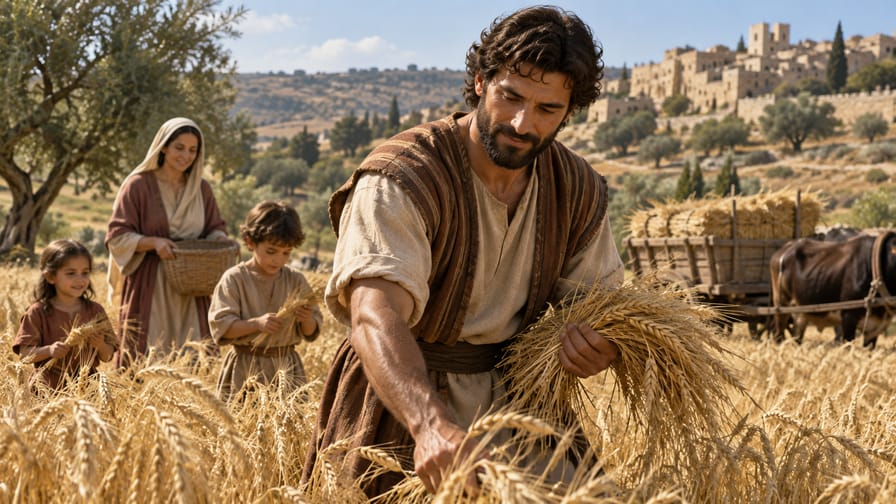
The figure of Obed, though not a central character in the biblical narrative, holds a position of immense theological and historical significance, especially from an evangelical Protestant perspective. He is the crucial genealogical link between Ruth, the Moabitess, and David, the great king of Israel, thereby becoming, by extension, a direct ancestor of Jesus Christ. His story, told primarily in the book of Ruth, highlights divine sovereignty, God's providence amidst human circumstances, and the inclusion of Gentiles in the redemptive plan.
This entry will explore the etymology of his name, his historical and narrative context, the implication of his role (even if passive), his profound theological and typological meaning, and his legacy within the biblical canon and interpretive tradition. The analysis will be founded on the Scriptures, with attention to exegesis and Reformed theology, emphasizing biblical authority and the centrality of Christ in salvation history.
1. Etymology and meaning of the name
The name Obed (in Hebrew: עֹבֵד, ‘Ōḇēḏ) derives from the Hebrew verbal root עבד (‘āḇaḏ), which possesses a rich semantic field. This root primarily means "to serve," "to work," "to cultivate," or "to worship." The noun derived from it, as in the case of Obed, can be translated as "servant," "worshipper," or "one who serves."
The transliteration of the name is consistent in biblical languages and modern versions. In the Old Testament, it is exclusively ‘Ōḇēḏ. In the New Testament, in the genealogies of Jesus, the name appears as Obed (Matthew 1:5) and Obēd (Luke 3:32), maintaining the same root and meaning.
The literal meaning of "servant" or "worshipper" for the name Obed is deeply resonant with the theological context of his lineage. The concept of servitude to God is central to Israelite faith and, later, to Christian faith. Kings like David, a descendant of Obed, are often called "the servant of the Lord" (2 Samuel 7:5).
Although there are no other prominent biblical characters with the same name who play an extensive narrative role, the choice or meaning of Obed's name can be seen as prophetic or, at the very least, providential. He emerges at a crucial moment in redemptive history, being the son of Boaz and Ruth, and the father of Jesse, who in turn would be the father of David (Ruth 4:21-22).
The theological significance of the name lies in the idea that God uses "servants" in His sovereign plan. Obed, whose name means "servant," is a vital link in the messianic genealogy. His very name points to the humility and dedication that would characterize the lineage of David and, preeminently, the Messiah, Jesus Christ, who came not to be served, but to serve (Mark 10:45).
2. Historical context and biblical narrative
Obed's life is situated in the period of the Judges, a turbulent era in Israel's history, characterized by a cycle of apostasy, foreign oppression, and divine deliverance through charismatic leaders. The book of Ruth, where Obed is introduced, serves as a counterpoint to this chaotic time, showing a refuge of faith and righteousness amidst the disorder (Judges 21:25).
The precise historical period, though not accurately dated in the book, is generally estimated to be prior to the establishment of the Israelite monarchy, probably in the 11th century B.C. The narrative of Ruth begins "in the days when the judges ruled" (Ruth 1:1), contextualizing the story in a time of political and social instability, but also of divine providence operating in the lives of individuals.
Obed is born in Bethlehem of Judah, a city that would later become famous as the birthplace of David and, subsequently, of the Messiah (Micah 5:2). His genealogy is of utmost importance: he is the son of Boaz, a wealthy and influential man from the tribe of Judah, and Ruth, a Moabitess who converted to the God of Israel and demonstrated remarkable loyalty and faith (Ruth 1:16).
The story leading to his birth is a narrative of redemption and providence. Ruth, a widow and foreigner, arrives in Bethlehem with her mother-in-law Naomi. Boaz, as a kinsman-redeemer (go'el), fulfills the levirate law (Deuteronomy 25:5-10) and, more broadly, the Mosaic law of protecting the vulnerable, by marrying Ruth (Ruth 4:9-10). This marriage is blessed with the birth of Obed.
The key biblical passages where Obed appears are concise but laden with meaning. His conception and birth are recorded in Ruth 4:13-17, where the women of Bethlehem celebrate the event, recognizing it as a blessing from the Lord for Naomi and for the continuity of the lineage. He is also mentioned in the genealogies in 1 Chronicles 2:12, Matthew 1:5, and Luke 3:32, confirming his unquestionable position in the ancestral line of David and Jesus.
The geography of Bethlehem is central, for it is there that the story of Ruth and Boaz unfolds, and where Obed is born. This city, though small, is chosen by God to be the origin point of crucial figures in salvation history. Obed's relationships with his parents, Boaz and Ruth, and his son Jesse (father of David), establish him as the essential intermediate link that connects the faith and goodness of his parents to the messianic promise that would be fulfilled in his grandson David and in his descendant Jesus.
3. Character and role in the biblical narrative
The Bible, specifically the book of Ruth, does not offer details about Obed's character or actions. Unlike his parents, Boaz and Ruth, whose virtues of righteousness, loyalty (hesed), and faith are widely highlighted, Obed is presented primarily as a name in a genealogy. His existence is his main contribution to the biblical narrative.
However, the absence of a detailed description of his character does not diminish his importance. On the contrary, the biblical narrative often uses figures like Obed to emphasize God's sovereignty and His faithfulness in fulfilling His purposes, often through people whose lives are not extensively documented. Obed's story is the story of divine providence in action.
His role is fundamentally genealogical: he is the son born from the marriage of Boaz and Ruth, and the father of Jesse. The women of Bethlehem, in blessing Naomi for Obed's birth, prophesy that he will be "a restorer of your life and a nourisher of your old age for your daughter-in-law, who loves you, has borne him, she who is better to you than seven sons" (Ruth 4:15). This passage, though not describing Obed's character directly, attributes to him a role of restorer and provider, through his very existence.
Obed's "vocation," if we may use such a term, is to be the vital link in the Davidic and messianic lineage. He is not a prophet, priest, or king, but his very life and procreation are acts of obedience to the divine plan. His existence demonstrates that God acts through generations, connecting individuals in a grand redemptive purpose. The faith and obedience of his parents culminate in his birth, ensuring the continuity of the promise.
Obed's significant actions, from a narrative standpoint, are to be born and to father a son, Jesse. These actions, though biologically simple, are theologically profound. They represent the continuity of the lineage of Judah, which had received the messianic promise in Genesis (Genesis 49:10). The character development of Obed, therefore, is not a life trajectory, but a genealogical link established by the divine hand.
In short, the figure of Obed, though silent and without described actions, is a testament to God's faithfulness. He is the result of faith, obedience, and providence, an indispensable link in the chain that would lead to King David and, finally, to the Messiah, Jesus Christ. His importance lies not in what he did, but in what he represents: divine intervention to sustain a lineage crucial for salvation history.
4. Theological meaning and typology
The theological significance of Obed is immense, not because of his own actions, but because of his position in God's redemptive history. He is a testament to divine faithfulness in maintaining and developing the messianic lineage, a line that extends from Adam and Eve (Genesis 3:15), passing through Abraham (Genesis 12:3) and Judah (Genesis 49:10), to David and, finally, Jesus Christ.
Obed serves as a crucial link in the progressive revelation of God's plan of salvation. His existence demonstrates that, even in times of spiritual decline like the period of the Judges, God is actively working behind the scenes, orchestrating events and lives to fulfill His promises. He is living proof of divine providence that transcends human failings and adverse circumstances.
Regarding Christocentric typology, Obed is not a type of Christ in the sense of prefiguring His actions or ministry. However, his existence is profoundly Christocentric. He is part of the promised "seed" who would crush the head of the serpent (Genesis 3:15). His position in the genealogy of Jesus, as recorded in Matthew 1:5 and Luke 3:32, establishes him as an indispensable element in the Messiah's lineage.
The inclusion of Ruth, a Moabitess, as Obed's grandmother and, therefore, in the lineage of David and Jesus, is theologically significant. It prefigures the future inclusion of Gentiles in the people of God, a central theme in New Testament theology (Ephesians 2:11-22). The story of Ruth and Obed demonstrates that God's grace is not restricted by ethnicity, but extends to all who trust in Him.
The figure of Obed is intrinsically linked to the divine covenants. His birth contributes to the fulfillment of the Abrahamic covenant (Genesis 12:1-3), which promised that all the families of the earth would be blessed through Abraham's offspring. Furthermore, by being David's grandfather, he is a pillar of the Davidic covenant (2 Samuel 7:12-16), which guaranteed a perpetual royal lineage for Israel, culminating in Christ.
Obed's connection to central theological themes is evident: his story underlines God's sovereignty, divine faithfulness, the grace that reaches Gentiles, the importance of faith and obedience (exemplified by Boaz and Ruth), and the providence that guides history to its climax in Christ. He is a reminder that God works through generations, using ordinary people to fulfill His extraordinary purposes.
In sum, Obed is a testament to the way God weaves the tapestry of salvation history, ensuring that His promise of a Redeemer comes to fruition. His existence is a prophetic fulfillment of the continuity of the seed, pointing unequivocally to the final fulfillment in Jesus, the Messiah, the "son of David" and "son of Abraham" (Matthew 1:1).
5. Biblical-theological legacy and canonical references
Obed's legacy, though not marked by great narrated deeds, is deeply rooted in biblical theology due to his strategic position in the messianic genealogy. He is fundamental to understanding the continuity of God's promise through generations and to authenticating the lineage of David and, consequently, of Jesus Christ.
In addition to the book of Ruth (Ruth 4:13-22), Obed is mentioned in other canonical books, which reiterates his genealogical importance. In 1 Chronicles 2:12, he is listed as the son of Boaz and the father of Jesse, in the genealogy of the tribe of Judah that leads to David. This mention in a book that focuses on the history and genealogy of Israel underlines his relevance to the identity and history of God's people.
In the New Testament, Obed appears in both genealogies of Jesus Christ, in both Matthew 1:5 and Luke 3:32. The inclusion of Obed in these lists is crucial for establishing Jesus' messianic legitimacy. Matthew traces the lineage through Joseph, while Luke traces it through Mary (although the exact interpretation of Luke's genealogy is debated, both confirm Jesus' ancestry through David).
Obed's presence in the New Testament genealogies is a vital point for Reformed and evangelical theology, which emphasizes historical accuracy and the authority of the Scriptures. The consistency of genealogical mentions, even if concise, serves to substantiate the claim that Jesus is the promised Messiah, the descendant of David. This reinforces the doctrine of the incarnation and Christ's identity as the fulfillment of Old Testament prophecies.
In the Jewish interpretive tradition, Obed is recognized as David's grandfather, an essential link in the royal lineage. For Christianity, his importance is amplified by his connection to Jesus. The story leading to his birth, in the book of Ruth, is frequently studied for its literary beauty and for its lessons on loyalty, grace, redemption, and the divine providence that operates through ordinary people, including a Gentile woman like Ruth.
The figure of Obed contributes to the understanding of the canon by demonstrating how God uses seemingly small or secondary events and individuals to advance His greater plan. He reminds us that every piece of biblical history, even a name in a genealogy, has a divine purpose and a theological meaning. His life, though without great deeds described, is an integral part of the narrative of redemption.
In summary, Obed's legacy is not one of great personal accomplishments, but of an existence providentially ordained by God. He is a silent, but indispensable, pillar in the genealogical bridge that connects the Old and New Testaments, promise and fulfillment, law and grace, culminating in the person and work of Jesus Christ, the true Servant of the Lord and Redeemer of humanity.