


Abinoam
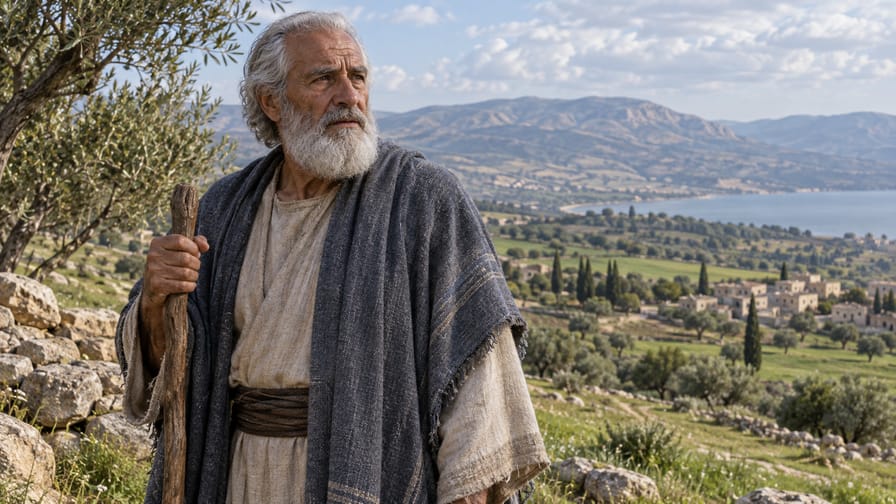
Abinoam is a figure briefly mentioned in the book of Judges, primarily known as the father of Barak, the military commander who, alongside the prophetess Deborah, delivered Israel from the oppression of King Jabin of Hazor and his general Sisera. While Abinoam himself does not play an active role in the narrative, his identity as Barak's father is significant, placing him within a lineage that contributed a crucial leader during a challenging period for Israel.
His story, though sparse, highlights the importance of family and community in raising individuals who respond to God's call. Abinoam's legacy is intrinsically linked to his son's courageous actions, reflecting the broader biblical theme that God often works through families and generations to accomplish his purposes.
1. Name and origin
1.1 Etymology and meaning
The name Abinoam (אֲבִינֹעַם, Avino'am) is a Hebrew name meaning “my father is pleasantness” or “my father is delight.” This suggests a positive and perhaps cherished relationship with his father, or it could reflect a hope for a pleasant and prosperous life. Names in ancient Israel often carried significant meaning, reflecting character, aspirations, or circumstances of birth. The name Abinoam, therefore, implies a sense of well-being or favor associated with his paternal lineage.
While the name itself doesn't directly reveal much about Abinoam's personal character, its meaning stands in contrast to the tumultuous times in which his son, Barak, would rise to prominence. It hints at a background of perhaps relative peace or contentment before the onset of severe oppression.
1.2 Family, era, and geography
Abinoam is identified as being from Kedesh in Naphtali (Judges 4:6). Kedesh was a significant city in the northern part of Israel, located in the tribal territory of Naphtali. This region was particularly vulnerable to northern invaders, which explains why the oppression from King Jabin, whose capital was Hazor, would have been acutely felt there.
He lived during the period of the Judges, a time in Israel's history (roughly 14th to 11th centuries BC) characterized by a cyclical pattern of apostasy, oppression by foreign powers, cries for help to God, and deliverance through divinely appointed judges. Abinoam's son, Barak, served as a judge during one of these cycles, specifically when Israel was under the harsh rule of the Canaanites for twenty years (Judges 4:3). The geographical location of Abinoam's family in Naphtali made them direct witnesses to this oppression and central to the ensuing deliverance.
2. Biblical narrative
2.1 Calling and key episodes
Abinoam himself receives no direct calling from God in the biblical narrative. His role is entirely defined by his fatherhood of Barak. The narrative focuses on Barak's response to Deborah's divine summons. Deborah, the prophetess and judge, sends for Barak, son of Abinoam, and relays God's command: “Go and march up to Mount Tabor, taking with you 10,000 men from Naphtali and Zebulun. And I will lure Sisera, the commander of Jabin’s army, with his chariots and his troops to the Kishon River. There I will give you victory over him” (Judges 4:6-7).
Barak's initial reluctance to go without Deborah (Judges 4:8) is a pivotal moment, leading to Deborah's prophecy that the honor of the victory would go to a woman. While Abinoam is not present in this exchange, his son's actions become a testament to the kind of upbringing or environment that produced a leader, albeit one who needed encouragement to step into his divine assignment.
2.2 Relationships and turning points
Abinoam's most significant relationship, as presented in Scripture, is with his son, Barak. The fact that Barak is consistently identified as “Barak son of Abinoam” (Judges 4:6, 4:12, 5:1, 5:12) underscores the importance of his paternal identity. This naming convention was common in ancient Israel and served to establish lineage and identity within the community. While we have no direct account of their interaction, it is reasonable to infer that Abinoam played a formative role in Barak's life, instilling values or providing the foundation for his son's eventual leadership.
The turning point for the family, and indeed for Israel, was when Barak, at Deborah's insistence, led the Israelite army to victory over Sisera's forces (Judges 4:14-16). This decisive battle, detailed in the Song of Deborah (Judges 5), brought forty years of peace to Israel. Abinoam's legacy is thus intertwined with this moment of national deliverance, a testament to the impact of one family's contribution to God's redemptive work.
3. Character and faith
3.1 Virtues and devotion
Since the Bible provides no direct account of Abinoam's actions or words, we must infer his virtues and devotion through his son, Barak. For Barak to be chosen by God, through Deborah, to lead Israel's army, suggests that he likely came from a family that maintained some degree of faithfulness to the Lord, even amidst widespread apostasy. In a period where “everyone did what was right in his own eyes” (Judges 21:25), raising a son who would respond to a divine call, however hesitantly, implies a foundation of reverence for God's authority.
Abinoam's role as a father, therefore, implicitly points to virtues such as responsibility, perhaps a quiet faithfulness, and the nurturing of a home environment where God's commands were at least acknowledged. His “pleasantness” (from his name's meaning) might have extended to his character, contributing to a stable household from which a leader could emerge.
3.2 Failures and lessons
The text offers no record of Abinoam's personal failures, which is common for minor biblical figures. However, the broader context of the book of Judges suggests that the entire nation, including individual families, struggled with consistent obedience to God. While Barak eventually acted, his initial hesitation to go into battle without Deborah could be seen as a lack of full faith or courage on his part (Judges 4:8). If this trait was present in Barak, it might reflect a general timidity or a need for external reassurance that could have been influenced by his upbringing or the prevailing spiritual climate.
The lesson from Abinoam's story, though indirect, is the profound impact of parental influence. Even when parents are not in the spotlight, their quiet faithfulness, or lack thereof, shapes the next generation. Abinoam's legacy is a reminder that raising children who are open to God's call, even if imperfectly, is a significant contribution to God's kingdom, especially in times of spiritual decline.
4. Theological significance and legacy
4.1 Christological foreshadowing or typology
Abinoam himself does not offer direct Christological foreshadowing. However, the broader narrative in which he is embedded—the cycle of sin, oppression, and deliverance through a divinely appointed leader—is a powerful type of Christ's redemptive work. Barak, Abinoam's son, acts as a deliverer (a “savior” in the sense of a judge), rescuing Israel from their enemies. This points forward to Jesus Christ, the ultimate Deliverer who rescues humanity from the oppression of sin and death.
The need for a leader like Barak, spurred by Deborah's prophetic word, highlights humanity's inability to save itself and its dependence on God's chosen instruments. This dependence finds its ultimate fulfillment in Christ, who alone is capable of bringing true and lasting salvation, not just from physical enemies but from spiritual bondage.
4.2 Witness in later Scripture and church memory
Abinoam is not mentioned again in later Scripture, but his son Barak is honored in the “hall of faith” in Hebrews 11:32, alongside other judges and heroes of faith. This indirect mention elevates Abinoam's family into the lineage of those who, “through faith conquered kingdoms, enforced justice, obtained promises, stopped the mouths of lions” (Hebrews 11:33). The inclusion of Barak in this esteemed list implicitly acknowledges the foundation laid by his family, including his father, Abinoam.
In church memory, Abinoam remains a minor figure, but his story serves as a quiet reminder of the unsung heroes of faith—those who may not be prominent in the narrative but whose lives and influence contribute to the larger tapestry of God's redemptive history. He represents the countless faithful parents who raise children to know and serve God, even when the world around them is hostile or indifferent.
5. Conclusion
Abinoam, the father of Barak, stands as a testament to the quiet yet profound influence of family in God's grand narrative. Though he remains in the background, his name, meaning “my father is pleasantness,” hints at a home that nurtured a son capable of responding to a divine call for national deliverance. His legacy is not one of personal fame, but of contributing to the lineage of faith that produced a judge who, alongside Deborah, brought freedom and peace to Israel. Abinoam's story subtly reminds us that every life, however seemingly small, plays a part in God's unfolding plan, ultimately pointing to the greater Father whose ultimate delight is found in the redemptive work of His Son, Jesus Christ, the true Deliverer of His people.