


Ruth
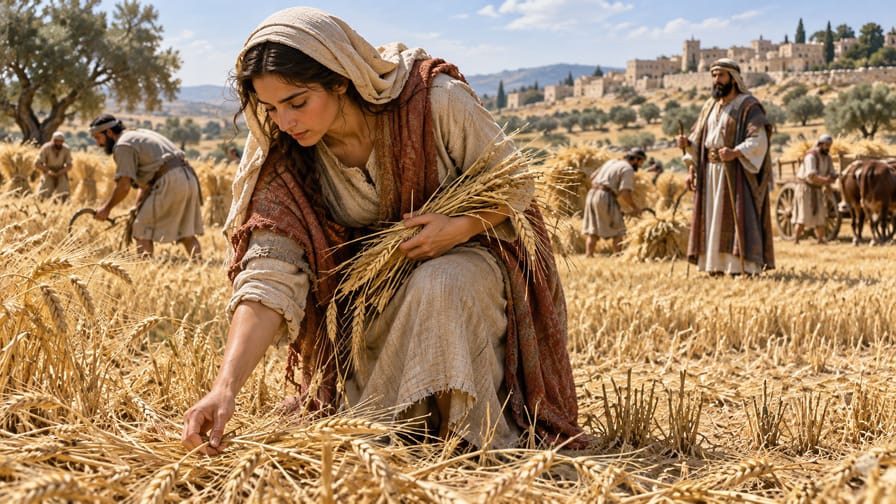
The biblical figure of Ruth is one of the most notable and beloved characters of the Old Testament, whose name titles one of the minor books of the Writings (Ketuvim) collection in the Hebrew Bible. Her story, though brief, is rich in theological and moral significance, serving as a powerful testimony to divine providence, human faithfulness, and the inclusion of Gentiles in God's redemptive plan. The evangelical Protestant perspective sees in Ruth an example of radical faith, unwavering loyalty, and a crucial link in the messianic genealogy, pointing to the coming of Christ.
This in-depth study will explore the etymology of her name, the historical context of her life, the depth of her character, her theological and typological significance, and the enduring legacy she left for the Christian faith. We will analyze her story through the lens of biblical authority, historical accuracy, and Christocentric typology, highlighting the perennial lessons for the contemporary church.
1. Etymology and meaning of the name
The name Ruth, in Hebrew Rût (רוּת), is of uncertain origin, but several etymological proposals have been presented by scholars. The most commonly suggested root for Rût is the Hebrew word re’ut (רְעוּת), which means "friendship", "companionship", or "companion". This interpretation deeply resonates with the character and actions of Ruth, who demonstrated extraordinary loyalty and friendship toward her mother-in-law Naomi.
Other suggestions include a derivation from the Arabic root ra’at, meaning "beauty" or "satisfaction", or even a connection to the Hebrew word ra’ah, which can mean "to see" or "to shepherd". However, the interpretation of "friendship" or "companion" is the most accepted and the one that best aligns with the book's narrative, where Ruth stands out for her faithfulness and companionship.
There are no other prominent biblical characters with the same name, making Ruth unique in her mention in the Scriptures. The singularity of the name and its implicit meaning contribute to the depth of the character. The name itself already prefigures the essence of her character and the role she would play in the history of redemption, as a faithful companion on the path of faith and covenant.
From a theological point of view, the meaning of "friendship" or "companionship" for the name Ruth is highly significant. It highlights the nature of Ruth's relationship with Naomi, which transcends family and cultural ties, and becomes an example of hesed (חֶסֶד), loyal and lovingkindness. This hesed is a divine attribute and is replicated in Ruth's actions toward her mother-in-law and, subsequently, in Boaz's actions toward Ruth.
The name, therefore, is not merely a label, but a prophetic description of the character's central nature. In a context of despair and loss, Ruth emerges as a symbol of unwavering loyalty, reflecting God's own faithfulness to His people. Her "friendship" and "companionship" extend beyond one person, becoming a type of the friendship God offers to humanity, even to foreigners and the marginalized.
2. Historical context and biblical narrative
The book of Ruth begins with the declaration: "In the days when the judges ruled..." (Ruth 1:1). This places the narrative in a turbulent period of Israel's history, approximately between the 12th and 11th centuries BC, after Joshua's conquest of Canaan and before the establishment of the monarchy. It was a time characterized by political anarchy, social instability, and religious apostasy, as described in the book of Judges, where "everyone did what was right in his own eyes" (Judges 21:25).
In this scenario of moral and spiritual chaos, Ruth's story shines as an oasis of faithfulness and hope. It unfolds during a period of famine in Israel, which led Elimelech, a man from Bethlehem of Judah, to migrate with his wife Naomi and their two sons, Mahlon and Chilion, to the land of Moab (Ruth 1:1-2). Moab was a neighboring nation to Israel, descended from Lot (Genesis 19:37), with a history of enmity and idolatry toward Israel (Deuteronomy 23:3-6).
Ruth's genealogy is revealed as being Moabite. Although the Scriptures do not detail her immediate ancestral lineage, the fact that she is a Moabite is crucial to the narrative. The Moabites were excluded from the congregation of Israel even to the tenth generation (Deuteronomy 23:3), which makes Ruth's inclusion in the Davidic and messianic lineage a powerful testimony to God's grace and sovereignty, transcending ethnic and cultural barriers.
2.1. Main events of her life
The narrative chronology of Ruth's life begins with her move to Moab and her marriage to Mahlon, Naomi's son (Ruth 1:4). After the death of her father-in-law Elimelech and, subsequently, of her husband Mahlon and her husband's brother, Chilion, Ruth finds herself widowed and childless, along with her mother-in-law Naomi and her sister-in-law Orpah (Ruth 1:5).
Upon learning that the famine had ceased in Judah, Naomi decides to return to her homeland. She tries to persuade her daughters-in-law to remain in Moab and find new husbands. Orpah, after some hesitation, returns to her people and her gods, but Ruth clings to Naomi with unwavering loyalty, expressed in her famous declaration of faith and commitment: "Where you go I will go, and where you lodge I will lodge. Your people shall be my people, and your God my God" (Ruth 1:16-17).
Together, Ruth and Naomi arrive in Bethlehem of Judah at the beginning of the barley harvest (Ruth 1:22). To provide food, Ruth goes to glean in the fields, a practice permitted by Mosaic law for the poor and foreigners (Leviticus 19:9-10 Deuteronomy 24:19). She "accidentally" ends up in the field of Boaz, a wealthy and influential relative of Elimelech (Ruth 2:3).
Boaz, informed about Ruth's faithfulness to Naomi, shows great kindness to her, ordering his servants to protect her and allowing her to glean abundantly. He also praises her for seeking refuge under the wings of Yahweh, the God of Israel (Ruth 2:12). Naomi, upon learning of Boaz's kindness, recognizes him as a kinsman-redeemer (go’el), someone with the responsibility to redeem the property and perpetuate the name of Elimelech's family (Ruth 2:20).
Following Naomi's instructions, Ruth presents herself to Boaz on the threshing floor during the night, seeking for him to fulfill his role as redeemer (Ruth 3:6-9). Boaz, honored by her integrity and selflessness, agrees to marry her, but first must resolve the issue with a closer relative who had the right of redemption (Ruth 3:12-13).
Boaz publicly negotiates with the closer relative at the city gate, the center of legal and social life. When the closer relative refuses the responsibility to redeem, Boaz assumes the right and obligation, marrying Ruth (Ruth 4:1-10). From this marriage, Obed is born, who becomes the father of Jesse and the grandfather of King David (Ruth 4:13-17). Thus, Ruth, the Moabite woman, is included in the messianic lineage, a prefiguration of the inclusion of Gentiles in God's plan of salvation.
3. Character and role in the biblical narrative
Ruth's character is one of the most praised and exemplary throughout Scripture, standing out for her virtues and spiritual qualities. She personifies hesed (חֶסֶד), loyal and lovingkindness, which is a central theme of the book. Her decision to stay with Naomi, even when Orpah returned, is the primary demonstration of this loyalty (Ruth 1:16-17). This loyalty transcends ties of blood and culture, reflecting a conscious choice of commitment to the people and the God of Israel.
In addition to loyalty, Ruth exhibits profound humility and diligence. Upon arriving in Bethlehem, she demands nothing, but sets out to work hard in the fields, gleaning ears of grain to support herself and Naomi (Ruth 2:2-3). Her willingness to perform arduous and often humbling work to provide for her family is a testament to her integrity and responsibility. Boaz recognizes this diligence (Ruth 2:7) and praises her for her character (Ruth 3:11).
Ruth's faith in Yahweh, the God of Israel, is another striking characteristic. Although a Moabite, she embraces Naomi's God, seeking refuge "under His wings" (Ruth 2:12). This expression is a metaphor for divine protection and entering into a covenant with God. Her faith is not merely a declaration but is manifested in obedience to Naomi's instructions and in trust in God's providence, even in uncertain circumstances (Ruth 3:5-6).
Ruth's purity and moral integrity are also evident. When she presents herself to Boaz on the threshing floor, following the custom of seeking a redeemer, her conduct is respectful and honorable. Boaz recognizes her as a "virtuous woman" (Ruth 3:11, in Hebrew ’ēshet chayil, אֵשֶׁת חַיִל), the same expression used for the ideal woman in Proverbs 31. This underlines her blameless character and her reputation in the community.
Ruth's role in the biblical narrative is multifaceted. She is, first of all, an example of a Gentile believer who turns to the God of Israel and is fully accepted into His community. Her story demonstrates God's ability to include all peoples in His redemptive plan. Secondly, she is the catalyst for the redemption of Elimelech's family, ensuring that the family name is not extinguished and that the inheritance is maintained through marriage to Boaz.
Thirdly, and perhaps most significantly, Ruth plays a crucial role in the messianic genealogy. Through her son Obed, she becomes the great-grandmother of King David and, consequently, a direct ancestor of Jesus Christ (Matthew 1:5). Her story is not just a beautiful narrative of loyalty and love, but an essential piece in the history of salvation, demonstrating God's sovereignty in orchestrating events and people to fulfill His redemptive promises.
4. Theological significance and typology
The book of Ruth is a theological jewel that offers profound insights into God's redemptive history and His progressive revelation. At its core, Ruth's story is a demonstration of divine providence, which operates in the details of everyday life to fulfill greater purposes. The apparent "coincidence" of Ruth gleaning in Boaz's field (Ruth 2:3) is, in fact, the sovereign hand of God guiding her steps.
One of the most prominent theological themes is the inclusion of Gentiles in God's plan. Ruth, a Moabite, is a foreigner and, according to the law, excluded from the congregation of Israel. However, through her faith and loyalty, she is not only accepted but honored and integrated into the community of Israel, becoming an ancestor of the Messiah. This prefigures the future inclusion of Gentiles in the church of Christ, breaking down ethnic and cultural barriers (Ephesians 2:11-22).
The concept of go’el (גֹּאֵל), the kinsman-redeemer, is central to the theological understanding of the book. Boaz, as the go’el, has the responsibility to redeem the property and the name of Elimelech's family by marrying the widow Ruth. This figure is a powerful typology of Christ. Just as Boaz rescues Ruth from her helpless situation and integrates her into his family, Christ is our supreme **Redeemer**.
Christ, our go’el, redeems us from the slavery of sin and death, paying the price of our salvation with His own blood. He takes us out of our condition as foreigners and adopts us as children and heirs of God (Galatians 4:4-7). Boaz's action in redeeming Ruth illustrates God's grace, which extends to us, unworthy sinners, to bring us into His family and give us an eternal inheritance.
Ruth's story also emphasizes the importance of faith and obedience. Ruth's decision to follow Naomi and her God is an act of radical faith. Her trust in Yahweh's providence and her obedience to Naomi's instructions result in blessings and the fulfillment of the divine plan. This underscores the evangelical Protestant doctrine that genuine faith is manifested in obedience and trust in God.
Ruth's connection to the Davidic and messianic lineage is the apex of her theological significance. She is explicitly mentioned in Jesus' genealogy in Matthew 1:5, along with other notable women like Tamar and Rahab. Her presence in this genealogy is not accidental it demonstrates that God's plan of salvation is not restricted to a single ethnicity or gender, but encompasses all humanity, preparing the way for the Messiah who would come for all.
Thus, Ruth points to Christ in several ways: as the **Redeemer** who rescues us from our spiritual poverty, as the one who includes Gentiles in His kingdom, and as the fulfillment of divine promises through a lineage that seemed unlikely. Ruth's story is, therefore, an anticipation of the gospel, revealing God's inclusive and redemptive love.
5. Biblical-theological legacy and canonical references
Ruth's legacy is profound and multifaceted, with her story resonating throughout the Scriptures and in Jewish and Christian interpretive tradition. Her primary canonical mention, besides the book that bears her name, is in the genealogy of Jesus Christ in the New Testament. Matthew's Gospel records: "Salmon fathered Boaz by Rahab, Boaz fathered Obed by Ruth, Obed fathered Jesse" (Matthew 1:5).
This inclusion in such a crucial genealogy underscores Ruth's importance for understanding the history of salvation. She is one of four women mentioned in Matthew's genealogy (the others being Tamar, Rahab, and the wife of Uriah, Bathsheba), all with stories involving unusual circumstances or Gentile origins. This reinforces the theme of divine grace that transcends human expectations and social and ethnic barriers.
The book of Ruth, though small, has significant influence on biblical theology. It serves as a counterpoint to the book of Judges, demonstrating that, even in the darkest times, faithfulness to God and the practice of hesed still existed. It also illustrates God's sovereignty in controlling the events of history to fulfill His covenant and His promises, culminating in the coming of David and, ultimately, the Messiah.
In Jewish interpretive tradition, the book of Ruth is read publicly during the feast of Shavuot (Pentecost), which celebrates the giving of the Torah and the harvest. The choice of Ruth for this feast is significant, as she is a proselyte who embraces the Jewish faith and her story takes place during the harvest. She symbolizes Israel's acceptance of the Torah and the inclusion of converts into the covenant community.
In Reformed and evangelical theology, Ruth is often studied as an example of saving faith and how God's grace operates to include those who are considered "outsiders" to the covenant. Her story is seen as a preparation for the fullness of the gospel, where "there is neither Jew nor Greek, there is neither slave nor free, there is no male and female, for you are all one in Christ Jesus" (Galatians 3:28).
Ruth's importance for understanding the canon lies in her ability to unite the narratives of the Old Testament with those of the New. She is not merely an inspiring story of loyalty and providence, but a vital link in the chain of messianic promise. Her life demonstrates that God's plan for redemption is inclusive, sovereign, and unfolds through ordinary people in extraordinary circumstances.
In summary, Ruth remains a perennial testimony to God's grace, human faithfulness, and the universality of the plan of salvation. Her story continues to inspire believers of all generations to demonstrate hesed, to trust in divine providence, and to recognize God's love that extends to all peoples, culminating in the person and work of Jesus Christ, the true **Redeemer**.