


Onan
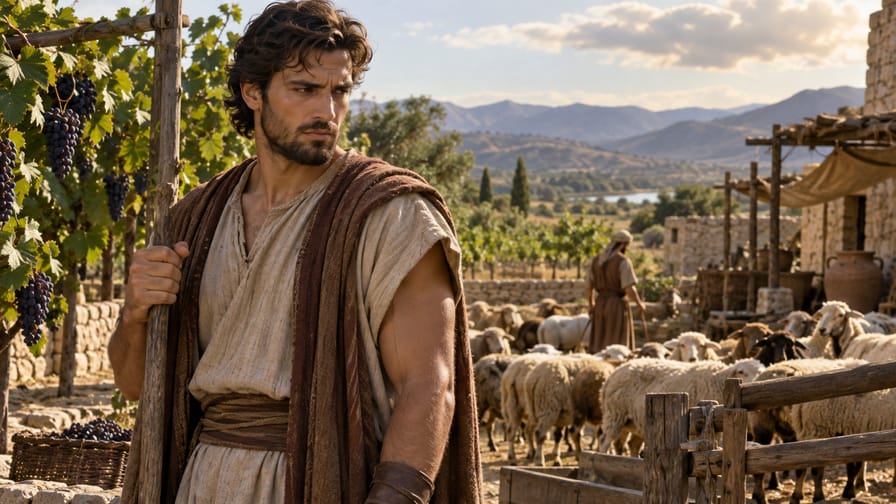
The figure of Onan, though briefly mentioned in the Scriptures, holds considerable theological and exegetical relevance, particularly in understanding the levirate law and divine judgment. His story, recorded in Genesis 38, serves as a pivotal point for discussions on obedience, family responsibility, and the nature of God’s justice. This analysis delves into its onomastic significance, the context of its narrative, its character, theological implications, and legacy in biblical and Reformed tradition.
From a conservative evangelical Protestant perspective, the narrative of Onan is examined with exegetical rigor, seeking to extract the eternal principles of God’s Word. Biblical authority is the foundation for understanding not only what happened, but why it happened and what spiritual and moral lessons can be learned. The story of Onan, therefore, is not merely an ancient account but a continuous revelation of God’s will and attributes.
The analysis aims to demystify anachronistic interpretations and focus on the original meaning of the Hebrew text. At the same time, it seeks to connect Onan’s story with larger themes of redemptive history, recognizing the progressiveness of revelation and the centrality of Christ as the fulfillment of all divine promises and laws. Thus, the figure of Onan, although a negative example, contributes to a deeper understanding of God's sovereignty and the necessity of human faithfulness.
1. Etymology and meaning of the name
The name Onan (’Ônān, אוֹנָן) is of Hebrew origin and appears in the Old Testament in Genesis 38:4, 8-9 and 46:12, as well as in Numbers 26:19 and 1 Chronicles 2:3. Its etymological root is uncertain, but some proposals have been put forth by scholars of Semitic languages. A possible derivation is from the root ’wn, which may be related to strength, vigor, or wealth, or even to mourning or affliction.
If the derivation is from "strength" or "vigor," the name could have an ironic meaning in the context of Onan’s narrative, given that he failed to exercise the necessary "strength" or "vigor" to fulfill his levirate obligation. Another suggestion is that it is linked to the word ’ôn (אוֹן), which can mean "iniquity" or "wickedness," especially in poetic contexts, although this is less likely as a direct origin of the proper name.
The theologian John Calvin, in his commentaries on Genesis, does not dwell extensively on the etymology of the name, but focuses more on Onan’s actions. However, Jewish and Christian tradition, throughout the centuries, has associated Onan’s name with his transgression, although there is no etymological consensus that directly links the name to the "sin" he committed. The meaning of the name, therefore, is more inferred by his role in the narrative than by a clear and unequivocal linguistic root.
There are no other prominent biblical characters with the same name who have distinct narratives. This makes Onan a singular figure in his mention and in the theological implications of his brief account. The theological significance of his name, therefore, is intrinsically linked to his story and the consequences of his actions, serving as an echo of his disobedience and subsequent divine judgment.
2. Historical context and biblical narrative
2.1. Historical period and family context
The story of Onan is set in the patriarchal period, specifically in the life of Judah, one of Jacob’s sons. This period, approximately dated between 2000 and 1700 BC, is characterized by the formation of the twelve tribes of Israel and the progressive revelation of God’s promises to Abraham, Isaac, and Jacob (Genesis 12:1-3 26:3-5 28:13-15). The narrative of Genesis 38 interrupts the story of Joseph, emphasizing the importance of Judah’s lineage in salvation history.
Onan was the second son of Judah with his wife, the Canaanite Bathshua (Genesis 38:2-4). His brothers were Er, the firstborn, and Shelah, the youngest. Judah’s family lived in a context where social laws and customs, though not yet formally codified like the Mosaic Law, already presupposed certain duties and responsibilities, especially regarding the preservation of lineage and family inheritance.
The geography of the narrative focuses on Adullam, where Judah settled, and Timnah, places associated with Judah’s interaction with the Canaanites and his own family (Genesis 38:1, 12). This setting reflects the patriarchs' initial contact with the peoples of the land of Canaan, a context of cultural and religious mixture that often tested the faith and obedience of Abraham's descendants.
2.2. The biblical narrative and the levirate duty
The story of Onan is central to understanding the levirate law, an ancient custom that would later be formalized in the Law of Moses (Deuteronomy 25:5-10). According to this custom, if a man died without leaving children, his brother was to marry the widow to raise offspring in the deceased's name, thus ensuring the continuation of the lineage and the preservation of the family inheritance.
Onan’s older brother, Er, married Tamar, but "Er, Judah’s firstborn, was wicked in the sight of the Lord so the Lord put him to death" (Genesis 38:7). After Er’s death, Judah commanded Onan to fulfill the levirate duty: "Then Judah said to Onan, ‘Go in to your brother’s wife and perform your duty as a brother-in-law to her raise up offspring for your brother’" (Genesis 38:8).
Despite his father’s command and cultural and moral obligation, Onan refused to fully comply with the levirate duty. The Scripture records: "But Onan knew that the offspring would not be his so whenever he lay with his brother’s wife, he spilled his semen on the ground to keep from providing offspring for his brother" (Genesis 38:9). This deliberate action by Onan was a clear violation of his responsibility and an act of selfishness.
Onan’s attitude was motivated by selfish personal interest: he did not want the offspring produced to be attributed to his deceased brother, as this would imply that the firstborn's inheritance would be divided with a son who would not legally be his own. The Bible is explicit about the divine disapproval of his conduct: "What he did was wicked in the Lord’s sight so the Lord put him to death also" (Genesis 38:10). Thus, Onan met the same fate as his brother Er, due to his own impiety.
3. Character and role in the biblical narrative
3.1. Analysis of character and moral failings
Onan’s character is revealed by his actions and the divine consequences that followed. The Scriptures do not present virtues or spiritual qualities in Onan on the contrary, he is portrayed as a selfish, disobedient, and disrespectful individual toward the divine and human laws of his time. His primary moral failing lies in his deliberate refusal to fulfill the levirate duty, an act that denotes profound insensitivity and selfish calculation.
Genesis 38:9 explicitly states that Onan "knew that the offspring would not be his". This demonstrates a clear awareness of the implications of the levirate law and an intentional decision to frustrate its purpose. He sought the benefits of the sexual act with Tamar but refused to accept the inherent responsibility, defrauding both his deceased brother and Tamar herself, who had a right to posterity.
Onan’s disobedience was not merely an act of disrespect toward Judah, his father, but a direct affront to divine order and the principle of justice. In a culture where the continuity of lineage was of utmost importance for identity and inheritance, Onan’s act was a serious crime against the social structure and God’s promise of offspring to the patriarchs. The theologian Matthew Henry highlights that Onan acted with "great malice" and "contempt" for God’s law.
The lack of character development for Onan in the narrative is notable. He appears briefly, fulfills his part in the plot, and is removed by divine judgment. This suggests that his role is to serve as a negative example, a warning about the consequences of selfishness and disobedience. His story is a microcosm of the seriousness with which God treats the violation of His commandments and indifference toward one’s neighbor.
3.2. Onan's role and significant actions
Onan’s main role in the narrative of Genesis 38 is that of a failed executor of the levirate duty. His specific calling or function at that time was to ensure the continuation of his brother Er's lineage, a duty of profound cultural and theological significance in patriarchal society. He intentionally and selfishly failed to fulfill this role.
Onan’s significant actions are summarized in Genesis 38:9: "he spilled his semen on the ground to keep from providing offspring for his brother". This action, often misinterpreted as a condemnation of masturbation or contraception in general, must be understood within its specific context. Onan’s sin was not simply a sexual act, but a refusal to fulfill a family and religious obligation, a denial of his responsibility to his brother and to Tamar.
Onan’s decision was a deliberate choice to deprive his brother of offspring and to defraud Tamar of her right to bear children and, consequently, social security. His wickedness, as Scripture describes it, lay in his intention to use Tamar for his own pleasure, while simultaneously avoiding the responsibility of perpetuating his brother’s lineage. This demonstrates a profound lack of love and justice.
Onan’s death, like that of Er, is not detailed in terms of its physical cause but is directly attributed to divine intervention: "What he did was wicked in the Lord’s sight so the Lord put him to death also" (Genesis 38:10). This underscores the gravity of his actions and the seriousness of God’s judgment on the disobedience and selfishness manifested in his character and decisions.
4. Theological significance and typology
4.1. Role in redemptive history and theological themes
The story of Onan, though a negative event, plays a role in redemptive history by highlighting the importance of lineage and offspring in the progressive revelation of the messianic promise. The interruption of Judah's lineage through Er and Onan, and Tamar's subsequent intervention, emphasizes God's sovereignty in preserving the line of promise, even in the face of human failure. Judah's offspring was crucial for the coming of the Messiah (Genesis 49:10).
The narrative of Onan connects to central theological themes such as obedience to God's will (even when expressed in socially sanctioned customs), divine justice, and judgment on iniquity. Onan’s death serves as a severe reminder that God does not tolerate selfish disobedience and the manipulation of His laws for personal gain. It is a vivid example of the seriousness of sin and its consequences.
The "sin of Onan" has been, throughout history, the subject of extensive theological discussions, often misinterpreted. Conservative evangelical Protestant exegesis emphasizes that Onan’s sin was not masturbation or contraception per se, but the refusal to fulfill the levirate duty and the act of defrauding his brother and Tamar of the promised offspring. Theologian John Murray, in his work on sexual ethics, highlights that context is fundamental for the correct interpretation of this passage.
The narrative also addresses the importance of covenant faithfulness. Although the levirate law was not yet a formal ordinance of the Mosaic covenant, it operated under the principles of the Abrahamic covenant, which valued the continuity of offspring. Onan’s failure was a failure of faithfulness to these principles and to his community.
4.2. Prefiguration and doctrinal lessons
There is no direct or positive Christocentric typology associated with Onan, given his negative character. However, his story can be seen as an antitipology or an example of how not to act regarding covenant responsibilities. In contrast to Onan’s disobedience, Christ is the perfect fulfiller of all law and all righteousness (Matthew 5:17). He did not shrink from fulfilling the duty of redeemer, taking responsibility for his "bride," the Church (Ephesians 5:25-27).
Onan’s story can also be used to illustrate the doctrine of God’s sovereignty over life and death, and His ability to intervene directly in human history to accomplish His purposes, even through human failures and sins. Onan’s death did not prevent the continuation of Judah’s lineage, which eventually led to David and, finally, to Jesus Christ (Matthew 1:1-16).
The doctrinal lessons drawn from Onan’s story include the seriousness of sin, the certainty of divine judgment on disobedience, the importance of individual and family responsibility, and the centrality of offspring in the Old Testament economy of salvation. The narrative of Onan and Tamar, in Genesis 38, is crucial for understanding how the messianic line was preserved, despite the failures of men.
The figure of Onan serves as a warning to believers of all ages about the dangers of selfishness and the refusal to fulfill the obligations that God places upon us, whether in the family, the church, or society. His story underscores that obedience to God must be complete and from the heart, and not a mere formality devoid of correct intention.
5. Biblical-theological legacy and canonical references
5.1. Influence on biblical theology and interpretive tradition
Onan is mentioned in Genesis 38:4, 8-10, 46:12, Numbers 26:19, and 1 Chronicles 2:3, primarily in genealogical lists, confirming his existence and his inclusion in the lineage of Judah. However, he has no direct literary contributions nor is he mentioned in other biblical books outside the genealogical context or the narrative of Genesis 38. His influence, therefore, lies in the impact of his brief, yet significant, story.
Onan’s story had a profound influence on biblical theology, especially in the Old Testament, by highlighting the importance of lineage and offspring for the continuity of the covenant. It anticipates and contextualizes the levirate law that would be formalized in Deuteronomy 25:5-10, showing that the principles underlying this law were already recognized and valued in the patriarchal period.
In Jewish interpretive tradition, Onan’s story is frequently discussed in terms of Halakha (Jewish law), especially in relation to the levirate duty (yibbum) and the gravity of frustrating procreation. The Talmud, for example, discusses the implications of Onan’s action, reinforcing the importance of procreation and the perpetuation of lineage.
In Christian tradition, particularly in Reformed and evangelical theology, Onan’s story is crucial for discussions on sexual ethics, marriage, and responsibility. However, there is an ongoing effort to correct the erroneous interpretation that the "sin of Onan" is synonymous with masturbation or contraception in general. Theologians such as R. C. Sproul and Wayne Grudem emphasize that Onan’s sin was an act of selfish disobedience and fraud against his brother and Tamar, within the context of the levirate law.
5.2. Onan's importance for understanding the canon
Onan’s story, though a negative event, is vital for understanding the biblical canon for several reasons. Firstly, it reinforces the authenticity and honesty of the Scriptures, which do not hesitate to record the failures and sins of Israel’s ancestors, even those in the messianic lineage. This demonstrates the realistic nature of biblical revelation, contrasting with mythologies that often idealize their heroes.
Secondly, Onan’s narrative underscores God’s providential sovereignty in preserving the lineage of Judah, from which the Messiah would come. Despite the failures of Er and Onan, and Judah himself in some respects, God ensured that the promise of offspring would not be frustrated, even using Tamar’s cunning for this purpose (Genesis 38:26). This points to God’s unwavering faithfulness to His covenant.
The story of Onan, therefore, contributes to the understanding of progressive revelation, showing how divine principles of justice and responsibility were already in operation before the formalization of the Mosaic Law. It sets a precedent for the seriousness with which God treats disobedience and selfishness, regardless of the era or cultural context.
Finally, the figure of Onan serves as a case study for responsible biblical interpretation. His story requires careful reading of the historical, cultural, and theological context to avoid anachronisms and misguided applications. For conservative evangelical Protestant theology, Onan is a reminder that the Word of God is living and active (Hebrews 4:12), and that His laws and judgments are eternal, even when expressed in specific cultural contexts.