


Amos
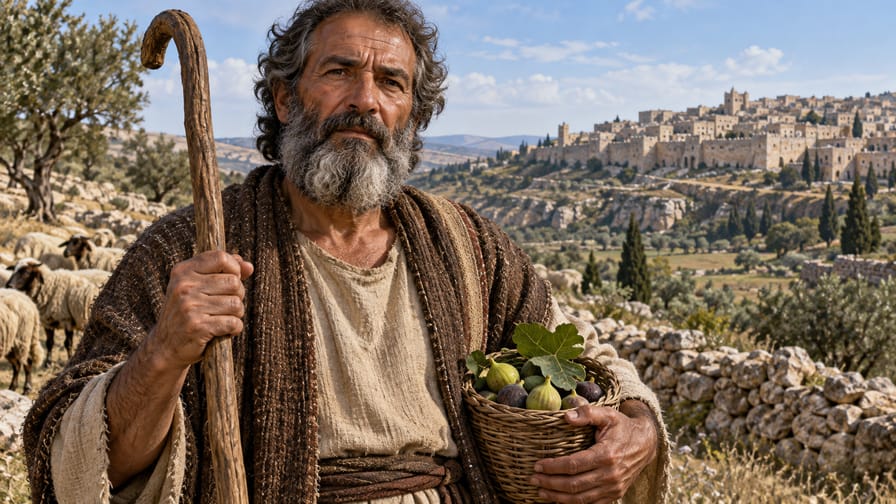
The figure of Amos emerges in the Scriptures as one of the minor prophets of the Old Testament, whose ministry stands out for its courage and its uncompromising message of judgment against social injustice and religious apostasy. His book, the third among the Twelve Minor Prophets, offers a window into the socio-political and spiritual reality of Israel in the 8th century B.C., challenging notions of prosperity without piety.
Analysis of his life and work reveals a simple man, called by God for an extraordinary task, whose words resonate with enduring theological relevance. From an evangelical Protestant perspective, Amos is seen as a herald of divine justice, an exponent of God's sovereignty over all nations and a prefigurement of the fullness of salvation in Christ.
1. Etymology and meaning of the name
The name Amos, in Hebrew עָמוֹס ('Amos), derives from the verbal root עָמַס ('amas), meaning "to carry," "to bear," or "to lay a burden upon." Thus, the most acceptable meaning for the name Amos is "burden-bearer" or "one who is carried/heavy."
This etymology is notably appropriate for the prophet, who bore the burden of God's message of judgment and condemnation upon Israel. He was tasked with proclaiming heavy and unpopular truths to a complacent nation, which certainly constituted a great emotional and spiritual weight for him.
There is no evidence of other prominent biblical figures with the exact same name playing significant roles in the Scriptures. This makes Amos a name singularly associated with this prophet from Tekoa.
From a theological point of view, the meaning of Amos's name underscores the nature of prophetic ministry. Prophets were often "burden-bearers," receiving messages from God that were heavy both for them and for the people to whom they were addressed.
This "burden" was not merely a matter of content, but also of responsibility and personal suffering. The divine choice of a "burden-bearer" to deliver such a severe message to Israel is, in itself, an act of profound theological significance, highlighting the seriousness of the prophetic call.
2. Historical context and biblical narrative
2.1 Period and socio-political setting
The ministry of Amos occurred during the reign of Uzziah (Uzias) in Judah and Jeroboam II (Jeroboão II) in Israel (Amos 1:1). This period, approximately between 760 and 750 B.C., marked an era of relative peace and economic prosperity for both kingdoms, especially for the Northern Kingdom, Israel.
Jeroboam II had restored the borders of Israel, as predicted by Jonah (Jonas 14:25), and trade flourished. However, this prosperity was superficial and was accompanied by severe social injustice, oppression of the poor, corruption, and rampant idolatry.
Religion in Israel was syncretistic, mixing the worship of Yahweh with pagan practices, and ritualistic observance had replaced true devotion and the practice of justice. The rich oppressed the needy, the courts were corrupt, and the elite lived in luxury and self-indulgence, ignoring the commandments of the Torah (Amos 2:6-8 5:10-12).
2.2 Family origin and prophetic call
Amos was from Tekoa (Tecoa), a small rural town about 16 km south of Jerusalem, in the kingdom of Judah (Amos 1:1). His occupation was a sheep breeder (noqed, נֹקֵד) and a dresser of sycamore-fig trees (boles shiqmim, בּוֹלֵס שִׁקְמִים), an activity that required care for wild fig trees (Amos 7:14).
This humble origin is crucial for understanding his ministry. Amos was not a professional prophet, trained in prophetic schools, but an ordinary man directly called by God (Amos 7:14-15). His message, therefore, was not of his own initiative, but an authoritative divine word.
Despite being from the southern kingdom, Judah, Amos was sent to prophesy primarily against the northern kingdom, Israel, and specifically at Bethel (Betel), one of the main religious centers of Israel, where idolatrous worship was practiced (Amos 7:10, 13).
2.3 Main events and relationships
The book of Amos is a compilation of his prophecies and visions. It begins with oracles of judgment against neighboring nations, establishing God's sovereignty over all peoples, before turning with even greater intensity against Judah and Israel (Amos 1:3-2:16).
A key narrative event is Amos's confrontation with Amaziah (Amazias), the priest of Bethel. Amaziah, bothered by Amos's message of judgment, accused him of conspiracy against the king and sent him back to Judah (Amos 7:10-13).
Amos's response to Amaziah (Amos 7:14-17) is one of the most revealing passages about the nature of his call and his divine authority. He was neither a "son of a prophet" nor a prophet by profession, but a man whom Yahweh had taken from tending the flock to prophesy to His people.
This confrontation highlights the resistance Amos faced and the authenticity of his vocation. Amos's prophecies focus on Samaria (Samaria), the capital of Israel, and Bethel (Betel), a religious center, denouncing the corruption and injustice prevalent in these cities.
3. Character and role in the biblical narrative
3.1 Analysis of character and spiritual qualities
The character of Amos, as revealed in his book, is marked by unwavering integrity and deep obedience to God. He was a man of simple but robust faith, who was not intimidated by the political or religious power of his time.
His courage is evident in openly confronting the elite of Israel and the priest Amaziah (Amos 7:10-13), proclaiming God's word straightforwardly, despite the threats and unpopularity of his message. Amos's honesty shines through in his declaration that he was not a professional prophet, but a servant called by God (Amos 7:14-15).
Amos's passion for justice and divine righteousness is a dominant trait. He identifies with the oppressed and cries out against the exploitation of the poor, corruption in the courts, and religious hypocrisy (Amos 5:21-24 8:4-6). His compassion for the needy is a reflection of God's own heart.
3.2 Vocation and specific function
Amos's role in the biblical narrative is that of a prophet of social justice and divine judgment. He was Yahweh's spokesperson, tasked with reminding Israel of its covenant obligations and the consequences of its infidelity. His function was to expose sin and apostasy, calling the nation to genuine repentance.
He was not a prophet of consolation for Israel at that time, but a herald of impending condemnation, although his book ends with a promise of restoration (Amos 9:11-15). Amos challenged Israel's false sense of security, which believed that its prosperity and religious rituals guaranteed divine protection, even amidst injustice and idolatry.
His significant actions include delivering oracles of judgment against neighboring nations, Judah, and, more vehemently, Israel. He used vivid language, symbolic visions, and logical arguments to communicate the certainty of divine punishment (Amos 7:1-9 8:1-3 9:1-4).
The development of Amos's character is most evident in his transition from a man of the field to an intrepid prophet. He demonstrated that obedience to God's call empowers individuals of humble origin to play crucial roles in salvation history, even if it means facing opposition and unpopularity.
4. Theological significance and typology
4.1 Role in redemptive history and central themes
Amos plays a vital role in the progressive revelation of God's redemptive history, particularly in articulating divine justice and Yahweh's universal sovereignty. He demonstrated that God is not just the God of Israel, but the Lord of all creation, who judges all nations for their sins (Amos 1:3-2:3).
Central theological themes in the book of Amos include God's sovereignty, the inevitability of divine judgment upon sin, the inseparability of true worship and social justice, covenant responsibility, and the hope of a remnant and future restoration. Amos emphasizes that Israel's election implied greater responsibility, not impunity (Amos 3:1-2).
"Justice" (mishpat, מִשְׁפָּט) and "righteousness" (tsedaqah, צְדָקָה) are key concepts, presented not merely as abstract ideals, but as divine imperatives for ethical and social life. Amos cries out: "But let justice roll on like a river, and righteousness like an ever-flowing stream" (Amos 5:24).
4.2 Christocentric typology and prophecies
Although Amos is not a direct typological figure of Christ in the same sense as David or Melchizedek, his ministry and message prefigure important aspects of Jesus' work and teachings. Amos's passion for justice and his denunciation of religious hypocrisy echo Christ's words against the Pharisees and Sadducees (Matthew 23).
Like Amos, Jesus rebuked the exploitation of the poor and corruption in religious centers (Matthew 21:12-13). Amos's emphasis on the need for a transformed heart and worship that manifests in justice and love for neighbor, rather than mere rituals, aligns perfectly with Jesus' teaching about worshipping God "in spirit and truth" (John 4:23-24).
Amos's prophecy about the "Day of the Lord" (Yom Yahweh, יוֹם יְהוָה) as a day of darkness and judgment for the wicked (Amos 5:18-20) finds its eschatological fulfillment in Christ's return to judge the world. More directly, the promise of restoration of the "fallen booth of David" (Amos 9:11) is a crucial messianic prophecy.
This prophecy is quoted in the New Testament by James (Tiago) at the Council of Jerusalem (Acts 15:16-17) to justify the inclusion of the Gentiles in the church. James argues that the rebuilding of the "tent of David" is fulfilled in the formation of the church, where Jews and Gentiles are united in Christ, establishing the messianic kingdom.
5. Biblical-theological legacy and canonical references
5.1 Literary contributions and influence on biblical theology
The book of Amos, part of the prophetic canon, is a masterpiece of Hebrew literature, utilizing vivid poetry, powerful imagery, and a persuasive rhetorical structure. Although there are no mentions of Amos in other Old Testament books outside of his own book, his message had a profound impact on subsequent prophetic theology.
His insistence on social justice as an essential component of true religion influenced later prophets such as Micah (Miqueias 6:8) and Isaiah (Isaías 1:16-17). Amos established a precedent for the prophetic denunciation of corruption and oppression, challenging the notion that material prosperity was always a sign of divine blessing, regardless of ethical behavior.
Amos's theology reinforces the doctrine of God's absolute sovereignty over history and over all nations. He teaches that God's covenant with Israel was not a license for sin, but a call to obedience and holiness, with severe consequences for infidelity.
5.2 Presence in interpretive tradition and evangelical theology
The quotation of Amos 9:11-12 in Acts 15:16-17 is the most significant reference to Amos in the New Testament and solidifies his canonical importance. This quotation demonstrates that Old Testament prophecies, even those that seem specific to Israel, have a broader and Christocentric fulfillment in the church age.
In the Christian interpretive tradition, especially in Reformed and evangelical theology, Amos is highly valued for his emphasis on morality and ethics as manifestations of true faith. Evangelical commentators like J. Alec Motyer and John Stott frequently cite Amos to advocate for the social responsibility of the church and believers.
Amos's message serves as a blunt reminder that true worship of God cannot be divorced from love for neighbor and the pursuit of justice in society. He challenges churches to examine whether their piety is authentic or merely ritualistic, ignoring the needs of the marginalized.
5.3 Importance for understanding the canon
Amos is fundamental for understanding the biblical canon because he links the theology of the Mosaic covenant with prophetic theology and, ultimately, with New Testament ecclesiology. He shows that God's promises and His judgments are consistent throughout redemptive history.
His book offers crucial insight into the nature of Israel's sin, not only as idolatry but also as systemic oppression. The message of Amos resonates today as a call to the church to be the voice of the voiceless, to seek justice, and to live a faith that manifests in concrete actions of love and righteousness, awaiting the full consummation of the Kingdom of Christ.