


Milcah
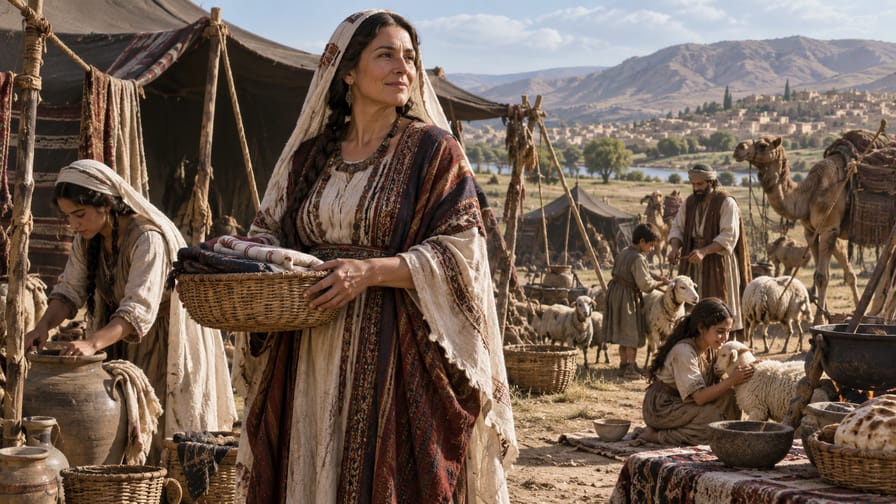
The figure of Milcah (in Hebrew: מִלְכָּה, Milkah) is one of the female characters of the Old Testament whose relevance lies more in her genealogical position and role in the history of the covenant than in her direct actions. She is a fundamental matriarch in the patriarchal lineage, connecting directly to the origins of the people of Israel. Although the biblical text offers few details about her personal life, her existence is crucial for understanding divine providence in the formation of the chosen nation and, subsequently, in the messianic lineage.
This analysis will explore the etymology of her name, her historical and narrative context, inferences about her character and role, her theological and typological significance, and her biblical-theological legacy, all from the perspective of conservative evangelical Protestantism. Exegetical precision and biblical authority will be the pillars of this approach, recognizing the sovereignty of God in every detail of redemptive history.
1. Etymology and Meaning of the Name
1.1 Original Name and Linguistic Derivation
The name Milcah, transliterated from Hebrew as Milkah (מִלְכָּה), is a feminine name that appears prominently in the genealogies of the book of Genesis. Its etymological root is intimately linked to the Hebrew noun מֶלֶךְ (melekh), which means "king." The feminine form of melekh is מַלְכָּה (malkah), which means "queen."
Although there is a slight difference in vocalization (Milkah versus Malkah), the semantic connection is widely accepted. Some scholars suggest that Milkah may be an archaic or dialectal form of "queen," or perhaps a variation that emphasizes "counsel" or "dominion." The Septuagint transliterates the name as Melcha (Μελχά), retaining the Hebrew phonetics.
1.2 Literal and Symbolic Meaning
Literally, the name Milcah is often interpreted as "queen" or "counselor." This meaning carries a connotation of nobility, dignity, and, in a certain sense, authority or influence. In a patriarchal society where names often reflected hopes, characteristics, or circumstances of birth, a name like Milcah might have suggested a position of respect or an inherent quality of leadership.
Symbolically, the name may point to the importance of the figure within the family structure and lineage. Even if Milcah does not have an active "royal" role in the narrative, her name may prefigure the dignity of her descendants and the importance of her role in preserving the lineage through which the Messiah would come. It is a name that, in a way, elevates her quiet stature in biblical history.
1.3 Variations and Other Characters with the Name
There are no significant variations of the name Milcah in the original biblical languages that alter its fundamental meaning. The form Milkah is consistent in the Masoretic Text. It is important to note, however, that there is another biblical character with the same name.
A second Milcah is mentioned in the book of Numbers as one of the daughters of Zelophehad (Numbers 26:33 27:1 36:11 Joshua 17:3). She was part of a group of sisters who pleaded with Moses for the right to inherit their father's land, as he had no sons. This Milcah is a distinct and later figure, not to be confused with Milcah, wife of Nahor and grandmother of Rebekah, who is the focus of this analysis.
1.4 Theological Significance of the Name in the Biblical Context
The theological significance of the name Milcah resides primarily in its connection to the covenant lineage. Although she is not a figure of active prominence, her name "queen" or "counselor" can be seen as a subtle indicator of the dignity and importance that God attributes to all links in the chain of redemption.
God, in His sovereignty, chooses and uses individuals, even those whose stories are briefly told, to fulfill His purposes. Milcah's name, with its resonance of nobility, reflects the honor of being part of the divine plan that would culminate in Christ, the true King. This perspective highlights God's providence in every genealogical detail.
2. Historical and Biblical Narrative Context
2.1 Historical Period and Context
Milcah lived during the patriarchal era, a period that, according to biblical chronology and archaeological studies, is generally dated between the late third and early second millennium B.C. (approximately 2100-1800 B.C.). She belongs to the generation immediately preceding Abraham, being his sister-in-law and wife of his brother, Nahor.
The political, social, and religious context of the time was that of ancient Mesopotamia, with the clan of Terah, father of Abraham and Haran, migrating from Ur of the Chaldeans to Haran. It was a tribal and nomadic society where family relationships and offspring were of paramount importance for the continuity and strength of the family group. Idolatry was prevalent, but Terah's family maintained a connection to the worship of the Most High God, though often mixed with pagan practices, as suggested in Joshua 24:2.
2.2 Genealogy and Family Origin
Milcah's genealogy is presented in Genesis 11:27-29. She is the daughter of Haran, the brother of Abraham and Nahor. Therefore, Milcah was the niece of both Abraham and Nahor. Interestingly, she married her uncle, Nahor, an endogamous practice common and acceptable in the culture of the time, which aimed to maintain the purity of the lineage and inheritance within the family clan.
Her family is the same as Abraham's, coming from the lineage of Shem through Terah. Milcah's father, Haran, is also the father of Lot, making Milcah Lot's sister. The mention of her sister, Iscah, in Genesis 11:29, is brief and offers no further details, but Iscah's inclusion in the genealogical record is notable, as few women are named in such lists.
2.3 Key Events and Biblical Passages
Milcah's life is not described with dramatic events or heroic actions. Her importance lies in her function as a wife and mother within the patriarchal lineage. The key biblical passages where she is mentioned are:
- Genesis 11:29: Presents her identity as the daughter of Haran and wife of Nahor. "The name of Abram’s wife was Sarai, and the name of Nahor’s wife was Milcah. Iscah was Milcah’s sister."
- Genesis 22:20-23: Lists her children with Nahor, highlighting Bethuel, the father of Rebekah. "Now after these things it was told Abraham, 'Behold, Milcah also has borne children to Nahor your brother: Uz the firstborn, Buz his brother, Kemuel the father of Aram, Chesed, Hazo, Pildash, Jidlaph, and Bethuel.' Bethuel became the father of Rebekah. These eight Milcah bore to Nahor, Abraham's brother."
- Genesis 24:15, 24: Confirms that Rebekah, Isaac's bride, is her granddaughter. "Before he had finished speaking, behold, Rebekah, who was born to Bethuel the son of Milcah, the wife of Nahor, Abraham’s brother, came out with her water jar on her shoulder... She said to him, 'I am the daughter of Bethuel, the son of Milcah, whom she bore to Nahor.'"
These passages show that, although Milcah is not a central figure in terms of event narrative, she is a vital piece in the genealogical web that leads to the formation of the covenant people.
2.4 Geography and Relationships with Other Characters
Milcah's life is geographically linked to Ur of the Chaldeans, her hometown, and Haran, where her family migrated with Terah (Genesis 11:31). It was in Haran that Nahor's family remained while Abraham continued his journey to Canaan. Haran, in northern Mesopotamia, was an important commercial and religious center, a point of cultural connection between the East and the West.
Her family relationships are crucial: she is the daughter of Haran, sister of Lot and Iscah, wife of Nahor, sister-in-law of Abraham and Sarai, mother of Bethuel, and grandmother of Rebekah. This network of kinship positions her as a key figure in Abraham's lineage, especially as the grandmother of Rebekah, who would become the wife of Isaac and mother of Jacob and Esau. Her connection to these central figures underscores her importance to the history of redemption.
3. Character and Role in Biblical Narrative
3.1 Analysis of Character and Virtues
The Bible is notably silent about Milcah's personal character and actions. There are no descriptions of her personality, her virtues, or any moral failings. She is presented, above all, in a genealogical context, as a link in the chain of descent. This absence of detail, however, does not diminish her importance but recontextualizes it for the biblical perspective that God's faithfulness often operates through ordinary people in ordinary roles.
We can infer some virtues based on her role as a matriarch in a patriarchal society. The expectation was that a woman would be faithful to her husband, diligent in her home, and fertile, contributing to the continuity of the family. The fact that she bore eight children with Nahor (Genesis 22:20-23) suggests that she excellently fulfilled the cultural expectation of her time to be a prolific mother.
3.2 Sins, Weaknesses, and Vocation
There is no mention of specific sins or weaknesses attributed to Milcah in Scripture. The biblical narrative does not dwell on negative aspects of her conduct, which is common for characters whose primary function is genealogical. Her vocation, as revealed in the Bible, is that of a wife and mother, a fundamental role in ancient society and crucial for the preservation of the lineage chosen by God.
In this sense, her "vocation" was to be a vessel through which God's promise to Abraham would be, indirectly, fulfilled. She is not called to a prophetic task or public leadership, but her life is intrinsically linked to God's plan for Abraham's descendants.
3.3 Role Played and Significant Actions
Milcah's primary role in the biblical narrative is that of a matriarch who contributes to Abraham's lineage through her son Bethuel and her granddaughter Rebekah. Her most significant action, from the perspective of salvation history, was giving birth to Bethuel. It is Bethuel who, in turn, would father Rebekah, the woman destined to be the wife of Isaac, the son of promise.
Without Milcah, the genealogical chain leading to Rebekah and, subsequently, to Jacob and the twelve tribes of Israel, would be broken. She is a silent, yet indispensable link. Her existence and fertility are, therefore, acts of great providential significance, even if they are not acts of her own heroic volition.
3.4 Character Development
Milcah is not a character who demonstrates development throughout the narrative. She is presented in her family identity and then referenced through her descendants. The purpose of the biblical text in mentioning her is not to explore her personal journey or spiritual growth, but rather to establish the genealogical connections necessary for the unfolding of God's plan.
Her "story" is, in fact, part of the larger story of Abraham and the formation of Israel. She serves as a reminder that God's faithfulness is manifested not only through great leaders but also through individuals who, in their discretion, fulfill essential roles in the execution of the divine plan.
4. Theological Meaning and Typology
4.1 Role in Redemptive History and Progressive Revelation
Milcah's theological significance is integral to redemptive history, albeit indirectly and structurally. She is a crucial link in the messianic lineage that God established from Adam, through Shem and Terah, to Abraham. God's promise to Abraham that from him would come a great nation and that through his offspring all the families of the earth would be blessed (Genesis 12:2-3) depended on the preservation of a specific lineage.
Milcah, as Rebekah's grandmother, who would be Jacob's mother, contributes to the progressive revelation of God's plan to form a people for Himself. Her existence demonstrates divine sovereignty in orchestrating even marriages and births to ensure that the covenant promise is faithfully fulfilled through the generations.
4.2 Prefiguration or Christocentric Typology
Milcah is not a direct typological figure of Christ in the sense that her actions or character prefigure aspects of Jesus' person or work. However, her importance lies in her contribution to the lineage from which the Messiah would come. Milcah's story, as part of the genealogy, points to God's faithfulness in preserving the "seed" through which salvation would be mediated.
Thus, she serves a broader typology of divine providence that works through generations to bring the Savior. The meticulousness of biblical genealogies, including the mention of Milcah, underscores the historicity and concreteness of Christ's incarnation, which is not a myth, but the fulfillment of a real and historical lineage (Matthew 1:1-17 Luke 3:23-38).
4.3 Covenants, Promises, and Theological Themes
Milcah is intrinsically linked to the Abrahamic covenant through her family. Although not a direct recipient of the covenant, her descendants are vital for its fulfillment. The promise of a "great nation" and that "in you all the families of the earth shall be blessed" (Genesis 12:2-3) could only be realized through a continuous and specific lineage.
Her story, though brief, illustrates central theological themes such as the sovereignty of God, who controls and directs human events, great and small, to fulfill His purposes the faithfulness of God in keeping His promises, even when the means seem insignificant and divine providence, which operates in the details of individual lives to accomplish a greater plan of salvation. Milcah's life is a silent testimony to the covenant faithfulness of God.
4.4 Doctrine and Teachings Associated with the Character
The figure of Milcah reinforces the doctrine of the importance of Scripture as the complete and sufficient revelation of God (sola Scriptura). Her relevance is entirely derived from what the Bible says about her, without the need for extra-biblical speculations. She teaches us about the dignity of the mother's and family's role in God's plan for humanity.
Furthermore, she serves as a reminder that God uses people in all spheres of life, not just the prominent ones, to advance His kingdom. The "history of salvation" is not just about heroes, but also about those who, in their daily lives, are instruments of divine providence. Evangelical Christian faith values the contribution of all members of the community of faith, recognizing that each has a role in God's redemptive plan.
5. Biblical-Theological Legacy and Canonical References
5.1 Mentions in Other Biblical Books and Contributions
Milcah, wife of Nahor, is mentioned exclusively in the book of Genesis (Genesis 11:29 22:20, 23 24:15, 24). There are no other references to her in other canonical books of the Old or New Testament. She is not credited with the authorship of any book, psalm, or epistle. Her contribution is, therefore, strictly genealogical and contextual, providing a historical basis for the patriarchal lineage.
It is crucial to reiterate the distinction between this Milcah and the daughter of Zelophehad, who is mentioned in Numbers and Joshua. The absence of Milcah (Nahor's wife) in other biblical texts reinforces her nature as a supporting figure in the main narrative, whose importance is validated by her strategic position in the covenant genealogy.
5.2 Influence on Biblical Theology and Interpretive Tradition
Milcah's influence on biblical theology lies in the validation of the integrity of genealogies. Her presence, even if brief, underscores divine attention to detail and the historical authenticity of the biblical record. In biblical theology, genealogical precision is vital for establishing the identity of the people of Israel and, subsequently, the messianic legitimacy of Jesus.
In the Jewish interpretive tradition, Milcah is recognized as one of the matriarchs who contributed to the formation of the "House of Israel" through Rebekah. Christian tradition, in turn, sees her as a link in God's chain leading to the coming of Christ, the Messiah. Evangelical commentators like John Calvin and Matthew Henry, when addressing Genesis, recognize the importance of figures like Milcah for the continuity of the covenant promise, even if they do not delve into her personal character due to the scarcity of textual information.
5.3 Treatment in Reformed and Evangelical Theology
In Reformed and evangelical theology, the figure of Milcah is often used to illustrate the doctrine of God's sovereignty and providence. God, in His wisdom and power, orchestrates all events, great and small, to fulfill His redemptive purposes. The mention of Milcah serves as an example of how God uses individuals, often unknown or with secondary roles, to advance His history of salvation.
Emphasis is placed on God's faithfulness to His covenant with Abraham and how He preserved the lineage through specific marriages and births. Evangelical theology, with its focus on the authority and inerrancy of Scripture, sees every name in the genealogies as significant and part of God's larger plan for the redemption of humanity through Jesus Christ.
5.4 Importance for Understanding the Canon
Milcah's importance for understanding the biblical canon lies in how she contributes to the cohesion and continuity of the narrative. The genealogies in Genesis, in which Milcah is a component, are not mere lists but theological structures that connect generations and demonstrate God's faithfulness in fulfilling His promises.
The inclusion of Milcah in the canon ensures that the reader understands the depth and extent of God's plan, which unfolds through multiple individuals and generations. She is a testament to the historicity of biblical faith and the divine providence that permeates the entire history of redemption, culminating in the person and work of Jesus Christ.