


Jeremiah
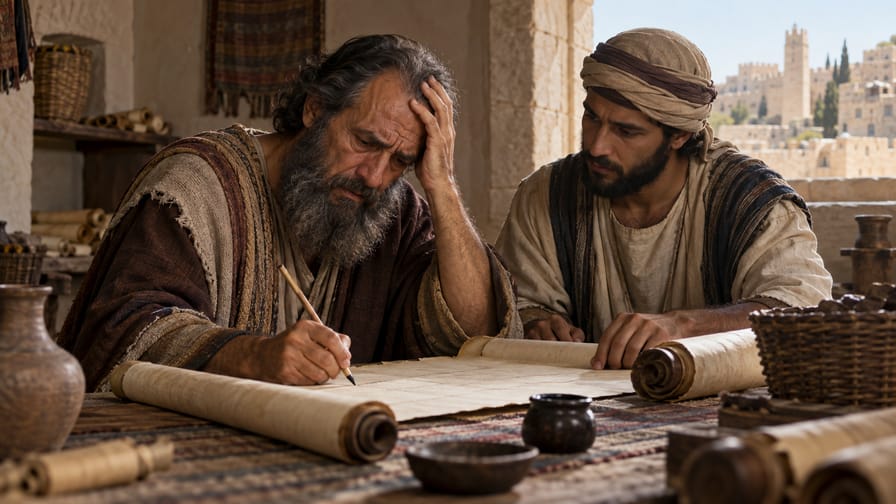
The figure of Jeremiah, one of the major prophets of the Old Testament, stands out for his profound sensitivity, unwavering faithfulness to God, and the poignant message of judgment and hope. His life and ministry unfolded during one of the most turbulent periods in Judah's history, marked by apostasy, political decline, and, ultimately, the destruction of Jerusalem and the Babylonian exile.
This article explores the etymology of his name, the historical context in which he lived, the nuances of his character, the theological significance of his work, and his enduring legacy for the Christian faith, from an evangelical Protestant perspective that values biblical authority and Christocentric typology.
1. Etymology and Meaning of the Name
The name Jeremiah derives from the Hebrew Yirmeyahu (יִרְמְיָהוּ) or, in its abbreviated form, Yirmeyah (יִרְמְיָה). The Greek transliteration in the Septuagint is Ieremias (Ἱερεμίας), from which the Portuguese form is derived.
The etymological root of the name is debated among scholars. A common interpretation connects it to the Hebrew verb rum (רוּם), meaning "to elevate," "to exalt," or "to raise up." Thus, Jeremiah would mean "Yahweh exalts" or "Yahweh raises up."
Another possible derivation links the name to the verb yarah (יָרָה), which can mean "to cast," "to throw," or "to found," "to establish." In this case, the name could be interpreted as "Yahweh casts/establishes" or "Yahweh founds."
Both interpretations carry a profound theological significance that resonates with the prophet's life and ministry. If "Yahweh exalts," it reflects divine sovereignty in raising up a prophet to speak in His name, even in the face of great opposition.
If "Yahweh casts/founds," it may allude to his calling "to uproot and tear down, to destroy and overthrow, to build and to plant" (Jeremiah 1:10), a work of judgment and restoration that God would accomplish through him.
Although Jeremiah is the most prominent prophet with this name, there are other lesser-known biblical figures who also bear it, such as a man from Gad who joined David (1 Chronicles 12:4) and a father of a Rechabite family (Jeremiah 35:3). However, the name is inextricably linked to the great prophet of Judah.
The meaning of the name foreshadows Jeremiah's role as an instrument of God to exalt divine justice and lay the foundations for a new covenant, even amid impending destruction. He was raised up by God for a monumental task.
2. Historical Context and Biblical Narrative
The prophetic ministry of Jeremiah spanned a period of approximately forty years, from the 13th year of Josiah's reign (ca. 627 BC) until some time after the fall of Jerusalem (586 BC), extending to the exile in Egypt (Jeremiah 1:2-3).
This was one of the most critical periods in Judah's history. The Assyrian Empire, which had dominated the region for centuries, was in decline, paving the way for the rise of Babylon as the dominant power. The unstable geopolitics had profound implications for Judah, which found itself squeezed between these powers.
Internally, Judah was in a state of profound apostasy and moral decay, despite the religious reform initiated by King Josiah. After Josiah's death at Megiddo (2 Chronicles 35:20-24), the nation quickly reverted to idolatry and social injustice.
Jeremiah was the son of Hilkiah, a priest from Anathoth, a priestly city located a few kilometers northeast of Jerusalem (Jeremiah 1:1). This priestly origin, however, did not spare him from persecution by the priests themselves and the people of his hometown (Jeremiah 11:18-23).
Key events in his life include his divine call in his youth, where God commissioned him as a "prophet to the nations" (Jeremiah 1:5). He was instructed not to marry or have children, a prophetic sign of the imminent calamity upon Judah (Jeremiah 16:1-4).
He delivered the famous "Temple Sermon," denouncing the people's false reliance on the temple as a guarantee of safety, while they practiced iniquity (Jeremiah 7:1-15). Because of this message, his life was threatened (Jeremiah 26:7-11).
Jeremiah witnessed and prophesied during the reigns of Josiah, Jehoahaz, Jehoiakim, Jehoiachin, and Zedekiah. He faced opposition from kings, false prophets, priests, and the people themselves, who often arrested and mistreated him (Jeremiah 20:1-6, Jeremiah 37:11-16, Jeremiah 38:1-6).
One of his most significant prophetic acts was the purchase of a field in Anathoth during the Babylonian siege (Jeremiah 32:6-15), a symbol of the future restoration of the land, even amidst destruction.
His faithful scribe and companion, Baruch, recorded his prophecies, including the scroll that was burned by King Jehoiakim (Jeremiah 36:1-32). After the fall of Jerusalem and the assassination of Gedaliah, Jeremiah was forced to go to Egypt with a remnant of the Jewish people (Jeremiah 43:1-7), where he likely ended his days.
The geography of his ministry was primarily concentrated in Jerusalem and its surroundings, including his hometown, Anathoth. His prophecies, however, extended to neighboring nations such as Egypt, Philistia, Moab, Ammon, Edom, Damascus, Elam, and Babylon (Jeremiah 46-51).
His relationship with the kings of Judah was one of constant confrontation, as he called them to repentance and submission to Babylon as God's judgment, while they sought political alliances with Egypt and relied on their own strength.
3. Character and Role in the Biblical Narrative
Jeremiah's character is one of the most transparent and humanly complex in all of Scripture, revealed in his "confessions" or "laments" (Jeremiah 11:18-12:6 15:10-21 17:14-18 18:18-23 20:7-18). He is often called the "weeping prophet" due to his profound anguish over his people's disobedience and suffering.
Among his virtues, an unwavering obedience to God stands out, even when the message was unpopular and brought great personal suffering. His perseverance in proclaiming the Word of God, despite rejection and persecution, is remarkable.
He demonstrated extraordinary courage in confronting kings, priests, and false prophets, always speaking God's truth without fear (Jeremiah 26:12-15). His love for the people of Judah, despite their rebellion, is evident in his tears and prayers for them (Jeremiah 9:1).
Despite his spiritual strength, Jeremiah also revealed human weaknesses and struggles. He expressed moments of despair, questioning God's justice and cursing the day of his birth (Jeremiah 12:1-4 20:14-18). These passages are not moral failings, but honest expressions of his troubled soul.
His calling was unique: to be a prophet "to the nations" (Jeremiah 1:5), with the task of uprooting and tearing down, but also of building and planting. He was God's spokesperson to a stubborn people, announcing divine judgment that would culminate in the destruction of Jerusalem and the exile.
Jeremiah's role was not limited to uttering oracles. He also performed symbolic prophetic acts, such as the ruined belt (Jeremiah 13:1-11), the broken jar (Jeremiah 19:1-13), and the wooden yoke (Jeremiah 27:1-11), all aimed at illustrating God's message of judgment and captivity.
His key decisions included refusing to yield to popular pressure, persisting in his message of submission to Babylon, and his choice to remain in Judah with the remnant after the fall of Jerusalem, before being forced into Egypt.
Throughout the narrative, Jeremiah's character develops from a young man hesitant in his calling (Jeremiah 1:6) to a prophet hardened by adversity, yet never broken in his faithfulness to Yahweh. He is a paradigm of suffering obedience and a faithful prophet in times of crisis.
4. Theological Significance and Typology
Jeremiah's ministry is crucial in redemptive history, marking a significant transition in God's progressive revelation. He prophesied on the threshold of a new era, where the Mosaic covenant would be broken by Israel's disobedience, and a new covenant would be necessary.
His message, though laden with judgment, paved the way for an understanding of the depth of Judah's sin and the need for radical divine intervention for restoration. He emphasized the importance of a circumcised heart (Jeremiah 4:4), an inner and not merely ritualistic faith.
The figure of Jeremiah is rich in Christocentric typology, foreshadowing aspects of the life and ministry of Jesus Christ. Like Jeremiah, Jesus was a prophet rejected by his own people and city (Matthew 13:57 Luke 4:24), who lamented over Jerusalem (Luke 19:41-44).
Both were men of sorrows, familiar with suffering (Isaiah 53:3), confronted religious hypocrisy and false reliance on institutions (Matthew 23:1-39), and were persecuted to death for their faithfulness to God.
Jeremiah's most prominent theological contribution is the prophecy of the New Covenant (Jeremiah 31:31-34). This covenant would be different from the Mosaic one, written not on tablets of stone, but on the hearts of the people, characterized by complete forgiveness of sins and an intimate knowledge of God.
This prophecy is fundamental to New Testament theology, being extensively quoted in Hebrews 8:8-12 and Hebrews 10:16-17 as fulfilled in Jesus Christ. He is the Mediator of this New Covenant, sealed with His blood (Luke 22:20).
Furthermore, Jeremiah prophesied about the "Righteous Branch" (Jeremiah 23:5-6 Jeremiah 33:15-16), a descendant of David who would reign with justice and righteousness. This is a clear messianic prophecy, pointing to Jesus Christ as the righteous King who would bring salvation and security to God's people.
Central theological themes in the book of Jeremiah include God's sovereignty over the nations, the gravity of sin and idolatry, divine justice in judgment, the necessity of genuine repentance, God's faithfulness to His promises of restoration, and the redemptive grace manifested in the New Covenant.
His message about individual responsibility (Jeremiah 31:29-30) was also an important theological development, preparing the way for a deeper understanding of the personal relationship with God.
For evangelical theology, Jeremiah underscores the truth that salvation is a work of God that transforms the heart, and does not depend on external rituals or a false security in religious symbols. The New Covenant in Christ is the consummation of the hope prophesied by Jeremiah.
5. Biblical-Theological Legacy and Canonical References
Jeremiah's legacy is immense, profoundly influencing biblical theology and the understanding of the canon. His book is one of the longest in the Bible and offers an unprecedented glimpse into the psyche of a prophet and the heart of God amidst the collapse of a nation.
In addition to the Book of Jeremiah, Jewish and Christian tradition also attributes the Book of Lamentations to him, which expresses pain and mourning for the destruction of Jerusalem and the exile, echoing the "weeping prophet."
He is mentioned in other biblical books, such as in 2 Chronicles 35:25, where it is said that he composed lamentations for the death of King Josiah. Daniel, during the Babylonian exile, studied Jeremiah's prophecies about the duration of the captivity (Daniel 9:2).
In the New Testament, Jeremiah's influence is notable. Besides the direct quotations of the New Covenant in Hebrews, there are allusions and parallels. In Matthew 2:17-18, Herod's slaughter of the innocents is interpreted as the fulfillment of Jeremiah's prophecy about Rachel weeping for her children (Jeremiah 31:15).
The popular perception of Jesus, recorded in Matthew 16:14, where some thought He was Jeremiah or one of the prophets, demonstrates the lasting impact of Jeremiah's figure in the Jewish imagination as the archetype of the suffering and courageous prophet.
In Jewish interpretive tradition, Jeremiah is a model of a faithful and suffering prophet, whose message of repentance and hope of restoration is central. In Christian tradition, he is revered as a precursor of Christ, especially through the prophecy of the New Covenant.
Intertestamental literature does not highlight him prominently, but his prophecies form the basis for messianic hope and the expectation of a new era of relationship with God, which would be developed later.
In Reformed and evangelical theology, Jeremiah is valued for his emphasis on divine sovereignty, human depravity, and the need for transformative grace. His preaching about the new heart and the law written within is a pillar of the doctrine of regeneration and justification by faith.
Jeremiah's importance for understanding the canon lies in his bridge between the covenants and his theological explanation of the exile as divine judgment, but also as preparation for a more glorious restoration. He helps us understand the continuity and discontinuity of God's redemptive plan.
In sum, Jeremiah is not merely a historical prophet, but a living voice that echoes through the centuries, calling to repentance, announcing judgment, but also proclaiming the unwavering hope of God's grace and the New Covenant in Jesus Christ.