


Hanun
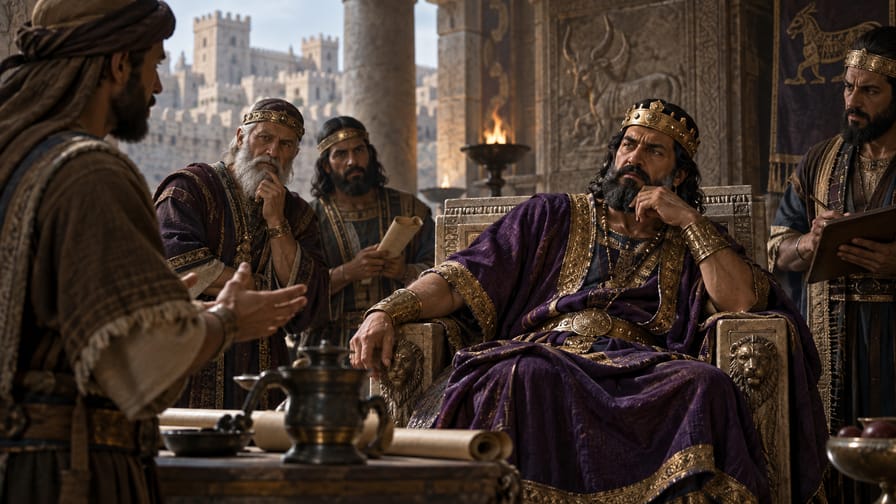
The figure of Hanun, king of the Ammonites, emerges in the Old Testament narratives as a crucial character whose actions triggered one of the most significant conflicts of David's reign. His story, though brief, is rich in theological and moral implications, serving as a case study on diplomacy, wisdom, and the consequences of poor leadership.
From an evangelical Protestant perspective, the analysis of Hanun must underscore the authority of Scripture, historical accuracy, and the progressive revelation of God's will. His legacy, marked by an act of profound disregard, resonates with themes of divine justice, God's sovereignty, and the importance of obedience to divine principles in human and political conduct.
1. Etymology and Meaning of the Name
The name Hanun derives from the Hebrew חָנוּן (Ḥānūn), which in turn has its root in the verb חנן (ḥānan), meaning "to be gracious," "to show favor," "to have mercy," or "to have compassion." Literally, the name Hanun can be translated as "gracious," "favored," or "merciful."
This etymology carries profound dramatic irony, given the Ammonite king's conduct toward David's ambassadors. Instead of demonstrating the grace or favor implicit in his name, Hanun acted with hostility and flagrant disrespect, transforming an offer of consolation into a grave diplomatic and personal insult.
There are no significant variations of the name Hanun in biblical languages that alter its etymological root or fundamental meaning. The form Ḥānūn is consistent in the Hebrew texts of the Old Testament. The uniqueness of his name in the context of his actions accentuates the dissonance between his character and the meaning of his name.
Although there is a Hanun mentioned in Nehemiah 3:13, 30, who participated in the rebuilding of Jerusalem's walls, this is a completely distinct individual who lived in a much later historical period. The Hanun in question is the Ammonite king, son of Nahash, whose reign intersects with David's.
The theological significance of the name lies in its ability to contrast divine grace with human failure to manifest it. The name "gracious" serves as a vivid reminder of the absence of grace in Hanun's decision, highlighting the depth of his offense and the subsequent justification for divine retribution through David.
2. Historical Context and Biblical Narrative
2.1. Historical Period and Political Context
The story of Hanun occurs during David's reign, approximately in the 10th century BCE (around 1000-970 BCE), after David had consolidated his power over Israel and Judah. The Kingdom of Israel under David was ascendant, seeking to establish its hegemony and peace with neighboring nations, or to subjugate them when necessary.
The Ammonites were a Semitic people who inhabited east of the Jordan River, in the region that today corresponds to Jordan. They were frequently hostile to Israel, but Hanun's father, Nahash, had maintained a somewhat friendly relationship with David, possibly due to their common enmity with King Saul (1 Samuel 11).
This alliance or tacit truce between David and Nahash forms the backdrop for the subsequent interaction. The death of Nahash and Hanun's ascension to the Ammonite throne mark a critical transition in diplomatic relations, altering the delicate balance of power and the expectations of peaceful coexistence in the region.
2.2. Genealogy and Family Origin
Hanun is explicitly identified as the son and successor of Nahash, king of the Ammonites (2 Samuel 10:1 1 Chronicles 19:1). The Ammonite royal lineage, though not detailed in the Bible, was of great importance for the continuity of the kingdom and for the legitimation of Hanun's power.
The mention of Nahash's kindness toward David suggests a debt of gratitude or a non-aggression pact that David wished to honor. David, by sending his servants to console Hanun on the death of his father, was acting in accordance with the diplomatic customs of the time and, more importantly, with a sense of hesed (kindness/loyalty) toward Nahash's memory.
2.3. Main Events and Biblical Passages
The central narrative involving Hanun is recorded in 2 Samuel 10:1-19 and 1 Chronicles 19:1-19, which are parallel accounts. After the death of Nahash, David sent a delegation to Hanun to express condolences, remembering the kindness Nahash had shown him.
However, the Ammonite princes, suspicious and ill-intentioned, convinced Hanun that David's ambassadors were disguised spies, sent to map the city and conquer it (2 Samuel 10:3). This malicious and unfounded interpretation led Hanun to commit a grave diplomatic and personal error.
In an act of profound humiliation and disrespect, Hanun shaved off half of each ambassador's beard and cut their garments in half, as far as their buttocks, and sent them away (2 Samuel 10:4). This outrage was a direct affront to the honor of David and his kingdom, and a most grievous personal insult in the culture of the Ancient Near East.
David, upon hearing what had happened, instructed his humiliated servants to remain in Jericho until their beards grew back. Hanun's reaction provoked a large-scale war, with the Ammonites hiring Aramean mercenaries to oppose Israel. David sent Joab and his entire army to battle, resulting in a decisive victory for Israel (2 Samuel 10:6-14).
The initial defeat of the Ammonites and their Aramean allies led to a second Aramean coalition, led by Hadadezer, king of Zobah. David personally led the Israelite forces and inflicted an overwhelming defeat on the Arameans, subjugating them and establishing Israelite hegemony over the region (2 Samuel 10:15-19 1 Chronicles 19:16-19).
2.4. Geography and Relationships with Other Characters
The central events occur in Ammon, whose capital was Rabbah (identified with modern Amman). The military campaign extended through several Aramean regions, including Beth-Rehob, Zobah, Maacah, and Ish-tob, whose kings and armies were hired by Hanun to fight David (2 Samuel 10:6).
Hanun's relationships are primarily with David, the king of Israel, and with his own counselors, who led him to make the disastrous decision. His father, Nahash, is a posthumous figure who serves to contextualize David's offer. Joab, the commander of David's army, is the main executor of military retribution against Hanun and his allies.
3. Character and Role in the Biblical Narrative
3.1. Analysis of Character and Moral Failings
Hanun's character, as revealed in Scripture, is marked by a notable lack of discernment and a propensity for distrust. He is portrayed as a leader easily influenced by malicious and paranoid advice from his princes, rather than evaluating the situation with wisdom or considering the nature of David's offer (2 Samuel 10:3).
His main moral failing was the flagrant violation of diplomatic norms and hospitality, transforming a demonstration of condolences into an act of deliberate humiliation. The shaving of beards and cutting of garments were profound insults, attacking the honor and dignity of the ambassadors and, by extension, of David and the entire nation of Israel.
Hanun's decision reveals pride, insensitivity, and a profound lack of political intelligence. He failed to perceive the consequences of his actions, precipitating his kingdom into an unnecessary and devastating war. His conduct is a classic example of the folly that arises from poor counsel and spiritual blindness.
3.2. Role and Significant Actions
Hanun's role in the biblical narrative is that of a catalyst for war between Israel and Ammon, and subsequently with the Aramean kingdoms. His actions are not those of a shrewd strategist, but of an impulsive and ill-advised king, who reacts with hostility to an offer of peace and consolation.
The humiliation of David's ambassadors is Hanun's most significant action. This act was not merely an insult, but a declaration of enmity and a direct challenge to David's power and honor. In a culture where honor was paramount, such an affront demanded a decisive military response to restore the dignity of the king and the nation.
Hanun's decision to hire Aramean mercenaries (2 Samuel 10:6) demonstrates his perception of the gravity of his offense and his fear of David's retribution. However, even this strategic decision was miscalculated, as it underestimated Israel's military strength and David's leadership, leading to an even greater defeat for the Ammonites and their allies.
4. Theological Significance and Typology
4.1. Role in Redemptive History and Progressive Revelation
The story of Hanun and the subsequent war with Ammon are embedded in the redemptive history of Israel as an example of divine providence in the protection of His people and His anointed king. David, as the bearer of the Davidic covenant (2 Samuel 7), was God's instrument to establish His kingdom on earth.
The affront to David was, in a broader sense, an affront to the authority God had conferred upon him. God's response, through Israel's victory, demonstrates His faithfulness to His covenant and His readiness to defend those He chose and anointed. The narrative underscores God's sovereignty over nations and the destinies of kings.
4.2. Connection to Central Theological Themes
The story of Hanun illustrates several central theological themes. Firstly, the theme of divine justice: God does not allow the honor of His servants to be outraged with impunity. The retribution against Hanun is not merely human vengeance, but a reflection of God's justice against injustice and arrogance (Proverbs 16:18).
Secondly, the importance of wisdom and good counsel. Hanun's folly in listening to his princes, instead of discerning David's sincerity, is a warning against ungodly counsel and a lack of spiritual discernment (Proverbs 11:14). The story is a testament that poor leadership and pride lead to ruin.
Thirdly, the concept of hesed (covenant kindness or loyalty) is central. David's offer to Hanun was an act of hesed, an extension of kindness based on the prior relationship with Nahash. Hanun's rejection of this hesed is a striking contrast to God's hesed toward David and Israel (Psalm 136).
4.3. Prefiguration or Christocentric Typology
The figure of Hanun itself is not a direct prefiguration or Christocentric typology in the sense of pointing to Christ. On the contrary, his story serves more as an anti-type or a negative contrast. The grace offered by David, a type of the Messianic King, was rejected by Hanun, resulting in judgment.
This narrative can be seen as a foreshadowing of the rejection of grace and peace offered by Christ to humanity. Those who reject Christ's offer of salvation, moved by distrust, pride, or ill will, will face the consequences of divine judgment, just as Hanun faced David's wrath.
In a broader sense, the humiliation of David's ambassadors can, in some interpretations, be seen as a shadow of the humiliation and suffering of Christ Himself, the Ambassador of the New Covenant, who was rejected and outraged by men, leading to the judgment of those who rejected Him (Isaiah 53:3 John 1:11).
5. Biblical-Theological Legacy and Canonical References
5.1. Mentions in Other Biblical Books and Influence on Biblical Theology
Hanun is mentioned only in the books of 2 Samuel and 1 Chronicles. His story is not directly revisited in other canonical texts, but the lessons drawn from his conduct and its consequences resonate throughout Scripture, especially in the wisdom books and the prophets, who frequently warn against pride, folly, and the rejection of justice.
The narrative of Hanun contributes to biblical theology by illustrating the complexities of international relations in the Old Testament era and the way in which God intervened in the affairs of nations to protect His purposes for Israel. It reinforces the doctrine of God's sovereignty, who can use even human wickedness to accomplish His plans.
5.2. Presence in Jewish and Christian Interpretive Tradition
In the Jewish interpretive tradition, the story of Hanun is frequently used to emphasize the importance of prudence and wisdom in matters of state. Rabbis highlight Hanun's folly in trusting malicious counselors and in failing to discern the true intentions of David, the king anointed by God.
In the Christian tradition, and particularly in Reformed and evangelical theology, the story of Hanun is viewed as a powerful illustrated sermon on the consequences of sin, distrust, and the rejection of grace. Evangelical commentators like Matthew Henry and John Gill highlight the justice of David's retribution and God's providence in defending the honor of His king and people.
The narrative serves as a reminder that the actions of leaders have vast implications, and that a lack of wisdom and the presence of pride can lead to personal and national ruin. It is frequently employed to teach about the importance of diplomacy, respect, and seeking godly counsel.
5.3. Importance for Understanding the Canon
The story of Hanun is vital for understanding the biblical canon, as it details a key event in David's reign, which solidified Israel's power in the region and subjugated enemies who opposed God's plan. It demonstrates God's continued faithfulness to His covenant with David and the establishment of His kingdom.
By recording the war with the Ammonites and the Arameans, Scripture provides essential historical context for understanding Israel's rise as a regional power under David and Solomon. The story of Hanun, although focused on a negative act, is an integral part of the grand tapestry of salvation history, revealing how God orchestrates events to fulfill His redemptive purposes.
In summary, Hanun remains a figure who, through his imprudent and insolent actions, serves as a powerful negative example in Scripture, underscoring the importance of wisdom, humility, and discernment in the face of offers of peace and divinely established authority. His story is an enduring testimony to divine justice and the inevitable consequences of disobedience and pride.