


Adbeel
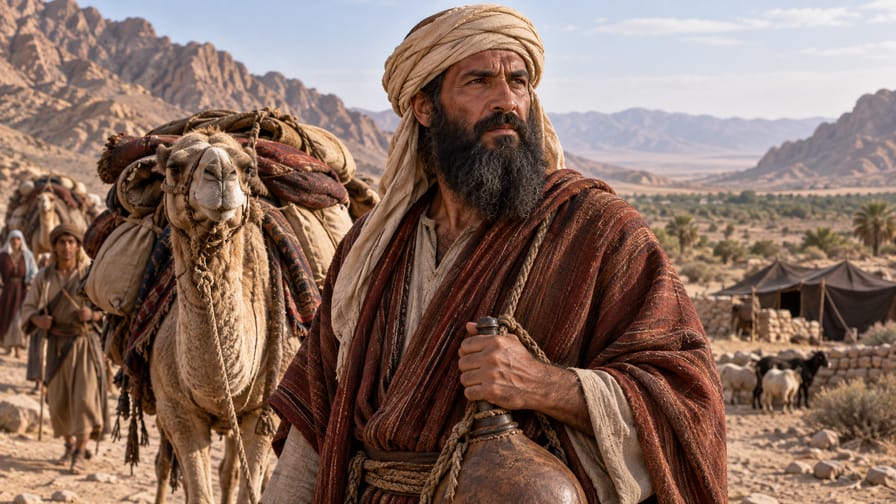
The figure of Adbeel, though briefly mentioned in the Scriptures, holds a specific place within the vast genealogical and historical tapestry of the Old Testament. He is presented as one of the twelve sons of Ishmael, the firstborn of Abraham and Hagar, Sarah's Egyptian servant.
His appearance is limited to genealogical lists, which means the Bible offers no details about his life, character, or individual actions. Nevertheless, his inclusion in the biblical canon, especially in contexts that delineate the lineage of Abraham, confers upon him a theological relevance that deserves to be explored from an evangelical Protestant perspective.
This analysis will seek to delve into the meaning of his name, the historical context of his existence as part of the Ishmaelite lineage, and the theological implications of his mention, considering God's sovereignty and His purposes for all nations, even those outside the direct lineage of the covenant of grace through Isaac.
Despite the scarcity of direct information, the presence of Adbeel in biblical genealogies serves as a reminder of God's faithfulness to His promises, not only to the covenant lineage, but also to the blessings granted to Ishmael, as declared to Abraham.
1. Etymology and Meaning of the Name
The name Adbeel (in Hebrew: אַדְבְּאֵל) is found in two passages of the Old Testament: Genesis 25:13 and 1 Chronicles 1:29. In both occurrences, he is listed as the third son of Ishmael, following Nebaioth and Kedar, and preceding Mibsam and Mishma.
The etymology of the name Adbeel is subject to some discussion among scholars, but the most widely accepted interpretation derives it from a combination of Hebrew or Semitic elements. One of the most common proposals suggests that the name may be composed of 'ad (אַד), meaning "flock" or "cloud," and 'el (אֵל), which is the Hebrew term for "God."
Thus, Adbeel would be interpreted as "flock of God" or "cloud of God." The idea of "flock of God" can symbolize divine protection over a group of people, or prosperity granted by God in terms of possessions and offspring, which would be consistent with God's promise to make Ishmael a great nation.
Another possible interpretation for the element 'ad (אַד) is "lord" or "majesty," which would make Adbeel "Lord of God" or "Majesty of God." However, this interpretation is less common and less aligned with Hebrew onomastic patterns that frequently use "God" ('El) as the second element to indicate a relationship of possession or divine attribution.
The interpretation of "flock of God" resonates with the divine promise made to Abraham in Genesis 17:20, where God declares: "As for Ishmael, I have blessed him I will make him fruitful and will greatly multiply him. He shall father twelve princes, and I will make him into a great nation." The name Adbeel, in this context, can be seen as a reflection of this promise of multiplication and prosperity under God's blessing.
There are no other biblical characters with the exact name of Adbeel. His nominal uniqueness reinforces his identity as one of Ishmael's sons, distinguishing him within the vast biblical genealogy. The theological significance of the name, therefore, is linked to God's sovereignty over Ishmael's descendants.
Even though Adbeel and his brothers were not in the lineage of the covenant of grace through Isaac, the name indicates that God recognized them and had a plan for them, granting them blessings and multiplication. This demonstrates the comprehensive scope of divine providence, which extends beyond the chosen line.
2. Historical Context and Biblical Narrative
Adbeel appears in the Scriptures as the third son of Ishmael, which places him historically in the patriarchal period, approximately in the 20th century BC. His life would have been set within the context of the nomadic Semitic tribes who inhabited the Arabian Desert region, east and south of Canaan.
The political, social, and religious context of the era was characterized by the formation of clans and tribes, with dominant patriarchal structures. The economy was based on herding flocks and, to a lesser extent, itinerant trade. Religion was predominantly polytheistic, although Abraham's family distinguished itself by monotheism and the worship of Yahweh (YHWH), the God of Israel.
The genealogy of Adbeel is clear: he is the son of Ishmael, grandson of Abraham and Hagar. Ishmael was Abraham's firstborn, born before Isaac, through Hagar, Sarah's servant, in a human effort to fulfill the divine promise of an heir (Genesis 16:1-4).
God, however, reaffirmed that the covenant of grace would be established through Isaac (Genesis 17:19-21), the son of promise. Despite this, God also promised to bless Ishmael because of Abraham, saying: "I will surely make him into a great nation" (Genesis 17:20).
The main biblical passages where Adbeel is mentioned are Genesis 25:13, which lists the sons of Ishmael immediately after Abraham's death, and 1 Chronicles 1:29, which repeats the list as part of the comprehensive genealogy from Adam to the kings of Israel. These passages serve to document Ishmael's descendants, fulfilling the divine promise that he would father twelve princes.
The geography associated with Adbeel and his brothers is the Arabian Desert, a vast region extending from southern Canaan to Mesopotamia. The Ishmaelite tribes were known for their mobility and for dwelling in tents, adapting to the arid conditions of the desert. They became the ancestors of various Arab and Bedouin peoples, who controlled the region's trade routes.
Adbeel's relationships with other biblical characters are indirect. He is the brother of Nebaioth, Kedar, and other sons of Ishmael, and therefore, Isaac's nephew. The Ishmaelites, as a whole, interacted with Isaac's descendants at different times in biblical history, not always peacefully, but also through trade relations and even mixed marriages at certain periods.
The inclusion of Adbeel in the genealogies emphasizes the precision and comprehensiveness of the Scriptures, which record not only the covenant lineage but also the family ramifications that developed from Abraham. This highlights God's sovereignty over the history of all peoples, and not just Israel.
The mention of Adbeel is a testimony to God's faithfulness in fulfilling His promises, even those that refer to more general blessings, distinct from the specific blessings of the covenant. He is part of the "great nation" that God promised to Ishmael, a people who, though not the people of the covenant, were still objects of divine providence.
3. Character and Role in the Biblical Narrative
The Scriptures provide extremely limited information about Adbeel's personal life. There are no narratives describing his character, virtues, flaws, actions, or decisions. He is, strictly speaking, a name in a genealogical list, without any character development.
Thus, it is not possible to analyze Adbeel's character as revealed in the Scriptures, for the Bible offers no such details. He is not presented as a model of faith, nor as an example of moral failing. His existence is documented, but not his biography or psychology.
The absence of information about Adbeel's individual character does not diminish his importance to the biblical narrative, but redirects the analysis to his representative role. He is not an active character, but a genealogical marker, evidence of the fulfillment of God's promise to Ishmael.
His primary role, therefore, is to be one of the "twelve princes" (Genesis 17:20) who would spring from Ishmael, each representing the head of a tribe or clan. The inclusion of Adbeel in the genealogical lists serves to validate the divine promise and show the branching of Abraham's family.
As one of Ishmael's sons, Adbeel, by implication, would have participated in the nomadic and tribal life of his people. He would have been a leader within his own tribe, contributing to the formation of the culture and identity of the Ishmaelites, a people distinct from the descendants of Isaac.
Despite the lack of details about his specific vocation or function, his position as one of the twelve sons suggests that he was a tribal patriarch, responsible for his own family and clan. This structure was common in the ancient world and was fundamental to the social organization of Semitic peoples.
The mention of Adbeel, though brief, serves to reinforce the veracity of divine promises. The Bible is a historical and theological record that is concerned with documenting the lineage of all involved in the grand narratives, even if some are merely names in the chronology.
Therefore, Adbeel's "character development" does not exist in the narrative sense. His relevance lies in his existence as a link in the chain of generations that demonstrates God's sovereignty over the history and destiny of peoples, and divine faithfulness in fulfilling His words.
Even though we have no insights into his inner life, the mere mention of Adbeel as the son of Ishmael and grandson of Abraham places him within the grand history of salvation, albeit peripherally to the main covenant line.
4. Theological Significance and Typology
The theological significance of Adbeel does not lie in his individual actions or character, but in his inclusion in biblical genealogies, which serve greater purposes in redemptive history. He is a testimony to God's faithfulness in fulfilling His promises, even those made to Ishmael, who was not in the line of the messianic covenant.
God promised Abraham that He would make Ishmael a great nation and that he would father twelve princes (Genesis 17:20). The mention of Adbeel and his eleven brothers in Genesis 25:13-16 and 1 Chronicles 1:29-31 is the direct fulfillment of this divine promise. This demonstrates God's sovereignty over history and the divine capacity to carry out His decrees for all peoples.
There is no direct Christocentric prefiguration or typology in Adbeel, nor does he explicitly point to Christ. His importance lies in the progressive revelation of God's nature: a God who blesses and fulfills His promises to all His creatures, even outside the elect line of salvation.
The presence of Adbeel in the genealogies underscores the distinction between the covenant of grace, established with Abraham through Isaac, which would culminate in Christ (Galatians 3:16), and the general blessings granted by God to Ishmael and his descendants. Isaac's lineage is the lineage of the messianic promise, while Ishmael's is the lineage of a great nation blessed in a more general way.
This distinction is crucial in evangelical Protestant theology, which emphasizes the particularity of divine election for salvation, while simultaneously recognizing God's common grace that extends to all humanity (Matthew 5:45 Acts 14:17). Adbeel is an example of this common grace manifested in the blessing of multiplication.
There are no direct citations or references to Adbeel in the New Testament. His relevance, therefore, remains in the Old Testament context, as part of the narrative of the formation of post-diluvian nations and the diversity of the human family, all under divine providence.
The story of Adbeel and his brothers connects to central theological themes such as God's faithfulness, divine sovereignty, and the comprehensiveness of His blessings. He reminds us that God is the Lord of all the earth and all peoples, and that His purposes extend beyond the nation of Israel.
The inclusion of Adbeel in the canon also serves as a reminder of the importance of genealogy in understanding biblical history. Genealogical lists are not merely tedious records, but theological documents that validate promises, establish lineages, and demonstrate God's hand in history.
Thus, although Adbeel is not a central character, his mention is a "small" fulfillment of a "great" promise, reinforcing the reliability of God's Word in all its details. This is vital for the evangelical perspective, which upholds the inerrancy and authority of the Bible.
5. Biblical-Theological Legacy and Canonical References
The legacy of Adbeel, as an individual figure, is quite limited in the biblical canon. He is not mentioned in any other biblical book apart from Genesis and 1 Chronicles, and there are no literary contributions attributed to him, such as the authorship of Psalms or epistles.
His influence on biblical theology is not manifested through his actions or teachings, but rather through his existence as one of the twelve sons of Ishmael. He contributes to the understanding of the extent of divine providence and the fulfillment of God's promises to Abraham, even those related to Ishmael.
In the Jewish interpretive tradition, the sons of Ishmael are recognized as the ancestors of Arab peoples. Although they are not the covenant lineage, their existence and multiplication are seen as part of the divine blessing granted to Abraham. Evangelical Christian tradition echoes this view, recognizing the distinction between the lineage of promise and the lineage of Ishmael.
There are no known references to Adbeel in intertestamental literature, which reinforces his nature as a genealogical figure without narrative development. His name simply attests to the veracity of the divine promise that Ishmael would father twelve princes.
In Reformed and evangelical theology, the treatment of Adbeel and the Ishmaelites falls within the discussion on election and common grace. Election for salvation is particular and passes through Isaac, Jacob, and the nation of Israel, culminating in Christ. However, God's common grace is manifested in His blessings for all humanity, including the descendants of Ishmael.
The importance of Adbeel for understanding the canon lies in his contribution to the completeness of biblical genealogies. These lists are not merely dry records, but integral parts of God's revelation, showing how His promises unfold throughout history.
The inclusion of Adbeel in the Scriptures reinforces the historical accuracy and veracity of God's Word. Every name, even the most obscure, has a purpose in the grand divine plan, validating the reliability of the Scriptures as a whole.
In summary, although Adbeel is not a prominent character, his mention serves as a reminder of God's faithfulness to all His promises and the comprehensiveness of His sovereignty over all peoples and nations, contributing to a more complete understanding of the history of redemption and divine providence.