


Shelemiah
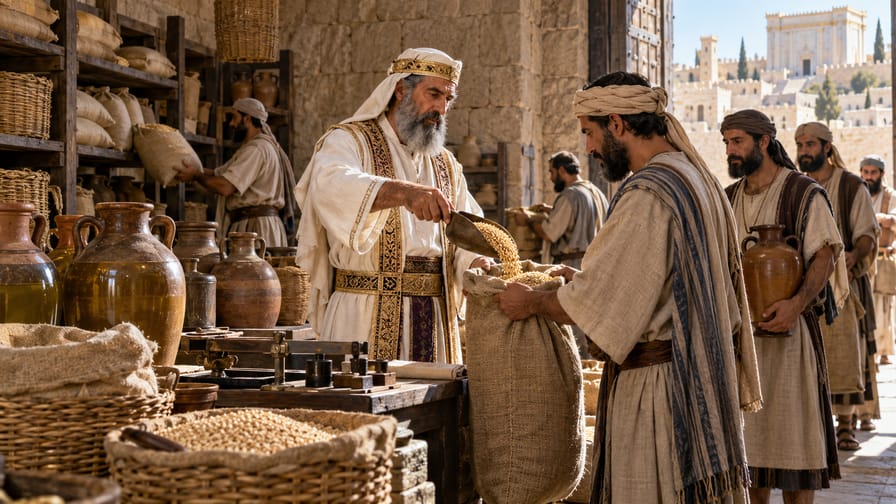
Shelemiah was a priest in Jerusalem in the time of Nehemiah. He appears in one verse only, Nehemiah 13:13, where Nehemiah records that he appointed him, together with a scribe, a Levite and an assistant, as treasurers over the storehouses of the temple, “for they were considered reliable, and their duty was to distribute to their brothers.”
That is all Scripture tells us about him. We do not know his age, his father’s name, his priestly division or anything he said. Yet the single sentence that mentions him carries a clear note of approval: he was chosen because he was trustworthy, at a moment when trust in the management of God’s house had been badly damaged.
The story of Shelemiah is therefore the story of an ordinary office faithfully held. It speaks to every believer who handles resources that belong to God and to others, and it points to the One who is faithful over God’s house as a Son.
1. Etymology and meaning of the name
The Hebrew name Shelemiah (שֶׁלֶמְיָה, Shelemyah, also written Shelemyahu) is built on the root sh-l-m, the same root as shalom, joined to Yah, a short form of the divine name YHWH. The root carries ideas of wholeness, completion and repayment. The name is therefore usually understood as “the LORD has repaid” or “the LORD has restored,” though some scholars prefer a sense close to “the LORD is peace” or “wholeness from the LORD.” The precise nuance is uncertain.
The name was relatively common in the late period of Judah and after the exile, which explains why several different men bear it in the Bible. Nothing in the text links the meaning of the name to this priest’s life, and it would be speculation to do so.
2. Historical context and biblical narrative
2.1 Family origin and genealogy
The only personal information given is that Shelemiah was “the priest,” that is, a member of the priestly families descended from Aaron. The text does not name his father or his house. No genealogy of the priests in Ezra or Nehemiah can be identified with him with certainty.
He must not be confused with other men called Shelemiah: two laymen who had married foreign wives in the days of Ezra (Ezra 10:39, 41), the father of Hananiah who repaired the wall (Nehemiah 3:30), several men in the days of Jeremiah (Jeremiah 36:14, 26; Jeremiah 37:3, 13) and a gatekeeper in the time of David (1 Chronicles 26:14).
2.2 Main events
Shelemiah’s appointment belongs to the last chapter of Nehemiah. After governing Judah for twelve years, Nehemiah returned to the court of Artaxerxes in the king’s thirty-second year, around 433 BC, and some time later obtained permission to come back to Jerusalem (Nehemiah 13:6-7). During his absence several abuses had crept in.
Eliashib the priest, who had been placed over the chambers of the house of God and was related to Tobiah, had given Tobiah a large room in the temple courts, the very room where the grain offerings, frankincense, vessels and tithes for the Levites, singers and gatekeepers had been kept (Nehemiah 13:4-5). Whether this Eliashib is the same person as the high priest of the same name (Nehemiah 3:1; Nehemiah 13:28) is debated. Nehemiah threw Tobiah’s furniture out, ordered the rooms to be cleansed and brought the vessels and offerings back (Nehemiah 13:8-9).
He also discovered that the portions of the Levites had not been given to them, so that the Levites and singers had gone back to their fields to survive (Nehemiah 13:10). He confronted the officials with the question, “Why is the house of God forsaken?” and restored the Levites to their posts. Then all Judah brought the tithe of grain, wine and oil into the storehouses (Nehemiah 13:11-12).
It was at this point that Nehemiah appointed Shelemiah the priest, Zadok the scribe and Pedaiah of the Levites, with Hanan the son of Zaccur, son of Mattaniah, as their assistant (Nehemiah 13:13). The Hebrew describes them as ne’emanim, “faithful” or “reliable,” from the same root as the word amen. Their task was to receive what came into the storehouses and distribute it fairly to their brothers. Nehemiah immediately follows the appointment with a prayer: “Remember me, O my God, concerning this” (Nehemiah 13:14).
3. Character and role in the biblical narrative
The text gives only one character trait, but it is an important one: Shelemiah was counted faithful. This was not a private opinion of Nehemiah; the verb suggests a reputation recognized by others. In a situation where a man in charge of the temple chambers had used his position to favor a powerful relative, the choice of a trustworthy priest was part of the remedy.
The composition of the group is also meaningful. Nehemiah did not entrust the storehouses to one man alone, but to a priest, a scribe and a Levite, with an assistant. Many interpreters see here a deliberate balance that represented the groups involved and provided mutual accountability. The text does not say this explicitly, but the plurality of the commission is evident.
We should not attribute to Shelemiah feelings, speeches or achievements that Scripture does not record. It is enough to see him as the text presents him: a priest whose integrity made him fit to handle what belonged to God and to his brothers.
4. Theological significance
4.1 The house of God must not be forsaken
Shortly before, the people had solemnly promised to bring their firstfruits and tithes and declared, “We will not neglect the house of our God” (Nehemiah 10:35-39; see also Nehemiah 12:44). The crisis of chapter 13 shows how quickly such promises can be broken. The prophet Malachi, whose ministry is probably close to this period, likewise rebuked the people for withholding tithes and called them to bring the full tithe into the storehouse (Malachi 3:8-10). Shelemiah’s appointment was a concrete step in restoring what the covenant required.
4.2 Faithfulness as the mark of a steward
Scripture repeatedly presents faithfulness as the essential quality of those who manage what belongs to God. Paul writes that “it is required of stewards that they be found faithful” (1 Corinthians 4:2). When the early church needed men to oversee the daily distribution, it looked for people of good reputation, full of the Spirit and of wisdom (Acts 6:1-6). Paul himself took care, in the collection for Jerusalem, to do what was honorable not only in the Lord’s sight but also in the sight of others (2 Corinthians 8:20-21). Shelemiah stands in this line of faithful administrators.
4.3 Christ, faithful over God’s house
The Letter to the Hebrews contrasts Moses, who was faithful in God’s house as a servant, with Christ, who is faithful over God’s house as a Son (Hebrews 3:1-6). Shelemiah is not a type of Christ, and the text gives no hint of that, but his modest office helps us appreciate the greatness of Jesus. Human stewards can fail, as Eliashib did; Christ never fails. He distributes to his people every spiritual blessing (Ephesians 1:3) and, as the faithful High Priest, gives each member what is needed (Hebrews 2:17).
5. Legacy and canonical references
Shelemiah the priest appears only in Nehemiah 13:13. No other passage mentions him with certainty, and attempts to identify him with other bearers of the name are speculative. The context of his appointment is found in Nehemiah 13:4-14, and the background of the obligations he administered is in Nehemiah 10:35-39 and Nehemiah 12:44-47.
His legacy is small in words but large in meaning. The Bible remembers him for one thing only: he could be trusted. In a book that honestly records the failures of priests and leaders, that simple commendation stands out.
6. Application for today
First, Shelemiah reminds us that reliability is a spiritual virtue. Churches, ministries and families need people who can be trusted with money, time and responsibilities that belong to others. Jesus taught that one who is faithful in a very little is also faithful in much (Luke 16:10).
Second, his story shows the value of shared accountability. Nehemiah did not rely on one gifted individual but formed a team with clear responsibilities. Christian communities are wise when they handle resources transparently and in plurality, not out of suspicion but out of love for integrity.
Third, his task was to distribute to his brothers. Faithful stewardship is not only about guarding resources but about making sure they reach those who serve and those in need. When the Levites were neglected, the worship of God suffered. Caring for those who minister is part of honoring the house of God (Galatians 6:6).
Finally, Shelemiah points us to the Lord who is perfectly faithful. Our faithfulness is small and imperfect, but it is a response to the faithfulness of Christ, who will one day say to his servants, “Well done, good and faithful servant” (Matthew 25:21). May we be found reliable in the storehouse God has entrusted to us.