


Hermes
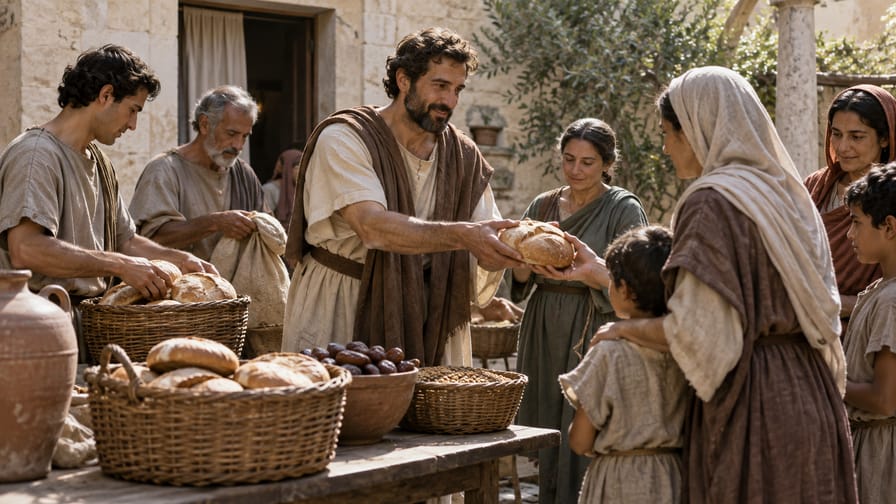
The figure of Hermes in the Bible, though briefly mentioned, offers a rich opportunity for exegetical and theological analysis, especially from a Protestant evangelical perspective. His most notable appearance is in Paul's epistle to the Romans, where he is greeted as a member of the Christian community in Rome. Furthermore, the name Hermes appears in Acts 14:12, referring to a pagan deity, which requires a careful distinction in the analysis.
This in-depth study will seek to explore the onomastic meaning of Hermes, his historical context, the role he plays in the biblical narrative, his theological significance, and the legacy that, despite his obscurity, he represents for understanding the body of Christ and the apostolic mission. The approach will be scholarly yet accessible, focusing on the authority of Scripture and the relevance of Reformed theology.
The mention of Hermes in Romans 16:14, in Paul's list of greetings, underscores the personal and relational nature of the apostolic ministry and the importance of each believer in the edification of the church. Even the less prominent characters in Scripture have a place in the great drama of redemption, revealing God's sovereignty and the breadth of His grace. The distinction between the individual and the pagan deity is crucial for a correct interpretation.
1. Etymology and meaning of the name
The name Hermes (Greek: Ἑρμῆς, Hermēs) has deep roots in Greek mythology. Linguistically, it derives from the name of the Greek god Hermes, who was known as the messenger of the gods, the god of commerce, travelers, thieves, eloquence, and luck. Its exact etymology is uncertain, but some theories connect it to the Greek word herma (ἕρμα), which refers to a heap of stones or a landmark, often used as a point of reference or boundary.
In Greco-Roman culture, it was common for people to be named after deities, whether out of family devotion or aspiration to certain qualities associated with the god. Thus, the name Hermes, when applied to an individual, did not necessarily imply direct worship of the pagan god, but was a common name at the time. In the biblical context, the presence of the name reflects the cultural reality of the Roman Empire, where pagan names were ubiquitous.
The Bible mentions the name Hermes in two distinct contexts, which require careful differentiation. In Acts 14:12, the inhabitants of Lystra, after witnessing Paul and Barnabas heal a paralyzed man, exclaim: "The gods have come down to us in human form!" They identify Barnabas as Zeus and Paul as Hermes (due to his eloquence, Paul being "the chief speaker"). This is the pagan god Hermes, the messenger, associated with communication.
However, the biblical figure that is the focus of this analysis is the individual named Hermes, mentioned in Romans 16:14. This Hermes is a believer in Rome, greeted by Paul, and should not be confused with the pagan deity. The theological significance of the name, in this case, does not lie in its connection to the pagan god, but in the fact that even individuals with names of pagan origins were reached by the grace of Christ and incorporated into the Church.
The presence of names like Hermes among early believers demonstrates the universality of the gospel, which transcends cultural and religious barriers. The gospel of Christ does not demand a change of name to erase a pagan past, but a transformation of the heart and loyalty. Thus, the name Hermes in the Christian context symbolizes God's ability to redeem and sanctify people from all backgrounds, integrating them into His family.
2. Historical context and biblical narrative
The mention of the believer Hermes occurs in the context of Paul's epistle to the Romans, specifically in chapter 16, which comprises a series of personal greetings and final exhortations. The epistle was written around 57-58 A.D., during Paul's third missionary journey, likely from Corinth. This period marks a crucial point in the development of the early church, with the gospel spreading vigorously throughout the Roman Empire.
The city of Rome, capital of the empire, was a melting pot of cultures, religions, and philosophies. The Christian community in Rome, though not directly founded by Paul, was significant and comprised both converted Jews and Gentiles. The political and social context was that of the Pax Romana, which, despite its tensions, facilitated the dissemination of the gospel through vast networks of communication and transportation.
The Epistle to the Romans is one of the deepest theological works of the New Testament, expounding the doctrine of justification by faith, God's sovereignty in salvation, and the practical life of the believer. Chapter 16, with its detailed greetings, serves as a reminder that theology is not abstract, but embodied in the lives of real people, like Hermes, who formed the backbone of local churches.
The main biblical passage where the believer Hermes is mentioned is Romans 16:14, where Paul writes: "Greet Asyncritus, Phlegon, Hermes, Patrobas, Hermas, and the brothers who are with them." This brief mention places him in a group of five men, followed by the note that "the brothers who are with them" should also be greeted. This suggests that Hermes was part of a group or a household that functioned as a meeting center for Christians in Rome.
The relevant geography is, therefore, the city of Rome. Although we have no details about Hermes' family origin or genealogy, we can infer that he, like many in the Roman church, was likely a converted Gentile or a Hellenized Jew. The lack of detailed information about his life is common for many secondary characters in Scripture, but his inclusion by Paul is in itself significant.
Hermes' relationships are with Paul, the apostle, and with the other believers mentioned in Romans 16, such as Asyncritus, Phlegon, Patrobas, and Hermas, in addition to the group of brothers associated with them. This demonstrates the communal nature of the early church and the network of relationships that sustained the Christian movement. These greetings were not mere formalities, but expressions of genuine affection and recognition of common faith.
3. Character and role in the biblical narrative
The brevity of Hermes' mention in Romans 16:14 means that Scripture does not provide a detailed description of his character, virtues, or flaws. However, his inclusion in Paul's list allows us to infer certain aspects of his life and role in the Christian community in Rome. The fact that he is greeted by Paul, an apostle rigorous in his assessments, already suggests that Hermes was a faithful and respectable believer.
We can infer that Hermes possessed essential spiritual qualities, such as faith in Christ and loyalty to the gospel. He was part of a group of brothers, which indicates his active participation in the life of the church. In an era of persecution and challenges for Christians, simple persistence in faith and fellowship was a notable virtue. His presence in Paul's list is a testament to his perseverance in the faith.
There is no record of sins, weaknesses, or moral failures associated with Hermes in Scripture, which does not mean he was perfect, but that his life was not marked by scandals worthy of mention. On the contrary, his inclusion in Paul's greetings places him among those considered worthy of apostolic recognition and appreciation, which is a positive testimony.
The specific calling or function of Hermes is not explicitly stated. He is not described as an apostle, prophet, evangelist, pastor, or teacher. It is more likely that he was an ordinary member of the church, but a faithful and committed member. His association with a group of brothers may indicate that he was a leader of a house church or an influential member within one of these groups, given the structure of the early church in Rome.
The role played by Hermes in the biblical narrative, though discreet, is significant. He represents the vastness and diversity of the body of Christ. The church is not composed solely of prominent figures, but also of innumerable faithful believers whose service and presence are vital for the health and growth of the gospel. Hermes is an example of the common believer who, through his faith and commitment, contributes to God's work.
His significant actions and key decisions, though not narrated, would be the decision to follow Christ, to remain faithful amidst a pagan society, and, presumably, to actively participate in the life of the Christian community. The development of his character, though not explicit, would be aligned with the process of sanctification that every believer experiences through the Holy Spirit, growing in godliness and love.
4. Theological significance and typology
The theological significance of Hermes, despite his limited mention, is profound from a Protestant evangelical perspective. He personifies the inclusion of ordinary individuals in God's redemptive history and the progressive revelation of His plan. Salvation is not reserved only for heroes of faith or charismatic leaders, but is extended to all who believe, regardless of their prominence.
Hermes, as one of many anonymous or little-known believers, serves as a reminder of the universal and inclusive nature of the gospel. Paul, by explicitly greeting these individuals, reinforces the doctrine of the church as the body of Christ, where every member, even the "less noble," is essential and valued (cf. 1 Corinthians 12:22-26). This underscores the dignity and value of each believer in the eyes of God and the community.
There is no direct Christocentric prefiguration or typology associated with Hermes, in the sense of him being a type of Christ. However, his presence in the Roman community can be seen as a fulfillment of God's promise to gather for Himself a people from all nations (cf. Isaiah 49:6 Acts 13:47). He is part of the Gentiles who were grafted into the olive tree of the covenant, as Romans 11 teaches, demonstrating the breadth of God's grace.
The mention of Hermes in Romans 16:14 directly connects him to central theological themes such as Christian fellowship (koinonia), God's grace, the obedience of faith, and the unity of the church. Paul's greetings are not merely social they demonstrate the interconnectedness and interdependence of believers and local churches. The faith of Hermes and his companions was part of the "obedience of faith" that Paul sought to promote among all nations (Romans 1:5 16:26).
The presence of Hermes in Paul's list also serves to illustrate the doctrine of election and effectual calling. God calls people from all walks of life, and the Holy Spirit enables them to live a life of faith and service within the Christian community. Hermes' life, though not detailed, is a silent testimony to the transforming power of the gospel and God's faithfulness in sustaining His people.
Reformed theology emphasizes God's sovereignty in every aspect of salvation and the believer's life. The inclusion of Hermes and other "obscure" individuals in Scripture reflects the truth that God uses the humble and those not notable in the eyes of the world to fulfill His purposes, demonstrating that glory belongs to Him alone (cf. 1 Corinthians 1:26-29). Every believer is a recipient of God's grace and a vital part of His eternal plan.
5. Biblical-theological legacy and canonical references
The only direct canonical reference to the believer Hermes is found in Romans 16:14. There are no other mentions of him in other biblical books, nor any literary contributions attributed to him. His influence on biblical theology does not lie in his recorded actions or teachings, but in his very existence as a member of the early church and in how Paul includes him in his greetings.
Hermes' legacy, therefore, is more symbolic than biographical. He represents the vast majority of believers throughout all ages of Church history: faithful people, perhaps without great prominence, but essential for the vitality and continuity of the community of faith. His mention in Romans underscores the importance of local fellowship and mutual recognition among believers, even at a distance.
In the Jewish interpretive tradition, the figure of Hermes (the believer) has no relevance, as he is a New Testament character and likely a Gentile. However, in the Christian tradition, especially in commentaries on Romans, Hermes is consistently noted as one of the many to whom Paul extends his personal greeting, emphasizing the relational nature of the apostolic ministry.
Reformed and evangelical theology treats Hermes as an example of the inclusiveness of the gospel and the valuing of each member in the body of Christ. Commentators such as John Murray, in his work on Romans, when addressing Romans 16, generally highlight the depth of Paul's pastoral care and his appreciation for each believer, regardless of their social status or renown. Douglas Moo, in his commentary on Romans, also emphasizes the importance of these greetings for understanding the nature of the early church.
The name Hermes also appears in later Christian tradition, with one of the Apostolic Fathers, Hermas, author of the Shepherd of Hermas, whom some suggest to be the same "Hermas" greeted in Romans 16:14, although this identification is uncertain and lacks conclusive evidence. However, the Hermes of Romans 16:14 is distinct from Hermas, being different names in the list.
The importance of Hermes for understanding the canon lies in his contribution to illustrating the network of relationships that sustained the early Christian movement. He reminds us that the great narrative of redemption is composed of countless individual stories of faith, hope, and love. His presence in Paul's epistle serves to humanize theology and reinforce the idea that the church is a community of redeemed people, each with their place and value before God.
In summary, Hermes, the believer from Rome, encapsulates the truth that faithfulness to Christ is the supreme criterion for significance in God's history. His life, though poorly documented, testifies to the gospel's ability to transform and integrate individuals from all backgrounds, making them participants in the eternal promise and the fellowship of the saints. He is a reminder that all members of the body of Christ are important, and that love and mutual recognition are essential marks of the true church.