


Darda
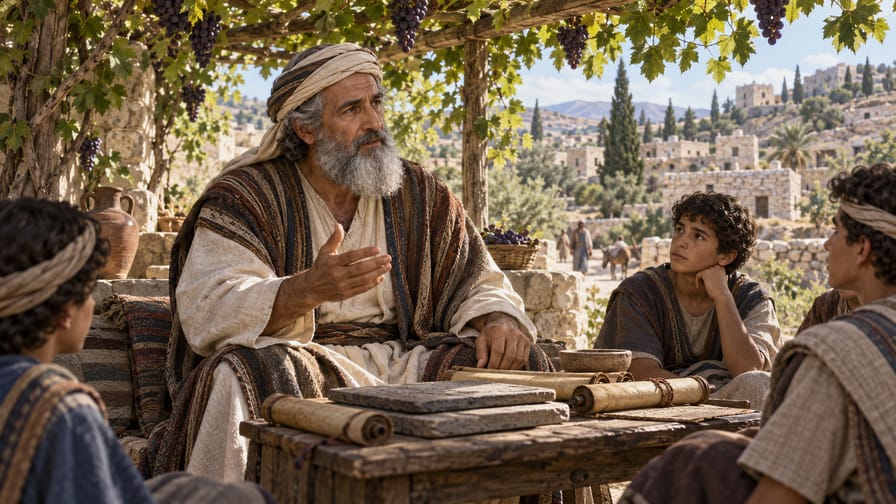
The figure of Dara, although briefly mentioned in the Holy Scriptures, offers a rich field for biblical and theological analysis, especially from an evangelical Protestant perspective. His inclusion in the genealogies of Israel and his association with wisdom serve as starting points for an exploration that transcends mere nominal identification, connecting him to larger themes of redemptive history and divine revelation.
This study seeks to deepen the understanding of Dara, examining his name, historical context, implicit character, theological significance, and legacy within the biblical canon. The analysis will be conducted with exegetical rigor, seeking to extract the truths that the Scriptures reveal about this character, however concise the mentions, always through a Christ-centered and Reformed lens.
The importance of secondary characters like Dara lies in their contribution to the complete mosaic of the biblical narrative, demonstrating God's providence in every detail of human history and His redemptive plan. Even in a few words, the Bible highlights Dara's wisdom, placing him in a pantheon of notable men who, ultimately, serve to exalt the incomparable wisdom of God, fully manifested in Christ Jesus.
1. Etymology and meaning of the name
The name Dara appears in the Hebrew Scriptures as דָּרַע (Dara) in 1 Chronicles 2:6. It is important to note that a variation of the name, דַּרְדַּע (Darda), is found in 1 Kings 4:31 (or 1 Kings 5:11 in some versions of the Hebrew Bible and translations). Most scholars agree that they refer to the same person, with Darda being a more complete form or an orthographic variation of Dara.
The etymological root of Dara/Darda is subject to some discussion among Hebraists. A common interpretation suggests a connection with the Hebrew דָּר (dar), which can mean "pearl" or "generation," and עַ (‘a), which can be a diminutive suffix or an indicator of possession or origin. Thus, the name could be interpreted as "pearl of wisdom" or "generation of wisdom," which aligns with the character's description as a wise man.
Another possible derivation relates the name to the root meaning "knowledge" or "circle of knowledge," suggesting someone with vast intellect and understanding. This interpretation reinforces Dara's reputation as one of the wisest men of his time, whose wisdom was a standard for comparison, as seen in 1 Kings 4:31.
The theological significance of the name, especially when associated with wisdom, is profound within the biblical context. Wisdom, in the Old Testament, is not merely human intelligence, but the ability to apply the knowledge of God in practical life, resulting in righteousness and the fear of the Lord (Proverbs 9:10). Dara's name, therefore, may have served as a reminder of his main characteristic and perhaps his calling.
There are no other prominent biblical characters with the exact name of Dara or Darda who are clearly distinct, which suggests that the two mentions refer to the same figure. This uniqueness, combined with the description of his wisdom, gives him a unique, though concise, identity in the sacred record.
The meaning of the name, "pearl of wisdom" or "generation of wisdom," is a testament to the high value placed on wisdom in Israelite culture. Wisdom was seen as a divine gift, essential for just governance and a godly life, and Dara's name reflects this high esteem.
2. Historical context and biblical narrative
2.1 Family origin and genealogy
Dara is first introduced in 1 Chronicles 2:6 as one of the five sons of Zerah, who in turn was the son of Judah and Tamar. His genealogy connects him directly to the tribe of Judah, the royal lineage of Israel, from which David and, subsequently, the Messiah would come. Dara's other brothers were Zimri, Ethan, Calcol, and Shammah.
The inclusion of Dara in such an important genealogy, that of Judah, is not accidental. The genealogies in Chronicles had the purpose of establishing the identity and continuity of the people of Israel after the exile, reaffirming their roots and the divine promises to them. They served to legitimize the priestly, royal, and tribal lineage, connecting the present to the divinely ordered past.
The historical period in which Dara lived, as inferred from his inclusion in the post-Jacob and pre-monarchy genealogy, would be that of the judges or the beginning of the united monarchy, around the 12th to 11th centuries BC. However, his mention in 1 Kings 4:31, in comparison with Solomon, places him as a figure of wisdom prior to or contemporary with, but already recognized by, the reign of Solomon (c. 970-931 BC).
2.2 Political, social, and religious context
The social and religious context of Dara's time was that of an Israel in formation, transitioning from semi-nomadic tribes to an established nation. Mosaic law was the religious foundation, and the worship of Yahweh was central, though often challenged by pagan influences from neighboring nations. Wisdom, in this period, was frequently associated with leaders, elders, and counselors who interpreted the law and governed with discernment.
The mention in 1 Kings 4:31 is particularly significant, as it places Dara as one of the wisest men of his generation, alongside Ethan (his brother, according to 1 Chronicles 2:6), Heman, and Calcol (also his brothers or close relatives in tradition). These individuals were so renowned for their wisdom that they became a point of reference for Solomon's incomparable wisdom.
The passage in 1 Kings 4:31 states: "He [Solomon] was wiser than all men, wiser than Ethan the Ezrahite, and Heman, Calcol, and Dara, the sons of Mahol and his fame spread throughout all the surrounding nations." This statement is crucial, as it establishes the prominence of Dara and his brothers as the standards of human wisdom at the time.
The geography related to Dara and his family would be the tribal region of Judah, south of Israel, with its cities and villages. Although there are no specific mentions of where Dara lived or exercised his wisdom, his connection with the lineage of Judah places him at the heart of Israel's history.
Relationships with other biblical characters are evident: his brothers (Ethan, Calcol, Heman, Zimri, Shammah) and, most notably, King Solomon. The comparison with Solomon does not diminish Dara's wisdom, but elevates Solomon's, which was a direct gift from God (1 Kings 3:12). Dara represents the pinnacle of human wisdom, while Solomon represents divine wisdom manifested in a man.
3. Character and role in the biblical narrative
Dara's character is inferred primarily from his reputation as a wise man. The Bible does not offer detailed narratives about his life, actions, or specific decisions. His wisdom is the defining characteristic that the Scriptures choose to record, elevating him to a status of intellectual and moral prominence in his time.
From a biblical perspective, wisdom is not just intellect or accumulated knowledge, but the ability to discern God's will and apply it to life. It is the ability to live piously and justly, according to divine principles. Therefore, the description of Dara as wise implies that he was a man of discernment, prudence, and, likely, of moral and spiritual integrity.
Dara's virtues and spiritual qualities, though not explicitly enumerated, would be intrinsically linked to the concept of wisdom in the Old Testament. This would include the fear of the Lord (Proverbs 1:7), justice, equity, and righteousness (Proverbs 2:9). A wise man was someone who understood God's ways and applied them in all spheres of life.
There is no mention of documented sins, weaknesses, or moral failures for Dara in the Scriptures. The absence of such records, while not implying perfection, preserves his image as a model of human wisdom. His role, therefore, is that of a paradigm of wisdom, a standard by which the wisdom of others could be measured.
Dara's specific vocation or function is not stated. However, his wisdom would have qualified him for roles of leadership, counsel, or teaching. In a tribal society, wise men were often consulted on legal, ethical, and governmental matters, acting as informal judges or counselors to tribal chiefs.
His primary role in the biblical narrative is to serve as a counterpoint to Solomon's wisdom. The description in 1 Kings 4:31 not only attests to Dara's wisdom, but, more significantly, highlights the magnitude of Solomon's wisdom, which surpassed that of all his most renowned contemporaries. Dara and his brothers represented the apex of human wisdom, which, however, was eclipsed by the divinely granted wisdom to Solomon.
Dara's significant actions and key decisions are not recorded. His relevance lies in his existence and his reputation, which contribute to the larger narrative of divine wisdom and the exaltation of Solomon as the wisest king. The character development is static in the Bible he is introduced already with the reputation of being wise and serves a specific purpose within the history of wisdom in Israel.
4. Theological significance and typology
The figure of Dara, though secondary, plays a significant role in redemptive history and the progressive revelation of divine wisdom. His inclusion in the genealogies of Judah connects him to God's plan to raise up a king and, ultimately, the Messiah from that lineage (Genesis 49:10).
Dara's wisdom, like that of other Old Testament wise men, prefigures the wisdom of Solomon and, more profoundly, the perfect and incarnate wisdom of Jesus Christ. Human wisdom, even at its peak like Dara's, is limited and imperfect. It serves as a mirror reflecting the need for a superior, divinely originated wisdom.
Reformed and evangelical theology emphasizes that all true wisdom emanates from God (James 1:5). Dara's wisdom, therefore, was not inherent in him autonomously, but a gift or capacity that God granted him or allowed him to develop. He thus becomes an example of the human capacity to reflect divine attributes, albeit in a limited way.
The comparison of Dara with Solomon in 1 Kings 4:31 is a prefiguration of messianic wisdom. Solomon, in his incomparable wisdom, is a type of Christ, who is the very Wisdom of God (1 Corinthians 1:24, 30). Solomon's wisdom was to govern Israel with justice, and Christ's wisdom is to govern the universe and redeem humanity.
In Proverbs, wisdom is personified and presented as co-creator with God (Proverbs 8:22-31). This personification is often interpreted Christocentrically as a reference to Christ, the eternal Word of God. Dara, as a man of wisdom, indirectly points to this incarnate divine wisdom.
Dara's life, however succinct its mention, connects to central theological themes such as God's providence in raising wise men to lead and instruct His people, and God's grace in bestowing such gifts. His existence in the biblical record underscores the importance of divine wisdom in guiding the history of salvation.
There are no direct quotes of Dara in the New Testament, nor is he explicitly associated with prophecies or covenants. However, the concept of wisdom that he represents is fundamental to New Testament theology, where Christ is the fullness of wisdom and knowledge (Colossians 2:3). Dara's wisdom is, therefore, a link in the chain of revelation that culminates in Jesus.
Dara's human wisdom, however great, could not lead to salvation. Salvation is through faith in Christ, who is God's wisdom for us, righteousness, sanctification, and redemption (1 Corinthians 1:30). The figure of Dara reminds us that, although wisdom is valued, it finds its true meaning and fulfillment in Christ.
5. Biblical-theological legacy and canonical references
Dara's legacy is primarily his mention in two crucial passages of the biblical canon: 1 Chronicles 2:6 and 1 Kings 4:31. These references, though brief, are sufficient to immortalize him as a name associated with wisdom and the lineage of Judah. His inclusion in the genealogies of Chronicles highlights the importance of each link in the chain of salvation history, demonstrating God's faithfulness to His promises.
There are no literary contributions attributed to Dara, such as the authorship of books, psalms, or epistles. His influence on biblical theology does not derive from his own works, but from his role as a benchmark of human wisdom. He is a character who helps define the greatness of Solomon's wisdom and, by extension, the transcendent wisdom of God.
In Jewish interpretive tradition, the wise men mentioned in 1 Kings 4:31, including Dara, are often exalted as figures of great intellect and knowledge, serving as examples of the human mind at its maximum potential. They are seen as the exponents of pre-Solomonic Israelite wisdom, setting a backdrop for the glory of Solomon's reign.
Reformed and evangelical theology, when addressing characters like Dara, emphasizes God's sovereignty in bestowing gifts and talents. Dara's wisdom is recognized as a divine gift, but always contextualized within the progressive revelation that culminates in Christ. Human wisdom, however impressive, is always inferior to divine wisdom and cannot, by itself, lead to the saving knowledge of God.
Evangelical commentators, when discussing 1 Kings 4:31, frequently use the mention of Dara and his brothers to illustrate the magnitude of Solomon's wisdom. They highlight that Solomon's surpassing of such notable wise men demonstrates the supernatural nature of his wisdom, which was a special gift from Yahweh (1 Kings 3:12-13).
Dara's importance for understanding the canon lies in his function as a "measure." He represents the pinnacle of human wisdom, a wisdom that, although commendable, is eclipsed by divine wisdom manifested in Solomon and, definitively, in Christ. He helps establish the uniqueness of Solomon's wisdom as a type of messianic wisdom.
The mention of Dara in the genealogies also reinforces the Bible's attention to detail and the continuity of the history of God's people. Each name, however briefly recorded, has its place in God's great redemptive plan, contributing to the tapestry of Israel's history and the coming of the Messiah.
In summary, Dara, although a character of few words, serves as a reminder of the value placed on wisdom in the Old Testament, of God's sovereignty in granting gifts, and of the superiority of divine wisdom over human. His figure points, indirectly, to the perfect and incarnate wisdom of Jesus Christ, the Word of God, in whom are hidden all the treasures of wisdom and knowledge (Colossians 2:3).