


Haman
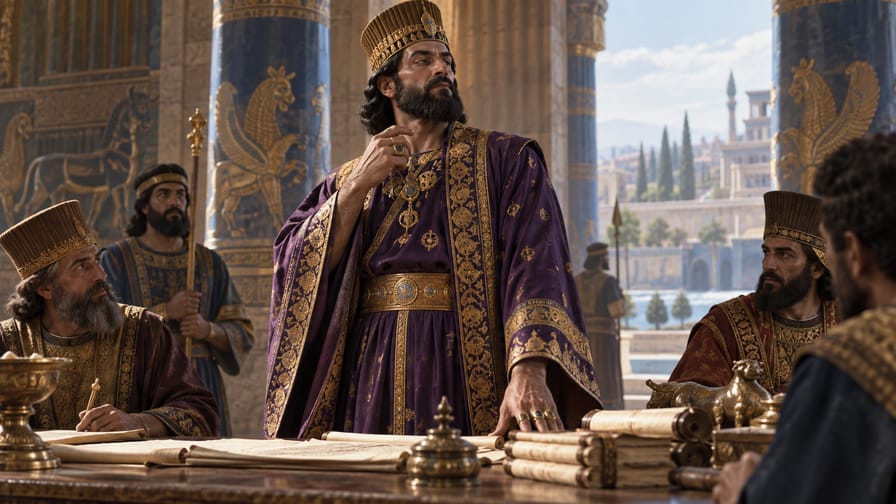
The figure of Haman, the Agagite, emerges from the pages of the book of Esther as one of the most infamous antagonists in biblical history. His narrative, though relatively short, is theologically rich, offering profound reflections on divine providence, the sovereignty of God, and the perversity of the human heart. From a Protestant evangelical perspective, the story of Haman is not merely a historical account of intrigue and redemption, but also a testament to God's unwavering care for His chosen people, Israel, and a prefiguration of the ultimate victory over the forces of evil.
This in-depth study will explore the etymology of his name, the historical context in which he lived, the complexity of his character, the theological significance of his actions, and his enduring legacy in Christian tradition, always with a keen eye on the authority of Scripture and its relevance for contemporary faith. The analysis will seek to unravel the layers of meaning behind a character who, by his malice, inadvertently served divine purposes.
1. Etymology and Meaning of the Name
The name Haman, in Hebrew Hāmān (הָמָן), is of uncertain etymology, which has led to various speculations among scholars. Some suggest a Persian origin, given the setting of the narrative, possibly derived from an ancient Persian term like Haumana, meaning "good thought" or "well-intentioned," which would be ironically contrasting with his wicked character.
Another theory points to a possible connection with the Elamite god Humman, or with Semitic roots that could evoke ideas of "tumult," "noise," or even "destroyer," which aligned perfectly with his genocidal intentions. The absence of a clear Hebrew root for the name strongly suggests its foreign provenance, reinforcing his identity as an outsider and enemy of God's people.
Despite the etymological uncertainty, the symbolic significance of Haman's name in the narrative is undeniable. He became synonymous with the relentless enemy of the Jewish people, an archetype of antisemitism and human arrogance that opposes divine decrees. His name evokes the image of an adversary whose purpose is annihilation, a role he plays with macabre zeal in the book of Esther.
There are no other prominent biblical characters with the same name, which grants Haman an infamous uniqueness. His designation as "the Agagite" (hā-ʾăḡāḡî) is of utmost theological importance, connecting him directly to Agag, the king of the Amalekites who was defeated by Saul, but whose lineage was not completely exterminated, according to 1 Samuel 15. This genealogical connection establishes an ancient and profound rivalry between Haman and Mordecai, a Benjamite, echoing the conflict between Israel and Amalek, a people whom God commanded to be utterly destroyed due to their persistent hostility (Exodus 17:14-16 Deuteronomy 25:17-19).
Thus, the name and ancestry of Haman are imbued with a theological significance that transcends mere identification. He represents the continuity of enmity against Israel, a historical and persistent enemy of God's covenant, whose ultimate defeat is a manifestation of divine faithfulness in protecting His people and fulfilling His promises. His name, therefore, not only identifies an individual but encapsulates an opposing force to God's redemptive plan.
2. Historical Context and Biblical Narrative
2.1 Period and Setting
The story of Haman unfolds in the Persian Empire, during the reign of Ahasuerus, generally identified with Xerxes I (486-465 BC). The book of Esther describes a vast empire that stretched from India to Ethiopia, with 127 provinces (Esther 1:1). This period is crucial for Jewish history, as it is situated after the return of some Jewish exiles to Jerusalem, but many still lived dispersed throughout the Persian Empire, as permitted by Cyrus the Great.
The main setting of the narrative is Susa (Shushan), the winter capital of Persia, a center of political power and intrigue. The social context was that of an opulent and complex royal court, where the king's favor was supreme and the lives of the subjects, including the Jews, depended on imperial will. The absence of explicit mention of God in the book of Esther, though notable, highlights the idea of divine providence acting behind the scenes of human events.
2.2 Family Origin and Genealogy
Haman is consistently identified as "the son of Hammedatha, the Agagite" (Esther 3:1). This genealogy is fundamental to understanding the depth of his enmity against Mordecai and the Jewish people. The designation "Agagite" connects Haman to the lineage of Agag, the Amalekite king who was spared by Saul, but subsequently executed by the prophet Samuel (1 Samuel 15:8-33).
Amalek was an ancestral and relentless enemy of Israel, having attacked the Israelites in the desert (Exodus 17:8-16). God had declared perpetual war against Amalek (Exodus 17:16) and commanded their complete destruction (Deuteronomy 25:17-19). The rivalry between Haman and Mordecai, a Benjamite (Esther 2:5), thus echoes the ancient conflict between Saul (also a Benjamite) and Agag, lending a tone of destiny and historical revenge to the narrative.
2.3 Key Life Events and Relationships
The life of Haman is entirely defined by his meteoric rise and subsequent catastrophic fall, documented in the book of Esther. He ascended to a position of great power and honor in the Persian court, being promoted by King Ahasuerus above all other princes (Esther 3:1). This exaltation required all the king's servants to bow down before him, an honor that Mordecai, a Jew, refused to pay (Esther 3:2).
Mordecai's refusal, motivated by his faith and perhaps by his awareness of Haman's Amalekite origin, inflamed Haman's wrath. His wounded pride led him to plan not only the death of Mordecai but the annihilation of all Jews in all provinces of the empire (Esther 3:6). He manipulated the king, offering a vast sum of money (ten thousand talents of silver, an immense fortune) to obtain a royal decree for the genocide (Esther 3:9-10).
Haman's plot was meticulously planned, including the casting of lots (pur) to determine the most "auspicious" date for the massacre (Esther 3:7). His wife, Zeresh, and his friends advised him to build a gallows fifty cubits high to hang Mordecai (Esther 5:14). However, divine providence intervened through Esther, the Jewish queen, and Mordecai.
Through Esther's courage, who revealed her Jewish identity and Haman's plot to the king (Esther 7:3-6), Haman's plans were exposed and reversed. In an ironic twist, the king, upon discovering Haman's treachery and his intention to exterminate the people of his own queen, ordered Haman to be hanged on the very gallows he had prepared for Mordecai (Esther 7:9-10). His ten sons were also hanged later (Esther 9:10), and the genocidal decree was reversed, allowing the Jews to defend themselves, resulting in the institution of the feast of Purim (Esther 9:20-32).
3. Character and Role in the Biblical Narrative
3.1 Analysis of Character
Haman's character is a case study in unbridled wickedness and pride. He is portrayed as a man consumed by arrogance, megalomania, and a deep, irrational hatred. His vanity was so great that Mordecai's mere refusal to bow down before him was enough to ignite a genocidal fury (Esther 3:5-6). He could not bear for someone not to grant him the honor he believed was his by right.
Envy and vengeance are dominant traits in his character. He was not content with punishing only Mordecai his hatred extended to all of Mordecai's people. This generalization of hatred is a striking characteristic of antisemitism, where enmity against an individual transforms into a desire for the annihilation of an entire ethnicity or religious group. Haman embodies this perversity in its most extreme form.
Furthermore, Haman demonstrates a remarkable capacity for manipulation and deceit. He presents to the king a plan to exterminate a "certain people" (Esther 3:8) without revealing the identity of the Jews or the true motivations behind his hatred. His argumentation was based on false accusations and the promise of riches, demonstrating his shrewdness in using power and greed for his own malicious ends. He is an architect of death and destruction.
3.2 Sins, Weaknesses, and Moral Failings
Haman's sins are manifold and grave. His pride (Esther 5:11) blinded him to reality and led him to his ruin. His uncontrolled wrath (Esther 3:5) propelled him to commit acts of unimaginable cruelty. The genocidal hatred (Esther 3:6) he harbored against the Jews is an abomination in the eyes of God, who had chosen this people to be a channel of blessing for all nations.
Haman's covetousness is also evident, both in his quest for power and in his offer of ten thousand talents of silver to the king (Esther 3:9), a sum he presumably expected to recover through the plunder of Jewish possessions. His lack of spiritual discernment and his reliance on his own wisdom and fortune (evidenced by the casting of the pur, Esther 3:7) led him to underestimate the hidden hand of God operating in favor of His people.
3.3 Role in the Narrative and Significant Actions
Haman's role in the biblical narrative is that of the main antagonist, a human instrument who, through his own wickedness, inadvertently serves to reveal God's sovereignty and providence. He is the catalyst that precipitates the crisis exposing Esther's courage and Mordecai's faithfulness.
His most significant actions include obtaining the royal decree for the genocide of the Jews (Esther 3:12-13), constructing the gallows for Mordecai (Esther 5:14), and his public humiliation when forced to honor Mordecai (Esther 6:11-12). Each of these actions, though initially intended to promote his own wicked interests, was divinely orchestrated for his own downfall and for the salvation of the Jewish people.
The development of Haman's character throughout the narrative is, paradoxically, the absence of moral development. He remains consistently wicked and relentless until the moment of his execution. His downfall is not a result of repentance or a change of heart, but of divine intervention and the courage of God's servants. He serves as a vivid example of how pride precedes ruin (Proverbs 16:18).
4. Theological Significance and Typology
4.1 Role in Redemptive History and Progressive Revelation
The story of Haman is fundamental to understanding God's redemptive history. Although God's name is not explicitly mentioned in the book of Esther, His providence is the central theme. Haman, in his attempt to annihilate the Jews, directly threatens the messianic lineage and the covenant promises made to Abraham, that through his offspring all families of the earth would be blessed (Genesis 12:3).
The preservation of Israel in the face of Haman's conspiracy demonstrates God's unwavering faithfulness to His promises, ensuring that the plan of salvation, which would culminate in Christ, would not be thwarted. Divine intervention, operating through "coincidental" events and the courage of Esther and Mordecai, reveals God's sovereignty over kings and empires, and over the wicked intentions of men (Proverbs 21:1).
4.2 Prefiguration and Christocentric Typology
While Haman is not a direct type of Christ, he functions as a powerful anti-type, representing the forces of evil that oppose God's people and, consequently, the plan of salvation culminating in Jesus Christ. His defeat prefigures Christ's ultimate victory over Satan, sin, and death.
The story of Haman reflects the cosmic struggle between the forces of light and darkness. Just as Haman sought to destroy the people from whom the Messiah would come, Satan seeks to thwart God's purposes. The miraculous salvation of the Jews through Esther and Mordecai, who put themselves at risk, can be seen as an echo of the greater salvation that would be accomplished by Christ, who gave Himself to save His people.
The reversal of Haman's decree, where death is transformed into life and condemnation into salvation for the Jews (Esther 8:11), is a powerful image of Christ's redemptive work, who transformed the curse of sin into blessing and death into eternal life for those who believe (Galatians 3:13-14 Romans 6:23).
4.3 Connection with Central Theological Themes
The figure of Haman and his story are intrinsically linked to several central theological themes. The sovereignty of God is perhaps the most prominent, demonstrated in how God uses even Haman's wickedness for His own purposes (Romans 8:28). Divine providence is evident in how seemingly random events (the king's insomnia, the remembrance of the records) are woven into a greater plan for Israel's salvation (Esther 6:1-3).
The judgment of God upon wickedness is clearly illustrated in Haman's downfall, who reaps what he sowed (Galatians 6:7), being executed on the very gallows he prepared for his enemy (Psalm 7:15-16). The story also emphasizes the importance of courage and intercession (Esther 4:16), and God's faithfulness in preserving His people, even when they are dispersed and in danger.
Haman's narrative serves as a vivid reminder of the reality of evil in the world and the constant need for vigilance and trust in God. It underscores the truth that, although evil may prevail for a time, divine justice will ultimately prevail, and the plans of the wicked will be thwarted (Proverbs 11:21).
5. Biblical-Theological Legacy and Canonical References
5.1 Mentions in Other Books and Influence on Biblical Theology
The figure of Haman is exclusive to the canonical book of Esther, not being mentioned in other books of the Hebrew Bible or the New Testament. However, his story has profound theological resonance, especially in Old Testament biblical theology, due to its vivid illustration of God's providence and sovereignty.
The narrative of Haman contributes to understanding the persistence of the conflict between Israel and the nations, and God's faithfulness in protecting His people from annihilation. It reinforces the doctrine of Israel's election and God's commitment to His covenant, even in the face of existential threats. The story of Haman is a testament to the truth that "whoever touches you touches the apple of His eye" (Zechariah 2:8).
5.2 Presence in Interpretive Tradition
In Jewish tradition, Haman is a central figure in the feast of Purim, where he is remembered as the arch-enemy of the Jewish people. During the reading of the book of Esther (the Megillah), it is customary to shout and make noise with noisemakers (ra'ashanim) whenever Haman's name is mentioned, symbolizing the eradication of his name and memory, according to the divine command against Amalek (Deuteronomy 25:19).
In Christian tradition, especially in Reformed and evangelical theology, Haman is often interpreted as a type of spiritual adversary, a precursor to figures who oppose God and His people throughout history. His story is used to illustrate the doctrine of God's providence, which operates even in humanly desperate circumstances, and the certainty of divine judgment upon the wicked.
Evangelical commentators like John Calvin, Matthew Henry, and Charles Spurgeon, while not extensively dwelling on Haman individually, emphasize God's sovereignty and the miraculous salvation of Israel in the book of Esther, with Haman serving as the instrument of the crisis that God resolves. The story is seen as a powerful reminder that God is in control, even when He seems absent.
5.3 Importance of the Character for Understanding the Canon
The story of Haman and his defeat are crucial for the completeness of the biblical canon. It offers a unique perspective on how God acts in secular history, without explicit supernatural interventions or direct mentions of His name, but with a providential hand that guides events toward the fulfillment of His purposes.
The book of Esther, with Haman as its antagonist, is a vital link in the chain of salvation history, ensuring the survival of the Jewish people through whom the Messiah would come. Without Haman's defeat, the lineage of David and, ultimately, Jesus Christ, could have been interrupted. Thus, the narrative of Haman is a testament to God's continuous faithfulness to His covenant and to His promise of redemption for all humanity through His Son.