


Who Wrote the Bible?
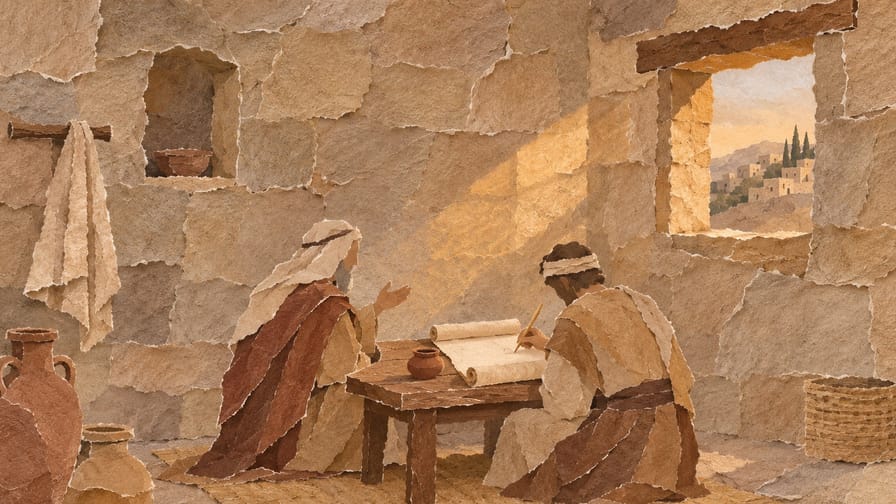
The Bible was written by about 40 human authors, from kings and shepherds to a fisherman and a physician, and its final author is God, who carried each of them along by the Holy Spirit (2 Timothy 3:16; 2 Peter 1:20-21). The number is approximate, because several books do not name the person who wrote them and the count shifts with the criteria. This is what is meant by inspiration: real human authors, with God as the final author.
Who wrote the Old Testament?
The authors of the Old Testament came from every layer of society: Moses, educated in Egypt (Acts 7:22); David, shepherd and king; Amos, who tended cattle and sycamore figs (Amos 7:14); Nehemiah, cupbearer to the king of Persia (Nehemiah 1:11). The Old Testament has 39 books, written in Hebrew and, in a few passages, Aramaic. In broad strokes:
- The Pentateuch (Genesis to Deuteronomy): tradition ascribes it to Moses, the subject of the next section.
- The historical books (Joshua to Esther): almost all anonymous. The text cites records of David's reign made by Samuel, Nathan, and Gad (1 Chronicles 29:29), and the Talmud assigns Judges and Samuel to Samuel and Kings to Jeremiah. That is tradition; the books themselves do not say so.
- Poetry and wisdom: more than seventy psalms carry David's name in the heading, and others carry the names of Asaph, the sons of Korah, Solomon, and Moses (Psalm 90). Proverbs opens with Solomon (Proverbs 1:1) and includes sayings of Agur and of King Lemuel (Proverbs 30:1; 31:1). Ecclesiastes presents itself as the work of a son of David, king in Jerusalem (Ecclesiastes 1:1), and tradition sees Solomon there. Job does not name its author.
- The prophets: the books of Isaiah, Jeremiah, Ezekiel, Daniel, and the twelve Minor Prophets bear the prophet's name. In some the text shows the writing: Jeremiah dictated his messages to the scribe Baruch (Jeremiah 36:4), and Daniel wrote down a dream (Daniel 7:1). In others the book does not say who put it in writing, as with Jonah, which is told in the third person.
Some details are debated: some scholars see more than one author in Isaiah, while the traditional reading keeps a single prophet, and the New Testament quotes both halves of the book under his name (Matthew 3:3; John 12:38-41). The authority of the book comes from God, not from the name in the heading.
Did Moses write the first five books?
The Pentateuch carries no single signature, but Scripture ties Moses to the writing of important parts of it: the war against Amalek (Exodus 17:14), the words of the covenant at Sinai (Exodus 24:4), the stages of the wilderness journey (Numbers 33:2), and the law handed to the priests (Deuteronomy 31:9). Jesus said that Moses wrote about him (John 5:46-47) and named the Law of Moses as one of the divisions of Scripture (Luke 24:44).
The text also contains passages that are hard to assign to Moses, such as the account of his death (Deuteronomy 34) and the list of Edom's kings, which speaks of a time before the monarchy in Israel (Genesis 36:31). Faithful Christians differ here, all with the same respect for Scripture, between two main readings:
- Moses wrote the whole Pentateuch, with a few later additions such as the account of his death. The Talmud (Baba Batra 14b-15a) records two ancient opinions about the last eight verses: that Joshua wrote them, or that God dictated them and Moses wrote them with tears.
- Moses is the principal author and lawgiver, and one or more inspired editors gathered, updated, and completed the material after him. Many evangelical scholars hold this reading.
Apart from these two readings stands the documentary hypothesis, which divides the Pentateuch into sources written centuries after Moses. It is the prevailing view in much of the academy, and many Christians reject it because of the testimony of Jesus and the apostles, who speak of Moses as an author.
The two readings in the list affirm what Jesus affirmed: Moses wrote, and what he wrote is Scripture. How much of the final shaping came from other hands is a question the Bible leaves open.
Who wrote the New Testament, and why does Hebrews have no signature?
The New Testament has 27 books, written in Greek in the first century. Tradition assigns the books to eight authors and leaves Hebrews without an identified author:
- Matthew, a former tax collector (Matthew 9:9), and John, a fisherman (Matthew 4:21) and one of the Twelve (Matthew 10:2), wrote Gospels as eyewitnesses, according to tradition. The Gospels do not name their author in the body of the text; the ancient titles and the early church attribute them to these men, and John's Gospel speaks of the disciple who testified to these things and wrote them down (John 21:24).
- Mark was not one of the Twelve; early tradition links his Gospel to the preaching of Peter. Peter calls a Mark his son (1 Peter 5:13), and it is tradition that identifies that Mark with the author of the Gospel.
- Luke, a physician and companion of Paul (Colossians 4:14; Philemon 24), wrote, according to tradition, the Gospel and the book of Acts, both addressed to Theophilus (Luke 1:3; Acts 1:1). Neither book names its author; the attribution comes from ancient tradition and is compatible with the “we” passages in Acts (Acts 16:10-17), which show a companion of Paul as the narrator.
- Paul, on the traditional reading, wrote 13 letters, from Romans to Philemon, drawing on secretaries such as Tertius (Romans 16:22) and signing in his own hand (1 Corinthians 16:21). Some scholars question the authorship of certain letters, especially the Pastoral Epistles; those who defend it note that the letters present themselves as Paul's (1 Timothy 1:1).
- Peter wrote 1 and 2 Peter, the first possibly with Silvanus as secretary (1 Peter 5:12); some scholars doubt that 2 Peter is his, though the letter claims it (2 Peter 1:1).
- James and Jude wrote the letters that bear their names; tradition identifies them with brothers of Jesus (Matthew 13:55), and Jude presents himself as the brother of James (Jude 1).
- John also wrote, according to tradition, 1, 2, and 3 John and Revelation, where the author calls himself John (Revelation 1:4). Justin and Irenaeus attributed Revelation to the apostle John; Dionysius of Alexandria, in the third century, doubted this (reported by Eusebius, Church History, book 7), though he accepted the Gospel and 1 John as the apostle's.
Hebrews is the best-known book with no declared author. As early as the third century, Origen admitted that only God knows for certain who wrote it. Paul, Barnabas, and Apollos are among the names proposed, and none can be proved. The church eventually received the book as Scripture, and its authority does not rest on a signature: it carries the apostolic testimony (Hebrews 2:3).
If men wrote it, is the Bible still the word of God?
Yes, because God and the human authors do not compete: he used real people without erasing their personalities. Luke says he investigated everything carefully before writing (Luke 1:1-4), and Paul wrote with his own emotions and style, yet the Thessalonians received his message as the word of God (1 Thessalonians 2:13). David declared that the Spirit of the Lord spoke through him (2 Samuel 23:2). The Greek word in 2 Timothy 3:16, theopneustos, means breathed out by God, and Scripture comes at once from that breath and from the work of authors of flesh and blood. That is why the evangelical tradition confesses that it is true in everything it affirms, in the original manuscripts.
Two misunderstandings come up often:
- “God dictated everything word for word.” Scripture does not generally present itself as mechanical dictation: the styles of Isaiah, Paul, and John are recognizable. There are moments when God commands that his words be recorded, as in the letters to the seven churches (Revelation 2:1), but that is not the rule.
- “The church, or Emperor Constantine, created the Bible centuries later.” The councils recognized books that the churches, for the most part, already received as Scripture; they did not invent them, though a few, such as Hebrews, James, 2 Peter, and Revelation, were discussed for longer. Nicaea, in 325, dealt with the deity of Christ, not with the list of books.
What changes when you know who wrote it?
Knowing that real people wrote in real times and places helps you read each book in its setting: a psalm of David on the run, a letter of Paul written from prison (Philippians 1:7), a prophecy of Jeremiah before the exile. And knowing that God is the final author gives confidence that the message holds together from beginning to end. Jesus himself, beginning with Moses and all the Prophets, explained to his disciples what the Scriptures said about him (Luke 24:27). The authors are many, but the center is one. When you open any book of the Bible, it helps to ask: who wrote this, to whom, and what does this text show of Christ?
Key Bible references
2 Tim 3:16 · 2 Pet 1:20-21 · Exod 24:4 · Luke 24:44 · John 5:46-47 · 2 Sam 23:2 · Luke 1:1-4 · 1 Thess 2:13