


Who Were the Nephilim (the Giants in Genesis 6)?
The Nephilim (Hebrew nephilim) are figures named in Genesis 6:4 and Numbers 13:33, tied to the time of the sons of God and the daughters of men; the text says little about them and does not make clear who their fathers were. Faithful Christians hold three readings: offspring of angels who united with women, descendants of Seth’s line, or children of kings and rulers. The word appears only twice in the Old Testament, and the passage is too brief to settle the matter with certainty.
What does Genesis 6:1-4 say about the Nephilim, and what does it leave out?
When humanity multiplied, the “sons of God” saw that the “daughters of men” were beautiful and took as wives any they chose (Genesis 6:1-2). God declared that his Spirit would not contend with humanity forever and set a limit of one hundred and twenty years, which many understand as a period of patience before the flood (Genesis 6:3). Then comes the central verse: the Nephilim were on the earth in those days, and also afterward, when the sons of God came to the daughters of men and they bore children; these were the mighty men (gibborim) of old, men of renown (Genesis 6:4).
Three cautions prevent mistakes from the start:
- The Hebrew does not say “giants.” The word nephilim is often linked to the verb naphal, “to fall,” but its exact sense is uncertain. The Septuagint, the ancient Greek translation, chose gigantes; that is why some English versions read “giants” and others keep “Nephilim.”
- The idea of immense size comes from Numbers 13:33, in the mouths of the spies, not from the Genesis narrative.
- The text does not explain where the Nephilim came from. The mighty men may be the Nephilim themselves, the children of these unions, or both.
The setting, however, is clear: right afterward, God sees that human wickedness was great and that the earth was filled with violence (Genesis 6:5-13). Scripture never names the Nephilim as the cause of the flood.
Who were the “sons of God”: angels, the line of Seth, or kings?
Here the disagreement is real, and each reading rests on texts worth weighing carefully.
Reading 1: angels who united with women
The Hebrew phrase bene ha-elohim refers to heavenly beings in Job 1:6 and 2:1, and a very close form appears in Job 38:7. It is also one of the oldest readings recorded outside the Bible: it is found in the Book of Enoch, and Josephus records in the first century the tradition of angels who fathered children with women. There are serious objections: Jesus said that in the resurrection people will be like the angels in heaven, who do not marry (Matthew 22:30), and those who reject the angelic reading see in this an argument against unions between angels and women, though the passage does not address Genesis 6. The judgment of Genesis 6 also falls on humanity, not on spiritual beings. Supporters answer that Jesus is speaking about the resurrection, not Genesis 6, and that some angels left their proper place (Jude 6).
Reading 2: the line of Seth
Here the “sons of God” are the descendants of Seth, among whom people began to call on the name of the Lord (Genesis 4:26), and the “daughters of men” are women of Cain’s line (Genesis 4:17-24). The sin would be mixed marriage, which dragged the faithful people into corruption. The Bible calls Israel sons of the Lord (Deuteronomy 14:1) and sons of the living God (Hosea 1:10), and Augustine defended this reading in the fifth century in The City of God. The objection is that Genesis 6 never mentions Seth or says that all his descendants were godly, and it is hard to explain why such marriages would produce such extraordinary men.
Reading 3: kings and rulers
Here the “sons of God” are nobles and kings, men who considered themselves above ordinary people. In Exodus 21:6 and 22:8-9, many translations render elohim as “judges,” and Psalm 82:6, which many read as addressed to human judges, calls authorities gods and sons of the Most High. Taking whatever women they chose (Genesis 6:2) recalls the abuse of power and violent polygamy of Lamech (Genesis 4:19-24). Some ancient Jewish interpreters read it this way; the Targum Onkelos, for example, renders the phrase as “sons of the nobles.” The objection is that in Job the same phrase refers to heavenly beings, and Genesis never calls these men kings.
None of the three is free of objections, so it is wise to hold the conclusion with humility.
Do Jude 6-7, 2 Peter 2:4, and the Book of Enoch settle it?
Jude 6-7 speaks of angels who did not keep their original position, left their proper dwelling, and are held in chains until judgment; verse 7 compares the immorality of Sodom and Gomorrah to that of these angels and mentions pursuing other flesh. Second Peter 2:4 says God did not spare the angels who sinned but cast them into Tartarus (tartarōsas); the next verse turns to the flood (2 Peter 2:5). Those who hold the angelic reading see an echo of Genesis 6 in these texts. Those who disagree note that neither passage cites Genesis 6, the Nephilim, or women, and that both may refer to the rebellion of angels in general.
The Book of Enoch (1 Enoch) is the extrabiblical source that develops the angelic reading. In the Book of the Watchers (1 Enoch 1-36), the account of the angels’ descent is in chapters 6 to 16: two hundred angels come down to earth, take wives, and father violent giants. The book circulated before the Christian era, and Jude 14-15 quotes a prophecy of Enoch that matches 1 Enoch 1:9. That shows Jude knew the book, not that the book is Scripture. Paul also quoted Greek poets (Acts 17:28; Titus 1:12) without canonizing any of them. The Protestant Bible has 66 books and does not include 1 Enoch; only the Ethiopian and Eritrean Tewahedo Orthodox churches count it in their canon. The book is a witness to what some Jews of that era thought, never an authority for deciding what Genesis 6 means.
Did the Nephilim survive the flood? What about Numbers 13:33?
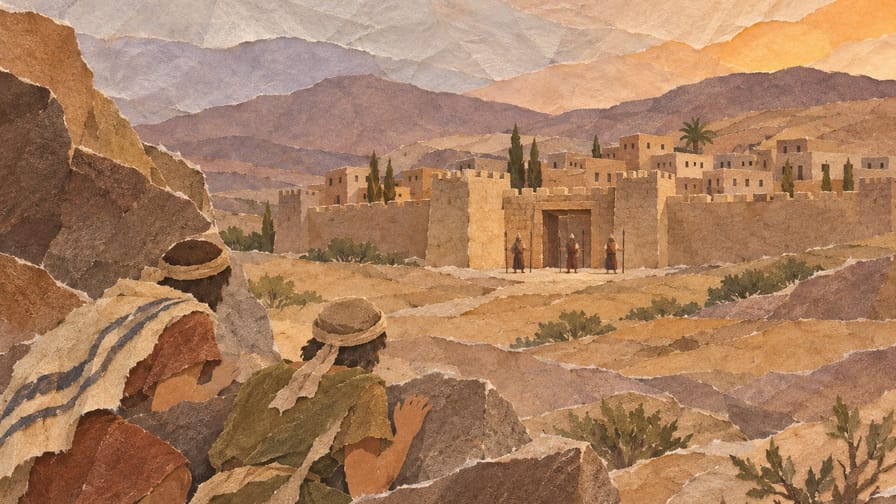
The Nephilim reappear when twelve spies return from Canaan. Ten of them spread a negative report: the sons of Anak, who according to them came from the Nephilim, were so large that the spies felt like grasshoppers beside them (Numbers 13:32-33). Caleb and Joshua answered with trust in the Lord (Numbers 13:30; 14:6-9). The text records the spies’ words, which it itself calls a negative report (Numbers 13:32). Scripture does not confirm on its own that the Anakim descended from the Nephilim; many understand that the spies exaggerated, though those who hold the angelic reading may take the statement literally.
The logical problem is well known: if the flood destroyed everyone except Noah and his family (Genesis 7:21-23; 1 Peter 3:20), how could there be Nephilim afterward? Some who hold the angelic reading understand the “and also afterward” of Genesis 6:4 to mean that the union happened again after the flood; others read “afterward” as the continuation of these unions before the flood, and the sense of “and also afterward” is debated. Still others suggest that “Nephilim” became a label for peoples of great stature. Scripture does mention tall peoples, such as the Rephaim (Deuteronomy 3:11) and the Anakim (Deuteronomy 9:2), without calling them children of angels. And the end of that story matters: Joshua cut off the Anakim from the hill country, leaving only Gaza, Gath, and Ashdod (Joshua 11:21-22), and Caleb drove out three sons of Anak (Joshua 15:14). The giants who terrified that generation did not stop God’s promise.
What misunderstandings surround the Nephilim, and what does this change for us?
- Claiming the Bible teaches with certainty that the Nephilim were children of fallen angels. The reading is ancient and respectable, but it is an interpretation, and faithful believers disagree with it.
- Treating 1 Enoch as part of the Bible.
- Linking the Nephilim to extraterrestrials, genetic experiments, or conspiracy theories. None of that is in the text.
What Scripture insists on saying lies elsewhere. In the midst of corruption, Noah found favor in the eyes of the Lord (Genesis 6:8), and God’s patience waited in the days of Noah while the ark was being built (1 Peter 3:20). The lesson for us does not depend on deciding who the Nephilim were. The spies measured the enemy by size; Caleb and Joshua measured by the God who had promised the land (Numbers 14:8-9). That does not guarantee that every battle ends as we wish, but it invites us to look first to the Lord. As for the origin of the Nephilim, the honest course is to admit that the text has not given us more than this.
Key Bible references
Gen 6:1-4 · Gen 6:5-8 · Num 13:30-33 · Job 1:6 · Job 38:7 · Jude 6-7 · 2 Pet 2:4 · Josh 11:21-22