


Who Are the 144,000 in the Book of Revelation?
The 144,000 of Revelation 7 and 14 are the sealed servants of God, kept by him and brought into the presence of the Lamb. Faithful Christians disagree about exactly who they are: one reading sees ethnic Israelites who believe, a group within God's people, and another sees a symbolic number that stands for all of God's people. On neither reading does the number limit how many are saved, because the same chapter goes on to show a crowd no one could count.
What do Revelation 7 and 14 say about the 144,000?
In Revelation 7:1-3, four angels hold back the winds of the earth until the servants of God are sealed on their foreheads. John says he heard the number of those sealed: 144,000, from every tribe of the sons of Israel, with 12,000 from each of the twelve tribes listed (Revelation 7:4-8). The seal (Greek sphragis) marks ownership and protection, and it stands in contrast to the mark of the beast (Revelation 13:16-17).
In Revelation 14:1-5 the 144,000 stand with the Lamb, with his name and his Father's name written on their foreheads. They sing a new song before the throne that only they can learn, and they are described as redeemed from among mankind, as firstfruits (Greek aparchē) for God and the Lamb. They follow the Lamb wherever he goes, no lie is found in their mouth, and they are blameless.
Two details call for care. The first is the list of tribes: it includes Levi, has both Joseph and Manasseh, leaves Ephraim out by name, and omits Dan. The text does not explain the choice, and linking Dan's absence to the tribe's idolatry (Judges 18:30-31; 1 Kings 12:28-30) is an inference.
The second is Revelation 14:4: they have not defiled themselves with women, for they are virgins (Greek parthenoi). One reading takes this as celibate men; another, as a figure of purity and loyalty, since in Revelation idolatry is described in the language of prostitution (Revelation 17:1-5). On neither reading does the text treat marriage as impure (Hebrews 13:4).
Are the 144,000 literal Israelites or a symbolic number?
Faithful Christians disagree here, and both readings have serious reasons. Israel's role in the end times as a whole has its own answer on this site; this answer stays with the 144,000.
The literal, ethnic Israel reading
Those who hold this reading note that the text names each tribe and gives every one the same figure, a precision a figure of speech would not require. They also note that “Israel” in the New Testament usually means the people of Israel, that the chapter itself contrasts the tribes of Israel (7:4) with people from every nation (7:9), and that Paul speaks of a purpose of God still unfolding for Israel (Romans 11:25-26). This is the typical reading of those who see these chapters as still to be fulfilled: the 144,000 would be Jews who believe in Jesus and are kept by God through the great tribulation.
The symbolic reading: all of God's people
Those who hold this reading remind us that the book was given in signs (Revelation 1:1; the Greek verb is esēmanen) and that its numbers tend to be figures: seven churches, seven seals, three and a half years, a thousand years. On this reading, the number 144,000 is 12 × 12 × 1,000, the tribes and the apostles multiplied by completeness, and the final city carries the names of the twelve tribes on its gates and of the twelve apostles on its foundations (Revelation 21:12-14). The New Testament also applies Israel's vocabulary to everyone who belongs to Christ (Galatians 3:29; Romans 2:28-29; 9:6-8; 1 Peter 2:9), and James 1:18 uses “firstfruits” for Christians in general.
There is also the argument from hearing and seeing. In Revelation 5:5-6, John hears about the Lion of the tribe of Judah and, looking, sees a Lamb: what he hears is interpreted by what he sees. In Revelation 7:4 he hears a number of tribes and, in 7:9, he looks and sees a crowd from every nation. The name on the forehead in 14:1 appears again on all God's servants in Revelation 22:4.
How each reading answers the other
Those who hold the symbolic reading answer that the contrast between the tribes (7:4) and the nations (7:9) is the same pattern of hearing and seeing described above, and many of them read “all Israel” in Romans 11:26 as God's people gathered from Jews and Gentiles.
Those who hold the literal reading answer on two points. In Revelation 5, the Lion and the Lamb are the same person; in 7:4 and 7:9, the two scenes describe groups with different traits (sealed by tribe on one side, and a countless multitude from every nation on the other), and “after this” opens a new scene. The calculation 12 × 12 × 1,000 is the interpreter's construction: the text speaks of 144,000 and of 12,000 per tribe, and does not give that multiplication.
Who is the great multitude of Revelation 7:9?
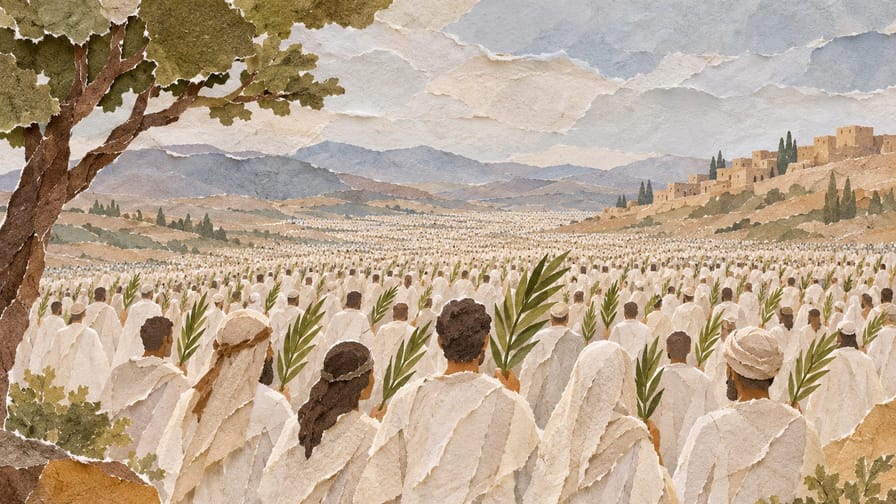
After hearing the number, John looks and sees a multitude that no one could count, from every nation, tribe, people, and language, standing before the throne and the Lamb, in white robes with palm branches in their hands (Revelation 7:9). They credit salvation to God and the Lamb (7:10), and one of the elders explains that these people come out of the great tribulation and have washed their robes in the blood of the Lamb (7:14).
That is why a frequent mistake is the idea that only 144,000 will be saved. The text contradicts it, because the very next scene shows people beyond counting. On the literal reading, the two groups are distinct: sealed Jews and believers from every nation. On the symbolic reading, they are one people, heard as a list of tribes and seen as a crowd from every nation. On both, everyone is washed in the blood of the Lamb.
What do Jehovah's Witnesses teach, and what does the text say?
Jehovah's Witnesses teach that the 144,000 are a literal, closed number of “anointed” Christians, chosen since Pentecost to rule with Christ in heaven. The great crowd would be a second class that lives forever on a restored earth. They are sincere people, and there is common ground: they also do not read the tribes of Revelation 7 as Israelites by blood. The text gives four reasons to doubt the two-class reading:
- Place: Revelation 7:9 and 7:15 put the great multitude before God's throne, serving him in his temple, and Revelation 14:3 puts the 144,000 in the same place. The text does not send one class to heaven and another to earth.
- One hope: Ephesians 4:4 speaks of one hope of the Christian calling, and John 10:16 speaks of other sheep brought into the same flock, not into a different one.
- The inheritance of all God's children: Romans 8:16-17, written to all the believers in Rome, says the Spirit bears witness with our spirit that we are God's children and, as children, heirs with Christ; the text does not speak of two classes of children.
- Number and figure: the reading treats the tribes as figures (Christians of every background) but the number as an exact count, an internal inconsistency; the two faithful readings above each apply a single standard to both (the literal reading takes tribes and number at face value; the symbolic reading takes both as figures). And Luke 12:32, a text the two-class reading often cites in favor of a small, closed group, speaks of the little flock to whom the Father wishes to give the kingdom; the text sets no numeric ceiling.
What do the 144,000 mean for readers today?
Whoever they are, the message of both chapters is comfort for a people under pressure. The seal says that God knows and keeps his own (Revelation 7:3; compare Ephesians 1:13). It does not promise a life without suffering: the multitude of 7:14 comes out of the great tribulation, and it is after it that God wipes away every tear (7:17).
Salvation, in the text, never depends on belonging to a number or a bloodline. The multitude's cry credits salvation to God and the Lamb (7:10). Anyone who wants to know whether they belong to Christ does not need to do arithmetic: they need to trust the Lamb.
The portrait in 14:5 is also a calling: undivided loyalty to Christ and truth in the mouth, in a world that pressures believers to compromise (Revelation 13:16-17). As for the exact identity of the 144,000, humility is in order: faithful brothers and sisters read it differently, and neither of those readings is a reason to set dates or break fellowship. What both readings affirm is the essential: Christ wins, returns, and brings his people into his presence.
Key Bible references
Revelation 7:1-8 · Revelation 7:9-17 · Revelation 14:1-5 · Revelation 21:12-14 · Romans 11:25-26 · Galatians 3:29 · Ephesians 4:4 · John 10:16