


Canaanite
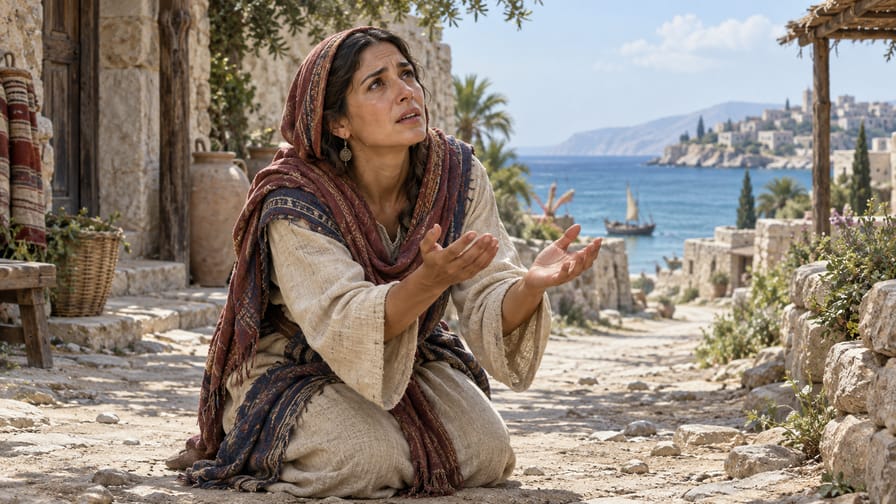
The figure of the Canaanite woman, found in the Gospels of Matthew and Mark, though not personally named, represents one of Jesus' most profound and theologically rich encounters with a Gentile. Her story challenges prejudices, demonstrates the depth of faith, and prefigures the universality of the gospel. The following analysis explores her identity, context, character, and theological significance from an evangelical Protestant perspective.
1. Etymology and meaning of the name
The woman in question does not have a personal name recorded in Scripture. She is identified by her ethnic and geographical origin. In the Gospel of Matthew, she is described as a Canaanite woman (Chananáia, Χαναναία), according to Matthew 15:22.
The etymological root of Canaanite refers to Canaan (in Hebrew: Kena'an, כְּנַעַן), a region historically associated with the descendants of Ham, son of Noah, and which became the promised land to Abraham and his descendants (Genesis 10:15-19 Genesis 12:7).
The term Canaan was frequently used to describe the peoples who inhabited the land before the Israelite conquest, known for their idolatrous and immoral practices (Deuteronomy 7:1-5). Thus, being a Canaanite carried a connotation of being pagan and, for the Jews, of belonging to a people hostile to God and Israel.
In the Gospel of Mark, she is identified as a Greek, Syrophoenician by birth woman (Surophoinikissa, Συροφοινίκισσα), in Mark 7:26. This description complements Matthew's, indicating her Canaanite ethnicity within the region of Phoenicia, which was culturally Hellenized ("Greek") due to Greco-Roman influence.
Phoenicia, which included cities like Tyre and Sidon, was the coastal part of ancient Canaan. Therefore, the two descriptions are not contradictory but complementary: she was a Canaanite living in Syrian Phoenicia, a region with strong Greek influence.
There are no other biblical characters with the "name" Canaanite, as, already mentioned, it is an ethno-geographical descriptor. The absence of a personal name emphasizes her identity as "the other," the foreigner, the non-Jew.
The theological significance of the name lies precisely in this identification as a Canaanite. She represents the foreigner, the marginalized, the historical enemy of Israel. Her faith and Jesus' response to her challenge ethnic and religious exclusivity, pointing to universal inclusion in God's plan of salvation.
2. Historical context and biblical narrative
2.1 Historical Period and Context
The narrative of the Canaanite woman is situated during the earthly ministry of Jesus Christ, specifically in a period of growing opposition from Jewish religious authorities. After confrontations with the Pharisees and scribes about traditions and ritual purity, Jesus withdraws to the regions of Tyre and Sidon (Matthew 15:21 Mark 7:24).
This geographical movement is significant, as Tyre and Sidon were Gentile port cities, located in the territory of Phoenicia, a region northwest of Galilee. Jesus' presence there indicates a phase of his ministry where he deliberately moves away from the Jewish crowds and the growing hostility in Israel.
The political and social context of the time was one of Roman occupation, with tensions between Jews and Gentiles being a prominent characteristic. Jews, in general, harbored a strong sense of national and religious identity, often accompanied by contempt and exclusivism towards Gentiles, whom they considered impure and outside of God's covenant.
2.2 The Biblical Narrative
The story of the Canaanite woman is recounted in Matthew 15:21-28 and Mark 7:24-30. Both passages describe a woman who approaches Jesus to ask for the healing of her daughter, who was severely tormented by a demon.
In Matthew's account, the woman cries out to Jesus: "Lord, Son of David, have mercy on me! My daughter is horribly demon-possessed" (Matthew 15:22). This cry is notable, as she, a Gentile, uses a messianic title ("Son of David") that demonstrates a surprising recognition of Jesus' identity.
Initially, Jesus does not answer her a word, and the disciples ask him to send her away, for she was bothering them with her cries (Matthew 15:23). This attitude of the disciples reflects the prevalent Jewish view of the time, which regarded Gentiles as intruders.
Jesus responds to the woman, explaining that his primary mission was for "the lost sheep of the house of Israel" (Matthew 15:24). This statement, though seemingly restrictive, is crucial for understanding the order of God's redemptive plan, which began with Israel and would extend to the Gentiles (Acts 1:8).
The woman, however, does not give up. She prostrates herself before Jesus, pleading: "Lord, help me!" (Matthew 15:25). Jesus' subsequent response is even more challenging: "It is not right to take the children's bread and throw it to the little dogs" (Matthew 15:26).
This metaphor, though it might seem offensive, was a common way for Jews to refer to Gentiles. However, Jesus uses the diminutive "little dogs" (kynária, κυνάρια), which referred to household pets, instead of "wild dogs," which softens the image and offers a small opening for the woman's response.
The Canaanite woman, with wisdom and humility, turns Jesus' metaphor to her advantage: "Yes, Lord, but even the little dogs eat the crumbs that fall from their masters' table" (Matthew 15:27). Her response demonstrates remarkable faith and an understanding of divine grace.
Impressed by her faith, Jesus declares: "O woman, great is your faith! Let it be done for you as you desire" (Matthew 15:28). At that very hour, her daughter was healed. Mark's account is similar, with Jesus stating: "For this saying, go the demon has left your daughter" (Mark 7:29).
3. Character and role in the biblical narrative
3.1 Virtues and Spiritual Qualities
The Canaanite woman is an extraordinary example of various spiritual virtues. Her most prominent characteristic is unwavering faith. Jesus himself praises her, saying: "O woman, great is your faith!" (Matthew 15:28). This faith was not based on her heritage or religious privilege, but on a deep conviction in Jesus' power and mercy.
Her perseverance is equally remarkable. She is not deterred by Jesus' initial silence, nor by the disciples' rebuke, nor by the harsh metaphor about the "children's bread." Her persistence in seeking help for her daughter demonstrates a determination stemming from a maternal love and a genuine hope in Christ.
The humility of the Canaanite woman is evident in her willingness to accept the position of a "little dog" at the Lord's table. Instead of being offended, she uses this image to argue in her favor, showing a deep understanding of her own condition and of Jesus' sovereignty. She does not demand, but pleads for grace.
The wisdom of her response ("Yes, Lord, but even the little dogs eat the crumbs that fall from their masters' table") reveals a discerning mind and the ability to transform an apparent obstacle into an opportunity. She argues from Jesus' own logic, showing that God's grace is abundant enough for everyone, even for those who consider themselves "crumbs."
3.2 Role Played in the Narrative
The role of the Canaanite woman in the biblical narrative is multifaceted and crucial. Firstly, she serves as a paradigmatic example of faith for all believers, Jews and Gentiles. Her story illustrates that true faith knows no ethnic, social, or religious barriers, and that God's grace is available to those who seek it with sincerity and persistence.
Secondly, she acts as a catalyst for the revelation of Jesus' mission. The encounter with her forces Jesus to articulate more clearly the order of his mission (first to Israel, then to the Gentiles), while simultaneously demonstrating the flexibility and universality of his compassion and redemptive power.
This episode also challenges the Jewish exclusivism of the disciples and of that era. Jesus' interaction with a Gentile, and the subsequent praise of her faith, serve as an important lesson about the inclusion of all peoples in God's plan, prefiguring the Great Commission (Matthew 28:19-20) and the extension of the gospel to the ends of the earth.
Furthermore, the Canaanite personifies the effectiveness of persevering prayer. Her insistence, despite obstacles, is rewarded by divine intervention. She teaches that we should not give up in the face of God's apparent silence or difficulties, but continue to cry out with faith and humility.
Her story also highlights maternal love and compassion. The motivation for her tireless search for Jesus was her daughter's suffering. This underscores the depth of parents' love and their willingness to go to extremes for the well-being of their children, making her a figure with whom many can identify in their own sorrows and quests.
4. Theological significance and typology
4.1 Role in Redemptive History and Progressive Revelation
The story of the Canaanite woman is a significant milestone in redemptive history, for it demonstrates the universality of God's grace and the extension of Jesus' ministry beyond the borders of Israel. Although Jesus stated that he was sent primarily "to the lost sheep of the house of Israel" (Matthew 15:24), this encounter reveals that God's ultimate purpose always included the Gentiles.
This episode acts as a progressive revelation of the plan of salvation. It prefigures the future apostolic mission to the Gentiles, which would become central after Christ's resurrection and ascension (Acts 1:8). The faith of the Canaanite is a link that connects Abraham's promise that all the families of the earth would be blessed through him (Genesis 12:3) with its fulfillment in Christ.
4.2 Connection with Central Theological Themes
The narrative of the Canaanite touches on several central theological themes from an evangelical Protestant perspective:
- Faith as the sole means of salvation: The woman's faith, not her ethnicity or works, was what moved Jesus to act. This resonates with the principle of sola fide (faith alone), emphasized in the Protestant Reformation, where salvation is by grace through faith in Christ (Ephesians 2:8-9).
- The sovereign grace of God: The healing of her daughter was an act of unmerited grace, extended to a Gentile who, in the eyes of Jewish society, had no right to messianic blessings. This illustrates the unconditional and sovereign nature of God's grace, which reaches whom He wills (Romanos 9:15-16).
- The inclusion of Gentiles in God's plan: This event is a powerful anticipation of the opening of salvation to all peoples, which would become a central doctrine of early Christianity. Paul, in particular, would extensively develop the theology of unity between Jews and Gentiles in Christ (Ephesians 2:11-22 Galatians 3:28).
- The nature of persistent prayer: The Canaanite woman serves as a model of how to pray with perseverance and humility, without giving up, even in the face of apparent rejections. Her story encourages believers to cry out to God with faith, knowing that He hears and answers (Luke 18:1-8).
- The pedagogy of Jesus: Jesus' apparent initial "harshness" can be seen as a test of faith, a way to reveal the depth of the woman's belief and, at the same time, to teach his disciples about the true nature of faith and divine mercy that transcends barriers.
4.3 Prophetic Fulfillment and Typology
Although the Canaanite woman is not a typological figure in the strict sense of prefiguring Christ, her story is deeply Christocentric. She points to Christ as the Messiah who came not only for Israel, but to be a light to the Gentiles (Isaiah 49:6 Luke 2:32). Her faith anticipates the faith of millions of Gentiles who would come to believe in Jesus.
This episode is a practical fulfillment of Old Testament prophecies that spoke of the coming of the Gentiles to worship the Lord (Isaiah 2:2-4 Zechariah 8:20-23). The healing of the Canaanite woman's daughter is not just a miracle, but a practical demonstration of the extension of God's kingdom to all who believe, regardless of their origin.
The way Jesus interacts with her – first testing her faith and then praising her and granting her request – reveals the nature of God who delights in responding to sincere faith. The faith of the Canaanite is a model for the faith that the gospel requires of all who wish to enter the kingdom of God.
5. Biblical-Theological Legacy and Canonical References
5.1 Mentions and Influence in Biblical Theology
The Canaanite woman is mentioned exclusively in the Gospels of Matthew 15:21-28 and Mark 7:24-30. She is not named in other biblical books, nor are there literary contributions attributed to her. However, her story has an immense influence on biblical theology, especially in understanding the inclusion of Gentiles in the plan of salvation.
The narrative serves as a precedent for the universal mission that would be inaugurated after Jesus' resurrection. It provides an evangelical foundation for Pauline theology that advocates for equality between Jews and Gentiles in Christ, emphasizing that salvation is by faith and not by descent from Abraham (Galatians 3:7-9 Romans 10:11-13).
5.2 Presence in Interpretative Tradition and Evangelical Theology
In Christian interpretative tradition, the Canaanite woman is often celebrated as an icon of faith, humility, and perseverance. Church Fathers like Augustine and Chrysostom, and reformers like Calvin and Luther, frequently drew upon this story to illustrate the nature of faith and the universality of God's grace.
In Reformed and evangelical theology, the story of the Canaanite is often used to teach about God's sovereignty in salvation, the effectiveness of persistent prayer, and the extension of the gospel to all nations. She is a living testimony that God shows no partiality (Acts 10:34) and that faith is the criterion for receiving His blessings.
Evangelical commentators like D. A. Carson and John MacArthur highlight the theological depth of the encounter, underscoring how Jesus, even while affirming his primary mission to Israel, demonstrates divine compassion that transcends ethnic and cultural barriers. The faith of the Canaanite woman is seen as a challenge to religious complacency and a call to total dependence on Christ.
The story also emphasizes the importance of global evangelization. The Canaanite woman, a foreigner, comes to Jesus in Gentile territory and receives the blessing. This validates the church's vocation to take the gospel to all peoples, fulfilling the Great Commission to make disciples of all nations (Matthew 28:19-20).
5.3 Importance for Understanding the Canon
The figure of the Canaanite woman is fundamental for understanding the biblical canon, as she illustrates the gradual transition of God's revelation from a specific nation (Israel) to humanity in general. She shows that God's plan for redemption has always been universal, though revealed in stages (Galatians 3:8).
Her story is a vital link between the Old Testament promises concerning the blessing of the nations and the fulfillment of these promises in the New Testament through Jesus Christ and the Church. It reinforces the doctrine that there is no salvation outside of Christ and that faith in Him is the only way to God (John 14:6).
In summary, the Canaanite woman, though without a personal name, leaves a profound theological legacy. Her faith, humility, and perseverance continue to inspire believers and shape the Church's understanding of God's universal grace and Christ's mission to save all who believe, regardless of their origin or condition.