


阿摩司书
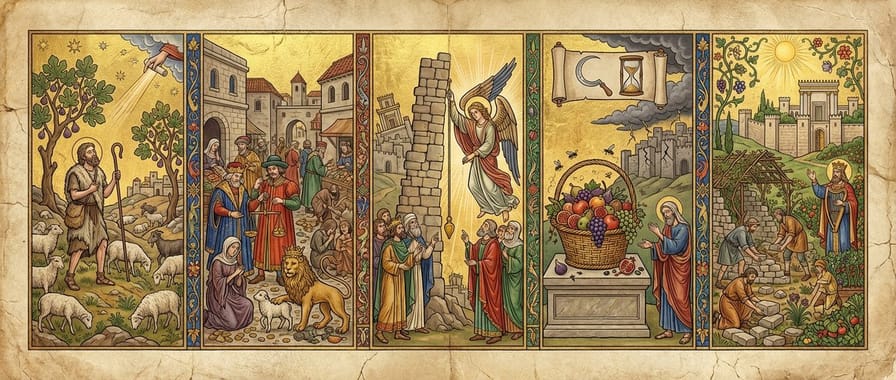
Illustration of the Book of Amos, one of the 39 books of the Old Testament (Nano Banana Pro).
This introduction to the book of the prophet Amos aims to establish a comprehensive and theologically robust model for the analysis of any book of the Holy Scriptures, founded on a conservative evangelical Protestant perspective. Recognizing the Bible as the inspired, inerrant, and infallible Word of God, as attested by 2 Timothy 3:16-17, we will approach Amos not merely as a historical document, but as a living and authoritative revelation. Our purpose is to explore its historical, literary, and theological depths, highlighting its perennial relevance for Christian faith and practice.
Amos, one of the twelve minor prophets, emerges as a powerful voice of justice and righteousness amidst the complacency and corruption of his era. His book, though concise, resonates with the majesty of divine sovereignty and the seriousness of divine judgment. Through a systematic analysis, we will examine the context in which Amos prophesied, the literary structure he employed, the theological themes he articulated, his intrinsic connections with the broader biblical canon, and the hermeneutical challenges his message presents. In doing so, we will seek to extract not only the original meaning of the text, but also its transformative application for the contemporary church, always through the lens of `Christocentric typology` and `progressive revelation` that culminates in Jesus Christ, the Lord.
This academic and pastoral approach seeks to honor the `verbal and plenary inspiration` of the Scriptures, defending `traditional authorship` and the integrity of the biblical text against the onslaughts of modern criticism which, at times, underestimates the unity and coherence of God's divine plan of salvation. By delving into the book of Amos, we are confronted with a God who is both merciful and just, a God who demands not only religious rituals, but a life of obedience and love for one's neighbor. May this introduction serve as a guide for a deeper understanding and richer appreciation of Amos's timeless message, enabling the reader to apply its principles to their own faith journey.
1. Historical Context, Dating, and Authorship
The book of Amos is one of the prophetic jewels of the Old Testament, providing a window into the sociopolitical and religious landscape of Israel in the 8th century BC. To fully comprehend its message and impact, it is imperative to accurately place it in its time and space. The `traditional authorship` attributes the book to Amos, a shepherd and fig-grower from Tekoa, a small town in Judah, as explicitly stated in Amos 1:1 and Amos 7:14-15. This attribution is widely accepted within conservative evangelical theology, which values `biblical inerrancy` and the trustworthiness of the Scriptures' own internal testimonies.
1.1 Authorship of Amos and Internal Evidence
The authorship of Amos is one of the clearest and least contested among the minor prophets. The book itself begins with the declaration: "The words of Amos, who was among the shepherds of Tekoa, which he saw concerning Israel in the days of Uzziah king of Judah, and in the days of Jeroboam the son of Joash, king of Israel, two years before the earthquake" (Amos 1:1). This introduction serves as a seal of authenticity, presenting the prophet, his origin, and the period of his activity. Furthermore, in Amos 7:14-15, Amos defends his prophetic calling before Amaziah, the priest of Bethel, stating: "I was no prophet, nor a prophet's son, but I was a herdsman and a dresser of sycamore figs. But the Lord took me from following the flock, and the Lord said to me, ‘Go, prophesy to My people Israel.’"
These passages are crucial. They not only establish Amos as the author and messenger, but also reveal his humble origin and his direct call from God, disassociating him from the professional prophetic schools of the time. The language, style, and vocabulary of the book reflect the simplicity and forthrightness of a man from the countryside, yet imbued with divine authority. The thematic and stylistic consistency throughout the book also corroborates the thesis of a single author. The evangelical perspective maintains that the internal testimony of the Scriptures is primary and sufficient to establish authorship, unless there is overwhelming evidence to the contrary, which is not the case for Amos.
1.2 Dating of the Prophetic Ministry
The dating of Amos's ministry is provided with remarkable precision in Amos 1:1: "in the days of Uzziah king of Judah, and in the days of Jeroboam the son of Joash, king of Israel, two years before the earthquake." Uzziah reigned in Judah approximately from 792-740 BC, and Jeroboam II reigned in Israel approximately from 793-753 BC. The overlap of these reigns, along with the mention of a specific earthquake (likely the great earthquake mentioned in Zechariah 14:5), places Amos's ministry around 760-750 BC. This makes him one of the earliest writing prophets of the Old Testament, a contemporary of Hosea and slightly earlier than Isaiah and Micah.
This dating is fundamental, as it places Amos in a period of relative peace and great economic prosperity for both kingdoms, especially the northern kingdom (Israel), under Jeroboam II. However, this prosperity was superficial and accompanied by deep social injustices, corruption, and growing religious syncretism. The mention of the earthquake, a memorable and apocalyptic event, serves as a temporal marker and perhaps as a harbinger of the imminent judgment that Amos proclaimed.
1.3 Political, Social, and Cultural Context
The context of the Ancient Near East during Amos's ministry was complex. The Assyrian Empire, though a latent threat, was in a period of relative weakness, allowing Israel and Judah to enjoy an era of territorial expansion and wealth. Jeroboam II had restored the borders of Israel, as predicted by Jonah (2 Kings 14:25), and trade flourished. However, this prosperity was unequally distributed. While an elite grew rich, the majority of the population, especially the poor and vulnerable, suffered oppression and exploitation. The rich lived in luxury, building ivory houses and enjoying lavish banquets, while the needy were crushed by debts and injustices in the courts.
Culturally, religious syncretism was rampant. Although the worship of Yahweh was maintained, it was deeply corrupted by the worship of Canaanite gods, such as Baal and Ashtoreth, and pagan practices. The sanctuaries of Bethel and Gilgal, originally places of Yahweh worship, had become centers of idolatry and empty rituals. Religious festivals were celebrated, but devoid of true piety and justice, transforming into mere formalities. Amos, coming from the south (Judah), was sent to confront this reality in the northern kingdom, Israel, which had significantly deviated from its covenant with God.
1.4 Response to Higher Criticism and Academic Skepticism
Modern `higher criticism`, in its more skeptical branches, often questions the unitary authorship of prophetic books, suggesting that Amos could be a compilation of oral traditions or texts from different authors and periods, with later additions. Arguments such as "language" or "theology" that appear "late" or the presence of "promises of restoration" (especially in Amos 9:11-15) that are seen as post-exilic editions, are raised to undermine the `traditional authorship` and `early dating` of the book.
The conservative evangelical perspective, however, defends the integrity of the book of Amos as a unitary work by the historical prophet. In response to criticism, it is argued that the mention of a "promising future" is not incongruent with the message of judgment, as the hope of restoration is a recurrent theme in biblical prophecy, even amidst condemnation. Prophets like Amos, while emphasizing judgment, often included a "remnant" and an "eschatological vision" of restoration, demonstrating God's faithfulness to His covenant. The language and theology are consistent with the 8th century BC, and the supposed "additions" can be perfectly attributed to Amos himself, reflecting the fullness of divine revelation. `Biblical inerrancy` leads us to accept the internal testimony as truly representative of the book's origin and message.
2. Structure, Division, and Main Content
The book of Amos, though relatively short, presents a carefully crafted structure that reinforces its prophetic message. Classified as prophetic literature, it combines oracles of judgment, laments, visions, and a final promise of restoration. The book's organization is not merely chronological, but thematic and rhetorical, designed to impact the listener or reader with the gravity of the divine message. Understanding its structure is essential to grasp the `argumentative flow` and the progression of God's revelation.
2.1 Literary Organization and Prophetic Genre
Amos is predominantly a book of `prophetic oracles`, characterized by discourses of judgment and warning. The prophetic genre, in the context of the Old Testament, was not limited to predicting the future, but involved proclaiming the Word of God to the prophet's contemporaries, confronting them with their covenant violations and calling them to repentance. Amos uses a variety of literary forms, including:
- Oracles against the nations: A series of pronouncements of judgment against Israel's neighboring peoples.
- Discourses of judgment: Extensive condemnations directed specifically at Israel and Judah.
- Visions: Five visions of judgment that illustrate the certainty and inevitability of divine punishment.
- Lamentations: Funeral dirges that anticipate the destruction of Israel.
- Dialogues: Interactions between God and the prophet, and between the prophet and his opponents.
- Hymns: Brief poetic passages that exalt the sovereignty and power of God.
2.2 Main Divisions and their Characteristics
The structure of Amos can be divided into three main parts, with a distinct introduction and conclusion:
- A. The title and statement of purpose (Amos 1:1-2): Introduces the prophet, the time of his prophecy, and the central theme – the roar of the Lord from Zion in judgment.
- B. Oracles of judgment against the nations and Israel (Amos 1:3–6:14):
- Oracles against neighboring nations (Amos 1:3–2:5): Eight oracles condemning Damascus, Gaza, Tyre, Edom, Ammon, Moab, Judah, and Israel for their transgressions. This section builds a sense of the inevitability of judgment, beginning with Israel's enemies and gradually approaching Judah and, finally, Israel.
- Oracles against Israel (Amos 2:6–6:14): The most extensive and severe part of the book, where Amos details Israel's transgressions: social injustice, corruption, idolatry, and empty religiosity. He uses the formula "For three transgressions of Israel, and for four, I will not revoke the punishment" (Amos 2:6), and includes sections such as "Hear this word, you cows of Bashan" (Amos 4:1) and the lament "Fallen, no more to rise, is the virgin Israel" (Amos 5:2).
- C. The five visions of judgment (Amos 7:1–9:10):
- First vision: Locusts (Amos 7:1-3): Judgment of locusts, Amos's intercession, and divine mercy.
- Second vision: Fire (Amos 7:4-6): Judgment by fire, Amos's intercession, and divine mercy.
- Third vision: Plumb line (Amos 7:7-9): God is with a plumb line, measuring Israel's righteousness and declaring that He will no longer pass by them unpunished.
- Narrative interlude (Amos 7:10-17): Amos's confrontation with Amaziah, the priest of Bethel, who tries to silence him, and Amos's prophetic response.
- Fourth vision: Basket of summer fruit (Amos 8:1-14): The end of Israel is near, like summer fruit that is ready to be harvested.
- Fifth vision: The Lord beside the altar (Amos 9:1-10): The Lord is determined to execute judgment, and there will be no escape.
- D. The promise of restoration (Amos 9:11-15): A section of hope that describes the restoration of the "fallen booth of David," the rebuilding of cities, and future prosperity, contrasting sharply with the preceding oracles of judgment.
2.3 Narrative or Argumentative Flow
The `argumentative flow` of Amos is carefully constructed to lead the reader from a general understanding of divine judgment to a specific and severe application for Israel, and then to a final hope. Amos begins with oracles against neighboring nations, creating an expectation that Israel would be spared, or at least not be the main focus. However, he subverts this expectation by directing the most severe judgment toward Israel and Judah, who, having a covenant relationship with God, are more responsible and, therefore, more guilty (Amos 3:2). This rhetorical strategy shocks the original audience, who expected their "enemies" to be the only ones judged.
The visions reinforce the inevitability of judgment, showing God as the active and determined agent of punishment. The narrative interlude with Amaziah serves to authenticate Amos's calling and underscore Israel's resistance to the divine message. Finally, the abrupt transition to the promise of restoration in chapter 9 offers a glimpse of God's faithfulness to His covenant and to a redemptive future, even after punishment. This `synthetic outline` reveals Amos's mastery in communicating the complex nature of God's character and His plan for humanity.
3. Central Theological Themes and Purpose
The book of Amos is a treasure of profound theological truths, which resonate with `Reformed systematic theology` and offer crucial insights into the character of God and His expectations for humanity. Amos's message is not merely a social critique of his time, but a timeless exposition of the divine principles of justice, sovereignty, and covenant faithfulness. Identifying and elaborating on these themes is fundamental to grasping the book's primary purpose.
3.1 Social Justice and Ethical Righteousness
One of the most prominent themes in Amos is `social justice` and `ethical righteousness`. The prophet vehemently denounces the oppression of the poor and needy, corruption in the courts, economic exploitation, and unrestrained greed (Amos 2:6-7; 4:1; 5:11-12). For Amos, true worship of God is inseparable from the practice of justice and righteousness in human relationships. He declares: "But let justice roll down like waters, and righteousness like an ever-flowing stream" (Amos 5:24). This passage is one of the most cited verses from Amos, encapsulating his passion for justice.
Reformed theology emphasizes that God is a God of justice and that authentic faith must be manifested in works of love and justice. The separation between cultic religion and social ethics is an abomination to the Lord (Amos 5:21-23). Amos reminds us that piety without the practice of justice is empty and hypocritical, echoing the prophets' emphasis on the `Mosaic covenant` and its ethical demands. The primary purpose here was to call Israel to repentance from their unjust practices, reminding them that God deeply cares about how His people treat one another, especially the vulnerable.
3.2 Sovereignty and Judgment of God
The `sovereignty of God` and His `imminent judgment` are central themes that permeate the entire book of Amos. The prophet portrays Yahweh as the universal Lord, whose power extends over all nations (Amos 1:3–2:16), and whose control over history and nature is absolute (Amos 4:6-12; 9:5-6). He is the Creator and Sustainer of the entire universe, and, therefore, has the right to judge all His creatures. The phrase "The Lord roars from Zion" (Amos 1:2) establishes from the outset the divine authority behind the message.
The `judgment of God` is presented as an inevitable consequence of disobedience and covenant violation. It is not an arbitrary act, but an expression of His `holiness` and `intrinsic justice`. The five visions of judgment (chapters 7-9) dramatize the certainty and severity of divine punishment. Reformed theology underscores `divine sovereignty` in all aspects of creation, providence, and redemption, and Amos is a powerful testimony to this truth. Amos's purpose, in this context, was to warn Israel about the inevitability of judgment if there was no genuine repentance, dispelling any false security based on election or empty rituals.
3.3 Idolatry and Apostasy
The `idolatry` and `apostasy` of Israel are recurrent themes in Amos's preaching. Although the book does not focus on the worship of pagan gods with the same intensity as Hosea, it criticizes how Israel had corrupted the worship of Yahweh, mixing it with pagan practices and empty rituals. The sanctuaries of Bethel, Gilgal, and Beersheba, which should have been places of legitimate worship, became centers of transgression (Amos 4:4; 5:5). Israel's religion had become a facade, devoid of true devotion and obedience to God's commandments.
Amos exposes the hypocrisy of a people who sought God in rituals, but whose hearts were far from Him, and whose lives were marked by injustice and immorality. `Apostasy` was not merely the worship of other gods, but the betrayal of the covenant through the neglect of justice and righteousness. Evangelical theology emphasizes the need for `true worship` "in spirit and truth" (John 4:24), and Amos serves as a severe reminder that form without content is unacceptable to God. The purpose was to call Israel back to `genuine faith` and `pure worship` that would be manifested in a life of complete obedience to His commandments.
3.4 Israel's Election and Responsibility
A crucial theme in Amos is `Israel's election` and the `responsibility` that stems from it. In Amos 3:2, the Lord declares: "You only have I known of all the families of the earth; therefore I will punish you for all your iniquities." This is a powerful statement: election does not grant immunity from judgment, but, on the contrary, increases responsibility. Because they were chosen and graced with the knowledge of God's law, Israel is more guilty for its transgressions than the pagan nations.
`Covenant theology` is fundamental here. Israel had entered into a covenant with God at Sinai, promising to obey His commandments. Election was for the purpose of being a light to the nations and a witness to God's character, but Israel failed to fulfill its part of the covenant. Amos dismantles Israel's false security, which presumed that their election would protect them, regardless of their conduct. Amos's purpose was to make clear that God's `elective grace` demands a response of `obedience and faithfulness`, and that disobedience would bring severe consequences, precisely because of the special relationship God had with them.
4. Relevance and Canonical Connections
The book of Amos is not an isolated piece of ancient literature; it is vitally embedded in the `complete canon` of the Scriptures, contributing to the narrative of redemption and pointing to the fullness of revelation in Christ. Its `theological importance` and `canonical connections` demonstrate the unity and coherence of God's plan throughout salvation history. The conservative evangelical perspective always seeks a `Christocentric reading` of the Old Testament, recognizing that all Scriptures testify of Jesus (John 5:39).
4.1 Importance of the Book within the Complete Canon
Amos is one of the earliest writing prophets, and his voice resonates with the urgency of a God who cares about justice and righteousness. His message sets important precedents for later prophecy, influencing prophets like Isaiah and Jeremiah, who also denounced social injustice and empty religiosity. Amos reinforces `covenant theology`, demonstrating that Israel's relationship with God was conditional upon obedience, despite its unconditional election as a people. He underscores the `universal sovereignty of God`, who is not only the God of Israel, but the Lord of all nations, capable of judging everyone.
The book of Amos also contributes to `biblical eschatology` with its final promise of restoration. The vision of the "rebuilding of the fallen booth of David" (Amos 9:11) is a crucial messianic prophecy, pointing to the restoration of the Davidic kingdom and the inclusion of the nations. Thus, Amos not only diagnoses the spiritual illness of his time, but also points to `future hope` in God, a theme that runs throughout the entire biblical narrative until its consummation in Christ.
4.2 Typological Connections with Christ
A `Christocentric reading` of Amos reveals `typological connections with Christ` and His kingdom. Amos, as a prophet of justice, prefigures Jesus, the `Righteous King` who would establish a kingdom of righteousness. Amos's denunciation of religious hypocrisy and social injustice finds its parallel in Jesus' preaching, who also confronted the religious leaders of His time for neglecting justice, mercy, and faith (Matthew 23:23). Jesus, in His coming, not only denounced injustice, but brought `perfect righteousness` through His life, death, and resurrection.
The promise of the restoration of the "fallen booth of David" (Amos 9:11) is the clearest `Christocentric typology`. This prophecy points to the coming of the `Davidic Messiah`, Jesus Christ, who would restore the kingdom of God in a far more glorious way than David's earthly kingdom. Christ's kingdom is a kingdom of justice and peace, where there is no oppression and where true worship is established. The Church, composed of Jews and Gentiles, is the initial manifestation of this restoration, extending to all nations, as envisioned by Amos.
4.3 Fulfillments in the New Testament
The most explicit fulfillment of Amos in the New Testament is found in Acts 15:16-18, where James, at the Council of Jerusalem, quotes Amos 9:11-12 to justify the inclusion of Gentiles into the Church. James states: "After this I will return and rebuild the tent of David that has fallen; I will rebuild its ruins, and I will restore it, that the rest of mankind may seek the Lord, and all the Gentiles who are called by my name, says the Lord, who makes these things known from of old."
This quote is fundamental, as it shows how the apostles understood Amos's prophecy as being fulfilled in the age of the Church, with salvation extended to the Gentiles. The "fallen booth of David" is not restored in a terrestrial political sense, but in the establishment of the `spiritual kingdom of Christ` through the Church, which gathers people from all nations under the sovereignty of `Lord Jesus`. This demonstrates the `progression of revelation` and the `unity of God's redemptive plan`, which transcends ethnic and cultural boundaries.
4.4 Quotations and Allusions in Other Biblical Books
Beyond the explicit quotation in Acts, the book of Amos resonates elsewhere in the canon. The theme of the "Day of the Lord," so prominent in Amos (Amos 5:18-20), is developed by other prophets and culminates in the eschatological descriptions of the New Testament, pointing to Christ's second coming and the final judgment. Later prophets, such as Micah and Isaiah, echo Amos's condemnations against injustice and religious hypocrisy. The New Testament, by emphasizing the importance of justice, mercy, and faith, and by condemning empty religiosity, alludes to the principles that Amos so vigorously defended. Jesus' exhortation to seek first the kingdom of God and His righteousness (Matthew 6:33) reflects the core of Amos's message, which linked true worship to righteous living.
4.5 Relevance for the Contemporary Church
Amos's message remains profoundly `relevant for the contemporary church`. In a world marked by social inequalities, corruption, poverty, and injustice, Amos's voice calls for an authentic faith that manifests in action. The church is challenged not to conform to superficial religiosity, but to be an agent of justice and mercy in the world, defending the oppressed and confronting structures of sin. The warning against false security and empty religiosity is a constant reminder for the church to evaluate its own worship and practices, ensuring they are genuine and God-centered.
Furthermore, Amos's message about the `sovereignty of God` and the `inevitability of judgment` serves as a call to evangelism and the proclamation of the gospel, which offers salvation from the coming judgment through Christ. The promise of restoration in Amos 9:11-15 also offers hope for the church, reminding us that God is faithful to His promises and that His kingdom of justice and peace will one day be fully established through `the Lord Jesus Christ`.
5. Hermeneutical Challenges and Critical Issues
The interpretation of the book of Amos, like that of any ancient text, presents its own `hermeneutical challenges`. For a `correct interpretation` faithful to `biblical inerrancy`, it is essential to approach these difficulties with discernment and with appropriate hermeneutical principles. The conservative evangelical perspective does not shy away from `critical issues`, but confronts them with the conviction of the truthfulness and authority of the Scriptures.
5.1 Specific Interpretation Difficulties of the Book
The main interpretation difficulties in Amos include:
- Poetic and prophetic language: The book is rich in metaphors, symbolism, hyperbole, and Hebrew parallelism, which can be challenging for the modern reader. Understanding the `prophetic literary genre` is crucial to avoid literally interpreting what is figurative, and vice versa.
- Historical and cultural allusions: Amos makes references to specific events, customs, and places in the Ancient Near East that may be obscure to those unfamiliar with the `cultural context` of the time. Historical and archaeological research is valuable for illuminating these passages.
- The nature of the "Day of the Lord": Amos presents the "Day of the Lord" as a day of darkness and not light for Israel (Amos 5:18-20), which contrasts with the popular expectation that it would be a day of salvation for them. Understanding this inversion is vital to grasp the gravity of the judgment.
- The transition from judgment to restoration: The abrupt shift from severe judgment to the promise of restoration in Amos 9:11-15 may seem disjointed to some. However, it is a common pattern in biblical prophecy, demonstrating God's faithfulness to His covenant and His redemptive plan.
5.2 Issues of Literary Genre and Cultural Context
As `prophetic literature`, Amos operates on the presupposition that God speaks through His messengers to confront sin and call to repentance. The prophet is not a mere soothsayer, but a spokesman for God. Understanding the `oracular genre` is essential, as oracles often use dramatic and poetic language to evoke a response. The `cultural context` of worship in the Ancient Near East, with its rituals and sacrifices, helps to understand Amos's critique of empty religiosity. Similarly, knowledge of the laws and social customs of the time illuminates the denunciations of injustice. `Evangelical hermeneutics` insists that the text must be interpreted in its own cultural and linguistic environment to discern the meaning intended by the original author.
5.3 Apparent Ethical or Theological Problems
Some readers may face `apparent ethical or theological problems` when reading Amos. The severity of God's judgment, the idea that election increases responsibility, and the apparent absence of mercy in much of the book can be challenging. However, these "problems" are resolved when one understands the `holiness of God` and the `seriousness of sin`. God's judgment is not arbitrary, but a righteous response to Israel's persistent rebellion against His covenant. God's `elective grace` does not nullify `human responsibility`; on the contrary, it intensifies it. God's mercy, though less prominent in the oracles of judgment, is revealed in Amos's intercession (Amos 7:1-6) and, finally, in the promise of restoration, demonstrating that God's character is both of justice and of love.
5.4 Faithful Evangelical Response to Skeptical Criticism
Modern `skeptical criticism` often questions the historicity of events, traditional authorship, and the unity of Amos, suggesting that the book is a collection of fragments or that promises of restoration are later additions. The `faithful evangelical response` defends the `unitary authorship of Amos` based on the internal testimony and the theological and literary coherence of the book. It is argued that the presence of oracles of hope is not a contradiction, but an integral part of the prophetic message, which often combines judgment and salvation. The `verbal and plenary inspiration` of the Scriptures implies that the text, as we have it, is the Word of God, and that its unity reflects the divine mind. Criticisms that seek to dismember the text often stem from naturalistic presuppositions that deny the possibility of `supernatural revelation` and `predictive prophecy`, presuppositions that evangelical theology rejects.
5.5 Hermeneutical Principles for Correct Interpretation
For a `correct interpretation` of Amos, the evangelical perspective proposes the following `hermeneutical principles`:
- Historical-grammatical interpretation: Seeking the original meaning of the text within its `historical, cultural, and linguistic context`. This includes the analysis of Hebrew grammar, vocabulary, and literary forms.
- Sensitivity to literary genre: Recognizing that Amos is `prophetic literature`, with its peculiar characteristics of symbolism, poetry, and rhetoric, distinguishing between literal and figurative language.
- Unity of the canon: Interpreting Amos in light of all Scripture, recognizing the `unity of divine revelation` and the coherence of God's plan. This means understanding Amos in its relationship with the Law, the other prophets, and, crucially, the New Testament.
- Christocentric reading: Seeking `typological connections` and `messianic fulfillments` in Jesus Christ. The Old Testament, including Amos, points to Christ, and its message finds its fullness in Him.
- Theological and pastoral application: Once the original meaning is established, seeking the `theological relevance` and `practical application` for the church and the contemporary believer, always with the guidance of the `Holy Spirit`.