


Titus
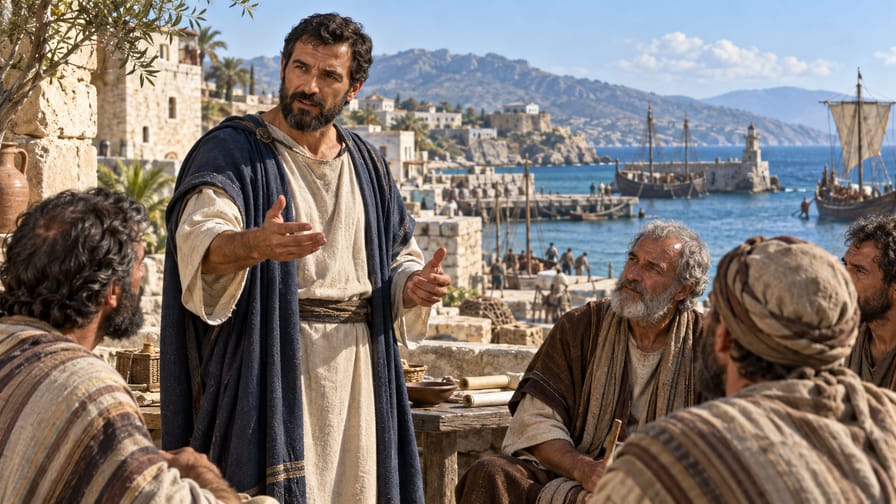
The figure of Titus, one of the apostle Paul's most trusted co-workers, emerges from the pages of the New Testament as a remarkable example of pastoral leadership and missionary dedication. His story, though not as extensively detailed as that of Peter or John, is fundamental for understanding the expansion of early Christianity and the organization of the first Gentile communities. An analysis of his life and ministry offers valuable insights into Pauline ecclesiology and the practical application of the Gospel in diverse cultural contexts.
This in-depth study seeks to explore the relevance of Titus from a Protestant evangelical perspective, emphasizing biblical authority and theological accuracy. We will address his onomastic significance, the historical context in which he operated, the characteristics of his character, his theological impact, and his lasting legacy for the Church. The Epistle to Titus, one of Paul's pastoral epistles, serves as a cornerstone for understanding the depth of his contribution and the trust placed in him by the apostle to the Gentiles.
1. Etymology and meaning of the name
The name Titus derives from the Greek Titos (Τίτος), a shortened form of Latin names such as Titus or Titinius. Although it is a name of Latin origin, it was widely adopted in the Greco-Roman world of the time. The exact etymological root is uncertain, but some scholars suggest a connection with the Latin term titus, which may be related to "honor" or "honored."
There is no direct equivalent or clear root in Hebrew or Aramaic for the name Titus, which is consistent with his identity as a Gentile, not a Jew. His non-Jewish origin is a crucial point in his biblical narrative, highlighted by Paul in Galatians 2:3, where he is explicitly called a "Greek."
The literal meaning of "honored" or "noble," if this etymology is accurate, symbolically resonates with the character and role that Titus played in the early Church. He was a worker whom Paul honored and in whom he placed great trust, delegating tasks of extreme importance and sensitivity to him. The absence of other notable biblical characters with the same name in significant contexts makes Titus a unique figure with this designation.
From a theological perspective, the name of Titus, although it does not possess an intrinsic prophetic or messianic charge like some Hebrew names, acquires significance through his life and ministry. He represents the inclusion of Gentiles in God's covenant of grace, being a living example that salvation is by faith in Christ Jesus, regardless of circumcision or the Mosaic Law. His very existence and acceptance as a leader in the Church confirm the universality of the Gospel.
2. Historical context and biblical narrative
2.1. Historical period and context
The life and ministry of Titus unfold in the vibrant and challenging context of the 1st century AD, a period of intense missionary activity and consolidation of the Christian Church. He operated during the decades of the 50s and 60s AD, accompanying the apostle Paul on his journeys and missions, amidst the vast Roman Empire. This was a time of great religious syncretism and increasing tensions between Jews and Gentiles, both in society and within the nascent Church itself.
Politically, the Roman Empire ruled with an iron fist, providing an infrastructure that, paradoxically, facilitated the dissemination of the Gospel through its roads and relative peace (Pax Romana). Socially, society was stratified, with slavery and well-defined hierarchies. Religiously, Judaism was a recognized religion, but Christianity, emerging from Judaism, began to be viewed with suspicion, especially due to its exclusive nature and its refusal to worship the emperor.
2.2. Origin and first contacts
The Bible informs us that Titus was a Greek (Galatians 2:3), which means he was a Gentile by birth and not subject to the Mosaic Law. His conversion to Christianity likely occurred through Paul's ministry, who describes him as his "true son in our common faith" (Titus 1:4). Although there are no details about his family or genealogy, his Gentile identity is crucial to understanding his role in the controversies of the early Church.
The first record of Titus occurs when he accompanies Paul and Barnabas to Jerusalem for the council described in Acts 15 and Galatians 2. This event, around 49 AD, was crucial for defining the relationship between the Law and grace for Gentile Christians. Paul's decision not to circumcise Titus, despite pressure from the Judaizers, was a landmark in the defense of the doctrine of justification by faith, without the works of the law (Galatians 2:3-5).
2.3. Key events and geography
After the Council of Jerusalem, Titus became one of Paul's most important emissaries. His presence is notable in several strategic missions and regions:
- Corinth: Titus was sent to Corinth on a delicate mission to resolve conflicts and collect offerings for the saints in Jerusalem (2 Corinthians 7:6-7, 13-16 8:6, 16-24). His ability to deal with a problematic church is evidenced by the joy and relief Paul felt upon receiving the good news of his return. He managed to restore peace and order, demonstrating great tact and firmness.
- Crete: After Paul's liberation from his first Roman imprisonment, he and Titus traveled to Crete. Paul left Titus on the island with the task of organizing the churches, appointing elders in each city, and correcting the false teachings that were infiltrating (Titus 1:5). This task required theological discernment and delegated apostolic authority.
- Nicopolis and Dalmatia: Paul planned to meet Titus in Nicopolis, where he intended to spend the winter (Titus 3:12). Later, during his second and final imprisonment, Paul mentions that Titus had departed for Dalmatia (2 Timothy 4:10), likely on an evangelistic mission or to organize churches in that region.
2.4. Relationships with other characters
Titus's most prominent relationship is with the apostle Paul, who considers him a "true son" (Titus 1:4) and his "partner and fellow worker" (2 Corinthians 8:23). This relationship demonstrates deep trust and affection. He also interacted with other co-workers of Paul, such as Timothy, although their missions and personalities were distinct. While Timothy is often presented as more reserved and in need of encouragement, Titus appears to have been a more robust leader, capable of handling difficult situations.
3. Character and role in the biblical narrative
3.1. Analysis of character and spiritual qualities
Although the Scriptures do not provide a detailed biography of Titus, the Pauline epistles reveal an exemplary character and remarkable spiritual virtues. He is portrayed as an individual of great faithfulness and reliability, essential qualities for an apostolic emissary. Paul entrusted him with missions of high sensitivity and complexity, which attests to his integrity and execution capability.
Courage is another striking characteristic of Titus. In Corinth, he faced a church full of divisions and immorality, delivering a severe letter from Paul and mediating reconciliation (2 Corinthians 7:6-7). In Crete, he was tasked with confronting false teachers and establishing order in a culture notorious for its moral difficulty (Titus 1:12-13), tasks that required bravery and discernment.
His wisdom and discernment are evident in his ability to handle delicate situations. The way he managed the collection for the poor in Jerusalem, encouraging the generosity of the Corinthians (2 Corinthians 8:6), demonstrates his ability to motivate and organize, always with a spirit of service and love. He was a practical and effective leader, focused on the edification of the Church.
3.2. Vocation and specific function
Titus's vocation was that of an apostolic assistant and itinerant pastoral leader. He was not an apostle in the sense of the Twelve or even Paul, but a "fellow worker" (2 Corinthians 8:23), a man to whom Paul delegated his authority for specific missions. His role was multifaceted, acting as:
- Emissary and Mediator: Sent to resolve conflicts and communicate Paul's instructions, as in Corinth.
- Ecclesiastical Administrator: Tasked with organizing churches, establishing leadership structures, and appointing elders, as in Crete (Titus 1:5).
- Preacher and Teacher: Responsible for teaching sound doctrine and refuting opponents (Titus 2:1, 15).
- Collector of Offerings: Tasked with overseeing the collection for the saints in Jerusalem (2 Corinthians 8:6).
The absence of mentions of specific moral failures or weaknesses in the biblical account suggests that Titus maintained a high standard of conduct, although, like every human being, he was subject to imperfections. His representation is that of a faithful and competent servant, a model of practical and dedicated Christian leadership.
3.3. Character development
Titus's trajectory shows continuous growth in responsibility and trust. From his first appearance as an uncircumcised Gentile taken to Jerusalem by Paul, he evolved into a mature and experienced leader, capable of facing complex challenges. His ability to undertake increasingly demanding tasks demonstrates a progression in his faith, wisdom, and pastoral discernment.
He began as a "test case" for Gentile freedom in the Gospel and ended as a "general" of Paul, tasked with establishing order and doctrine throughout an entire island. This development underscores the importance of experience and practical training in Christian ministry, and how God empowers those who are faithful and obedient to the call.
4. Theological significance and typology
4.1. Role in redemptive history and progressive revelation
The figure of Titus is of utmost importance for redemptive history, especially concerning the inclusion of Gentiles in God's plan of salvation. His life is a practical demonstration of the truth that salvation is by grace, through faith in Jesus Christ, and not by works of the law or ethnic identity (Ephesians 2:8-9). He is a living testimony to the abolition of the barrier between Jews and Gentiles in Christ (Ephesians 2:14-16).
Paul's decision not to circumcise Titus, as narrated in Galatians 2:3-5, was a crucial defense of the purity of the Gospel. This event helped shape the progressive revelation that the Church is composed of people from all nations, united in Christ, without the need to convert to Judaism or fulfill its ceremonial ordinances to be accepted by God.
4.2. Christocentric prefiguration or typology
Although Titus is not a typological figure in the classic sense of directly prefiguring Christ as an Old Testament king, prophet, or priest, his ministry reflects aspects of Christ's character and work in an indirect and ecclesiological way. Titus, as a servant of Christ and of Paul, demonstrates Christ's love and patience in the edification of the Church. He embodies the spirit of service and sacrifice that Christ exemplified.
His work of reconciliation in Corinth and establishing order in Crete points to Christ as the Great Shepherd who organizes and purifies His Church, His body. Titus's firmness in defending sound doctrine and confronting error mirrors the truth that Christ is the Truth and the Guardian of the faith. He is an instrument in God's hands to manifest the grace of Christ to the Gentiles, becoming a model of how Christ's grace is extended and applied through His ministers.
4.3. Connection with central theological themes
The Epistle to Titus, and by extension the life of Titus himself, is intrinsically linked to several central theological themes from a Protestant evangelical perspective:
- Justification by Faith: The story of Titus as an uncircumcised Gentile fully accepted into Pauline ministry is living evidence of the doctrine of justification by faith alone (Galatians 2:16).
- Sound Doctrine: The Epistle to Titus repeatedly emphasizes the importance of sound doctrine and the need to refute false teachings (Titus 1:9 2:1). This underscores the authority of Scripture and the responsibility of its ministers.
- Grace and Good Works: The letter to Titus harmonizes God's saving grace with the necessity of good works as evidence of genuine faith (Titus 2:11-14 3:4-8). Titus himself is an example of someone saved by grace who dedicates himself to good ministerial works.
- Ecclesiology and Pastoral Leadership: The epistle provides clear guidelines for the organization of the Church, the qualification of elders, and the conduct of all members (Titus 1:5-9 2:1-10). Titus was the executor of these instructions, establishing a model for Church governance.
- Transcultural Mission: Titus's life is a testament to God's mission to reach all nations, breaking down cultural and ethnic barriers to form a people for Himself (Matthew 28:19-20).
The life and ministry of Titus confirm Pauline theology that God's grace is for all, and that faith in Christ is the only path to salvation and to a life of holiness and service. His experience is a validation of the universality of the Gospel.
5. Biblical-theological legacy and canonical references
5.1. Mentions and literary contributions
Titus is mentioned in four New Testament books, all within the Pauline epistles: Galatians 2:1, 3 2 Corinthians 2:13 7:6, 13-14 8:6, 16, 23 12:18 Titus 1:4 and 2 Timothy 4:10. The most significant literary contribution associated with him is, obviously, the Epistle to Titus, although the authorship is Paul's. This letter is one of the Pastoral Epistles, along with 1 and 2 Timothy, and offers invaluable insight into Paul's concerns for the order and doctrine of the Church.
The Epistle to Titus is a concise manual on pastoral leadership and Christian conduct. It addresses the qualifications for elders, instruction for different age and social groups in the church, the importance of sound doctrine, and the necessity of good works as fruit of faith. Its inclusion in the biblical canon is vital for understanding early Christian ecclesiology and ethics.
5.2. Influence on biblical theology
Titus's influence on biblical theology is profound, especially in areas such as ecclesiology and pastoral theology. His story and the epistle bearing his name solidify the principles of Church governance, establishing the need for qualified and godly leadership. The emphasis on sound doctrine and the refutation of heresies is a lasting legacy that shaped Reformed and evangelical theology.
The Epistle to Titus serves as a pillar for understanding the relationship between faith and works, grace and holiness. It teaches that God's saving grace also instructs us to live godly, righteous, and holy lives in this present world (Titus 2:11-12). This balance is fundamental for conservative evangelical theology, which rejects both legalism and antinomianism.
5.3. Presence in the interpretive tradition
In the Christian interpretive tradition, Titus is consistently seen as a model of a faithful and effective ministerial leader. The Church Fathers, such as Clement of Rome and Jerome, recognized the importance of his work and the epistle. During the Protestant Reformation, theologians like John Calvin frequently cited the Epistle to Titus to defend the need for a well-defined ecclesiastical order and godly, doctrinally sound leadership.
In contemporary Protestant evangelical theology, Titus remains a central figure for discussions on pastoral qualification, ecclesiastical discipline, transcultural evangelism, and the application of sound doctrine in the daily life of the congregation. He is an example of how faith should be lived and taught in a challenging world.
5.4. Importance for understanding the canon
The presence of the Epistle to Titus in the biblical canon is crucial for providing a complete picture of Paul's mission and the development of the early Church. Without it, we would lose important insights into the organization and life of Gentile communities, as well as the practical application of Gospel truths in a pastoral context. It complements Paul's theology, showing how his great doctrinal themes were put into practice.
The life of Titus, exemplified in the epistle, is a testimony to delegated authority and pastoral responsibility. It reinforces the importance of the succession of leaderships and the transmission of faith from generation to generation, ensuring the continuity of evangelical truth. Thus, Titus and the epistle bearing his name are indispensable elements for the fullness of canonical revelation, offering timeless principles for the Church of all ages.