


Jonah
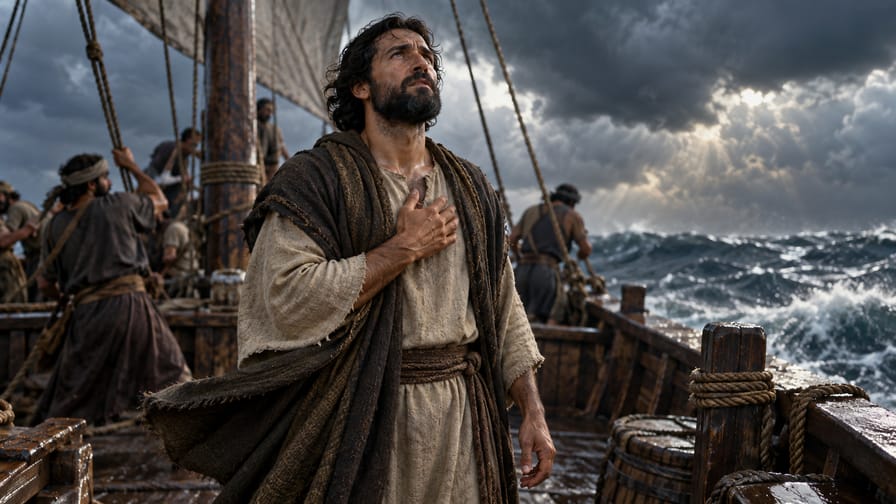
The figure of Jonah, the prophet, is one of the most singular and theologically rich in the Old Testament canon. His book, though small, addresses profound themes such as divine sovereignty, God's mercy towards all nations, the nature of prophecy, and the human condition of obedience and rebellion.
From an evangelical Protestant perspective, the narrative of Jonah is seen as a historical record of miraculous events, with direct prophetic and typological implications for the person and work of Jesus Christ. His story challenges prejudices and expands the understanding of divine grace.
1. Etymology and meaning of the name
The name Jonah derives from the Hebrew Yonah (יוֹנָה), which literally means "dove". This etymological root is consistent across various Semitic languages and is found in several biblical passages referring to the bird.
The linguistic derivation is clear, connecting the prophet's name directly to the symbol of the dove. Although there are no other prominent biblical characters with the same name, the image of the dove is rich in symbolism within the biblical context, frequently associated with peace, purity, and, in some contexts, lamentation or fragility.
In the Old Testament, the dove is the bird Noah sends out to check if the floodwaters had receded (Genesis 8:8-12), symbolizing hope and a new beginning. In the New Testament, the Holy Spirit descends upon Jesus like a dove at his baptism (Matthew 3:16), indicating purity and divine presence.
The theological significance of the name Jonah ("dove") within the context of his own narrative is multifaceted. It may ironically contrast with his initial reluctant and angry character, far from the meekness and peace that the dove generally represents.
Alternatively, it may symbolize Jonah's role as a messenger of God, just as Noah's dove carried a message. However, his message was not one of peace, but of judgment, though tempered by the opportunity for repentance and divine mercy.
The designation "dove" may also evoke the prophet's fragility and vulnerability in the face of the magnitude of the task and God's wrath, as well as his subsequent dependence on divine mercy, which he so reluctantly desired for Nineveh.
2. Historical context and biblical narrative
2.1. Historical period and family origin
Jonah, son of Amittai, is identified in 2 Kings 14:25 as a prophet from Gath Hepher, a city in Galilee, within the territory of the tribe of Zebulun. He prophesied during the reign of Jeroboam II, king of Israel, who ruled from approximately 793 to 753 BC.
This period was an era of relative prosperity and territorial expansion for the Northern Kingdom, Israel, following a time of Aramean oppression. Jonah prophesied the restoration of Israel's borders, from Hamath to the Sea of the Arabah, a prophecy that Jeroboam II fulfilled.
The political and social context of the time was one of an Israel proud of its conquests, but spiritually decadent, as evidenced by contemporary prophets Amos and Hosea. Popular religion and idolatry were rampant, despite material blessings.
Assyria, with its capital Nineveh, was an emerging and feared power, known for its brutality. Although weakened around 760 BC due to plagues and internal revolts, which may have contributed to Nineveh's receptiveness to Jonah's message, it would soon recover and become an existential threat to Israel.
2.2. Main events of his life and geography
The narrative of the book of Jonah begins with the divine call to go to Nineveh and cry out against it (Jonah 1:1-2). Jonah, however, disobeys and attempts to flee to Tarshish, a city believed to be in Spain, at the western edge of the known world at the time (Jonah 1:3).
He embarks on a ship in Joppa, a port on Israel's Mediterranean coast. During the voyage, a great storm arises, leading the sailors to cast lots, which fall on Jonah, revealing his guilt (Jonah 1:4-7).
After confessing his disobedience, Jonah is thrown into the sea and swallowed by a great fish, where he remains for three days and three nights (Jonah 1:11-17). Inside the fish, he prays to God in a psalm of repentance and trust (Jonah 2:1-9).
The Lord then commands the fish to vomit him onto dry land (Jonah 2:10). Receiving the divine call a second time, Jonah obeys and goes to Nineveh, a "very large" city, which took three days to cross (Jonah 3:1-4).
His preaching of judgment, "Yet forty days, and Nineveh shall be overthrown," leads to a massive repentance on the part of the king and the people, who fast and dress in sackcloth (Jonah 3:4-9). God, seeing their repentance, relents from bringing the disaster He had threatened (Jonah 3:10).
The story culminates with Jonah's anger over God's mercy toward Nineveh, and God's lesson on compassion, using a plant that grows and dies, and a worm, to illustrate divine concern for all creation, including the inhabitants of Nineveh (Jonah 4:1-11).
3. Character and role in the biblical narrative
Jonah's character is presented in Scripture with brutal honesty, revealing a deeply flawed man, yet chosen and used by God. His main virtue, or perhaps, his most notable characteristic, is his prophetic calling, a direct call from God.
He is a prophet who, despite his reluctance, utters the word of God with authority, resulting in an unprecedented revival. His prayer in the belly of the fish (Jonah 2) reveals deep theological knowledge and faith in God as Savior.
However, Jonah's weaknesses and moral failures are the central focus of the book. His initial disobedience (Jonah 1:3) is a clear act of rebellion against the divine will, motivated by ethnic prejudice and exacerbated nationalism. He did not want the Assyrians, enemies of Israel, to receive God's mercy.
Jonah's anger over Nineveh's salvation (Jonah 4:1) is shocking and reveals a selfish heart, more concerned with his own reputation as a prophet of judgment than with the salvation of thousands. He preferred Nineveh to be destroyed rather than for God to show compassion.
His impatience, his narrow view of God's grace, and his lack of compassion for the Gentiles are striking traits. Jonah is, in many respects, an anti-hero, a prophet who becomes a negative example of what it means to resist God's purpose.
The development of Jonah's character throughout the narrative is ambiguous. Although he obeys the second call and goes to Nineveh, the end of the book leaves him in a state of stubbornness and anger, without an explicit resolution of his heart. God, however, continues to dialogue with him, demonstrating His persistent grace.
His role is unique: to be a prophet who, through his own experience of disobedience and miraculous rescue, prefigures the death and resurrection of Christ. He is a reluctant messenger of God's grace to the Gentiles, forced to confront his own prejudices.
4. Theological significance and typology
The book of Jonah plays a crucial role in redemptive history, expanding the progressive revelation of God's universal purpose. It challenges the exclusivist view that salvation is only for Israel, demonstrating divine compassion for all nations, including Israel's enemies.
God's sovereignty is a central theme, visible in His control over the storm, the fish, the plant, the worm, and the east wind (Jonah 1:4, 17 4:6-8). God is the Lord of all creation and all peoples.
The Christocentric typology of Jonah is explicitly affirmed by Jesus Christ in the New Testament. He refers to himself as "greater than Jonah" and establishes the "sign of the prophet Jonah" (Matthew 12:39-41 Luke 11:29-32) as the only proof of His messiahship for an unbelieving generation.
This "sign" is Jonah's stay for three days and three nights in the belly of the great fish, prefiguring the death, burial, and resurrection of Jesus Christ for three days and three nights. Just as Jonah was rescued from death, Christ would be raised to life, validating His message.
Jonah's preaching to the Ninevites and their repentance also prefigure the preaching of the gospel to the Gentiles through Christ and His apostles. Nineveh's repentance serves as a contrast and a judgment to the unbelief of Israel, which rejected a greater message.
Central theological themes in the book include God's sovereign grace, which extends beyond Israel's borders human obedience and disobedience divine judgment and the possibility of repentance and God's compassion, which longs for the salvation of all peoples.
The book of Jonah teaches that God is not only the God of Israel but the God of all humanity, and that His mercy transcends human prejudices. It reveals the depth of God's love, even for those considered enemies.
Jonah's refusal to accept divine grace for the Ninevites highlights the need for believers to align their hearts with God's missionary heart, who desires that "all men would be saved and come to a full knowledge of the truth" (1 Timothy 2:4).
5. Biblical-theological legacy and canonical references
The figure of Jonah is mentioned primarily in the book that bears his name and in 2 Kings 14:25, which identifies him as a historical prophet. His most significant mention outside the book of Jonah occurs in the Synoptic Gospels, where Jesus Christ quotes him.
Jesus' references to Jonah (Matthew 12:39-41 16:4 Luke 11:29-32) solidify the historicity of the prophet and the events in his book, since Jesus bases His own messianic prefiguration on these occurrences. For evangelical theology, this is an unquestionable validation of the narrative's veracity.
The book of Jonah, though not authored by the prophet, is a didactic narrative that illustrates profound theological truths. Its inclusion in the minor prophetic canon is a testament to its importance for understanding the nature of God and Israel's mission in the world.
In the Jewish interpretative tradition, Jonah is often read on Yom Kippur (Day of Atonement), emphasizing repentance and God's mercy. In the Christian tradition, his story is seen as a powerful illustration of God's redemptive plan for the Gentiles and, crucially, as a type of Christ.
Reformed and conservative evangelical theology defends the literal historicity of the book of Jonah, including the miracle of the great fish. Such an approach is consistent with the authority of Scripture and God's sovereignty to perform miracles, especially in light of Jesus' affirmation.
Commentators like John Calvin and Matthew Henry, both influential figures in the Reformed tradition, treated the story of Jonah as a real event, emphasizing its lessons on obedience, divine grace, and the missionary calling.
The story of Jonah continues to influence biblical theology by underlining the universality of God's love and mercy, challenging ethnocentrism and religious exclusivism. It serves as a perpetual reminder of God's readiness to forgive those who repent, regardless of their origin.
Jonah's relevance for understanding the canon lies in its expansion of the understanding of the Abrahamic covenant (Genesis 12:3) and the promise of blessing to all families of the earth, preparing the ground for full Gentile inclusion in the New Testament.
In summary, Jonah is more than a story about a prophet and a fish it is a historical parable of God's grace, human disobedience, and the prefiguration of the greatest prophet, Jesus Christ, who would bring salvation not only to one nation but to the entire world.