


Ham
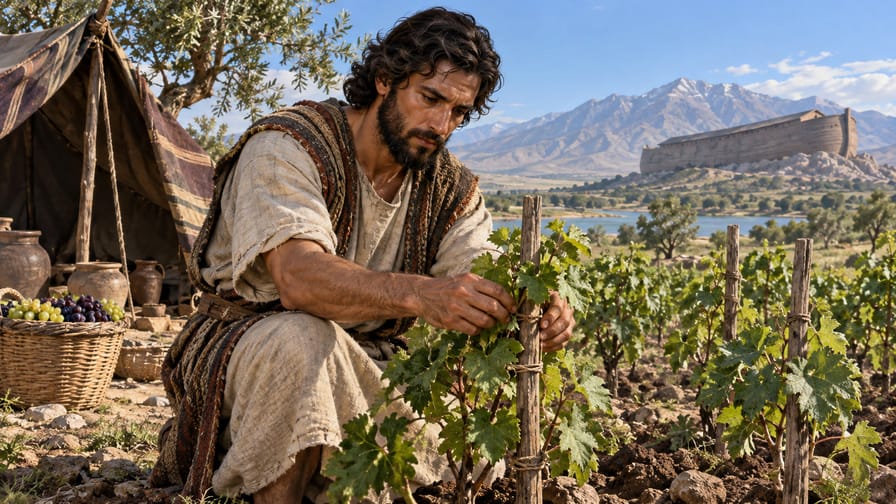
The figure of Ham, one of Noah's three sons, is of utmost importance for understanding the origins of post-diluvian nations and for the biblical theology of divine sovereignty and the consequences of sin. His story, though brief, is central to the narrative of Genesis, laying the groundwork for future developments in the history of redemption. This entry explores the etymology, narrative context, character, theological significance, and legacy of Ham from a conservative evangelical Protestant perspective.
The analysis of Ham transcends mere biographical description, delving into the implications of his actions for the history of humanity and for the progressive revelation of God's plan. His descendants form peoples crucial to the history of Israel, such as the Egyptians and the Canaanites, making his role indispensable for understanding the Old Testament. Reformed theology, in particular, has delved into the narrative of Ham to draw lessons about the persistence of sin, divine justice, and the interconnectedness of generations.
1. Etymology and meaning of the name
The name Ham, in Hebrew, is Ḥām (חָם). The etymology of this name is a subject of debate among scholars, but the most common interpretations associate it with concepts of "hot," "burnt," or "brown/dark-skinned." This derivation is often linked to the climatic and geographical characteristics of the lands where his descendants settled, notably warm regions of the Middle East and Africa.
The etymological root of Ḥām (חָם) may suggest a connection with the arid and sunny climate of the Hamitic lands. While there is no explicit biblical statement about the symbolic meaning of the name, the association with "heat" can be seen as a reference to the regions south of Palestine, which were known for their hot climate and for being inhabited by darker-skinned peoples, such as the Egyptians and Ethiopians.
There are no significant variations of the name Ham in biblical languages, remaining consistent in Hebrew and its transliterations into the Greek Septuagint (Cham). The uniqueness of the name and its direct association with Noah's son distinguish him from other biblical characters, with no prominent figures bearing the same name in the canon.
The theological significance of the name lies more in its geographical and ethnographic implications than in a direct symbolism of his character. The identification of the "sons of Ham" with specific peoples (such as Egypt, Ethiopia, and Canaan) is crucial for understanding biblical geography and Israel's interactions with these nations throughout history. The name, therefore, serves as a fundamental genealogical and geographical marker.
Interpretative tradition has, at times, attempted to link the name Ham to the concept of "shame" or "disrespect," in a post-facto association with the incident in Genesis 9. However, this connection is more of a popular interpretation than a robust etymological derivation. The most accepted etymology remains linked to heat or skin coloration, reflecting the geographical distribution of his descendants.
2. Historical context and biblical narrative
2.1 Family origin and genealogy
Ham is one of Noah's three sons, born before the Flood, as recorded in Genesis 5:32 and Genesis 6:10. His brothers were Shem and Japheth. Together with his father, his mother, his brothers, and their wives, Ham was one of the eight survivors of the universal Flood, entering the ark by divine command (Genesis 7:13).
The historical period of Ham is immediately after the Flood, marking the beginning of the Earth's repopulation. Biblical chronology, while not providing exact dates for these primeval events, places them thousands of years before the Christian era, in a context of restoration and new beginning for humanity. The setting was a land purified by divine judgment, but still marked by the persistence of human sin.
The main appearance of Ham in the biblical narrative occurs in Genesis 9:18-27, which describes the incident of Noah's drunkenness and the subsequent curse of Canaan. After the Flood, Noah became a farmer and planted a vineyard. One day, he drank of the wine, became drunk, and lay uncovered in his tent (Genesis 9:20-21).
It was in this context that Ham "saw the nakedness of his father" and, instead of covering him with reverence, went out and told his two brothers, Shem and Japheth (Genesis 9:22). The brothers, with an attitude of filial respect, took a garment, covered Noah by walking backward, avoiding looking at their father's nakedness (Genesis 9:23).
When Noah awoke and learned what his younger son (or Ham's son, referring to Canaan) had done to him, he pronounced a curse on Canaan, Ham's son, and blessings on Shem and Japheth (Genesis 9:24-27). This event is central to understanding Ham's role and its genealogical consequences.
Ham's descendants are detailed in Genesis 10:6-20, known as the "Table of Nations." His sons were Cush, Mizraim, Put, and Canaan. From these arose the peoples who inhabited regions crucial to biblical history: Cush (Ethiopia, Sudan), Mizraim (Egypt), Put (Libya), and Canaan (the land of Canaan, Palestine). These peoples formed powerful civilizations and were often adversaries of Israel.
The geography related to Ham and his descendants is vast, encompassing much of the Middle East and North Africa. From the Nile Valley (Egypt) to the fertile lands of Mesopotamia and the Mediterranean coasts (Canaan), the "sons of Ham" established kingdoms and cities that would play significant roles in subsequent Old Testament events.
2.2 The curse of Canaan and its implications
Noah's curse did not fall directly on Ham, but on his son Canaan: "Cursed be Canaan! A servant of servants shall he be to his brothers" (Genesis 9:25). This prophecy had profound implications for the history of the Canaanites, who would later be subjugated by Israel, descendants of Shem.
Ham's relations with his brothers Shem and Japheth are marked by contrast in Genesis 9. While Ham demonstrated disrespect, Shem and Japheth acted with reverence and honor toward their father. This distinction is crucial for understanding the subsequent blessings and curses, which would shape the destiny of nations.
3. Character and role in the biblical narrative
Ham's character, as revealed in the Scriptures, is primarily defined by his action in the incident of Noah's nakedness. The Bible does not offer an extensive portrayal of his virtues or spiritual qualities, focusing on a moment of moral failure that had lasting repercussions. He is a character whose role is more dramatic and consequential than exemplary.
Ham's attitude in "seeing the nakedness" of his father and, more importantly, in divulging the incident to his brothers, is interpreted as a grave lack of respect and filial reverence. In a culture where honor and shame were central concepts, exposing a father's nakedness was an act of profound dishonor, equivalent to an aggression against his authority and dignity (cf. Leviticus 18:6-19, which prohibits the "uncovering of nakedness" of close relatives, indicating the seriousness of the act).
The exact nature of Ham's sin has been the subject of much theological discussion. Some interpretations, though less common in conservative evangelical theology, suggest incest or homosexuality. However, the predominant view is that the primary sin was the lack of filial reverence, the scorn, and the exposure of his father's shame, in contrast to the attitude of Shem and Japheth (Genesis 9:23).
There is no biblical evidence that Ham had a specific vocation or function, such as prophet, priest, or king. His role in the narrative is that of one of the three pillars of post-diluvian humanity, but his action in the incident of Noah highlights him as the catalyst for a curse that would profoundly affect one of his lineages, that of Canaan.
Ham's significant actions are limited to the event in Genesis 9. Unlike Shem, who is the ancestor of Abraham and, therefore, of the messianic lineage, or Japheth, who is blessed with expansion, Ham is associated with an act of dishonor and the origin of peoples who would become enemies of Israel, such as the Canaanites.
There is no development of Ham's character throughout the biblical narrative. He appears as an actor in a crucial event and is then mentioned primarily through his descendants in the Table of Nations (Genesis 10). His importance lies more in the consequences of his actions and the genealogy he establishes than in any complexity or evolution of his personal character.
The central lesson of Ham's character, for the evangelical perspective, lies in the demonstration of the persistence of human sin even after a cataclysmic judgment like the Flood. God's grace saved Ham from destruction, but sinful nature continued to manifest, bringing consequences for future generations. This underscores the need for redemption that would only come through the lineage of Shem.
4. Theological significance and typology
The figure of Ham and the incident in Genesis 9 have profound theological significance in redemptive history and progressive revelation. They illustrate the persistence of man's sinful nature even after the divine judgment of the Flood, demonstrating that moral corruption was not eradicated, only contained. The narrative serves as a foreshadowing of the need for a more radical divine intervention to deal with sin.
Ham is not a typologically Christocentric figure that is, he does not directly prefigure Christ. On the contrary, his story and the curse of Canaan can be seen as an antithetical example, highlighting the need for redemption and the reality of divine judgment. The narrative prepares the ground for the calling of Abraham and the formation of Israel through the lineage of Shem, through which God's blessing would be channeled to all nations (Genesis 12:3).
The covenants and promises related to Ham are indirect. Noah's prophecy concerning Canaan ("Cursed be Canaan! A servant of servants shall he be to his brothers") and the blessings on Shem and Japheth ("Blessed be the Lord, the God of Shem!", "May God enlarge Japheth") are prophecies that would be fulfilled in the history of peoples (Genesis 9:25-27). The subjugation of the Canaanites by Israel (descendants of Shem) is a direct fulfillment of this curse and blessing.
The New Testament makes no direct mention of Ham. However, Jesus' genealogy in Luke 3 traces his lineage through Shem, confirming the importance of Noah's blessing on Shem and the centrality of his offspring to God's redemptive plan. The absence of Ham in the messianic genealogies highlights his secondary role in the direct history of salvation.
The story of Ham connects to central theological themes:
- Sin and Fall: The narrative demonstrates the depth and persistence of human sin, which transcends punishment and requires a work of grace and inner transformation.
- Divine Judgment: The curse on Canaan illustrates God's justice and the consequences of disrespect and impiety. This judgment foreshadows future judgments on the Canaanite peoples due to their idolatrous and immoral practices (cf. Leviticus 18:24-28).
- Sovereignty of God: Even through Ham's flawed actions and Noah's prophecies, God demonstrates His sovereignty in guiding the history of nations for His own purposes, preparing the way for redemption.
- Grace and Curse: Ham's story serves as a contrast between the grace that saves from the Flood and the persistent consequences of sin, resulting in a curse for a specific lineage.
The prophetic fulfillment of the curse of Canaan is evident in Israel's conquest of the Promised Land, where the Canaanites were subjugated and driven out. This subjugation was not an act of racism, but a divine judgment on the moral and religious depravity of the Canaanites, who had filled up the measure of their iniquity (Genesis 15:16).
Evangelical theology emphasizes that the curse on Canaan should not be interpreted as a justification for racism or the enslavement of any people. The curse was specific to Canaan and his descendants, not to Ham as a whole, nor to all dark-skinned peoples. Racist interpretations are a heretical distortion of the biblical text and are vehemently rejected by Reformed and evangelical theology.
5. Biblical-theological legacy and canonical references
Ham's legacy in the Bible is primarily genealogical and historical, serving as the ancestor of nations that would play a significant role in the history of Israel. Besides the passages in Genesis, Ham is mentioned in 1 Chronicles 1:4 in the genealogy that traces Abraham's lineage, and his descendants are listed in 1 Chronicles 1:8-16, reiterating the importance of his offspring for the formation of peoples.
References to the "sons of Ham" or the "land of Ham" (which refers to Egypt) appear in various Psalms, highlighting Egypt as a stage for powerful divine interventions in favor of Israel. For example, Psalm 78:51, Psalm 105:23, 27, and Psalm 106:22 mention Egypt as the "land of Ham" when narrating the Exodus and the plagues, underscoring God's sovereignty over all nations.
Ham made no direct literary contributions to the biblical canon. His influence, however, is profound in biblical theology, especially in understanding the origin of nations and divine providence in history. The Table of Nations (Genesis 10), in which Ham's descendants occupy a substantial part, is a fundamental ethnographic and theological document, showing the unity of the human race and its diversification under God's sovereignty.
In Jewish interpretive tradition, Ham's incident has been the subject of intense discussion, with various theories about the exact nature of his sin. Christian tradition, unfortunately, for centuries, misinterpreted the curse of Canaan, improperly using it to justify slavery and racism against African peoples, an interpretation that is theologically unsustainable and morally abominable.
Contemporary Reformed and evangelical theology categorically rejects any attempt to use the narrative of Ham to justify racism or oppression. It emphasizes that the curse was on Canaan, not on Ham, and was linked to a specific sin and not to racial characteristics. The Bible promotes the unity and equality of all peoples, created in the image of God (Genesis 1:27 Acts 17:26).
Ham's importance for understanding the canon lies in his role in the genealogy of nations and in the preparation for the narrative of redemption. His story demonstrates that, even after a new beginning, sin persists, and the need for a Savior is universal. The curse of Canaan, in turn, establishes a precedent for divine judgment on impiety and idolatry, which would be widely manifested in the history of Israel.
In summary, Ham is a biblical figure whose relevance transcends his brief appearance. He is a vivid reminder of the reality of sin and its consequences, but also a crucial element in the genealogical and prophetic tapestry that points to God's sovereign plan in the history of humanity and redemption, culminating in Christ.