


Cleopas
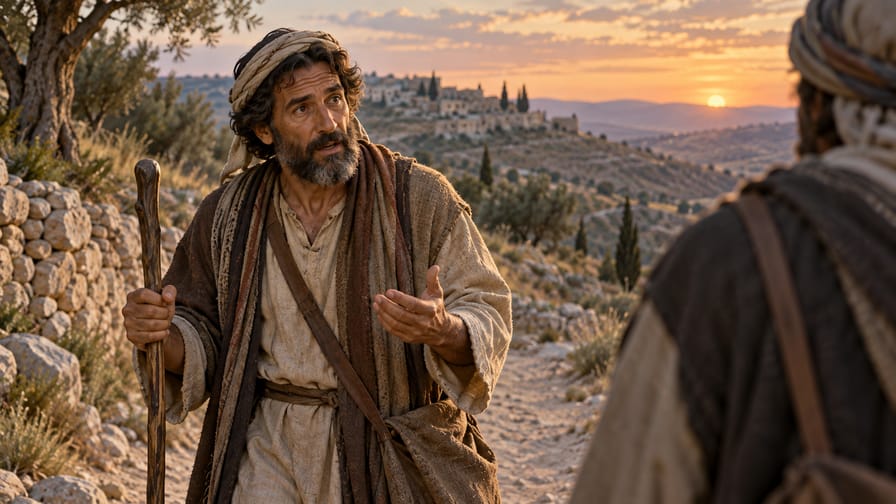
The figure of Cleopas, though briefly mentioned in the Scriptures, emerges with a theological depth and a redemptive significance that transcend the extent of his appearance. He is one of the two disciples who encounter the resurrected Jesus on the road to Emmaus, as narrated in the Gospel of Luke. His story is not merely an account of a personal encounter with the risen Christ, but also a powerful illustration of central themes of Christian faith, such as initial unbelief, divine revelation through the Scriptures, and the transformative joy of Christ's presence.
From an evangelical Protestant perspective, the analysis of Cleopas emphasizes the authority of the Scriptures, the centrality of Jesus' resurrection, and the necessity of a living and responsive faith. His experience serves as a microcosm of the journey of many believers, who transition from confusion and despair to understanding and witness, guided by the Word of God and the Holy Spirit. This entry will explore the etymology, historical context, character, theological significance, and legacy of Cleopas, providing a comprehensive analysis for a biblical-theological dictionary.
1. Etymology and meaning of the name
The name Cleopas (Greek: Κλεοπᾶς, Kleopas) is an abbreviated or diminutive form of the Greek name Kleopatros, which means "glory of the father" or "famous by his father." This derivation suggests a Hellenistic origin or a Greek cultural influence on the disciple's family, not uncommon in a Judea under Roman rule and with a strong presence of Greek culture.
Although the name Kleopas appears only once in the New Testament, specifically in Luke 24:18, its etymological root reflects a common practice of compound Greek names. The full form Kleopatros was quite well-known, with Kleopas serving as an affectionate or abbreviated form, similar to how "Demetrios" might be shortened to "Demetras."
It is important to note the distinction between Kleopas (Cleopas) and Clopas (Greek: Κλωπᾶς, Klopas), the latter mentioned in John 19:25 as the husband of Mary, the sister of Jesus' mother. Although the names are phonetically similar in some pronunciations and often confused, the difference in Greek spelling (Kleopas vs. Klopas) and their respective etymologies suggest that they are distinct individuals.
Clopas is generally considered a Greek transliteration of an Aramaic name, such as Qlopha or Halpai, while Kleopas is clearly of Greek origin. Early Christian tradition, such as that of Eusebius of Caesarea and Hegesippus, sometimes attempted to identify the two, suggesting that Cleopas of Emmaus was the same Clopas, brother of Joseph and father of James, son of Alphaeus, and other relatives of Jesus. However, this identification lacks explicit biblical basis and is generally viewed with skepticism by modern scholars due to linguistic differences and lack of corroboration in the Scriptures.
From a theological point of view, the meaning "glory of the father" for the name Cleopas, though not directly explored in the biblical narrative, can be seen as an irony or a prefiguration. On the road to Emmaus, Cleopas and his companion were blind to the glory of the Father manifested in Jesus Christ. Only after the revelation of the Scriptures and the breaking of bread were their eyes opened to recognize the true glory of God incarnate and resurrected.
The name, therefore, acquires a retrospective symbolic meaning: Cleopas, who sought the "glory of the father," finds it fully in the person of the Son of God, who is the very glory of the Father (cf. John 1:14, Hebrews 1:3). The experience of Cleopas illustrates how true divine glory is revealed not in worldly power, but in the humiliation, death, and resurrection of Jesus Christ.
2. Historical context and biblical narrative
The appearance of Cleopas is set within the immediate context of the resurrection of Jesus Christ, which occurred on the first day of the week, around 30-33 A.D. The period was one of great turmoil and expectation in Jerusalem. The crucifixion of Jesus had profoundly shaken his disciples, many of whom saw in him the Messiah who would free Israel from Roman rule, and now they were disillusioned and frightened.
Politically, Judea was under the direct rule of the Roman Empire, governed by a procurator, Pontius Pilate, who had authorized Jesus' execution. The Jewish religious leadership, comprised mainly of Sadducees and Pharisees, exerted great influence over the population, and many of them had conspired against Jesus, seeing him as a threat to their authority and the established order. This climate of tension and disillusionment is fundamental to understanding the state of mind of Cleopas and his companion.
2.1. The disillusionment and the journey to Emmaus
The central biblical narrative involving Cleopas is found in Luke 24:13-35. On the very day of Jesus' resurrection, two of his disciples were on their way to Emmaus, a village about eleven kilometers from Jerusalem (approximately 60 stadia). Cleopas is the only one named among the two, which suggests some prominence or recognition in the early Christian community.
They were deeply saddened and confused, intensely discussing the recent events that had occurred in Jerusalem: Jesus' crucifixion and the disturbing reports about his empty tomb. Their messianic hopes had been thwarted, for they had expected Jesus to be the one "who was going to redeem Israel" (Luke 24:21).
2.2. The encounter with the resurrected Christ
As they walked and talked, Jesus himself approached and began to walk with them, but their eyes were "kept from recognizing him" (Luke 24:16). This inability to recognize him is a crucial theological element, suggesting that the blindness was not merely physical, but spiritual, requiring divine intervention for revelation.
Jesus, disguised, asked them about what they were discussing. Cleopas, surprised that a stranger could be unaware of the recent events, responded with a detailed summary of the crucifixion of Jesus of Nazareth, whom they considered "a prophet powerful in word and deed before God and all the people" (Luke 24:19). They expressed their disillusionment and also mentioned the women's reports of angels who claimed Jesus was alive, and the visit of some of their companions to the tomb, confirming that the body was not there, but without seeing him.
2.3. The interpretation of the Scriptures and the breaking of bread
Jesus then rebuked them for their unbelief and slowness of heart to believe all that the prophets had spoken. He began a comprehensive explanation of the Scriptures, "starting with Moses and all the Prophets," interpreting "in all the Scriptures what was said concerning him" (Luke 24:27). This is a pivotal moment, as it demonstrates Jesus' authority as the interpreter of God's own Word and the centrality of the Old Testament for understanding his person and work.
As they approached Emmaus, the disciples invited Jesus to stay with them, for it was late, and the day was almost over (Luke 24:29). Their hospitality is notable. During the meal, Jesus "took bread, blessed it and broke it, and gave it to them" (Luke 24:30). In this act, their eyes were opened, and they recognized him, but he disappeared from their sight. The breaking of bread is a symbolic act, echoing both the Last Supper and Jesus' meals with his disciples, and foreshadowing the Lord's Supper.
2.4. The return to Jerusalem and the witness
Immediately after recognizing Jesus and his disappearance, Cleopas and his companion exclaimed, "Were not our hearts burning within us while he spoke to us on the road and opened the Scriptures to us?" (Luke 24:32). Full of joy and conviction, they returned hurriedly to Jerusalem, finding the eleven apostles and others gathered, who had already heard that the Lord had risen and had appeared to Simon Peter (Luke 24:34). They, in turn, told their own experience on the road and how Jesus was recognized in the breaking of the bread.
3. Character and role in the biblical narrative
Although Luke's narrative is concise, it reveals important aspects of Cleopas' character and his role in the resurrection story. He is presented as a disciple of Jesus, indicating a prior commitment to the Lord, even if his faith had been shaken by the events of the crucifixion.
3.1. A disillusioned disciple, slow to believe
Cleopas' character is initially marked by disillusionment and slowness to believe. He and his companion had "downcast faces" (Luke 24:17), reflecting the deep sadness and loss of hope that had fallen upon Jesus' followers. Their expectation of a political Messiah who would redeem Israel had been shattered by the cross, showing a still limited understanding of God's divine purpose.
Jesus rebuked them directly, saying, "O foolish ones, and slow of heart to believe all that the prophets have spoken!" (Luke 24:25). This admonition reveals that, despite having heard Jesus' teachings and the Old Testament prophecies, they had not yet fully connected the dots, demonstrating a common weakness among the disciples before the illumination of the Holy Spirit.
3.2. Openness to dialogue and hospitality
Despite his sadness and confusion, Cleopas demonstrates a remarkable openness to dialogue. He does not hesitate to share his concerns and the story of the events in Jerusalem with the stranger who joins them on the road (Luke 24:18-24). This willingness to converse about the Scriptures and the events is a virtue that allows Jesus to intervene and instruct them.
Furthermore, Cleopas' hospitality is evident. As they arrived at Emmaus, they invited the "stranger" to stay with them, saying, "Stay with us, for it is toward evening and the day is now far spent" (Luke 24:29). This welcoming attitude is crucial, for it is during the meal that Jesus reveals himself to them. Christian hospitality is an important biblical value, and here it opens the doors to divine revelation.
3.3. Recipient of revelation and witness
Cleopas' primary role in the narrative is that of a recipient of Christ's revelation. He is not an apostle in the sense of the Twelve, nor a prophetic leader, but an ordinary disciple who has the honor of a personal and transformative encounter with the risen Lord. His experience is an example of how Jesus reveals himself to individuals of sincere faith, even if imperfect.
Cleopas' transformation is dramatic: from disillusionment and sadness, he transitions to a burning joy in his heart (Luke 24:32) and the urgency to share the good news. He and his companion become witnesses of the resurrection, returning immediately to Jerusalem to report what they had seen and heard (Luke 24:33-35). This quick return and the proclamation of the resurrection are the culmination of his character development, demonstrating a restored and strengthened faith.
In summary, Cleopas represents the common disciple who, despite failures and confusion, is loved by Christ and guided to the truth. His character as seekers, hospitable individuals, and, finally, witnesses, resonates with the faith journey of many believers throughout the ages. He is a reminder that faith is not static, but a process of growth, revelation, and response to the risen Lord.
4. Theological significance and typology
Cleopas' experience on the road to Emmaus is one of the most theologically rich post-resurrection narratives in the New Testament. It serves as a powerful demonstration of the reality of the resurrection, the authority of the Scriptures, and the nature of Christian faith.
4.1. The reality of the resurrection and the glorified body
Jesus' appearance to Cleopas and his companion is irrefutable proof of Christ's bodily resurrection. Although their eyes were "kept" from recognizing him (Luke 24:16), Jesus was physically present, walking, talking, and eating with them. This refutes any notion of a merely spiritual or symbolic resurrection, reaffirming the evangelical Protestant doctrine of a Christ resurrected in body and soul.
The fact that Jesus was initially unrecognizable, but then recognized in the breaking of bread, suggests the nature of his glorified body: it is the same body, but transformed and capable of transcending known physical limitations. This scene offers a glimpse into the hope of resurrection for all believers, whose bodies will also be transformed to be like Christ's glorious body (cf. Philippians 3:21).
4.2. The centrality of the Scriptures and Christ-centered interpretation
One of the most significant points of the narrative is Jesus' interpretation of the Scriptures. "'Beginning with Moses and all the Prophets, he explained to them what was said in all the Scriptures concerning himself'" (Luke 24:27). This passage establishes a fundamental hermeneutical principle for evangelical theology: the Old Testament Scriptures point to Christ and find their fulfillment in him.
Jesus demonstrates that the entire Old Testament canon is Christ-centered, revealing God's redemptive plan that culminates in his death and resurrection. Cleopas' experience underscores that a full understanding of God's Word is not possible without the illumination of Christ himself and the Holy Spirit. It is this revelation that makes their hearts "burn" (Luke 24:32), connecting intellectual truth with spiritual experience.
4.3. The breaking of bread and eucharistic communion
Jesus' act of breaking the bread and blessing it is a moment of recognition and revelation. Although not explicitly called the Lord's Supper, this event has strong eucharistic resonances. It points to the importance of communion (koinonia) and the breaking of bread as a means by which believers remember and experience Christ's continued presence (cf. 1 Corinthians 11:23-26).
For Reformed and evangelical theology, the breaking of bread on the Emmaus road emphasizes that Christ's presence in the Supper is not merely symbolic, but real and spiritual, nourishing the faith of believers. It is a reminder that Christ reveals himself in acts of communion and service, not merely in great displays of power.
4.4. Faith as a journey and the transformation of unbelief into witness
Cleopas' journey from sadness and unbelief to joy and witness is a paradigm of the faith experience. He and his companion represent the human struggle to understand God's plans, especially when those plans challenge earthly expectations. The narrative illustrates that faith is not the absence of doubt, but the response to God's revelation, which transforms doubt into certainty.
Cleopas' transformation from a disillusioned man to a fervent witness is a testament to the transformative power of the resurrection. His haste to return to Jerusalem to share the good news demonstrates the inherent missional and evangelistic nature of Christian faith. The Emmaus experience, therefore, is a model for discipleship, where understanding of the Scriptures and communion with Christ lead to the proclamation of the Gospel.
5. Biblical-theological legacy and canonical references
The story of Cleopas, although restricted to a single account in the Gospel of Luke, has left a profound theological and practical legacy for the Christian church. His narrative is a pillar for understanding Jesus' resurrection and the Christ-centered interpretation of the Scriptures, central elements of evangelical faith.
5.1. Contribution to the Lukan canon and the theology of the resurrection
The mention of Cleopas is exclusive to Luke 24, which underscores the unique contribution of the Gospel of Luke to the biblical canon. Luke, as historian and theologian, vividly details this appearance, enriching the evidence of Jesus' resurrection with a personal and transformative testimony. This account is crucial for consolidating the doctrine of Christ's bodily resurrection, a cornerstone of Christian faith (cf. 1 Corinthians 15:3-8).
Cleopas' narrative is frequently cited in Christian apologetics as one of the historical and experiential proofs of the resurrection. It offers indirect eyewitness testimony, through disciples who were convinced not only by an empty tomb but by a personal encounter with the living Lord.
5.2. Influence on biblical hermeneutics and Reformed theology
Jesus' method of interpreting "all the Scriptures" (Old Testament) for Cleopas, showing what "was said concerning him" (Luke 24:27), is one of the most important hermeneutical teachings of the New Testament. It grounds the Christ-centered approach to the Bible, which is a vital principle in Reformed and evangelical theology.
Commentators like John Calvin and Matthew Henry, and modern theologians like R.C. Sproul and D.A. Carson, frequently point to this passage to emphasize that the Bible should be read as a unified story of redemption, culminating in Christ. Cleopas' experience validates expository preaching that reveals Christ throughout the entire canon, not just in the Gospels.
5.3. The Lord's Supper and Christian communion
The "breaking of bread" with Cleopas and his companion (Luke 24:30-31) has been historically associated with the Lord's Supper and the meaning of Christian communion. Although not an institution of the Supper, the scene illustrates Christ's presence among his people when they gather in his name and partake of meals that recall his work.
The interpretive tradition, both Catholic and Protestant, has seen in this episode a model for Christian liturgy, which often combines the preaching of the Word (Jesus explaining the Scriptures) with the celebration of the Eucharist/Supper (the breaking of bread). For evangelicals, it reinforces the conviction that Christ is spiritually present and active in the communion of his church.
5.4. The importance of personal witness and evangelism
Cleopas' legacy also lies in his transformation from a disillusioned disciple to a passionate witness. The haste with which he and his companion returned to Jerusalem to share their experience (Luke 24:33-35) serves as a powerful encouragement for personal evangelism and discipleship.
Cleopas' story reminds believers that a genuine encounter with the risen Christ results in a vibrant faith and an irresistible desire to share the good news. He personifies the call of every believer to be a witness to the resurrection, proclaiming the truth of the Gospel with a heart burning for Christ's revelation.
In summary, the figure of Cleopas, though seemingly minor, is fundamental to biblical theology. His narrative in the Gospel of Luke is an enduring testimony to Jesus' resurrection, to Christ's interpretive authority over the Scriptures, and to the transformative power of a personal encounter with the Lord. His story continues to inspire and instruct believers in their journey of faith, from doubt to witness.