


Achan
1. Etymology and Meaning of the Name
The name Achan, in Hebrew, is עָכָן (’Akan), as recorded in Joshua 7:1. However, a notable variation is found in Joshua 7:25 and 1 Chronicles 2:7, where the name appears as עָכָר (’Akar), transliterated as Achar. This alteration is not merely an orthographic difference but carries deep theological and symbolic significance, directly related to the character's actions.
The etymological root of עָכָר (’Akar) is the verb (’akar), which means "to trouble," "to disturb," "to cause problems," "to bring disaster," or "to throw into confusion." The name Achan, therefore, was changed to Achar by Joshua and the community of Israel as a pun or a descriptive epithet.
Literally, Achar means "he who troubles" or "he who brings calamity." This name change serves as a perpetual memorial of Achan's action, who indeed troubled the nation of Israel and brought great calamity upon it, resulting in the defeat at Ai and the death of thirty-six Israelite men, as narrated in Joshua 7:4-5.
There are no other prominent biblical characters with the same name or its variations. The uniqueness of the name and its association with such a tragic and significant event in Israel's history reinforce the divine intention that the name of Achan, or rather, Achar, should be a vivid reminder of the consequences of sin and disobedience.
The theological significance of the name lies in its function as a self-fulfilling prophecy and a divine judgment. The name Achan, which perhaps did not initially have a negative meaning, became intrinsically linked to his sinful conduct. The alteration to Achar validates the interpretation of the name as a reflection of his character and actions.
This practice of changing or interpreting names in light of significant events is common in the Scriptures, underscoring the belief that names can carry a destiny or a description of a person's essence. In the case of Achan/Achar, the name serves as a theological lesson on the seriousness of sin within the covenant community.
2. Historical Context and Biblical Narrative
2.1 Period and General Context
The story of Achan unfolds during the period of the conquest of Canaan, immediately after the miraculous fall of Jericho, an event dated approximately between 1400 and 1200 BC, depending on the chronology of the Exodus. This was a crucial time of transition for the nation of Israel, as they were moving from a nomadic existence in the wilderness to settling in the Promised Land, under the leadership of Joshua.
The political and social context of the time was one of war. Israel was engaged in the divinely ordained task of dispossessing the Canaanite nations, according to the promise made to Abraham (Genesis 15:18-21). Relationships with neighboring peoples were primarily hostile, and the conquest was viewed as a "holy war" or herem (ban), where God fought for Israel, and the spoils of certain cities were consecrated to Him or completely destroyed.
Religiously, Israel was under the Mosaic Covenant, characterized by specific laws and commandments that governed all aspects of life, including warfare. Obedience to God was fundamental for the nation's success and blessing, while disobedience brought curses and defeat, as established in Deuteronomy 28.
2.2 Family Origin and Genealogy
Achan was the son of Carmi, grandson of Zabdi, and great-grandson of Zerah, of the tribe of Judah (Joshua 7:1 1 Chronicles 2:7). The tribe of Judah was one of the most prominent and powerful in Israel, destined to produce the royal lineage and, in the future, the Messiah (Genesis 49:10). Achan's transgression, therefore, was not that of a marginalized individual, but of someone from a prominent family and tribe within the Israelite community.
The mention of his genealogy underlines the importance of individual and corporate responsibility. The reputation of a family and a tribe was intrinsically linked to the conduct of its members, and Achan's sin brought shame and guilt upon his lineage and upon the entire tribe of Judah, and by extension, upon the entire nation.
2.3 Main Events and Biblical Passages
The narrative of Achan is centrally found in Joshua 7. The events can be chronologically structured as follows:
- The Divine Command: Before the fall of Jericho, Joshua instructed the people not to take anything for themselves that was consecrated to the Lord (herem), warning that whoever did so would bring a curse upon the entire camp of Israel (Joshua 6:18-19). Everything of value was to be dedicated to the treasury of the Lord.
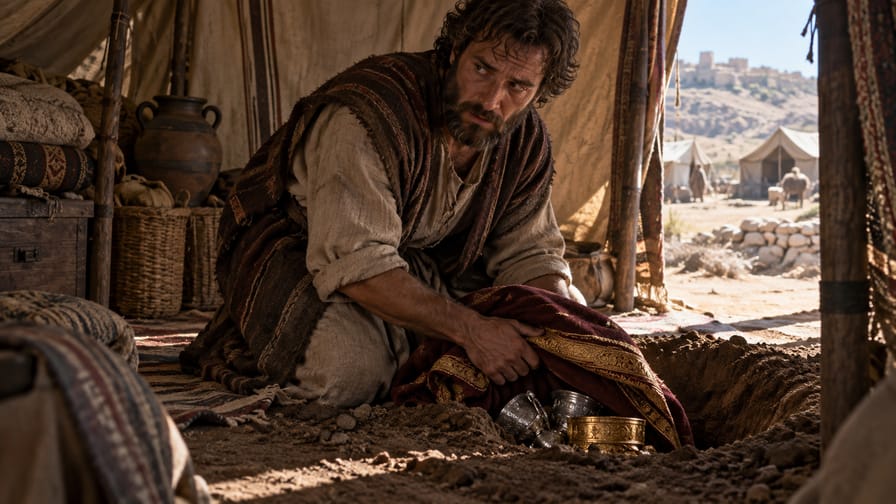
- Achan's Sin: Despite the clear warning, Achan coveted and took a valuable Babylonian cloak, two hundred shekels of silver, and a bar of gold weighing fifty shekels, hiding them under his tent (Joshua 7:21). This action was an act of direct disobedience to God's command.
- Defeat at Ai: As a consequence of Achan's sin, Israel suffered a humiliating defeat in the battle against the small city of Ai, losing thirty-six men and being forced to retreat (Joshua 7:4-5). This defeat revealed that God's presence had withdrawn from among the people, and Joshua became deeply distressed.
- The Divine Investigation: Joshua cried out to God, who revealed that there was sin among Israel, and that the curse was upon them because someone had taken of the devoted things (Joshua 7:10-12). God instructed Joshua to consecrate the people and to identify the culprit by tribal, family, and individual lot (Joshua 7:13-15).
- Confession and Judgment: Through the lot, Achan was identified. Pressed by Joshua, he confessed his sin and revealed where he had hidden the stolen items (Joshua 7:16-21). As a result, Achan, his family, and all his possessions were taken to the Valley of Achor, where they were stoned and burned, and a large heap of stones was raised over them as a memorial (Joshua 7:22-26).
Geography is vital to the narrative. Jericho, the first great city to be conquered, Ai, the site of the defeat, and the Valley of Achor (which means "valley of trouble" or "valley of calamity"), where Achan was executed, are places that became intrinsically linked to his story.
Achan's relationships with other biblical characters are limited to Joshua, the leader of Israel, and his own family. Joshua plays the role of judge and executor of divine justice, while Achan's family shares his fate, raising theological questions about corporate responsibility and the extent of divine judgment.
3. Character and Role in the Biblical Narrative
3.1 Analysis of Character and Moral Failings
Achan's character is revealed in Scripture primarily through his single, yet devastating, action. He is portrayed as an individual motivated by covetousness and disobedience. Despite the clear instructions from God and Joshua regarding the herem (the banishment of spoils from Jericho), Achan succumbed to material temptation.
His primary moral failing was covetousness, which led him to disobey an explicit divine command (Joshua 6:18-19). He saw the Babylonian cloak, the silver, and the gold, and he desired them, which is a direct violation of the Tenth Commandment (Exodus 20:17). This covetousness manifested itself in an act of theft and concealment, demonstrating an attitude of disrespect for the sanctity of things consecrated to God.
Furthermore, Achan displayed profound dishonesty and deceit. He hid his sin, hoping it would not be discovered, and did not repent voluntarily. Only when God's hand identified him through the lot did he confess his transgression, which suggests that his confession was more a forced acknowledgment than a genuine repentance (Joshua 7:19-21).
His action also reveals a lack of faith in God's provision for Israel and an indifference to the well-being of the community. He prioritized his own material gain over the sanctity of the nation and obedience to God, which resulted in serious consequences for everyone.
3.2 Vocation and Role in the Narrative
Achan was a soldier and an ordinary member of the community of Israel. His vocation was not one of prominent priestly, prophetic, or military leadership, but his position as a member of the tribe of Judah, a tribe of great importance, highlights that sin can come from any social stratum.
His role in the biblical narrative is that of the "troubler of Israel" (Joshua 7:25), a vivid example of the devastating consequences of individual sin in the covenant community. He serves as a catalyst for the revelation of God's holiness and the seriousness of obedience to the Mosaic Covenant.
Achan's significant actions are his act of disobedience in taking the spoils of Jericho and his subsequent confession. His key decision was to yield to temptation and steal the forbidden items, thus breaking Israel's covenant with God. This decision had an immediate and catastrophic impact on the nation.
There is no positive character development for Achan in the narrative. He is introduced as a transgressor and is judged and executed for his sin. His story is a somber parable about the corrosive nature of sin and God's unyielding justice against it, especially within His chosen people.
4. Theological Significance and Typology
4.1 Role in Redemptive History and Progressive Revelation
Achan's story plays a crucial role in redemptive history, highlighting God's uncompromising holiness and the seriousness of sin, especially during the period of the conquest of Canaan. This episode underscores that God's blessing upon Israel depended on faithful obedience to His covenant and that the presence of untolerated sin among the people compromised their entire relationship with Him.
The narrative progressively reveals the nature of God's covenant with Israel. It was not merely a legal agreement, but a covenantal relationship that required purity and holiness. Achan's sin demonstrated that the disobedience of one individual could affect the entire community, as God viewed Israel as a corporate unit.
4.2 Connection to Central Theological Themes
Achan's story is intrinsically linked to several central theological themes from an evangelical Protestant perspective:
- Holiness of God: God is holy and demands holiness from His people. The violation of the herem at Jericho was a direct affront to God's holiness, who had claimed those spoils for Himself. The defeat at Ai was a clear sign of the withdrawal of God's holy presence due to sin (Joshua 7:11-12).
- Consequences of Sin: Sin has devastating consequences, not only for the sinner but for the entire community. Achan's transgression resulted in the death of Israelite soldiers and the shame of a military defeat, demonstrating the interconnectedness of the individual's destiny with that of the nation.
- Corporate Responsibility: This episode illustrates the doctrine of covenantal solidarity or corporate responsibility. The sin of one member of the covenant affected the entire body, requiring a collective purification to restore communion and God's blessing upon Israel.
- Obedience to the Covenant: Achan's story is a powerful reminder of the importance of strict obedience to divine commands. Israel's prosperity and victory in Canaan were conditioned on their faithfulness to the covenant (Deuteronomy 28).
- Divine Justice: God is just and judges sin. The judgment and execution of Achan and his family were not acts of cruelty but of divine justice, necessary to remove the stain of sin and restore the holiness of God's people.
- Divine Grace (in the removal of sin): Although Achan faced judgment, the removal of sin through his death allowed God's grace to be restored to Israel, enabling them to resume the conquest and experience victory at Ai (Joshua 8).
4.3 Prefiguration or Christocentric Typology
Although Achan is not a typological figure in the direct sense of prefiguring Christ, his story offers important parallels and contrasts that point to the necessity and work of Christ:
- The Problem of Sin and Christ's Solution: Achan's sin brought curse and separation between God and His people. Achan's death was an atoning sacrifice to remove the "trouble" from Israel, allowing the nation to be purified. This prefigures, on a deeper level, the work of Christ, who became a curse for us (Galatians 3:13) and whose atoning death removed the sin and curse of humanity, opening the way for reconciliation with God.
- The Responsibility of the Representative: Achan's failure as a representative of the community who brought judgment highlights the need for a perfect representative. Jesus Christ is the perfect "Second Adam" and the true Israel, who fully obeyed God, brought not a curse, but blessing and salvation for those who believe in Him.
- The Purification of the Community: The purification of Israel through the removal of Achan's sin points to the purification of the Church (the new Israel) through the blood of Christ. The church, as the body of Christ, is called to keep itself pure from sin, and Achan's story serves as a warning against secret sin and its consequences (cf. Acts 5:1-11, Ananias and Sapphira).
Achan's story, therefore, is not merely a record of a past mistake, but a profound revelation of the nature of God, the gravity of sin, and the need for a mediator and atoner to restore communion between God and humanity, pointing to the redemptive work of Jesus Christ.
5. Biblical-Theological Legacy and Canonical References
5.1 Mentions in Other Biblical Books and Influence
Achan's story is revisited in other biblical passages, which attests to its lasting importance in Israel's theological memory. In Joshua 22:20, when the eastern tribes were about to be judged for building an altar, Phinehas reminds them of Achan's sin: "Did not Achan the son of Zerah act unfaithfully regarding the devoted things, and wrath fell on all the congregation of Israel? And did not that man perish alone for his iniquity?" This reference underscores the lesson of corporate responsibility and the severity of divine judgment against sin.
Furthermore, 1 Chronicles 2:7 includes Achan (here called Achar) in a detailed genealogy of Judah, with the additional note: "The sons of Carmi: Achar, the troubler of Israel, who transgressed in the matter of the devoted things." This genealogical mention perpetuates Achan's name as a historical and theological reminder of his act and its consequences, ensuring that his story would not be forgotten.
Achan's literary contribution is null, as he was not a biblical author. However, his life and death had a significant influence on the biblical theology of the Old Testament, establishing a clear precedent regarding the holiness of holy war (herem) and the need for ritual and moral purity within the covenant community.
5.2 Presence in Interpretive Tradition and Reformed Theology
In Jewish and Christian interpretive tradition, Achan is universally recognized as an archetypal example of covetousness, disobedience, and the consequences of individual sin that affects the collective. Ancient and medieval commentators frequently used his story to illustrate the seriousness of sin and the justice of God.
In Reformed and evangelical theology, Achan's story is frequently used to teach about the holiness of God, the gravity of sin, corporate responsibility, and the need for purity in the church. Theologians such as John Calvin and other reformers emphasized that the church, as the new Israel, is a covenantal body, and untreated sin within it can bring divine disfavor and weaken its testimony.
The conservative evangelical perspective underscores the biblical authority of the account, seeing it not merely as a moral story, but as a historical truth that reveals the nature of God and His requirements for His people. Achan's story serves as a warning against secret sin, covetousness, and disobedience, encouraging believers to live in holiness and transparency before God and the community of faith.
The importance of Achan for understanding the canon lies in its function of illustrating fundamental principles of God's covenant with Israel. It demonstrates that entry and permanence in the Promised Land were not guaranteed solely by divine election, but also required the people's obedience and faithfulness to His law. Achan's story, therefore, is essential for understanding the dynamic of blessing and curse in Israel's history and, ultimately, the need for a Savior who could deal with the problem of sin once and for all.
This episode, though somber, is a cornerstone in biblical theology, serving as a perennial reminder that God is holy and just, and that sin, however hidden, never escapes His sight and always brings consequences. The removal of Achan's sin was an act of purification that allowed Israel to advance in its mission, prefiguring the final and perfect purification accomplished by Christ.