


Reu
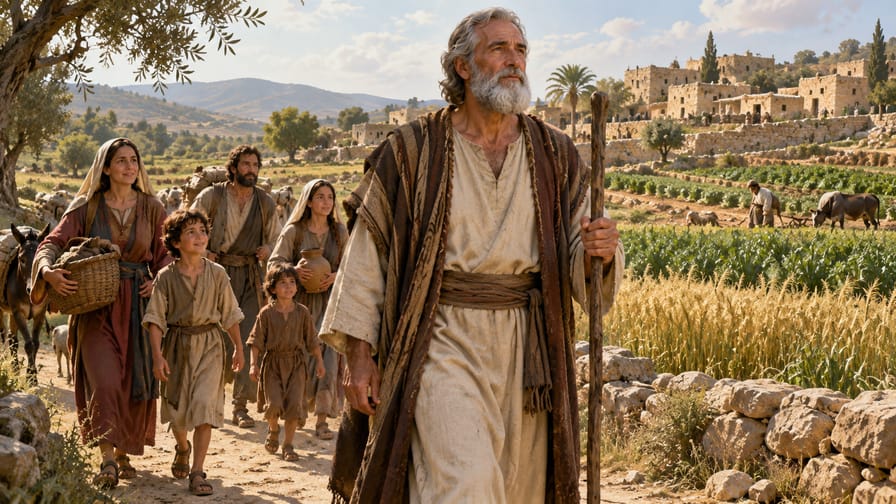
The figure of Reu (Hebrew: רְעוּ, Re‘u), though of minimal narrative appearance in the Scriptures, plays a fundamental role in understanding redemptive history and the messianic lineage. He is one of the post-diluvian patriarchs, a crucial link in the genealogy that connects Shem to Abraham, and consequently, to Jesus Christ. His existence and position in the biblical records underscore God's sovereign faithfulness in preserving the promised seed.
This analysis will seek to explore the onomastic meaning of Reu, his historical and narrative context, his implicit character and role, and his profound theological relevance from a conservative evangelical Protestant perspective. The scarcity of biographical details does not diminish his importance but rather highlights it, for each name in the genealogy points to the meticulous divine providence that weaves the tapestry of salvation.
The approach will be scholarly and encyclopedic, suitable for a biblical-theological dictionary, with an emphasis on biblical authority, historical accuracy, and exegetical precision. Typological and doctrinal connections will be highlighted, always with a Christocentric view, to reveal how the life and position of Reu contribute to the grand narrative of divine redemption as revealed in the Holy Scriptures.
1. Etymology and Meaning of the Name
The name Reu, in its original Hebrew form רְעוּ (Re‘u), derives from the verbal root רָעָה (ra‘ah), which possesses a rich semantic field. This root is commonly translated as "to shepherd," "to feed," "to care for," but can also mean "to associate with," "to become a friend," or "to be a friend." Thus, the literal meaning of the name Reu is often interpreted as "friend" or "companion," and by extension, "shepherd" or "one who pastures."
The Greek translation of the Septuagint (LXX) and the New Testament (Luke 3:35) transliterate the name as Ragau (Ῥαγαῦ). Although there is a slight phonetic variation, the underlying meaning of "friend" or "shepherd" is consistently maintained by interpretive tradition. This etymological consistency is crucial for understanding the character's identity and role, even if his biblical account is concise.
The absence of other prominent biblical characters with the exact name of Reu makes this patriarch unique in his designation. However, the root רָעָה (ra‘ah) is fundamental to biblical theology, especially concerning the concept of God as the Great Shepherd (Psalm 23:1 Ezekiel 34:11-16 John 10:11) and the pastoral calling of leaders of God's people.
Theologically, the meaning "friend" or "shepherd" can be seen as an echo of God's relational nature and the importance of community in salvation history. Although there is no direct evidence in the text that Reu played an active pastoral role, his name may symbolize the need for leadership and care in preserving the elect lineage. He represents a link of divine "friendship" and "care," even if passive, in the chain leading to the Messiah.
The choice or attribution of names in the Old Testament was often laden with prophetic or descriptive meaning, reflecting birth circumstances, parental hopes, or a divine destiny. For Reu, his name, "friend" or "shepherd," may have anticipated the relational nature of God's covenant with humanity, culminating in God's friendship with Abraham (Isaiah 41:8 James 2:23) and Christ's shepherding of His people.
Therefore, even if the narrative offers no details about his personal character, the very name of Reu hints at qualities of care, companionship, and leadership that are central to the progressive revelation of God's plan. The etymology of the name thus offers an initial lens through which his theological relevance can be appreciated, even in the absence of a detailed biography.
2. Historical Context and Biblical Narrative
Reu is situated in the post-diluvian and pre-Abrahamic period, a crucial era of transition in human history as narrated in Genesis. He is the fifth descendant of Shem after the Flood, being the son of Peleg and the father of Serug (Genesis 11:18-20). His life occurs during a period extending for approximately two and a half centuries after the event of the Tower of Babel and the subsequent dispersion of languages and peoples.
According to Genesis 11:18-21, Reu lived 32 years before begetting Serug and, after the birth of his son, lived another 207 years, begetting other sons and daughters. His total longevity was 239 years, a noticeable decline compared to the ages of the antediluvian patriarchs, but still significantly greater than modern life expectancy. This gradual reduction in longevity is a recurring theme in the genealogy of Genesis 11, reflecting the consequences of the Fall and divine judgment upon humanity.
The social and religious context of Reu's era is marked by the increasing diversity of nations and the emergence of different cultures and languages, a direct result of the judgment at Babel (Genesis 11:1-9). Humanity was spreading across the earth, and the seeds of idolatry and apostasy, which would later characterize pagan nations, were already being sown. The lineage of Shem, however, was the lineage of hope, preserving the knowledge of the true God, though perhaps amid increasing challenges.
Geographically, the post-diluvian patriarchs, including Reu, are generally associated with Mesopotamia, the "land between rivers." The city of Ur of the Chaldeans, from where Abraham would later be called, was a cultural and religious center of great importance in that region. Although the Bible does not specify Reu's exact birthplace or residence, he was part of the Mesopotamian environment that preceded Terah and Abraham's migration to Haran and, subsequently, to Canaan.
Key biblical passages mentioning Reu are limited, yet vital. He appears in the genealogy of Genesis 11, which traces the lineage from Shem to Abraham, and again in 1 Chronicles 1:25, which reiterates this same genealogy. His inclusion in the genealogy of Jesus Christ in Luke 3:35 is of paramount theological importance, connecting him directly to the messianic lineage of the New Testament, a bridge between the Old and New Testaments.
Reu's relationships with other biblical characters are primarily genealogical: he is the son of Peleg, whose name means "division," and the father of Serug, who in turn is the father of Nahor, grandfather of Terah, and great-grandfather of Abraham. This chain of fatherhood is the backbone of God's redemptive plan, demonstrating divine sovereignty in the selection and preservation of a specific lineage through which the promise of the seed would be fulfilled.
3. Character and Role in the Biblical Narrative
Analyzing Reu's character, like that of many genealogical figures, is challenging due to the absence of explicit narrative details about his actions, decisions, or personal qualities. The Scriptures do not describe specific moral virtues or flaws attributed to him his mention is strictly genealogical, focusing on his function as a link in the chain of Shem's descent. However, this apparent lack of information does not render him irrelevant, but rather highlights his implicit and essential role.
Reu's primary "role" in the biblical narrative is that of a progenitor. He is the father of Serug, and through this fatherhood, he ensures the continuity of the messianic lineage. In a broader sense, his existence and that of other genealogical patriarchs demonstrate God's faithfulness in preserving the promised "seed" in Genesis 3:15, despite the moral and spiritual decline of post-diluvian humanity. He is a silent testimony to divine sovereignty over human history and biology.
Although no significant actions or key decisions made by Reu are documented, his inclusion in the genealogy of Genesis 11 implies a life of conformity to the divine pattern of procreation and longevity established for humanity after the Flood. He fulfilled his part in God's plan by marrying, having children, and living to an old age, perpetuating the line that would culminate in Abraham and, ultimately, in Christ.
We can infer a character of obedience and perhaps of faith, not through recorded heroic acts, but by the simple continuity of the lineage. In a world increasingly straying from the knowledge of God, the preservation of the Semitic line to Abraham suggests that these patriarchs, in some way, maintained the tradition of worshipping the true God. They were the guardians of the messianic hope in their generation.
Reu's role, therefore, is not that of an active prophet, priest, or king, but that of an essential "link." He represents the importance of generational faithfulness, where each individual, however anonymous they may seem, plays an irreplaceable part in God's grand plan. His life is a reminder that the history of salvation is built not only on the shoulders of great leaders but also on the silent obedience of many.
Reu's character development is not traceable in the narrative. He is presented as a name on the list, a father, and a son. Nevertheless, his mere existence in the genealogy of Genesis 11 and Luke 3 is a powerful testimony to the divine providence that operates through generations, ensuring that the plan of redemption progresses unswervingly, step by step, name by name, until its fulfillment in Jesus Christ. His life, though without dramatic events, is a pillar of salvation history.
4. Theological Significance and Typology
The theological relevance of Reu lies primarily in his position in the messianic lineage, an unbroken link demonstrating God's faithfulness in fulfilling His promises of redemption. He is part of the "seed" promised in Genesis 3:15, a promise that, though initially vague, is progressively refined through the biblical covenants. The inclusion of Reu in the genealogies of Genesis 11 and Luke 3 is an affirmation of divine sovereignty over history.
The figure of Reu is not a direct type of Christ in the sense of prefiguring a specific aspect of His person or work. However, he is part of a broader and indirect typology: the typology of lineage. The genealogical chain from Shem to Abraham, and from Abraham to Christ, is a testament to God's patience and determination in preparing the way for the Savior. Each patriarch in this line, including Reu, is an indispensable piece in the puzzle of salvation history, collectively pointing to the Messiah.
The presence of Reu in the genealogy reinforces the doctrine of election and divine providence. God sovereignly chooses and preserves a lineage through which His promise will be fulfilled, even amidst a world increasingly idolatrous and distant from Him. The inclusion of names like Reu, without great recorded deeds, emphasizes that God's work does not depend on human greatness but on His own faithfulness and power. He is an example of God's common grace that sustains life and lineage.
In the New Testament, Reu is explicitly mentioned in the genealogy of Jesus in Luke 3:35, where he is called Ragau. This mention is crucial, for it legitimizes Jesus' human descent from Adam, confirming His full humanity and His connection to the entire history of redemption. Luke's genealogy, which traces back to Adam, emphasizes the universality of Christ's work, who came to redeem humanity in general, not just Israel.
Reu's life, though devoid of narrative details, connects to central theological themes such as God's faithfulness (2 Timothy 2:13), the preservation of the seed (Genesis 9:1 12:2), and the preparation for the Abrahamic covenant (Genesis 12:1-3). He is part of God's plan to establish a nation through which all the families of the earth would be blessed. His existence is evidence of God's meticulous control over history to accomplish His redemptive purposes.
In summary, Reu is a reminder that God works through generations, using individuals who may not have fame or power, but who are faithful in their role of continuing the lineage. His life is a testimony to the constant progression of God's revelation, culminating in the incarnation of Christ. He is not a prophetic fulfillment in himself, but a vital link in the chain of fulfillments that fully manifests in Jesus, the Messiah, the Son of God and Son of Man.
5. Biblical-Theological Legacy and Canonical References
The biblical-theological legacy of Reu, though not marked by great works or direct teachings, is profoundly significant due to his strategic position in the canonical genealogies. His mentions in Genesis 11:18-21, 1 Chronicles 1:25, and Luke 3:35 are the only direct references to him in the Scriptures, but each one underscores his importance for understanding salvation history and the messianic lineage.
In Genesis 11, Reu is one of the ten post-diluvian patriarchs who link Shem to Abraham, establishing the line through which Abraham's call and the covenant would be realized. This genealogy is crucial for biblical theology, as it demonstrates the continuity of God's plan from creation to the formation of Israel. The mention in 1 Chronicles 1 reiterates this importance, solidifying the genealogy as an authentic historical and theological record.
The inclusion of Reu in Jesus' genealogy in Luke 3 is the most impactful of all. By tracing Jesus' ancestry back to Adam, Luke not only confirms Christ's humanity but also emphasizes the universality of His redemptive mission. Reu, as a common ancestor, connects Jesus not only to the Jewish people but to all humanity, echoing the promise to Abraham that in him all the families of the earth would be blessed (Genesis 12:3).
In Jewish interpretive tradition, genealogies are seen as vital records of the identity and destiny of the people of Israel. Although Reu is not a central figure in rabbinic narratives or midrashim, his presence in Shem's lineage is recognized as part of the preparation for Abraham. In Christian theology, especially in Reformed and evangelical circles, the accuracy and historicity of these genealogies are defended as evidence of the trustworthiness of Scripture and God's sovereignty over history.
Evangelical commentators such as John Gill and Matthew Henry, when addressing genealogies, emphasize that each name, however obscure it may seem, is a reminder of divine providence that guided each generation toward the fulfillment of God's plan. Reu's life, therefore, contributes to the doctrine of special providence, where God not only sustains the universe but also directs the events and lives of individuals for His specific purposes.
Reu's importance for understanding the canon lies in his contribution to the unity and coherence of the biblical narrative. He is one of many "links" connecting the Old Testament promises with their fulfillment in the New Testament. His inclusion in the genealogies demonstrates God's meticulousness in preserving the messianic lineage, ensuring that the Messiah would be born of the promised seed, as prophesied from Eden (Genesis 3:15).
In conclusion, although Reu left no record of great deeds or words, his existence and his mention in the Scriptures are a silent, yet powerful, testimony to God's unwavering faithfulness. He is a pillar of redemptive history, a reminder that every generation and every individual, however anonymous, plays a role in the grand drama of salvation that culminates in Jesus Christ, the Lord and Savior of all humanity.