


Mephibosheth
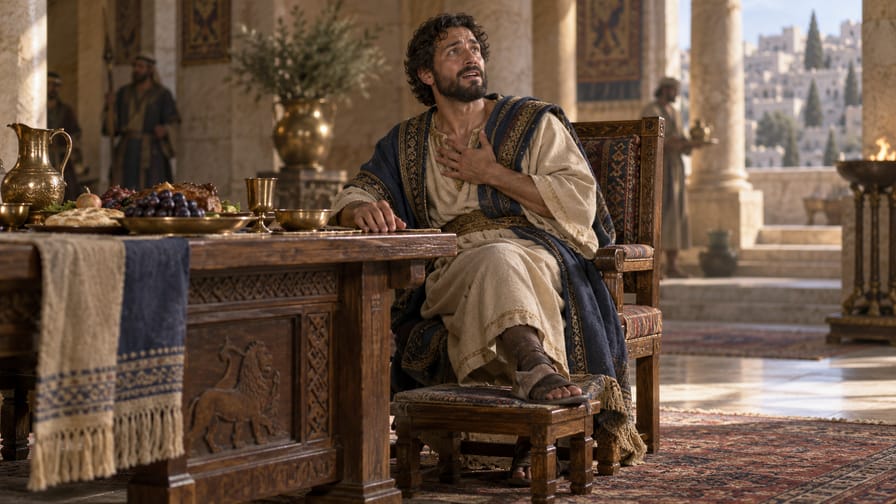
The figure of Mephibosheth, grandson of King Saul and son of Jonathan, emerges in the Scriptures as a powerful symbol of grace and covenant faithfulness. His story, recorded primarily in the book of 2 Samuel, offers a rich tapestry of theological themes crucial for understanding divine sovereignty and God's mercy towards the unworthy.
From an evangelical Protestant perspective, the narrative of Mephibosheth is frequently interpreted as a foreshadowing of the fallen human condition and the gratuitous restoration granted by God in Christ. His life illustrates profound truths about covenant, adoption, and the nature of redemptive love, resonating with central doctrines of the Reformed Christian faith.
1. Etymology and meaning of the name
1.1 Original name and linguistic derivation
The name Mephibosheth is a transliteration of the Hebrew Məphîbōšet (מְפִיבֹשֶׁת). It is a compound name which, in its original form, probably had a slightly different meaning, but was altered due to later cultural and religious sensitivities, as was common in antiquity.
The first part of the name, Məphî (מְפִי), is derived from the word peh (פֶּה), which means "mouth," "opening," or "expression." The second part, bōšet (בֹּשֶׁת), means "shame" or "disgrace." Thus, a literal translation of the name would be "my mouth is shame" or "from the mouth of shame."
1.2 Variations and theological meaning of the name
It is widely accepted by scholars that Mephibosheth is a modified form of an earlier name, Merib-baal (מְרִיב בָּעַל), which means "contender of Baal" or "Baal contends." This variation is found in 1 Chronicles 8:34 and 9:40.
The change from "Baal" to "Bosheth" (shame) was a common practice in Israel to avoid association with the Canaanite god Baal, whose worship was abominable to Yahweh. Names like Ish-Bosheth (originally Ishbaal) also reflect this alteration, replacing the name of the pagan deity with a term of disgrace.
This onomastic substitution carries an implicit theological meaning. The "shame" in Mephibosheth's name, though referring to a pagan idol, can symbolically point to the condition of disgrace or unworthiness he represented as a remnant of a fallen dynasty. However, this shame is dramatically reversed by David's grace.
2. Historical Context and Biblical Narrative
2.1 Historical Period and Family Origin
The story of Mephibosheth unfolds during the transition from Saul's reign to David's, and subsequently at the height of the Davidic kingdom. He was the son of Jonathan, the legitimate heir to the throne of Israel and David's best friend, and the grandson of Israel's first king, Saul. His genealogy is mentioned in 1 Chronicles 8:34 and 9:40.
This period was marked by intense political instability and civil war. After the death of Saul and Jonathan in the battle of Gilboa (1 Samuel 31), David was anointed king over Judah, while Ish-Bosheth (also known as Ishbaal), Mephibosheth's uncle, reigned over the northern tribes for a time (2 Samuel 2:8-10).
2.2 Main Events in Mephibosheth's Life
The life of Mephibosheth is marked by a series of crucial events, detailed primarily in 2 Samuel.
- The Fall and the Disability (2 Samuel 4:4): At the age of five, upon receiving the news of the death of Saul and Jonathan, his nurse took him to flee. In her haste, he fell and became lame in both feet. This physical disability made him vulnerable in a society where kings frequently eliminated dynastic rivals.
- Hiding in Lo-Debar (2 Samuel 9:1-5): For many years, Mephibosheth lived hidden in Lo-Debar, in the house of Machir, son of Ammiel, a region meaning "no pasture" or "land of nothing." This exile reflects his condition as marginalized and forgotten, a remnant of Saul's house.
- David's Grace (2 Samuel 9:6-13): David, remembering his covenant with Jonathan (1 Samuel 20:14-17), sought for someone from the house of Saul. Upon finding Mephibosheth, David extended extraordinary grace to him: he restored all of Saul's land to him and commanded that he should eat at his table continually, like one of the king's sons.
- Ziba's Treachery (2 Samuel 16:1-4): During Absalom's rebellion, Mephibosheth's servant, Ziba, deceived David, claiming that Mephibosheth had remained in Jerusalem hoping to restore Saul's kingdom. David hastily granted all of Mephibosheth's land to Ziba.
- The Partial Rehabilitation (2 Samuel 19:24-30): After David's return to Jerusalem, Mephibosheth came to meet him, demonstrating loyalty and explaining Ziba's treachery. Although David did not restore all his land, he divided it between him and Ziba, a decision that Mephibosheth accepted with humility and gratitude, prioritizing the king's well-being.
The geography of his life, from Jerusalem (where he was born), to Lo-Debar (his refuge), and back to Jerusalem (in David's court), symbolizes his journey from disgrace to restoration. His relationship with David is the central axis of the narrative, bearing witness to David's faithfulness to his covenant with Jonathan.
3. Character and Role in the Biblical Narrative
3.1 Analysis of Character and Qualities
Mephibosheth's character is revealed through his few, yet significant, interactions in Scripture. He is primarily presented as a man of great humility and vulnerability. His physical disability made him dependent and placed him at a disadvantage in the society of the time.
When David summoned him, Mephibosheth prostrated himself and described himself as a "dead dog" (2 Samuel 9:8), an expression of extreme humility and recognition of his insignificance. This attitude of submission and gratitude is one of his most striking qualities, contrasting with the arrogance frequently associated with members of deposed royal houses.
3.2 Weaknesses and the Incident with Ziba
The narrative also suggests a possible passivity or naiveté in Mephibosheth, especially in the episode with Ziba. It is possible that his disability and reclusive life had made him less adept at dealing with court intrigues.
Despite his later explanation to David, his failure to accompany the king during Absalom's flight, even if due to physical incapacity, allowed Ziba to defame him. David's decision to divide the land, rather than fully restore it, may indicate that David was not entirely convinced of Mephibosheth's innocence or that he wished to avoid further conflict.
3.3 Role in the Biblical Narrative
Mephibosheth's primary role in the narrative is not that of a leader or war hero, but that of a recipient of grace. He serves as the object of David's faithfulness to his covenant with Jonathan, a covenant of love and loyalty that transcended death and the political conventions of the time (1 Samuel 20:14-17).
His story illustrates the extent of David's loyalty and, by implication, God's loyalty to His covenants. Mephibosheth is a vivid reminder that God's sovereign grace often reaches the most unlikely and unworthy, elevating them to a position of honor.
4. Theological Significance and Typology
4.1 Role in Redemptive History and Progressive Revelation
The story of Mephibosheth, though an Old Testament event, resonates deeply with the themes of redemptive history. He is not a character who directly contributes to the messianic line, but his experience serves as a powerful illustration of God's grace in action.
His narrative progressively reveals the nature of covenant and divine mercy. David, as king and a typological figure of Christ, extends unmerited grace, based solely on a covenant of love. This action foreshadows the saving grace that would come through the true King, Jesus Christ.
4.2 Foreshadowing and Christocentric Typology
The typology of Mephibosheth is rich and multifaceted, especially from an evangelical Protestant perspective.
- David as a type of Christ: David's action in seeking Mephibosheth and restoring him is a clear type of God's grace in Christ. David, the king, not only forgives but restores and elevates the lame and forgotten to a position of honor at his table.
- Mephibosheth as a type of the sinner: Mephibosheth, lame and from the house of a rejected king, living in Lo-Debar (barren land), represents fallen humanity, spiritually crippled by sin and living in a "far country" from God's presence. He cannot approach by his own merits.
- The covenant of Jonathan and David as a type of the New Covenant: The covenant between Jonathan and David (1 Samuel 20) is the basis of the grace extended to Mephibosheth. This foreshadows the New Covenant in Christ, where grace is granted not by our merits, but by God's faithfulness to His covenant with His Son.
- The king's table as a type of communion with God: Eating at the king's table symbolizes full acceptance, honor, and fellowship. This points to the Lord's table in the New Covenant, where believers, once alienated, are invited to participate in fellowship with God through Christ (Luke 14:15-24).
The story of Mephibosheth is, therefore, a living parable of justification and adoption. He is declared righteous and treated as a son of the king, not by his works, but by David's sovereign grace, founded on a previous covenant. This echoes the doctrine of salvation by grace through faith (Ephesians 2:8-9).
4.3 Connection to Central Theological Themes
The narrative of Mephibosheth illuminates several crucial theological themes:
- Grace and Mercy: David's action is a pure example of sovereign grace, extended to someone who had no right to it, but who received it by pure mercy.
- Covenant and Faithfulness: The story highlights David's faithfulness to his covenant with Jonathan, serving as a shadow of God's unwavering faithfulness to His covenants.
- Restoration and Adoption: Mephibosheth is restored to his inheritance and adopted into the royal family, illustrating the restoration of humanity in Christ and the adoption of believers as children of God (Romans 8:15 Galatians 4:5).
- Humility and Dependence: Mephibosheth's humble response to David's grace teaches the appropriate attitude of a believer before God's salvation.
Although Mephibosheth is not directly quoted in the New Testament, the theological principles embodied in his story are fundamental for understanding the work of Christ and the believer's experience. Reformed commentators, such as John Calvin, frequently use this narrative to illustrate the doctrine of grace.
5. Biblical-Theological Legacy and Canonical References
5.1 Mentions in Other Biblical Books and Interpretive Tradition
Besides 2 Samuel, Mephibosheth is mentioned in 1 Chronicles 8:34 and 9:40, where he is called Merib-baal, as part of the genealogy of Saul's house. These references confirm his historical existence and his lineage, reinforcing the authenticity of his story.
In Jewish interpretive tradition, the story of Mephibosheth is seen as an example of David's piety and the importance of honoring covenants. In Christianity, especially in Reformed and evangelical theology, his story has gained prominence as one of the most vivid illustrations of the gospel in the Old Testament.
5.2 Influence on Biblical and Evangelical Theology
The narrative of Mephibosheth has significant influence on biblical theology, especially in the articulation of the doctrine of grace. He serves as a paradigm for understanding salvation as a unilateral and unmerited act of God.
Evangelical theologians frequently use him to explain how God, in His sovereignty, seeks out those who are lost and without hope, and invites them to His table. The story of Mephibosheth is a sermon in itself on the depth of divine mercy and the extent of God's covenant love.
He represents the human condition before redemption: incapacitated (lame), marginalized (Lo-Debar), and from the "house" of a rejected government (Saul). David's intervention is the image of Christ's work that rescues, restores, and adopts, transforming shame into honor and exile into fellowship.
5.3 Importance for Understanding the Canon
The story of Mephibosheth, though an seemingly secondary episode in David's saga, is fundamental for understanding the theological coherence of the biblical canon. It demonstrates the consistency of God's character throughout salvation history, revealing His faithfulness, justice, and grace.
His life enriches the understanding of the Davidic promises, showing that God's covenant with David was not only about a throne and a dynasty, but also about the grace that would flow through that lineage. The story of Mephibosheth, therefore, is a vital piece in the great mosaic of God's progressive revelation, pointing to the fullness of grace found in Jesus Christ.