


Jehoahaz
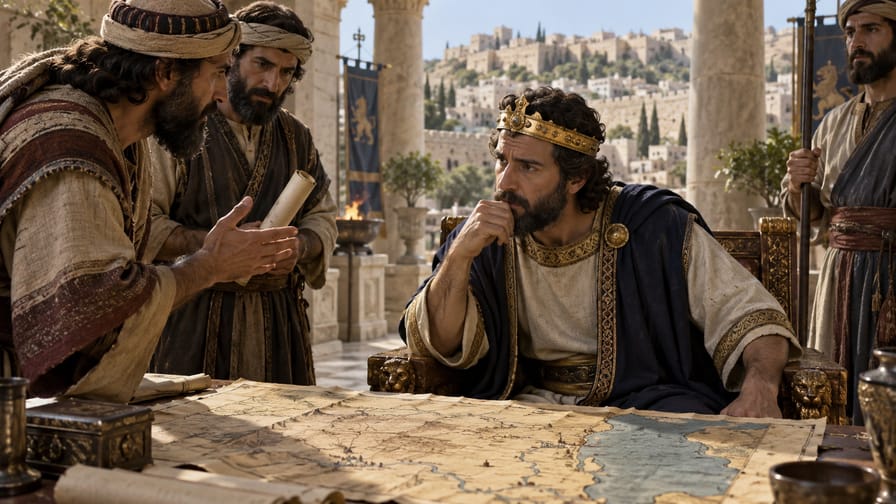
The figure of Jehoahaz (or Joahaz) emerges in the Scriptures as a vivid reminder of the fragility of human leadership and the inexorability of divine judgment upon disobedience. His brief and tragic history, set against the final decline of the Kingdom of Judah, offers profound theological lessons on the sovereignty of God, the consequences of sin, and the need for a righteous king.
This article will examine Jehoahaz from an evangelical Protestant perspective, focusing on his onomastic significance, the historical context of his reign, the analysis of his character and role, his theological relevance, and the legacy he left in the Scriptures. The analysis will seek careful exegesis of the biblical passages, integrating knowledge of the original languages and the contributions of evangelical scholars.
1. Etymology and Meaning of the Name
1.1 Original Name and Linguistic Derivation
The name Jehoahaz is a transliteration of the Hebrew יְהוֹאָחָז (Yeho'achaz), which also appears as יְהוֹחָז (Yehochaz) in some variations. This name is a theophoric compound, uniting the divine tetragrammaton YHWH (represented by Yeho- or Yo-) with the Hebrew verbal root אָחַז ('achaz).
The root 'achaz has multiple meanings, including "to grasp," "to seize," "to possess," "to take hold of," or "to apprehend." The combination of these elements forms a name with a quite specific and profound theological meaning, which dramatically contrasts with the king's fate.
1.2 Literal and Symbolic Meaning
Literally, Jehoahaz means "The Lord has grasped," "The Lord has possessed," or "The Lord has apprehended." This meaning evokes God's sovereignty and power over life and destiny, suggesting that the named person is under divine protection or possession.
Symbolically, theophoric names like Jehoahaz often expressed a declaration of faith or a pious aspiration of the parents. They reflected the hope that God would act protectively or possessively toward the individual. However, the life of King Jehoahaz of Judah reveals a tragic irony, for he was not "grasped" by God in the sense of being preserved on his throne or of following His ways.
1.3 Variations and Other Characters with the Name
Although the name יְהוֹאָחָז (Yeho'achaz) is consistently applied to the son of Josiah, other biblical figures share names with similar roots or variations. For example, Ahaziah (אֲחַזְיָהוּ - 'Achazyahu), king of Judah and king of Israel, has a name that also derives from 'achaz, meaning "The Lord has grasped" or "Yahweh has apprehended." In 2 Chronicles 21:17 and 22:1, Ahaziah of Judah is sometimes called Jehoahaz in some versions, indicating a possible variation or onomastic interchange.
In addition to the king of Judah, there is also a Jehoahaz who was king of Israel, son of Jehu (2 Kings 10:35 13:1). Although also a king, his story is distinct and occurs in an earlier period. This article primarily focuses on Jehoahaz of Judah due to his relevance in the context of the fall of Jerusalem and his prophetic connections.
1.4 Theological Significance of the Name in the Biblical Context
The theological significance of the name Jehoahaz is accentuated by the contrast between its meaning and the reality of his reign. "The Lord has grasped" should imply a life of obedience and divine protection, but Jehoahaz "did what was evil in the sight of the Lord" (2 Kings 23:32).
This contrast serves to illustrate that a pious inheritance or a theophoric name does not guarantee personal faith or divine blessing. Individual choice for obedience or disobedience is the determining factor, even for those with names that invoke the Lord. The name, in its context, becomes a testimony to rejected grace and to the sovereignty of God who, at times, "grasps" for judgment.
2. Historical Context and Biblical Narrative
2.1 Historical Period and Geopolitical Context
The reign of Jehoahaz occurred in 609 BC, a period of intense geopolitical turbulence in the Near East. The great Assyrian Empire had declined, and two new powers were rapidly emerging: the Neo-Babylonian Empire under Nebuchadnezzar and Egypt under Pharaoh Necho II. Judah, a small vassal kingdom, found itself tragically squeezed between these giants.
This was the exact moment after the death of the pious King Josiah in the Battle of Megiddo, where he attempted to intercept Necho II, who was on his way to assist Assyria against Babylon (2 Kings 23:29 2 Chronicles 35:20-24). Josiah's death was a devastating blow to Judah, marking the end of an era of reform and spiritual revival.
2.2 Family Origin and Genealogy
Jehoahaz was the son of King Josiah and Hamutal, daughter of Jeremiah, from Libnah (2 Kings 23:31). His lineage connected him directly to the house of David, to whom God had promised an eternal throne (2 Samuel 7:12-16). However, the Davidic promise was conditioned on obedience, and the last kings of Judah failed gravely in this aspect.
He had an older brother, Eliakim, who would later be renamed Jehoiakim by Pharaoh Necho II and placed on the throne (2 Kings 23:34). The popular choice of Jehoahaz, the younger son, over Eliakim, is an intriguing detail that suggests a possible division in the court or a preference of the people for a leader who perhaps represented a more direct continuity of the lineage after Josiah's sudden death.
2.3 Main Events of Life and Reign
The biblical narrative of Jehoahaz's life is remarkably brief, covering only three months of reign (2 Kings 23:31 2 Chronicles 36:2). After Josiah's death at Megiddo, the people of Judah anointed him and proclaimed him king in Jerusalem (2 Kings 23:30 2 Chronicles 36:1). This popular action, though legitimate, was quickly nullified by a foreign power.
As Necho II returned victorious from his campaign, he stopped at Riblah, in the land of Hamath, and sent for Jehoahaz. There, he imprisoned him, deposing him from the throne (2 Kings 23:33). This act demonstrated Judah's total subjugation to Egyptian power. Necho imposed a heavy tribute of one hundred talents of silver and one talent of gold on Judah, and then enthroned Jehoahaz's brother, Eliakim, changing his name to Jehoiakim (2 Kings 23:34-35).
Jehoahaz was taken as a prisoner to Egypt, where he remained until his death (2 Kings 23:34 2 Chronicles 36:4). Jeremiah's prophecy laments this exile, stating that he "will never return" and "will die in the place to which they carried him captive, and will never again see this land" (Jeremiah 22:10-12). His story is a microcosm of the tragedy that would befall Judah.
2.4 Geography and Relationships with Other Characters
The main locations associated with Jehoahaz include Jerusalem, where he was enthroned, and Riblah, where he was imprisoned. His final journey took him to Egypt, where he met his end. Key biblical passages are found in 2 Kings 23:30-34, 2 Chronicles 36:1-4, and Jeremiah 22:10-12.
His most significant relationships were with his father, Josiah, whose legacy of righteousness he did not follow with his mother, Hamutal with his brother Eliakim/Jehoiakim, who replaced him on the throne and with Pharaoh Necho II, who deposed him and took him captive. The interaction with Jeremiah, although the prophet did not speak directly with Jehoahaz in the narrative, is crucial for a theological understanding of his fate, as Jeremiah laments his plight.
3. Character and Role in the Biblical Narrative
3.1 Analysis of Character as Revealed in the Scriptures
Jehoahaz's character is summarized concisely and condemnatorily: "He did what was evil in the sight of the Lord, according to all that his fathers had done" (2 Kings 23:32). This statement is a standard verdict for the wicked kings of Israel and Judah, indicating a failure to follow God's Law and, presumably, involvement in idolatry or other abominable practices.
It is particularly shocking coming from the son of Josiah, one of Judah's most pious kings, who led a significant revival (2 Kings 22-23). Jehoahaz's rapid apostasy, even after his father's example and teaching, underscores the depth of spiritual corruption in Judah and the inability of a superficial revival to change everyone's heart.
3.2 Documented Sins, Weaknesses, and Moral Failures
Although the Scriptures do not detail Jehoahaz's specific sins, the phrase "he did what was evil in the sight of the Lord" is comprehensive. It implies a deliberate rejection of divine commandments, which often included the toleration or promotion of idolatry, social injustice, and the neglect of true worship in the Temple.
His most prominent failure was not following the legacy of his father Josiah, who had purified the land of altars and idols (2 Kings 23:4-20). The brevity of his reign suggests that he did not have time to completely reverse Josiah's reforms, but his willingness to "do what was evil" indicates an inclination toward apostasy that would have led Judah even further away from God.
3.3 Vocation, Calling, and Specific Function
Jehoahaz's vocation was to be king of Judah, a position of immense spiritual and political responsibility in the theocracy of Israel. As king, he was expected to be a guardian of God's Law, a promoter of justice, and a spiritual leader for the people.
However, he failed to fulfill God's calling for the Davidic monarchy. His reign brought neither stability nor righteousness, but rather an acceleration of the decline that would lead to the Babylonian exile. He was a king who, though anointed by the people, was not sustained by God in his purpose.
3.4 Role Played and Key Decisions
Jehoahaz's role in the biblical narrative is that of a catalyst for divine judgment. His rapid ascent and fall serve as a harbinger of Judah's fate. His enthronement by the people, followed by his deposition by a foreign power, illustrates Judah's loss of sovereignty and its increasing vulnerability.
Jehoahaz's key decision, though not explicitly recorded as a single act, was to follow the wicked ways of his predecessors. This choice of heart sealed his destiny and contributed to the unfolding scenario of judgment upon the nation. He showed no sign of repentance or seeking God, unlike his father Josiah.
3.5 Character Development Throughout the Narrative
Due to his extremely short reign, there is no significant character development for Jehoahaz in the biblical narrative. He is presented as a wicked king from the outset and remains so until his tragic end in Egyptian exile. His story is more a static example of the consequences of disobedience than an arc of personal development.
His life serves as a solemn warning: not even proximity to a pious father like Josiah can guarantee personal righteousness. Faith and obedience are individual choices that each must make before God. Jehoahaz's story is a link in the chain of events that led Judah to captivity, demonstrating the persistent corruption of the monarchy.
4. Theological Significance and Typology
4.1 Role in Redemptive History and Progressive Revelation
Jehoahaz's story, though brief, is crucial in the redemptive history of Israel. It marks the final turning point in the decline of the Kingdom of Judah, after the brief respite of Josiah's revival. His rapid fall signals that God's judgment upon Judah's persistent idolatry and injustice was now in full swing, irreversible.
His story illustrates the progressive revelation of God's character as a just and holy judge who will not tolerate sin indefinitely, even from His covenant people. God's patience has limits, and Jehoahaz's apostasy after Josiah demonstrates that the measure of Judah's sin was complete.
4.2 Divine Judgment and God's Sovereignty
Jehoahaz's fate is a clear example of divine judgment. God used Pharaoh Necho II as an instrument to remove a wicked king and impose His will upon Judah. This highlights God's sovereignty over nations and their leaders, even those who do not know Him (Isaiah 10:5-7).
The removal of Jehoahaz and the imposition of a heavy tribute by Necho II were not mere political accidents, but part of the divine plan to discipline Judah for its infidelity to the covenant. As Calvin observed, God governs the world not by chance, but by His sovereign providence, even using pagan kings for His purposes.
4.3 Related Covenants, Promises, and Prophecies
Jehoahaz's story contrasts sharply with the promises of the Davidic Covenant. Although God had promised an eternal lineage to David (2 Samuel 7:12-16), that promise was conditioned on the obedience of the kings. The failure of Jehoahaz and his successors to obey God led to the temporary interruption of the Davidic monarchy and the exile.
Jeremiah's prophecy concerning Jehoahaz is particularly impactful: "Weep not for him who is dead, nor grieve for him, but weep bitterly for him who goes away, for he shall return no more to see his native land" (Jeremiah 22:10). This prophecy was literally fulfilled, for Jehoahaz died in Egypt, underscoring the veracity of God's Word and the certainty of His judgment.
4.4 Christocentric Typology and Associated Doctrines
The figure of Jehoahaz is not typological in the direct sense of prefiguring Christ. On the contrary, he serves as an antitype, an example of the failure of earthly monarchy to provide the necessary salvation and justice. His story points to the profound need for a perfect King, a King who would not do evil in the sight of the Lord, but who would rule with perfect righteousness and justice.
This King is Jesus Christ, the true Son of David, whose kingdom will have no end (Luke 1:32-33) and who will not be deposed by any earthly power. Jehoahaz's story, therefore, indirectly points to Christ, demonstrating the fallibility of all human kings and the need for the divine Messiah.
Associated doctrines include the sovereignty of God, divine justice, the consequences of sin, the fallibility of human leadership, and the necessity of repentance and obedience. Jehoahaz's life illustrates that spiritual inheritance does not guarantee personal salvation each individual is responsible for their own faith and obedience to God.
5. Biblical-Theological Legacy and Canonical References
5.1 Mentions of the Character in Other Biblical Books
The main references to Jehoahaz of Judah are in 2 Kings 23:30-34 and 2 Chronicles 36:1-4, which recount his brief reign and his removal by Pharaoh Necho II. The prophet Jeremiah makes a poignant mention of him in Jeremiah 22:10-12, lamenting his exile and death in Egypt and using him as an example of the imminent judgment upon the royal house of Judah.
These passages are crucial for understanding the transition of the Kingdom of Judah from a state of relative independence (under Josiah) to complete subjugation by foreign powers, first Egypt and then Babylon. Jehoahaz is a landmark on the road to exile.
5.2 Influence on Biblical Theology
Jehoahaz's brief history has significant influence on biblical theology, especially in the understanding of divine judgment and God's sovereignty. He demonstrates that, even after a revival like Josiah's, persistence in sin will inevitably lead to divine punishment.
His story reinforces the doctrine of individual and national responsibility before God. The fall of Jehoahaz, a king of the Davidic line, also prefigures the interruption of the monarchy in Israel and the need for new divine intervention to definitively restore David's throne in the Messiah.
5.3 Presence in Jewish and Christian Interpretive Tradition
In Jewish interpretive tradition, Jehoahaz is often seen as an example of the monarchy's degeneration and the reason why God permitted the exile. The rabbis often emphasize the disconnect between his theophoric name and his wicked conduct as a sign of the hypocrisy and apostasy of the era.
In Christian theology, especially from a Reformed evangelical perspective, Jehoahaz is a case study on the gravity of sin and God's faithfulness in fulfilling His warnings of judgment. He is used to illustrate the truth that God's grace is not license for sin and that persistent disobedience has severe consequences, even for those with a religious heritage.
5.4 Treatment of the Character in Reformed and Evangelical Theology
Reformed and evangelical commentators, such as John Calvin and Matthew Henry, often highlight the swiftness with which Judah reverted to sin after Josiah's death, using Jehoahaz as the first example of this regression. They emphasize that an external revival cannot change an unregenerated heart and that true faith requires personal obedience.
Jehoahaz's story serves to reinforce the doctrine of God's sovereignty, who uses even the actions of pagan powers to execute His plans of judgment. He is a reminder that all earthly kingdoms are transient and that the only eternal and unshakable Kingdom is that of Christ.
5.5 Importance of the Character for Understanding the Canon
The inclusion of Jehoahaz's story in the biblical canon is vital for understanding the theology of Israel's history. He represents Judah's point of no return, the beginning of the countdown to the Babylonian exile.
His narrative, along with Jeremiah's prophecies, validates the authority of God's prophetic word and demonstrates the coherence of the divine plan of redemption and judgment. It helps us understand why judgment came upon Judah and sets the stage for the emergence of the Messiah as the only truly righteous King capable of redeeming His people.
In summary, Jehoahaz, although a secondary character in terms of reign duration, is a figure with profound theological significance. His life is a testimony to the seriousness of sin, the unwavering justice of God, and the need for a perfect Savior and King, who is Jesus Christ.