


Jairus
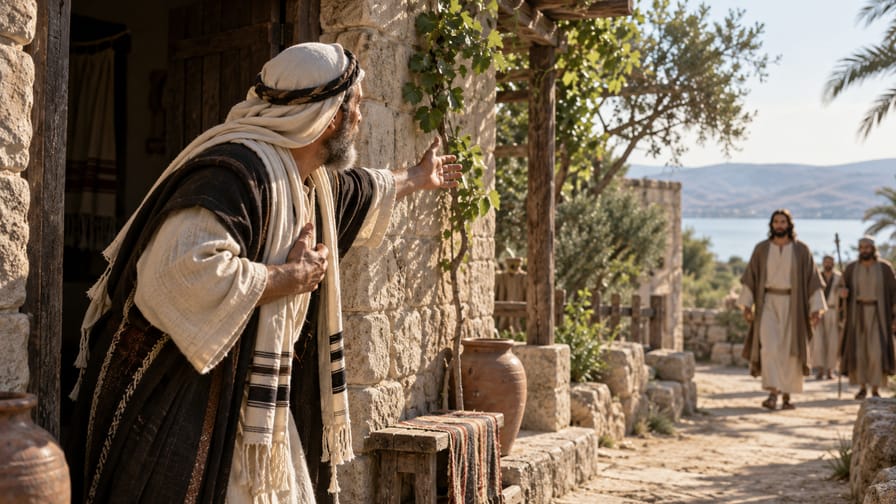
The figure of Jairus, one of the secondary but profoundly significant characters in the synoptic gospels, emerges as a touching example of faith, despair, and the sovereignty of Jesus Christ's power over death. His story, intrinsically linked to one of Jesus' most remarkable miracles, offers rich layers of theological and exegetical meaning.
This study proposes a comprehensive analysis of Jairus, exploring his etymology, the historical and narrative context in which he lived, his character and role, the profound theological relevance of his story, and his legacy for the Christian faith, from a conservative evangelical Protestant perspective, which values the inerrant authority of Scripture and the centrality of Christ.
The narrative of Jairus is not merely a healing account, but a powerful demonstration of Jesus' messianic mission, who came to bring life and light to a world immersed in darkness and death. His story is an invitation to reflect on the nature of faith, divine compassion, and the triumph of life over humanity's greatest adversities.
1. Etymology and meaning of the name
The name Jairus, as it appears in the New Testament, is the Greek form Iairos (Ἰάϊρος), which is a transliteration of the Hebrew Ya'ir (יָאִיר). This name is derived from the Hebrew root יָאַר (ya'ar), meaning "to illuminate," "to shine," or "to bring light."
Therefore, the literal meaning of the name Jairus is "He (God) illuminates" or "He (God) will make shine." In a more active context, it can mean "one who illuminates" or "one who awakens." This connotation of light and awakening is deeply symbolic and prophetic, especially in the context of the biblical narrative in which Jairus appears.
The most known variation of the name in the Scriptures is Jair, present in the Old Testament. One of the judges of Israel, Jair, is mentioned in Judges 10:3-5, known for having governed Israel for 22 years and for having thirty sons who rode on thirty donkeys and possessed thirty cities.
Another Jair is the father of Elhanan, who killed Lahmi, the brother of Goliath, according to 1 Chronicles 20:5. The occurrence of the name in different eras and contexts demonstrates its popularity and the positive meaning associated with illumination or awakening.
The theological significance of the name Jairus in the context of the New Testament is notable. The fact that his name means "He (God) illuminates" or "He (God) awakens" powerfully resonates with Jesus' action of raising his daughter from the dead.
Jesus is the "light of the world" (John 8:12) and the "awakener" of life. Thus, the name of Jairus can be seen as a prefiguration or an echo of Christ's work, who brings light to the darkness of death and awakens those who sleep in the slumber of eternity, both physically and spiritually.
2. Historical and biblical narrative context
The story of Jairus is set during the earthly ministry of Jesus Christ, specifically during a period of intense activity in Galilee, around 28-30 A.D. This was a time when Jesus was performing numerous miracles and teaching multitudes, challenging the religious and social structures of the era.
The political context was one of Roman domination over Judea and Galilee, with Herod Antipas ruling as tetrarch. Socially, Jewish society was stratified, with religious leaders, such as the Pharisees and scribes, exercising great influence.
Jairus is described as a "synagogue official" (Mark 5:22 Luke 8:41). This was a position of great prestige and responsibility in the local Jewish community. The synagogue official was responsible for the administration of the synagogue building, the supervision of worship services, and the organization of Torah reading and prayers.
His function implied respect and authority, placing him among the prominent figures of his city, probably Capernaum or a nearby locality, given the geography of Jesus' miracles in Galilee.
The main narrative involving Jairus is recounted in the synoptic gospels: Matthew 9:18-26, Mark 5:21-43, and Luke 8:40-56. The chronology of events begins with Jesus returning from the region of the Gerasenes (Gadarenes) and being received by a crowd by the sea.
It is at this moment that Jairus approaches Jesus, prostrates himself at His feet, and implores for help. His only daughter, about twelve years old, was at the point of death (Mark 5:23) or already dead, depending on the initial perspective of Matthew's account.
Jairus' urgency and social standing highlight the depth of his despair, leading him to seek help from someone whom many religious leaders viewed with suspicion. As Jesus went with Jairus to his house, the famous episode of the woman with a hemorrhage occurs, who touches the fringe of Jesus' cloak and is instantly healed (Mark 5:25-34 Luke 8:43-48).
During this interruption, messengers arrive from Jairus' house with the devastating news that the girl had died, advising him not to trouble the Teacher any further (Mark 5:35 Luke 8:49). This moment represents the climax of human drama and Jairus' faith.
Jesus, however, hears the words and immediately encourages Jairus: "Do not fear, only believe!" (Mark 5:36 Luke 8:50). Upon arriving at the house, Jesus finds mourning and weeping, but declares that the girl is not dead, but sleeping. He expels those who scoff and, taking only Peter, James, and John, and the girl's parents, enters where she lay.
With the words "Talitha cumi!" (Aramaic for "Little girl, I say to you, arise!") (Mark 5:41), Jesus raises the child. He then instructs the parents to give her something to eat and to tell no one what had happened (Mark 5:43 Luke 8:56).
The geographical location of the events is, without doubt, the region of Galilee, probably Capernaum, a central city for Jesus' ministry. This city was a meeting point and a strategic location for the propagation of His message and miracles.
Jairus' relationship with Jesus is that of a desperate suppliant seeking the help of the Messiah. Although there are no records of previous interactions, Jairus' willingness to humble himself publicly before Jesus demonstrates an extraordinary faith, or at least a desperate hope, that transcends the social and religious conventions of the time.
3. Character and role in the biblical narrative
Jairus' character is revealed in the Scriptures primarily through his actions and his interaction with Jesus. The most prominent characteristic is his faith, or at least a deep hope and recognition of Jesus' power.
Despite his position of authority as a synagogue official, Jairus demonstrates remarkable humility by prostrating himself at Jesus' feet (Mark 5:22 Luke 8:41). This act of public supplication was unusual for someone of his status, indicating the intensity of his love for his daughter and his despair in the face of imminent death.
His persistence in seeking Jesus, even amidst a crowd and with his daughter dying, underscores his determination. He did not send servants but went personally, which demonstrates the depth of his anguish and the seriousness of his request.
Jairus' faith is severely tested when news of his daughter's death arrives. Jesus' instruction, "Do not fear, only believe!" (Mark 5:36), is a watershed moment in the narrative, a call to unwavering trust even in the face of contrary evidence.
Jairus' response to this exhortation is not explicitly described, but his continued presence alongside Jesus, allowing Him to go to his house and perform the miracle, demonstrates that he accepted the challenge of faith.
Jairus' role in the biblical narrative is fundamentally that of a catalyst for the demonstration of Jesus' power over death. He is not a prophet, priest, or king, but an ordinary father, though of high standing, who finds himself in an extraordinary situation.
His story illustrates Jesus' compassion and His ability to intervene in human reality supernaturally. He serves as an example of the truth that faith, even if initially small or desperate, can be the channel for the manifestation of divine power.
Jairus' significant actions include his decision to seek Jesus, his public humiliation, and his obedience to Jesus' instruction not to fear. These decisions are crucial for the development of the narrative and for the revelation of Jesus' character and power.
There is no extensive character development of Jairus throughout a lengthy narrative, as occurs with central figures of the Old Testament. His story is a concentrated episode that serves to highlight the glory of Christ. Nevertheless, it is reasonable to infer that the encounter with Jesus and the resurrection of his daughter profoundly transformed his life and his faith.
He witnessed firsthand Jesus' power over death, an experience that certainly shaped his understanding of the Messiah and his own faith in God. Jesus' command that the news not be spread (Mark 5:43) can be interpreted as a measure to manage messianic expectations and prevent premature political uproar, allowing Jairus' and his family's faith to be solidified in private.
4. Theological significance and typology
The story of Jairus and the resurrection of his daughter possess a profound and multifaceted theological significance, essential for understanding Jesus' mission in redemptive history. This event is a powerful progressive revelation of Jesus' power and messianic identity.
Firstly, the resurrection of Jairus' daughter demonstrates Jesus' sovereignty over death. Death, humanity's last enemy (1 Corinthians 15:26), is here subjugated by the word of Christ. This miracle prefigures Jesus' own resurrection and the future resurrection of believers.
It is clear evidence that Jesus is not merely a healer or teacher, but the Lord of life and death, which connects Him directly with the promise of eternal life and the final victory over sin and death, central themes of Christian theology.
From a Christocentric perspective, the narrative of Jairus points to Christ as the Messiah who brings life. The meaning of Jairus' name, "He (God) illuminates" or "He (God) awakens," gains a powerful typological dimension when Jesus, the Light of the World, awakens Jairus' daughter from the sleep of death.
Jesus is the fulfillment of the hope for a Messiah who would bring restoration and abundant life (John 10:10). The resurrection is a sign of the Kingdom of God invading the realm of death, an anticipation of the new creation.
The story also emphasizes the importance of faith. Jesus' exhortation, "Do not fear, only believe!" (Mark 5:36), is a fundamental doctrine for evangelical theology. Jairus' faith, though tested and perhaps initially faltering, is the bridge through which God's power is manifested.
This episode illustrates that genuine faith is not the absence of fear or doubt, but the choice to trust in God despite the circumstances. It is a vivid example of the truth that "without faith it is impossible to please God" (Hebrews 11:6).
The interruption by the healing of the woman with a hemorrhage, who is also healed by faith, serves as a contrast and a reinforcement of the theme of faith. The woman touched Jesus secretly, while Jairus implored publicly both, however, demonstrated faith and received divine intervention.
This interlude demonstrates Jesus' compassion and His availability to attend to everyone, regardless of social status or condition. Jairus' twelve-year-old daughter and the woman, who had suffered for twelve years, create a parallel that underscores the comprehensiveness of Jesus' grace.
The doctrine of grace is clearly visible, for Jesus demands nothing from Jairus but faith. The resurrection is not a reward for merit, but a manifestation of God's sovereign grace through Christ. Life is a gift from God, and resurrection is the supreme gift that challenges human limitations and the reality of death.
The resurrection of Jairus' daughter, along with that of the widow of Nain's son (Luke 7:11-17) and Lazarus (John 11:1-44), establishes a pattern of Jesus demonstrating His power over death, preparing the ground for the understanding of His own resurrection as the central event of salvation history.
5. Biblical-theological legacy and canonical references
The story of Jairus, though brief, left a lasting biblical-theological legacy, being one of the most cited and studied narratives in the synoptic gospels. His story is not mentioned in other biblical books outside the gospels of Matthew, Mark, and Luke, but its influence on biblical theology is considerable.
The resurrection of Jairus' daughter is one of Jesus' most powerful miracles and is fundamental for understanding His divine authority. It serves as irrefutable testimony that Jesus is the promised Messiah, who has power over the forces of death, an attribute exclusive to God.
In Christian interpretive tradition, the story of Jairus is frequently used to illustrate the nature of faith and Jesus' compassion. From the early church fathers to the Reformers and contemporary evangelical theologians, the narrative has been a point of reference for sermons and studies on God's power and the human response of trust.
Evangelical commentators, such as William Hendriksen in his New Testament Commentary, highlight the interruption by the woman with a hemorrhage as a "divine parenthesis" that serves to intensify Jairus' despair and, consequently, the glory of Jesus' miracle. Jairus' faith, tested to the utmost, is a model of dependence on Christ.
In Reformed and evangelical theology, the story of Jairus is seen as a confirmation of the divinity of Christ and the efficacy of His word. The words "Talitha cumi" are more than a command they are a creative word, which brings life where there was death, echoing the power of God's word in creation (Genesis 1:3) and in the new creation.
Jesus' instruction to give the resurrected girl something to eat (Mark 5:43) is often interpreted as a reminder of the full reality of the resurrection and the need for physical sustenance, even after a supernatural event, underscoring the incarnational and practical nature of Jesus' ministry.
Jairus' importance for understanding the canon lies in how his story fits into the mosaic of progressive revelation. It is not merely an isolated event, but a vital link in the chain of evidence that points to Jesus as the Savior and the Lord, the only one who can offer life in the midst of death and hope in the midst of despair.
The narrative of Jairus continues to inspire and encourage believers around the world, reminding them that, even in the most desperate situations, faith in Jesus Christ can move mountains and bring life to that which seemed irremediably lost.